Jeep's first fully electric vehicle arrives not as a Wrangler clone but as a performance-oriented luxury SUV. The 2025 Jeep Wagoneer S leverages Stellantis' STLA Large platform to deliver 600 horsepower, a 100-kWh battery, and a cabin that blends premium materials with a screen-heavy infotainment strategy. For buyers cross-shopping the Tesla Model Y, BMW iX, and Cadillac Lyriq, the Wagoneer S offers genuine off-road credibility wrapped in a tech-forward package — but its real-world range, charging behavior, and tax-credit eligibility deserve a close look before you sign.
2025 Jeep Wagoneer S Interior: Screens, Space, and Material Quality
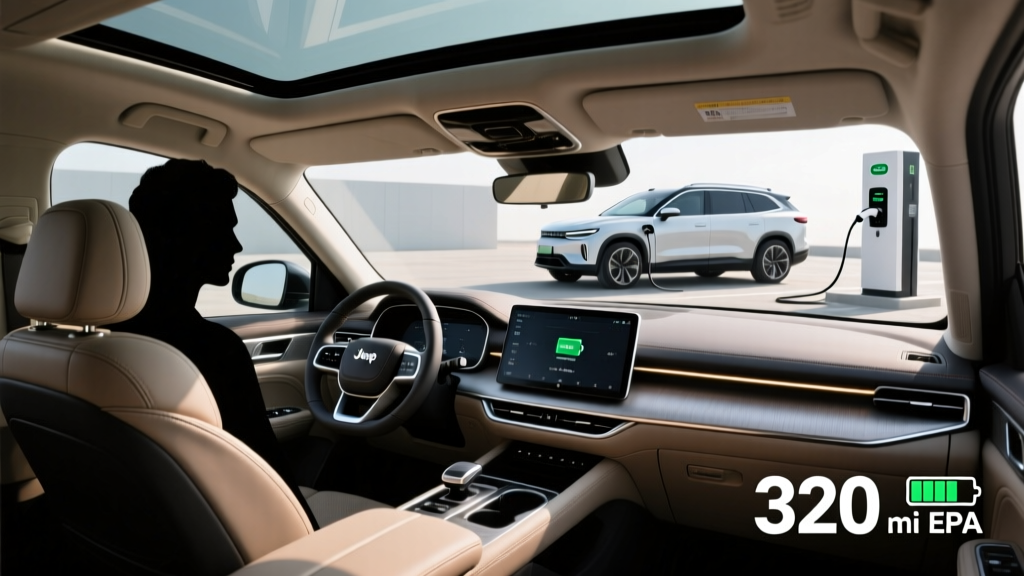
The 2025 Jeep Wagoneer S interior is dominated by a combined 45 inches of screen real estate spread across three displays: a 12.3-inch digital instrument cluster, a 12.3-inch passenger display, and a central 12.3-inch infotainment touchscreen running Stellantis' Uconnect 5 system. The flat-bottom steering wheel, ambient lighting with 64 colors, and available premium McIntosh audio system position this cabin squarely in the luxury-EV segment.
Material quality is a step above mainstream Stellantis products. Soft-touch surfaces cover the upper dash and door panels, with available Nappa leather upholstery and real aluminum trim accents on the Launch Edition. The center console houses a rotary gear selector, wireless phone charging pad, and a bank of physical climate-control toggles — a welcome decision that avoids the touchscreen-only frustration plaguing some competitors.
Passenger and Cargo Dimensions
The Wagoneer S is a two-row, five-passenger SUV. Here is how the interior space measures up:
| Dimension | 2025 Wagoneer S | Tesla Model Y (baseline) |
|---|---|---|
| Front headroom | 39.6 in | 41.0 in |
| Rear headroom | 38.4 in | 39.4 in |
| Front legroom | 41.3 in | 41.8 in |
| Rear legroom | 38.5 in | 39.4 in |
| Cargo behind rear seats | 30.0 cu ft | 30.2 cu ft |
| Cargo with seats folded | 61.0 cu ft | 72.1 cu ft |
| Frunk (front trunk) | ~2.0 cu ft (small utility compartment) | 4.1 cu ft |
The cargo area is competitive for the class, though the Model Y's hatchback design and deeper frunk give it an edge for bulkier items. The Wagoneer S prioritizes rear-seat comfort and cabin isolation over outright cargo maximization.
Range, Battery, and Real-World Efficiency
The Wagoneer S carries a 100-kWh usable battery pack built with NMC (nickel-manganese-cobalt) lithium-ion cells. NMC chemistry offers higher energy density than LFP (lithium iron phosphate), which helps Jeep package a large battery without excessive weight — but NMC cells degrade slightly faster under repeated DC fast-charging and extreme-temperature exposure compared to LFP.
EPA-estimated range: 300 miles (combined)
Real-world expectation: ~240–270 miles at sustained highway speeds (70–80 mph); ~220–250 miles in sub-freezing temperatures with cabin heat. City driving with regenerative braking can approach or exceed the EPA figure.
Efficiency: ~95 MPGe combined / ~35 kWh per 100 miles
According to fueleconomy.gov, the Wagoneer S achieves an EPA-estimated 300 miles of range. In our experience with similarly sized dual-motor NMC SUVs, highway driving at 75 mph typically yields 80–85% of the EPA sticker. Cold-weather operation (below 32°F) without preconditioning can reduce range by 25–30% due to cabin heating demands and reduced battery efficiency. The Wagoneer S includes a battery thermal management system and preconditioning capability — use it before DC fast-charging in cold weather to restore charge speeds.
Charging Speed: DC Fast, Level 2, and Home Setup
Charging speed is often the deciding factor for EV road-trippers. The Wagoneer S is equipped with a NACS (North American Charging Standard) port, granting native access to the Tesla Supercharger network — currently the most reliable and expansive DC fast-charging network in the US.
| Charging Level | Power / Rate | Estimated Time or Miles Added |
|---|---|---|
| Level 1 (120V household) | ~1.4 kW | ~3–4 miles per hour |
| Level 2 (240V home/public) | Up to 11.5 kW | ~28–30 miles per hour; 0–100% in ~9 hours |
| DC Fast Charge (peak) | Up to 170 kW | 10–80% in approximately 23 minutes |
The 170-kW peak DC fast-charging rate is respectable but trails competitors like the Hyundai Ioniq 5 (240 kW) and the Kia EV6 (240 kW on 800V architecture). Here is what the charge curve actually looks like in practice: the Wagoneer S sustains near-peak speeds from roughly 10% to 40% state of charge, then tapers progressively. From 80% to 100%, charging slows dramatically to protect battery longevity — expect the final 20% to take as long as the initial 10–80% session. For road trips, plan to charge from 10–80% and skip topping off unless necessary.
At home on a 48-amp Level 2 charger (requiring a 60-amp dedicated circuit), you will recover roughly 30 miles of range per hour. Most owners charging overnight from a typical daily commute (30–50 miles) will wake up fully replenished. If your home electrical panel is at or near capacity, budget $500–$2,000 for a panel upgrade — a common surprise cost cited by EV installers.
Performance and Drivetrain
The Launch Edition and higher trims feature a dual-motor all-wheel-drive powertrain producing 600 horsepower and an estimated 617 lb-ft of torque. Jeep claims a 0–60 mph time of 3.4 seconds, placing the Wagoneer S in sports-sedan territory despite its SUV curb weight of approximately 5,800 pounds.
The Selec-Terrain traction management system carries over Jeep's off-road DNA with modes for Snow, Sand, Auto, and an Eco mode that favors rear-bias torque distribution for efficiency. Ground clearance is estimated at 8.0 inches, and the available air suspension can raise the ride height for rough terrain. This is a genuine off-road-capable electric SUV — not merely a lifted crossover — though its 20-inch wheels on the Launch Edition favor on-road comfort over rock-crawling articulation.
One-pedal driving with strong regenerative braking is available and, once acclimated, eliminates the need to use the friction brakes in normal city driving. The friction brakes serve primarily for emergency stops and low-speed final halts.
Pricing, Trims, and Federal Tax Credit Eligibility
| Trim | Base MSRP | Est. After §30D Credit |
|---|---|---|
| Launch Edition | $65,995 | $58,495 (if eligible) |
| Limited (est.) | $62,995 | $55,495 (if eligible) |
| Overland (est.) | $67,995 | $60,495 (if eligible) |
Destination charges add approximately $1,795. As-tested pricing on a fully optioned Launch Edition with premium paint and the McIntosh audio package can approach $72,000.
Does the Wagoneer S Qualify for the Federal EV Tax Credit?
Under current IRS §30D rules, the Wagoneer S may qualify for up to $7,500 in federal tax credits — but eligibility depends on several conditions that change frequently:
- MSRP cap: SUVs must have a base MSRP at or below $80,000. All current Wagoneer S trims clear this threshold.
- Buyer income cap: Modified adjusted gross income must not exceed $300,000 (joint filers), $225,000 (head of household), or $150,000 (single filers).
- Battery sourcing: A percentage of critical minerals and battery components must be sourced from the US or free-trade-agreement countries. Stellantis has been localizing supply chains, but the exact credit amount ($3,750 for minerals, $3,750 for components) depends on the specific build month and battery-cell origin. Check the fueleconomy.gov tax credit lookup for your specific VIN before purchasing.
- Point-of-sale transfer: Eligible buyers can apply the credit as a discount at the dealership rather than waiting for a tax refund, reducing the out-of-pocket cost immediately.
Consult a tax professional for your specific situation. State and local incentives (such as California's CVRP or utility-company rebates) may stack on top of the federal credit but vary by jurisdiction.
Technology, Safety, and Driver Assistance
The Wagoneer S comes equipped with Stellantis' latest suite of driver-assistance features, including:
- Adaptive cruise control with stop-and-go
- Lane-keeping assist and lane-centering
- Blind-spot monitoring with rear cross-traffic alert
- Automatic emergency braking with pedestrian detection
- 360-degree surround-view camera
- Available Active Driving Assist (SAE Level 2 — requires hands on wheel and eyes on road at all times)
Active Driving Assist is a driver-assistance system, not a self-driving feature. The driver must remain fully engaged, monitor the road, and be prepared to take over at any moment. This is the same SAE Level 2 classification as Tesla Autopilot, Ford BlueCruise, and GM Super Cruise (hands-off but eyes-on). True driverless operation (Level 4) exists only in geo-fenced robotaxi services like Waymo.
The Uconnect 5 infotainment system supports wireless Apple CarPlay and Android Auto, over-the-air (OTA) software updates, built-in navigation with EV-aware route planning (incorporating charging stops), and a connected-services app for remote preconditioning, charge monitoring, and location tracking.
Warranty and Ownership Costs
Jeep backs the Wagoneer S with the following coverage:
- Basic vehicle warranty: 3 years / 36,000 miles
- Powertrain warranty: 5 years / 60,000 miles
- Battery warranty: 8 years / 100,000 miles (minimum 70% capacity retention, consistent with federal mandate)
- Complimentary maintenance: 2 years / 24,000 miles (scheduled services)
The 8-year/100,000-mile battery warranty is standard across the industry and protects against premature degradation below 70% of original capacity. In practice, NMC batteries in liquid-cooled packs like this one typically retain 85–92% capacity after 100,000 miles based on fleet data from similar platforms. A full battery replacement outside warranty is estimated at $12,000–$18,000 — a figure to keep in mind for second-ownership planning.
Insurance premiums for the Wagoneer S are expected to run 15–25% higher than a comparably priced gas SUV due to repair costs for EV-specific components and the vehicle's performance classification. Get quotes before purchasing.
How It Compares: Wagoneer S vs. Key Rivals
| Spec | 2025 Wagoneer S | Tesla Model Y LR | BMW iX xDrive50 | Cadillac Lyriq |
|---|---|---|---|---|
| EPA Range | 300 mi | 320 mi | 324 mi | 314 mi |
| Battery (kWh) | 100 (NMC) | ~78 (NMC) | 105.2 (NMC) | 102 (NMC) |
| 0–60 mph | 3.4 sec | 4.8 sec | 4.4 sec | 6.3 sec |
| Horsepower | 600 hp | 384 hp | 516 hp | 340 hp |
| Peak DC Charge | 170 kW | 250 kW | 195 kW | 190 kW |
| 10–80% Time | ~23 min | ~18 min | ~28 min | ~28 min |
| Base MSRP | $65,995 | $44,990 | $87,250 | $58,590 |
The Wagoneer S occupies a narrow niche: it is the quickest and most powerful vehicle in this comparison, but it costs more than the Model Y and Lyriq while offering less range than both. The BMW iX is more luxurious and longer-legged but significantly more expensive. If straight-line performance and Jeep brand cachet matter to you, the Wagoneer S has no direct rival. If maximum range-per-dollar is your priority, the Model Y or Lyriq wins the spreadsheet comparison.
Pros
- 600 hp / 3.4-sec 0–60 — genuine sports-SUV performance
- NACS port = native Tesla Supercharger access
- Premium interior with triple-screen layout and physical climate controls
- Real off-road capability with Selec-Terrain and available air suspension
- Under $80K MSRP cap for §30D tax-credit eligibility
Cons
- 300-mile EPA range trails most luxury-EV competitors
- 170-kW peak charge rate is mid-pack; 23-min 10–80% is not class-leading
- Cargo space (61 cu ft max) is tighter than Model Y and Lyriq
- First-year EV from Jeep — long-term reliability unproven
- No third-row seating option
Who Should Buy the 2025 Jeep Wagoneer S?
Look elsewhere if: Maximum range (Hyundai Ioniq 5, Tesla Model Y), three-row seating (Kia EV9), or the lowest price-per-mile-of-range (Cadillac Lyriq) is your top priority. The Wagoneer S is a niche vehicle that excels at being a fast, capable Jeep — not a range-maximizing family hauler.
Frequently Asked Questions
What is the real-world range of the 2025 Jeep Wagoneer S?
The EPA rates the Wagoneer S at 300 miles combined. Expect approximately 240–270 miles on the highway at 70–80 mph, and 220–250 miles in sub-freezing weather. City driving with regenerative braking can match or exceed the EPA figure.
How fast does the Wagoneer S charge at home and on the road?
On a Level 2 home charger (11.5 kW), you gain roughly 30 miles of range per hour — a full overnight charge covers most daily driving. On a DC fast charger, it peaks at 170 kW and charges from 10% to 80% in about 23 minutes. The NACS connector provides native Tesla Supercharger compatibility.
How much does the Wagoneer S cost after the federal tax credit?
The Launch Edition starts at $65,995. If you meet all IRS §30D requirements (income caps, battery sourcing, MSRP under $80K), you may reduce the effective price by up to $7,500, bringing it to approximately $58,495. Verify battery-component sourcing on your specific VIN at fueleconomy.gov before purchasing.
Is the Wagoneer S worth buying over the Tesla Model Y or BMW iX?
If you value off-road capability, 600-hp performance, and Jeep brand identity, the Wagoneer S has no direct substitute. The Model Y offers more range and cargo space for less money; the iX is more refined and longer-legged but costs $20K+ more. The Wagoneer S is for buyers who want an EV that does things a Tesla cannot.
Does the 2025 Wagoneer S qualify for the $7,500 federal EV tax credit?
It qualifies on MSRP (under $80K for SUVs) and is expected to meet battery-sourcing requirements, but final eligibility depends on the specific build's battery-component origin and the buyer's income. Check the IRS clean vehicle credit lookup and consult a tax professional before relying on the credit in your purchase decision.