Tesla Model Y 2026 Review: Beyond the 0% APR Headline
When Tesla advertises 0% APR financing on the Model Y, it catches attention — and rightly so. In a market where EV loan rates from traditional lenders routinely sit between 6% and 9%, a zero-percent factory offer can save buyers thousands over a 48- or 60-month term. But financing deals come and go; the vehicle underneath them is what you actually live with. This review examines the 2026 Tesla Model Y on its engineering merits: its real-world range, charging behavior, interior practicality, and total ownership economics — so you can decide whether the car itself justifies pulling the trigger while the money is cheap.
Spec Sheet: 2026 Tesla Model Y at a Glance
| Attribute | Long Range AWD | Performance AWD | RWD (Standard) |
|---|---|---|---|
| EPA Range | 320 mi | 290 mi | 260 mi |
| Battery (usable) | ~75 kWh (NMC) | ~75 kWh (NMC) | ~60 kWh (LFP) |
| Drivetrain | Dual-Motor AWD | Dual-Motor AWD | Rear-Wheel Drive |
| Horsepower | ~384 hp | ~456 hp | ~295 hp |
| 0–60 mph | 4.8 sec | 3.5 sec | 6.6 sec |
| Peak DC Charge Rate | 250 kW | 250 kW | 170 kW |
| 10–80% DC Time | ~25 min | ~25 min | ~30 min |
| Level 2 Home Rate | 11.5 kW (~44 mi/hr) | 11.5 kW (~44 mi/hr) | 11.5 kW (~44 mi/hr) |
| EPA Efficiency | 122 MPGe / 28 kWh/100mi | 111 MPGe / 30 kWh/100mi | 128 MPGe / 26 kWh/100mi |
| Cargo (rear seats up) | 30.2 cu ft | 30.2 cu ft | 30.2 cu ft |
| Cargo (rear seats folded) | 72.1 cu ft | 72.1 cu ft | 72.1 cu ft |
| Base MSRP | $48,990 | $54,990 | $44,990 |
Sources: fueleconomy.gov, Tesla Model Y design page.
Charging Speed and Infrastructure Advantage
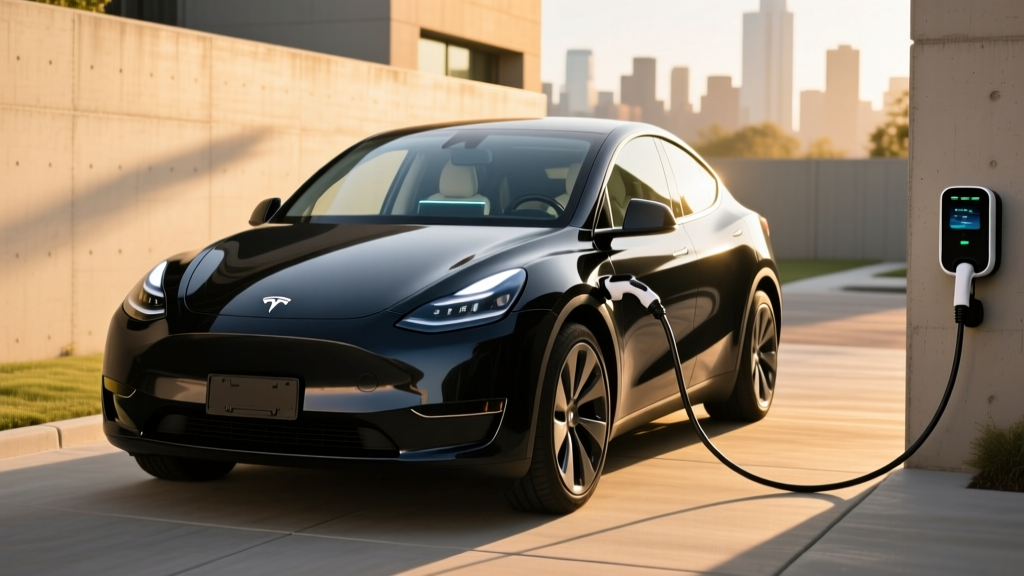
The Model Y's charging story has two chapters: the hardware on the car, and the network behind it. On the car side, Long Range and Performance trims peak at 250 kW on DC fast chargers using the native NACS connector. That peak rate is not sustained across the entire session — Tesla's charge curve holds roughly 250 kW from 10% to about 35% State of Charge (SoC), then tapers progressively. A 10–80% session takes approximately 25 minutes at a V3 Supercharger or any NACS-compatible 250+ kW station. The last 20% (80–100%) can add another 25–30 minutes, which is why road-trippers learn to hop between chargers at 80% rather than wait for a full battery.
| Charging Level | Power (kW) | Speed (mi/hr added) | Typical Use Case |
|---|---|---|---|
| Level 1 (120V) | ~1.4 kW | ~4–5 mi/hr | Overnight top-up, emergencies |
| Level 2 (240V, 48A) | 11.5 kW | ~44 mi/hr | Home Wall Connector, workplace |
| DC Fast (V3 Supercharger) | Up to 250 kW | ~1,000+ mi/hr (peak) | Road trips, 10–80% in ~25 min |
| DC Fast (V4 Supercharger) | Up to 250 kW (NACS) | ~1,000+ mi/hr (peak) | Newer Tesla sites, open to other EVs |
At home on a Tesla Wall Connector (hardwired, 60A circuit), the Model Y accepts 11.5 kW, replenishing the Long Range battery from 20% to 80% in roughly 4 hours — easily covered by an overnight session. If your home electrical panel maxes out at a 40A circuit (common in older homes), expect ~9.6 kW or ~37 mi/hr, which still covers daily commuting for most drivers.
The network advantage is tangible. Tesla's Supercharger network now exceeds 6,000 stations in North America, and with the industry-wide adoption of NACS, the Model Y charges natively at every Supercharger without an adapter. For buyers comparing against CCS-equipped rivals that still rely on adapters or spotty Electrify America reliability, this is a meaningful daily-ownership differentiator.
Battery Chemistry: LFP vs. NMC in the Model Y Lineup
Tesla uses two distinct battery chemistries across the Model Y range, and the choice affects how you should charge and maintain the vehicle:
| Factor | LFP (RWD Standard Range) | NMC (Long Range / Performance) |
|---|---|---|
| Energy Density | Lower (hence 260-mi range) | Higher (320-mi range) |
| Cycle Life | 3,000+ cycles | ~1,500–2,000 cycles |
| Daily Charge Recommendation | 100% OK daily | 80% for daily; 100% before trips |
| Cold-Weather Performance | More range loss in cold | Better cold tolerance |
| Cost | Lower (reflected in MSRP) | Higher |
If you are a commuter who can charge at home every night and rarely road-trips, the LFP-equipped RWD model offers exceptional long-term durability with less degradation anxiety. If you need maximum range or live in a cold climate, the NMC Long Range is the stronger pick — just adopt the 80% daily charge habit to preserve longevity.
Pricing, 0% APR Savings, and Federal Tax Credit
The 0% APR financing offer is the hook, but the full cost picture requires stacking it against the IRS §30D federal tax credit. Here is how the math works for a Long Range AWD buyer in early 2026:
| Cost Element | Long Range AWD | RWD Standard |
|---|---|---|
| Base MSRP | $48,990 | $44,990 |
| Destination Fee | $1,390 | $1,390 |
| Federal Tax Credit (§30D) | Up to $7,500 | Up to $7,500 |
| Effective Price (after credit) | ~$42,880 | ~$38,880 |
| 0% APR 60-mo Payment | ~$715/mo | ~$648/mo |
| Typical 7% APR 60-mo Payment | ~$850/mo | ~$770/mo |
| Interest Saved with 0% APR | ~$8,100 | ~$7,320 |
The 0% APR deal saves a Long Range buyer roughly $8,100 in interest over five years compared to a market-rate loan. Combined with the $7,500 federal credit (applied as a point-of-sale rebate under current rules), the effective acquisition cost drops substantially.
- MSRP Cap: SUVs must be at or below $80,000 (all Model Y trims qualify)
- Buyer Income Cap: AGI ≤ $300,000 (joint), $225,000 (head of household), $150,000 (single)
- Battery Sourcing: Critical minerals and battery components must meet escalating North American/free-trade-partner thresholds — Tesla has largely localized supply, but confirm current-year compliance at purchase
- Point-of-Sale Transfer: Credit can be transferred to the dealer at purchase for an immediate price reduction, rather than claimed on your tax return
- VIN Registration: Vehicle must be registered for personal use, primarily in the United States
Source: IRS §30D guidelines. Consult a tax professional for individual eligibility.
Performance, Efficiency, and Daily Drivability
The Long Range AWD Model Y delivers 384 horsepower and a 4.8-second 0–60 mph time — brisk enough to merge onto any freeway with confidence, if not quite the neck-snap of the Performance trim's 3.5 seconds. More relevant for daily driving is the instant torque delivery: there is no turbo lag or downshift delay, just immediate thrust from a stop.
Efficiency is where the Model Y earns its reputation. At 28 kWh per 100 miles (Long Range), it consumes less energy per mile than nearly any competing electric SUV. For context, the Ford Mustang Mach-E Extended Range AWD uses roughly 32 kWh/100mi, and the Hyundai Ioniq 5 AWD sits around 33 kWh/100mi. At the U.S. average electricity rate of $0.17/kWh, the Model Y Long Range costs about $4.76 to travel 100 miles — compared to roughly $12.50 for a 25 MPG gas SUV at $3.15/gallon.
The heat pump (standard on all 2026 Model Y trims) is a notable efficiency advantage in cold weather. Unlike resistance-heater-based EVs that can lose 35–40% of range at 20°F, the Model Y's heat pump typically limits cold-weather range loss to 20–25%, based on real-world winter driving data.
Interior, Cargo, and Technology
The 2026 Model Y's cabin follows Tesla's minimalist ethos: a single 15.4-inch touchscreen handles navigation, climate, media, and vehicle settings. There is no instrument cluster — speed and range data appear on the screen's upper corner. The refreshed interior (introduced with the 2025 update) added ventilated front seats, ambient lighting, and improved sound insulation that noticeably reduces wind noise at highway speeds compared to pre-2025 models.
Passenger space: Front legroom is 41.8 inches; rear legroom is 40.5 inches — competitive with midsize SUVs. The rear seat fits three adults on shorter trips, though the center position is narrow. The panoramic glass roof creates an airy feel but does reduce headroom slightly for taller passengers.
Cargo: 30.2 cubic feet behind the second row, expanding to 72.1 cubic feet with seats folded. The front trunk (frunk) adds 4.1 cubic feet for charging cables or a small bag. A power-folding second row and a flat load floor make the Model Y genuinely practical for furniture runs or camping trips.
Driver Assistance: Basic Autopilot (lane centering, adaptive cruise) is standard. Full Self-Driving (Supervised) remains a $8,000 option or $99/month subscription. It is critical to understand that FSD is an SAE Level 2 system — the driver must remain fully attentive, hands on or near the wheel, and legally responsible for the vehicle at all times. It is not autonomous driving.
Warranty and Long-Term Ownership
Tesla's warranty structure for the 2026 Model Y:
- Basic Vehicle: 4 years / 50,000 miles
- Battery & Drive Unit: 8 years / 120,000 miles (Long Range/Performance); 8 years / 100,000 miles (RWD)
- Battery Capacity Guarantee: Minimum 70% retention over the warranty period
Real-world degradation data from Tesla's fleet reports and third-party tracking (e.g., Recurrent Auto) shows NMC Model Y batteries retaining approximately 88–92% capacity at 100,000 miles, well above the warranty threshold. LFP batteries in the RWD model show even slower degradation curves, with many owners reporting 95%+ retention at 60,000 miles when charged to 100% regularly.
Insurance costs remain a consideration. Model Y premiums average 15–25% higher than comparable gas SUVs, driven by repair costs for aluminum body panels and sensor recalibration after collisions. Budget $1,800–$2,400/year depending on your state and driving record.
Pros
- Best-in-class Supercharger network access (native NACS)
- Class-leading efficiency (28 kWh/100mi)
- Strong real-world range retention with heat pump
- 0% APR + $7,500 credit = exceptional value window
- Over-the-air updates add features post-purchase
- Spacious cargo area with flat load floor
Cons
- Minimalist interior not for everyone (no physical buttons)
- FSD subscription is expensive and still Level 2
- Insurance premiums above segment average
- Rear visibility is limited (no rear wiper on some trims)
- Service center wait times can be long in some metro areas
- Ride quality firm on 20-inch wheels
How the Model Y Stacks Up Against Key Rivals
The Model Y does not exist in a vacuum. Here is how it compares on the metrics buyers actually cross-shop:
| Metric | Tesla Model Y LR AWD | Ford Mach-E ER AWD | Hyundai Ioniq 5 AWD |
|---|---|---|---|
| EPA Range | 320 mi | 290 mi | 260 mi |
| Peak DC Charge | 250 kW | 150 kW | 240 kW |
| 10–80% Time | ~25 min | ~45 min | ~18 min |
| Efficiency | 28 kWh/100mi | 32 kWh/100mi | 33 kWh/100mi |
| Base MSRP | $48,990 | $50,995 | $50,100 |
| NACS Native | Yes | No (adapter needed) | No (adapter needed) |
The Ioniq 5 charges faster in absolute terms (18 minutes 10–80%) thanks to its 800V architecture, but the Model Y's Supercharger network reliability and superior efficiency tilt the road-trip advantage in Tesla's favor. The Mach-E offers a more traditional interior layout but trails on range and charging speed.
Choose the Hyundai Ioniq 5 if: You prioritize the fastest possible DC charging sessions and prefer a more conventional interior with physical controls.
Choose the Ford Mach-E if: You want a traditional dealership experience for service and prefer a more car-like interior design.
Frequently Asked Questions
What is the real-world range of the 2026 Tesla Model Y?
The EPA rates the Long Range AWD at 320 miles. In real-world mixed driving, expect 275–290 miles on highway-dominant trips at 70–75 mph. In winter conditions below 30°F, range drops to approximately 230–250 miles without preconditioning. The heat pump helps mitigate cold-weather losses compared to resistance-heated EVs.
How fast does the Model Y charge at home and on road trips?
At home on a Level 2 Tesla Wall Connector (11.5 kW), the Model Y adds roughly 44 miles of range per hour — a full overnight session covers any daily commute. On DC fast chargers, it peaks at 250 kW and charges from 10–80% in approximately 25 minutes, though the rate tapers significantly above 80% SoC.
Does the Tesla Model Y qualify for the $7,500 federal tax credit?
Yes, all 2026 Model Y trims fall under the $80,000 SUV MSRP cap for the §30D credit. However, buyer eligibility depends on adjusted gross income (≤$300,000 joint, $150,000 single) and battery sourcing compliance. The credit can be transferred to Tesla at point of sale for an immediate price reduction. Always verify current-year sourcing requirements with your tax advisor before purchase.
Is the Model Y worth buying versus competitors in 2026?
For buyers who prioritize charging infrastructure reliability, efficiency, and over-the-air feature updates, the Model Y remains the segment benchmark. The 0% APR financing offer adds $8,000+ in interest savings over five years, making the effective cost highly competitive. If you prefer a traditional dealership service experience or need the absolute fastest DC charging, the Ioniq 5 or Mach-E are strong alternatives.
What are the biggest drawbacks of owning a Model Y?
The most common owner complaints center on the minimalist interior (no physical climate or volume controls), above-average insurance premiums, firm ride quality on larger wheels, and occasional service center wait times in high-density markets. FSD remains a Level 2 system despite its name and $8,000 price tag — it does not replace an attentive driver.
How long will the Model Y battery last?
Tesla warranties the battery for 8 years/120,000 miles (Long Range) with a minimum 70% capacity retention guarantee. Fleet data from third-party trackers shows NMC batteries retaining 88–92% at 100,000 miles. LFP batteries in the RWD model show even slower degradation. With proper charging habits (80% daily for NMC, 100% acceptable for LFP), most owners should see well over 150,000 miles before meaningful range loss.