The Tesla Model X remains one of the most recognizable electric SUVs on the road, and much of that identity comes from its defining feature: an enormous panoramic windshield that stretches up and over the front-row occupants like an aircraft canopy. For 2026, the Model X continues to blend that dramatic glass roof with serious performance, a mature Supercharger ecosystem, and family-friendly practicality via its available third row. But the windshield is more than an aesthetic flex — it shapes the entire cabin experience, for better and worse. This review covers everything a prospective buyer needs to know about the Tesla Model X, from its panoramic windshield and real-world range to charging speeds, tax credit eligibility, and how it stacks up against rivals.
The Tesla Model X Windshield: What Makes It Unique
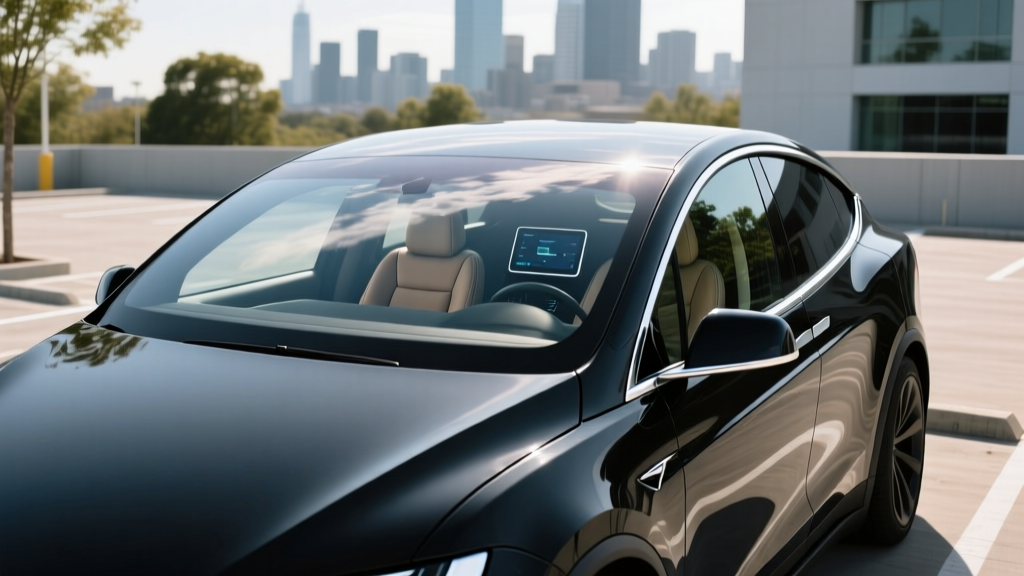
The Model X's panoramic windshield is the largest production windshield ever fitted to a passenger vehicle. It extends from the base of the hood all the way past the B-pillar, creating an unbroken glass canopy over the front seats. Tesla applies a solar-tint band across the upper portion to reduce glare and heat, and the glass itself is acoustic-laminated for noise reduction.
In practice, the effect is striking. Visibility upward is unmatched — you see traffic lights, tree canopies, and open sky in a way no conventional SUV allows. The tinted upper section does a competent job of cutting direct overhead sun, though in peak summer heat at southern latitudes, the cabin can still absorb noticeable radiant warmth through the glass. Tesla's HVAC system compensates, but it's a factor worth noting for buyers in Arizona, Texas, or the Deep South.
The windshield also integrates the mounting point for the Model X's forward-facing cameras and sensor suite used by Autopilot and Full Self-Driving (Supervised). Any replacement requires recalibration, and Tesla's glass replacement cost is significantly higher than a standard SUV windshield — expect $1,200 to $1,800 for a full windshield replacement including calibration, compared to $300–$600 for a typical mainstream SUV. Comprehensive insurance coverage is strongly recommended.
Range, Battery, and Real-World Efficiency
The 2026 Tesla Model X Long Range carries a usable battery capacity of approximately 95 kWh using a nickel-based NMC (nickel manganese cobalt) chemistry. This is not an LFP battery — Tesla reserves lithium iron phosphate cells for the rear-wheel-drive Model 3 and Model Y trims. The NMC pack offers higher energy density, which the heavy Model X needs to achieve its range targets.
EPA Estimated Range: 335 miles
Real-World Highway (70 mph, moderate temps): ~280–300 miles
Real-World Cold Weather (below 30°F, mixed driving): ~235–265 miles
Plaid Trim EPA Range: 311 miles (real-world highway ~260–280 miles)
The gap between EPA and real-world range in the Model X is wider than in smaller EVs like the Model Y, primarily due to aerodynamic drag at highway speeds and the vehicle's 5,100+ lb curb weight. The dual-motor all-wheel-drive system is efficient around town where regenerative braking recovers energy, but sustained 75–80 mph freeway cruising will see consumption climb to roughly 38–42 kWh per 100 miles. For comparison, the EPA combined efficiency rating sits at 98 MPGe (roughly 34 kWh/100mi).
Cold-weather impacts are significant. The Model X does use a heat pump for cabin heating (standard since the 2021 refresh), which mitigates some range loss compared to resistive heaters. However, battery chemistry and cabin demands in sub-freezing temperatures still knock 20–30% off the EPA figure. Preconditioning the battery while plugged in before departure is essential in cold climates to preserve range and ensure optimal DC fast-charging speeds.
| Spec | Long Range | Plaid |
|---|---|---|
| EPA Range | 335 miles | 311 miles |
| Battery (usable) | ~95 kWh, NMC | ~95 kWh, NMC |
| Drivetrain | Dual-motor AWD | Tri-motor AWD |
| Horsepower | 670 hp | 1,020 hp |
| 0–60 mph | 3.8 seconds | 2.5 seconds |
| MPGe (combined) | 98 MPGe | 93 MPGe |
| Max DC Charge Rate | 250 kW | 250 kW |
| Base MSRP | $79,990 | $94,990 |
Charging Speeds: Supercharger, Home, and Destination
The Model X charges via Tesla's proprietary NACS (North American Charging Standard) connector, which is now the industry standard adopted by Ford, GM, Rivian, and most major automakers through 2025–2026. This gives the Model X native access to the entire Tesla Supercharger network — over 20,000 stalls in North America — without adapters.
| Level | Power (kW) | Miles of Range Added per Hour | 10–80% Time |
|---|---|---|---|
| Level 1 (120V outlet) | ~1.2 kW | ~3 mi/hr | Not practical (60+ hrs) |
| Level 2 (240V, 48A Wall Connector) | 11.5 kW | ~34 mi/hr | ~7 hours (full charge) |
| DC Fast Charge (V3 Supercharger) | Peak 250 kW | ~200 mi in 15 min | ~30 minutes |
A critical detail on DC fast charging: the 250 kW figure is a peak rate, not a sustained rate. The Model X's charging curve tapers as the battery fills. You'll see 250 kW only at a low state of charge (roughly 10–25%), with the rate stepping down progressively through 150 kW, 100 kW, and below 50 kW as you approach 80%. A 10–80% charge takes approximately 30 minutes at a V3 Supercharger stall under ideal conditions (battery preconditioned, moderate ambient temperature). Expect 40–50 minutes in cold weather if the battery hasn't been preconditioned via navigation routing to the charger.
For home charging, the Tesla Wall Connector on a 60-amp circuit (48 amps continuous) delivers 11.5 kW, adding roughly 34 miles of range per hour. A full overnight charge from 20% to 100% takes about 7 hours, which is adequate for most owners who plug in nightly. Note that daily charging to 100% is not recommended for NMC batteries — Tesla advises setting a daily charge limit of 80–90% and charging to 100% only before long trips. This is a key difference from LFP batteries, which tolerate daily 100% charges without accelerated degradation.
Performance, Cargo, and Interior Practicality
The Model X Long Range's dual-motor AWD powertrain produces 670 horsepower and launches the 5,185-lb SUV to 60 mph in 3.8 seconds — quicker than a Porsche Cayenne S and remarkably swift for a three-row family hauler. The Plaid trim's tri-motor setup (one front, two rear) pushes output to 1,020 horsepower and a 2.5-second 0–60 time, making it one of the fastest production SUVs ever built.
Handling is competent but not sporty. The air suspension provides a comfortable ride and adjustable ground clearance (from 5.9 to 8.2 inches), useful for light off-road situations or steep driveways. However, the Model X's weight is felt in corners, and rivals like the BMW iX offer more engaging dynamics. Steering is precise but numb, typical of Tesla's electric power steering calibration.
Inside, the Model X offers seating for five (standard), six (optional captain's chairs), or seven (optional third row). The third row is best suited for children — adult legroom in the rearmost seats is tight at roughly 32 inches. With all rows in use, cargo space behind the third row is limited to about 15 cubic feet. Fold the third row and you get approximately 42 cubic feet; fold both rear rows for a maximum of about 88 cubic feet. The front trunk (frunk) adds roughly 6.6 cubic feet of additional storage.
The 17-inch center touchscreen controls virtually all vehicle functions, including climate, glovebox, and mirror adjustment. The yoke steering wheel is standard (a conventional round wheel is available as a no-cost option). Build quality has improved markedly since the 2021 refresh, though some owners still report minor panel-gap inconsistencies and occasional rattles from the falcon-wing rear doors.
Pricing, Tax Credit Eligibility, and Ownership Costs
The 2026 Tesla Model X Long Range starts at an MSRP of $79,990 (including destination), while the Plaid begins at $94,990. Popular options include the six-seat interior ($6,500), FSD (Supervised) capability ($8,000 one-time or $99/month), and premium paint colors ($1,500–$2,500). A well-equipped Long Range with six seats and FSD can reach $95,000+ before incentives.
- MSRP Cap: SUVs must have an MSRP at or below $80,000. The Model X Long Range base MSRP of $79,990 qualifies; the Plaid at $94,990 does NOT qualify.
- Buyer Income Cap: Modified AGI must not exceed $300,000 (married filing jointly), $225,000 (head of household), or $150,000 (single).
- Battery Sourcing: Critical minerals and battery components must meet phased-in domestic/free-trade sourcing thresholds. Tesla's supply chain has been evolving — verify current-year compliance on IRS.gov or via the dealer's point-of-sale attestation.
- Point-of-Sale Transfer: Eligible buyers can transfer the credit to Tesla at purchase, reducing the purchase price directly rather than waiting for a tax refund.
- Final Assembly: Must be assembled in North America (Model X is built in Austin, TX — qualifies).
Source: IRS §30D Clean Vehicle Credit. Rules are subject to change. Consult a tax professional for personal eligibility.
If eligible, the $7,500 federal credit brings the effective price of a base Model X Long Range to approximately $72,490. However, adding options can push the MSRP above the $80,000 cap and disqualify the vehicle. Buyers targeting the credit should configure carefully and confirm the final MSRP on the window sticker before delivery.
Insurance costs for the Model X are notably higher than average. Expect annual premiums of $2,800–$4,200 depending on your state, driving record, and coverage level — roughly 40–60% above a comparably priced BMW X5 or Mercedes GLE. Tesla's own insurance product is available in many states and can sometimes undercut traditional carriers, particularly for drivers with clean records.
Autopilot, FSD, and Driver-Assist Technology
Every Model X comes standard with Tesla's Basic Autopilot, which includes adaptive cruise control, lane-centering, and automatic emergency braking. The optional Full Self-Driving (Supervised) package adds automatic lane changes, Navigate on Autopilot (highway on-ramp to off-ramp), traffic light and stop sign recognition, and the city-streets driving capability.
Both Autopilot and FSD (Supervised) are classified as SAE Level 2 driver-assistance systems. The driver must remain attentive, keep hands on the wheel (or demonstrate engagement via Tesla's cabin monitoring), and be prepared to take over at any moment. These are not autonomous driving systems. Level 4 driverless operation (no human required) is currently available only through robotaxi services like Waymo in select metro areas.
In our experience, FSD (Supervised) handles most highway scenarios competently and city driving has improved substantially through iterative neural-network updates. However, it still makes unpredictable decisions in construction zones, unprotected left turns with complex sightlines, and unfamiliar rural roads. Treat it as a fatigue-reducing assist, not a replacement for driving.
Pros, Cons, and How It Compares
- Panoramic windshield creates unmatched cabin openness
- 335-mile EPA range is strong for a three-row electric SUV
- Access to Tesla Supercharger network (20,000+ stalls)
- Falcon-wing doors ease child-seat installation and rear access
- 670 hp standard; 1,020 hp Plaid is absurdly quick
- Over-the-air updates continuously add features
- Standard heat pump for cold-weather efficiency
- Base price near $80K; options quickly push past tax-credit cap
- Windshield replacement is costly ($1,200–$1,800 with calibration)
- Third row is tight for adults; cargo space limited with all rows up
- Insurance premiums 40–60% above comparable luxury SUVs
- Falcon-wing doors can be slow in tight parking spaces and have sensor quirks
- Cabin can get warm in direct summer sun despite tint
- Yoke steering polarizing; round wheel is a no-cost option
Against key competitors, the Model X occupies a distinct niche. The BMW iX xDrive50 ($87,250) offers a more luxurious interior, better ride quality, and roughly 320 miles of range, but lacks a third row. The Rivian R1S ($82,700) provides genuine off-road capability, a more usable third row, and comparable range, but charges more slowly on DC (peak ~220 kW on the newer quad-motor platform). The Mercedes EQS SUV ($104,400) is more refined and quiet but starts well above the Model X and suffers steeper depreciation. The Model X's combination of range, Supercharger access, performance, and the dramatic windshield experience remains unique in the segment.
Who Should Buy the Tesla Model X?
The Model X is best suited for families who want an electric three-row SUV with strong range and access to the most reliable fast-charging network in North America. It's ideal for tech-forward buyers who value over-the-air updates, quick acceleration, and the theatrical experience of falcon-wing doors and the panoramic windshield. Road trippers benefit enormously from Supercharger density and 335-mile range.
It's less ideal for buyers who prioritize interior luxury and ride refinement (look at the BMW iX or Mercedes EQS SUV), need a genuinely adult-friendly third row (consider the Rivian R1S or Kia EV9), or want to minimize insurance costs. Budget-conscious buyers who don't need three rows should consider the Model Y, which offers similar technology at roughly half the price.
- You need three rows + strong range + Supercharger access
- The panoramic windshield and falcon-wing doors appeal to you
- You want 670+ hp in a family SUV
- You can keep MSRP at or below $80K to capture the $7,500 tax credit
- Adults regularly ride in the third row (Rivian R1S is better)
- You want a traditional luxury interior (BMW iX, Mercedes EQS SUV)
- Insurance costs are a dealbreaker
- You don't need three rows (Model Y saves $30K+)
Frequently Asked Questions
What is the real-world range of the Tesla Model X?
The EPA rates the 2026 Model X Long Range at 335 miles. In real-world highway driving at 70–75 mph in moderate temperatures, expect 280–300 miles. In cold weather (below 30°F), range drops to approximately 235–265 miles depending on driving style and cabin heating demands. The Plaid trim's EPA rating is 311 miles, with real-world highway figures around 260–280 miles.
How fast does the Model X charge at home and on the road?
At home on a Level 2 Tesla Wall Connector (48A, 240V), the Model X charges at 11.5 kW, adding about 34 miles of range per hour — a full charge takes roughly 7 hours. On a V3 Supercharger, it peaks at 250 kW and can add up to 200 miles in about 15 minutes under ideal conditions. A 10–80% DC fast charge takes approximately 30 minutes with a preconditioned battery, or 40–50 minutes in cold weather without preconditioning.
Does the Tesla Model X qualify for the federal EV tax credit?
The Model X Long Range at its base MSRP of $79,990 falls under the $80,000 SUV cap for the §30D federal credit, so it can qualify — provided the buyer meets income limits ($300K joint / $150K single) and the vehicle's battery meets current-year critical mineral and component sourcing requirements. The Plaid at $94,990 exceeds the MSRP cap and does not qualify. Always verify current sourcing compliance on fueleconomy.gov and consult a tax professional.
How much does a Tesla Model X windshield replacement cost?
Expect $1,200 to $1,800 for a full panoramic windshield replacement including ADAS camera recalibration. This is significantly more than a conventional SUV windshield due to the glass's size, acoustic lamination, and the calibration requirements for Autopilot cameras. Comprehensive auto insurance typically covers glass replacement, though deductibles vary by state and policy.
Is the Model X worth buying over the Rivian R1S or BMW iX?
It depends on priorities. The Model X wins on Supercharger network access, raw acceleration, and the panoramic windshield experience. The Rivian R1S offers a more usable third row, genuine off-road capability, and a more adventurous design. The BMW iX delivers superior interior luxury and ride comfort but lacks a third row. Test-driving all three is the best way to decide — the Model X's cabin feel, driven largely by that windshield, is something no competitor replicates.
What is the battery warranty on the Tesla Model X?
Tesla covers the Model X battery and drive unit with an 8-year/150,000-mile warranty (whichever comes first), with a guaranteed minimum capacity retention of 70%. This is competitive with the industry standard. Tesla's NMC batteries have demonstrated moderate degradation curves — most owners report 5–10% capacity loss over the first 100,000 miles based on aggregated fleet data, though individual results vary with charging habits and climate.
Sources: EPA Fuel Economy, Tesla Model X Specifications, IRS §30D Clean Vehicle Credit. All pricing and specifications reflect 2026 model year data at time of publication and are subject to change.