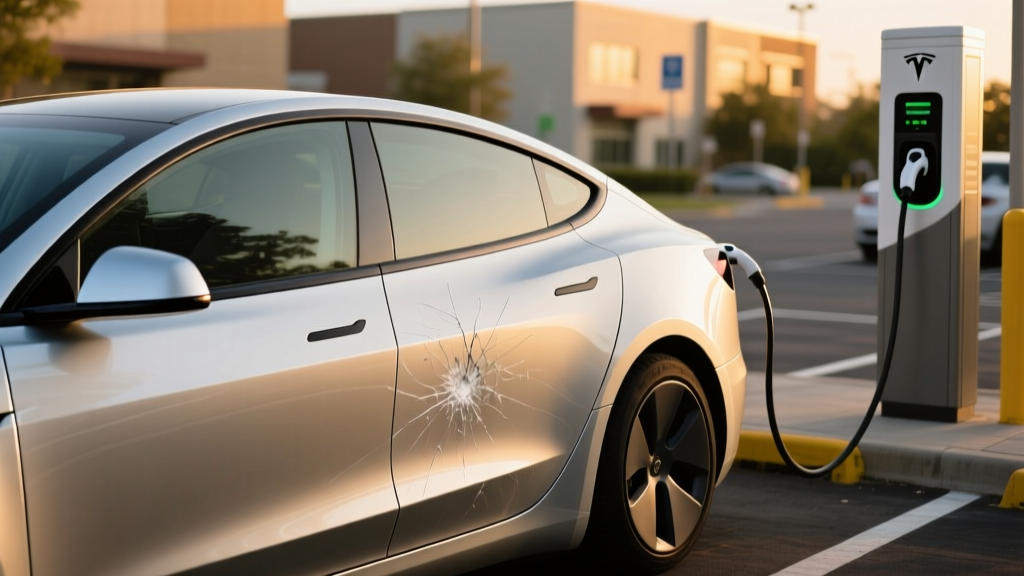
There's a sinking feeling every EV owner knows: you walk back to your parked Tesla and find a fresh, jagged scratch running along the door panel. Getting your Tesla keyed is more than cosmetic damage — it's a violation that can cost hundreds or thousands to repair and triggers a cascade of insurance and warranty questions. But Tesla owners have one major advantage that gas-car drivers don't: Sentry Mode.
This guide covers exactly what to do if your Tesla is keyed, how Sentry Mode can catch the culprit, realistic repair cost ranges, insurance implications, and the prevention strategies that actually work. We'll also touch on the broader ownership context — because understanding your Tesla's paint quality, warranty coverage, and security features helps you respond faster and smarter.
Why Teslas Get Keyed (and Why It's More Common Than You Think)
EVs, and Teslas in particular, attract disproportionate vandalism. The reasons are a mix of visibility, ideology, and opportunity:
- High visibility: Teslas are instantly recognizable. Their clean, badge-light design paradoxically makes them stand out in any parking lot.
- Anti-EV sentiment: Multiple studies and news reports have documented ideologically motivated vandalism against electric vehicles. A 2023 study published in the journal Energy Research & Social Science found that EV owners report higher rates of vandalism than internal-combustion vehicle owners.
- Assumed wealth: Vandals often target vehicles they associate with affluence, and Tesla's brand positioning — despite the Model 3 starting under $40,000 — still triggers this assumption.
- Parking patterns: EV owners often park in dedicated charging spots or high-traffic urban areas where vehicles sit unattended for extended periods.
The good news? Tesla's onboard camera system and security features give you tools that most vehicle owners simply don't have.
What to Do Immediately If Your Tesla Is Keyed
Time matters. Here's a step-by-step response protocol:
- Don't touch the scratch. Oils from your fingers can contaminate the area and complicate paint correction or touch-up work.
- Document everything. Photograph the damage from multiple angles in good lighting. Include wide shots showing the vehicle's location and close-ups of the scratch depth and length.
- Check Sentry Mode footage. Open the Tesla app or access the USB drive (if you have local recording enabled). Sentry Mode saves the 10 minutes of footage preceding a triggered event. If someone keyed your car, there's a strong chance it was captured.
- File a police report. Even if local law enforcement won't dispatch for cosmetic vandalism, you can typically file a report online or by phone. You'll need the report number for insurance claims.
- Notify your insurer. Vandalism is covered under comprehensive (not collision) insurance. Your deductible applies, but the claim won't typically raise your rates the way an at-fault accident would.
- Get a repair estimate. Tesla-certified body shops and mobile paint correction specialists can assess whether the scratch is clear-coat only (buffable), paint-deep (requires touch-up or respray), or primer/metal-deep (full panel work).
How Sentry Mode Catches Vandals in the Act
Sentry Mode is Tesla's always-on surveillance system that activates when the vehicle is parked and locked. Here's how it works in a keying scenario:
Camera coverage for keying incidents:
| Camera | Coverage Area | Keying Detection Likelihood |
|---|---|---|
| Front repeater (left/right) | Front fenders, front doors | High — captures side approach and arm movement |
| Rear repeater (left/right) | Rear doors, rear quarter panels | High — best angle for rear-door keying |
| Main front camera | Forward-facing, wide angle | Low — only captures front-facing approach |
| Backup camera | Rear of vehicle | Medium — captures rear hatch/bumper area |
Critical Sentry Mode requirements:
- The vehicle must have at least 20% battery remaining (Sentry Mode disables below this threshold).
- A properly formatted USB drive must be inserted in the glovebox port for local recording. Without it, you get notification-only mode (no saved footage) unless you have Premium Connectivity with the dashcam clip upload feature.
- Sentry Mode must be enabled in the vehicle settings (it can be set to activate automatically or manually).
According to Tesla's official owner's manual, Sentry Mode recordings can be used as evidence in police reports and insurance claims. Multiple Tesla owners have successfully identified and prosecuted vandals using this footage.
Tesla Paint Repair Costs: What You'll Actually Pay
Repair costs for a keyed Tesla depend on scratch depth, panel location, and whether you choose a Tesla-certified body shop or an independent detailer.
| Damage Level | Description | Repair Method | Estimated Cost |
|---|---|---|---|
| Clear coat only | Fingernail doesn't catch in scratch | Machine polish / paint correction | $150–$400 |
| Through paint to primer | Fingernail catches; white/gray visible | Touch-up paint + wet sand + polish | $300–$800 |
| Down to bare metal | Metal visible, rust risk if untreated | Panel respray (body shop) | $800–$2,500+ |
| Full-length deep key (multiple panels) | Continuous scratch across 2+ panels | Multi-panel respray | $2,000–$5,000+ |
Tesla paint quality note: Tesla's Fremont and Shanghai factory paint has historically drawn criticism for thinness and inconsistency. The Austin-built Model Y (2022+) and refreshed Model 3 Highland (2024+) feature improved paint processes, but Tesla paint remains thinner than many legacy automakers. This means scratches penetrate deeper layers faster, and color-matching on resprays can be challenging — another reason to use a Tesla-approved body shop that has access to factory paint codes and specifications.
Insurance, Deductibles, and Whether to File a Claim
Vandalism claims fall under your comprehensive coverage, not collision. Key insurance considerations:
- Deductible: Your comprehensive deductible (typically $250–$1,000) applies. If the repair cost is close to or below your deductible, paying out of pocket avoids a claim on your record.
- Rate impact: Comprehensive claims generally have less impact on premiums than at-fault collision claims. However, multiple comprehensive claims in a short period can trigger rate increases.
- Sentry Mode evidence: If your footage identifies the vandal, your insurer may subrogate (pursue recovery) against the responsible party, potentially recouping your deductible.
- Gap coverage: If you're leasing or financing and the damage is severe enough to total the vehicle (rare for keying), gap coverage handles the difference between actual cash value and your loan balance.
Decision framework:
File a claim if: Repair cost exceeds your deductible by $500+, you have Sentry Mode footage identifying the vandal (aids subrogation), or the damage spans multiple panels requiring professional respray.
Pay out of pocket if: The scratch is clear-coat only (under $400 to fix), your deductible is high ($1,000), or you've filed multiple recent comprehensive claims.
Prevention: How to Stop Your Tesla From Getting Keyed
You can't eliminate the risk entirely, but these strategies meaningfully reduce it:
Paint Protection Film (PPF)
A full-body PPF application ($2,500–$6,000 depending on coverage area and film brand) adds a sacrificial urethane layer over your paint. Most key scratches will cut into the film rather than the paint, and many PPF products feature self-healing properties that erase minor scratches with heat application. Popular options include XPEL Ultimate Plus and SunTek Reaction. PPF won't stop a determined vandal pressing hard with a key, but it converts what would be a $1,500 respray into a $200 film section replacement.
Ceramic Coating
Ceramic coatings ($800–$2,000 professional application) add a hard, hydrophobic layer to your paint. While they don't prevent keying, they make scratches slightly less likely to penetrate the clear coat and make the surface easier to polish afterward. Think of ceramic coating as a complement to — not a replacement for — PPF.
Strategic Parking
- Park in well-lit, high-traffic areas with visible security cameras.
- Choose end spots or spots near building entrances where foot traffic provides natural surveillance.
- Avoid parking near vehicles with pre-existing damage or bumper stickers that signal antagonism toward EVs.
- Use a garage whenever possible — even a carport significantly reduces opportunistic vandalism.
Sentry Mode Optimization
- Keep Sentry Mode enabled at all times when parked. The energy draw is roughly 1–2 miles of range per hour, a small cost for security.
- Ensure your USB drive is properly formatted and has adequate storage (64GB+ recommended).
- Enable the "Sentry Sounds" feature, which plays an audible warning when the system detects a threat — this alone deters many vandals.
- Set up exclusion zones for trusted locations (like your home garage) to save battery if you prefer manual activation elsewhere.
Physical Deterrents
- A visible dashcam indicator light (Tesla's cameras are somewhat hidden) can be supplemented with an aftermarket visible camera or blinking LED.
- "Sentry Mode Active" window decals (available from third-party sellers) alert potential vandals that they're being recorded before they act.
Tesla's Warranty: What's Covered and What Isn't
Understanding your Tesla warranty helps you avoid paying for damage that might be covered — and prevents you from filing warranty claims for damage that won't be.
| Warranty Category | Coverage Period | Keying/Vandalism Covered? |
|---|---|---|
| Basic Vehicle Limited Warranty | 4 years / 50,000 miles | No — vandalism is excluded |
| Battery & Drive Unit Warranty | 8 years / 100,000–120,000 miles (varies by model) | No — unrelated to paint damage |
| Paint Warranty | 4 years / 50,000 miles | No — covers factory defects, not external damage |
| Comprehensive Insurance | Per your policy terms | Yes — this is your primary coverage for vandalism |
Tesla's warranty explicitly excludes damage caused by "abuse, misuse, negligence, or acts of vandalism." Your recourse for keying damage is always through insurance or out-of-pocket repair — never through a warranty claim.
Frequently Asked Questions
Can Sentry Mode footage be used in court?
Yes. Sentry Mode recordings have been accepted as evidence in both criminal proceedings and civil insurance claims. The footage includes timestamps and GPS location data. Ensure you preserve the original files on the USB drive and provide copies (not the only copy) to law enforcement.
Does a key scratch void my Tesla warranty?
No. A key scratch is cosmetic damage and does not affect your powertrain, battery, or basic vehicle warranty. However, if you choose an unauthorized body shop for repairs and they damage wiring, sensors, or cameras during the repair, that subsequent damage may not be covered.
How much does Sentry Mode drain the battery?
Sentry Mode consumes approximately 1–2 miles of rated range per hour, or roughly 15–30 miles over an 8-hour workday. On a Model 3 Long Range with an EPA-estimated 341 miles of range, that's a meaningful but manageable drain. Sentry Mode automatically disables when the battery drops below 20% to protect your ability to reach a charger.
Should I get PPF on my Tesla to prevent keying damage?
PPF is the single most effective physical defense against keying. A full-body application costs $2,500–$6,000 but can prevent thousands in paint repair. It's most cost-effective on high-risk vehicles: Teslas parked in urban environments, high-traffic lots, or areas with documented anti-EV vandalism. If your Tesla is garaged at home and at work, the ROI is lower.
Will Tesla's body shop match my paint color perfectly?
Tesla-approved body shops have access to factory paint codes and mixing systems, but Tesla's paint has historically been inconsistent between batches — even within the same model year and color. Expect a close match, but be aware that slight variation is possible, especially on older vehicles where the original paint has oxidized. A quality shop will blend into adjacent panels to minimize visible differences.
Is getting my Tesla keyed a hate crime?
In most jurisdictions, vandalism is prosecuted as criminal mischief or malicious destruction of property, not as a hate crime. However, if the vandalism is accompanied by threatening notes targeting EV ownership or environmental beliefs, some jurisdictions may consider enhanced charges. Always report the full context to law enforcement.