The Physics of a 5,000-Pound Electric SUV
When you're evaluating a large, three-row electric SUV, mass matters. The weight of a Tesla Model X isn't just a trivia number — it directly shapes how the vehicle accelerates, stops, consumes energy, wears tires, and ultimately costs you money over its lifetime. At 5,185 pounds for the Long Range AWD trim (per Tesla's 2025/2026 spec sheet), the Model X is one of the heaviest passenger vehicles in the EV market, rivaling the GMC Hummer EV pickup in sheer mass.
Why so heavy? The answer is straightforward: a massive battery pack, a full aluminum-and-steel body structure sized for seven passengers, dual electric motors with permanent all-wheel drive, and the mechanical complexity of the signature Falcon Wing rear doors. Every one of those features adds utility — but none of them are lightweight.
This review breaks down the Model X not just by its curb weight, but by every metric that matters to an actual buyer: real-world range, charging speed, ownership cost, and how it stacks up against rivals like the Rivian R1S and BMW iX.
Full Specifications at a Glance
| Specification | Long Range AWD | Plaid (Tri-Motor AWD) |
|---|---|---|
| Curb Weight | 5,185 lbs | 5,390 lbs |
| EPA Range | 348 miles | 326 miles |
| Battery (usable) | ~95 kWh (NMC) | ~95 kWh (NMC) |
| Drivetrain | Dual-Motor AWD | Tri-Motor AWD |
| Horsepower | 670 hp | 1,020 hp |
| 0–60 mph | 3.8 seconds | 2.5 seconds |
| Top Speed | 155 mph | 163 mph |
| MPGe (combined) | 98 MPGe | 93 MPGe |
| Efficiency (kWh/100 mi) | 34 kWh/100 mi | 36 kWh/100 mi |
| Max DC Fast Charge | 250 kW | 250 kW |
| 10–80% DCFC Time | ~32 minutes | ~32 minutes |
| Level 2 Charge Rate | 11.5 kW (44 mi/hr) | 11.5 kW (44 mi/hr) |
| Seating | 5, 6, or 7 | 5, 6, or 7 |
| Cargo (behind 3rd row) | ~15 cu ft | ~15 cu ft |
| Cargo (max, all rows folded) | ~85 cu ft | ~85 cu ft |
| Towing Capacity | 5,000 lbs | 5,000 lbs |
| Base MSRP | $79,990 | $94,990 |
| Battery/Drive Unit Warranty | 8 yr / 150,000 mi | 8 yr / 150,000 mi |
Source: Tesla official specifications and fueleconomy.gov (EPA). Pricing reflects MSRP before destination or incentives; verify current figures at time of purchase.
How the Model X's Weight Affects Real-World Range
The EPA rates the Model X Long Range at 348 miles of range. The Plaid, with its extra motor and slightly heavier build, drops to 326 miles. Those are competitive numbers for a vehicle this large — but the real world rarely matches the sticker.
EPA Estimate: 348 mi (Long Range) / 326 mi (Plaid)
Expect in mixed highway driving: ~280–310 mi
Expect at sustained 75+ mph: ~260–285 mi
Expect in cold weather (below 32°F): ~220–260 mi (30–35% loss is typical for NMC packs in freezing temps without preconditioning)
The Model X's 5,185-lb mass amplifies energy consumption at highway speeds, where aerodynamic drag and rolling resistance compound. In city driving with frequent regenerative braking opportunities, you'll get closer to the EPA number.
The weight of a Tesla Model X becomes most apparent on the highway. Moving over 5,000 pounds at 75 mph requires substantially more energy than, say, a 4,000-pound Tesla Model Y. The efficiency penalty shows up in the consumption figures: at 34 kWh per 100 miles, the Model X is among the least efficient EVs on the market per mile traveled. For comparison, a Model Y Long Range consumes roughly 27 kWh/100 mi.
That said, Tesla's thermal management system — which includes a heat pump standard on all current Model X vehicles — helps mitigate cold-weather range loss. Preconditioning the battery before driving (or before arriving at a Supercharger via the navigation system) is essential to maximizing both range and charging speed in low temperatures.
Charging Speed: DC Fast Charging and Home Level 2
Heavy vehicles with large batteries need robust charging infrastructure. The Model X supports a peak DC fast-charge rate of 250 kW on Tesla's V3 Superchargers. In practice, that peak rate only holds for a narrow window at low state of charge (typically 10–25% SoC), after which the charge curve tapers progressively.
| Charging Method | Power / Rate | Time / Range Added |
|---|---|---|
| Level 1 (120V standard outlet) | ~1.4 kW | ~3–4 miles per hour |
| Level 2 (240V home, 48A) | 11.5 kW | ~44 miles per hour / full charge ~9 hours |
| DC Fast Charge (V3 Supercharger) | Up to 250 kW peak | 10–80% in ~32 minutes; ~175 mi in 15 min |
| DC Fast Charge (V4 Supercharger) | Up to 250 kW (current Model X cap) | Similar to V3; future OTA may unlock higher rates |
Charging-curve reality check: The 250 kW peak is not sustained. Expect an average rate of roughly 150–170 kW across a 10–80% session, which is why the total time is around 32 minutes rather than the ~23 minutes a constant 250 kW would theoretically deliver. Above 80% SoC, the rate drops sharply — a characteristic of NMC lithium-ion chemistry that protects long-term battery health. Plan to charge to 80% on road trips and move on rather than waiting for a full top-off.
At home, the Model X accepts up to 11.5 kW on a 240V Level 2 circuit (48 amps), which adds about 44 miles of range per hour. A full overnight charge from near-empty takes approximately 9 hours. Installation of a Tesla Wall Connector on a dedicated 60-amp circuit typically costs $800–$2,000 depending on your electrical panel's proximity to the garage and whether a panel upgrade (to 200A service) is needed. Always get a quote from a licensed electrician before budgeting.
Performance: Defying Its Own Mass
This is where the Model X narrative gets interesting. Despite tipping the scales at well over 5,000 pounds, the dual-motor Long Range model hits 60 mph in 3.8 seconds — a figure that embarrasses most gas-powered sports sedans. The tri-motor Plaid variant does it in an absurd 2.5 seconds, making it one of the quickest production SUVs ever built, regardless of powertrain.
The instant torque delivery of electric motors is the key. Unlike an internal-combustion engine that needs to rev into its power band, the Model X's motors deliver maximum torque from zero RPM. The all-wheel-drive system manages traction across all four wheels independently, and the low center of gravity (thanks to the under-floor battery pack) keeps the vehicle surprisingly composed through corners for its size.
That said, weight is weight. You'll feel the mass during hard braking — stopping distances are longer than lighter EVs — and tire wear is a genuine ownership cost to budget for. Expect to replace tires every 25,000–35,000 miles, and high-performance 22-inch tires for the Model X can run $300–$400 per corner.
Pricing, Trims, and Federal Tax Credit Eligibility
| Trim | Base MSRP | Federal §30D Credit | Effective Price (if eligible) |
|---|---|---|---|
| Long Range AWD | $79,990 | $0 (exceeds MSRP cap) | $79,990 |
| Plaid Tri-Motor AWD | $94,990 | $0 (exceeds MSRP cap) | $94,990 |
The Model X does not qualify for the $7,500 federal EV tax credit under IRS §30D rules. The reason is simple: the credit applies an MSRP cap of $80,000 for SUVs and vans, and while the Long Range trim's base MSRP is just under that threshold at $79,990, the mandatory destination and order fees push the effective price above the cap in most configurations. Additionally, buyer income limits apply ($300,000 joint / $150,000 single filer MAGI), and battery critical-mineral sourcing requirements must be met. Even if a base Long Range model technically squeaks under the cap, most buyers adding any options will exceed it.
For the latest rules, always check IRS.gov's clean vehicle credits page and consult a tax professional before making a purchase decision based on credit eligibility.
State-level incentives may still apply. States like California, Colorado, and Massachusetts offer additional rebates or tax credits that may partially offset the cost — but these vary by jurisdiction, income, and vehicle price. Check your state's energy office or DMV for current programs.
Interior Space, Cargo, and Daily Practicality
The Model X is available in five-, six-, and seven-seat configurations. The six-seat layout with second-row captain's chairs is the most popular for families, offering a walk-through to the third row and individual comfort for rear passengers.
- Front legroom: 41.2 inches
- Second-row legroom: 38.4 inches
- Third-row legroom: 32.7 inches (tight for adults on long trips)
- Cargo behind 3rd row: ~15 cu ft
- Cargo behind 2nd row (3rd folded): ~43 cu ft
- Max cargo (all rear rows folded): ~85 cu ft
- Front trunk (frunk): ~6.6 cu ft
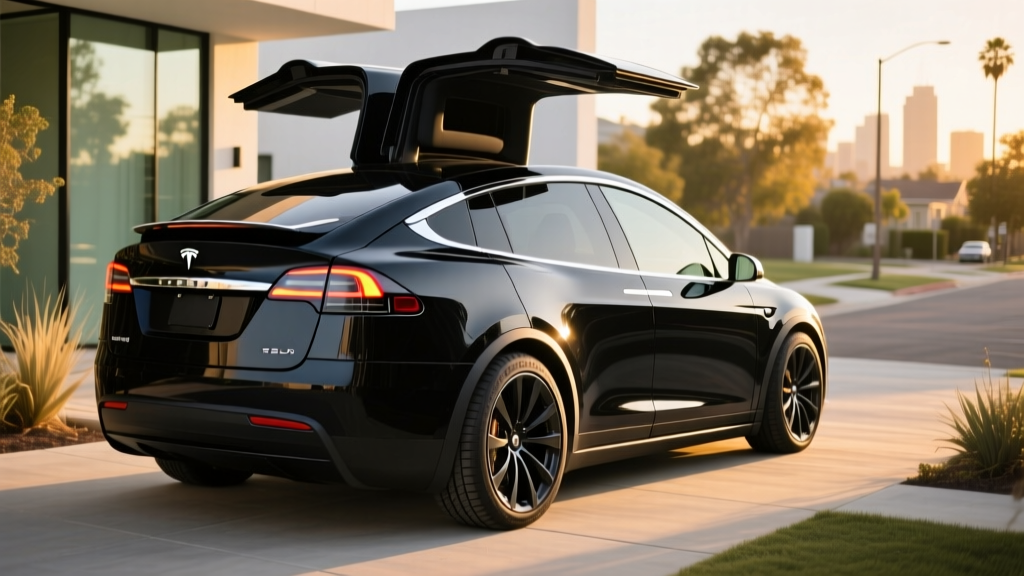
The Falcon Wing doors are the Model X's defining design feature. They open upward in a gullwing motion, providing excellent overhead clearance for loading children into car seats or accessing the second row in tight parking spaces. However, they add weight, mechanical complexity, and potential maintenance cost. The doors use sensors to detect overhead and side obstacles, but in practice, they can be slower to open and close than conventional doors — something to consider if you use parking garages with low clearances regularly.
The 17-inch center touchscreen runs Tesla's latest infotainment software, which includes navigation, streaming media, gaming, and vehicle controls. The yoke steering wheel is standard on the Plaid and optional on the Long Range. A second-row 8-inch touchscreen provides rear passengers with climate and entertainment controls.
Driver Assistance and Autonomous Features
Tesla's Autopilot and Full Self-Driving (Supervised) are SAE Level 2 driver-assistance systems. The driver must remain fully engaged, with hands on the wheel and eyes on the road, at all times. These systems do not make the Model X a self-driving vehicle. Only Level 4 services like Waymo operate without a human driver, and only in geofenced areas.
The Model X comes standard with Basic Autopilot, which includes adaptive cruise control and lane-keeping assist. Tesla's optional Full Self-Driving (Supervised) package ($8,000 as of 2025/2026) adds automatic lane changes, Navigate on Autopilot (highway on/off-ramp handling), Autopark, and Smart Summon. While FSD has improved significantly, it remains a supervised system that requires constant driver attention and can make errors in construction zones, adverse weather, and complex intersections.
Standard active safety features include automatic emergency braking, blind-spot monitoring, side-collision warning, and obstacle-aware acceleration. The Model X has earned a 5-star overall safety rating from NHTSA.
Pros, Cons, and the Verdict
- Class-leading acceleration — 2.5s 0–60 (Plaid) in a 7-seat SUV
- Access to Tesla's Supercharger network — the most reliable DC fast-charging network in the US
- 348-mile EPA range is strong for a vehicle this size
- Falcon Wing doors are genuinely useful for car-seat loading
- Over-the-air updates continuously add features
- 8-year/150,000-mile battery and drive unit warranty
- 5,000-lb towing capacity with trailer hitch included
- 5,185+ lb curb weight drives high tire wear and energy consumption
- 34 kWh/100 mi is inefficient — high per-mile electricity cost
- No federal tax credit due to MSRP cap
- Falcon Wing doors add weight, complexity, and potential repair cost
- Third row is tight for adults
- Yoke steering wheel is polarizing and not ideal for low-speed maneuvering
- Panel gaps and interior material quality lag behind BMW/Mercedes at this price
How It Compares: Model X vs. Rivian R1S vs. BMW iX
The Model X doesn't exist in a vacuum. Here's how its weight and key specs compare to two direct competitors:
| Spec | Tesla Model X LR | Rivian R1S Dual-Motor | BMW iX xDrive50 |
|---|---|---|---|
| Curb Weight | 5,185 lbs | ~6,965 lbs (Max Pack) | ~5,660 lbs |
| EPA Range | 348 mi | 410 mi (Max Pack) | 324 mi |
| 0–60 mph | 3.8 sec | 5.0 sec | 4.4 sec |
| Max DCFC | 250 kW | 220 kW | 200 kW |
| Base MSRP | $79,990 | $79,900 | $87,250 |
| Federal Credit | No (MSRP cap) | Partial/No (varies by config) | No (MSRP cap) |
| Seating | Up to 7 | Up to 7 | 5 only |
The Rivian R1S is heavier but offers more range with its Max Pack and superior off-road capability. The BMW iX is a five-seater with a more luxurious interior but less range and no third row. The Model X occupies a unique niche: the fastest, most tech-forward seven-seat EV with Supercharger access — at the cost of efficiency and build-quality perception.
Who Should Buy the Tesla Model X?
Choose the Model X if:
- You need three rows of seating and want the quickest SUV available
- You road-trip frequently and value the Supercharger network's reliability
- You tow a trailer up to 5,000 lbs and want electric towing range
- You want OTA software updates that add real features over time
- Energy efficiency and per-mile cost are top priorities (consider Model Y or iX)
- You need a true luxury interior at this price point (BMW iX, Mercedes EQS SUV)
- You want federal tax credit eligibility (look at vehicles under $80K SUV cap)
- You don't need 7 seats — a Model Y gives similar tech in a lighter, cheaper package
The weight of a Tesla Model X is both its defining engineering challenge and the reason it delivers such a unique combination of space, speed, and range. At 5,185 pounds, it demands more energy per mile and wears through tires faster than lighter alternatives — but it also carries a 95 kWh battery that delivers 348 miles of EPA-rated range while launching to 60 mph in under four seconds with seven people aboard. No other vehicle on the market offers that specific combination.
Whether that trade-off is worth $79,990+ without a federal tax credit depends entirely on your priorities. If you value speed, Supercharger access, and three-row practicality above all else, the Model X remains singular. If efficiency, luxury fit-and-finish, or credit eligibility top your list, the Rivian R1S, BMW iX, or even Tesla's own Model Y deserve a serious look.
Frequently Asked Questions
What exactly does the Tesla Model X weigh?
The 2025/2026 Tesla Model X Long Range AWD has a curb weight of 5,185 pounds. The Plaid tri-motor variant weighs approximately 5,390 pounds. These figures include the battery pack, which accounts for roughly 1,200–1,500 pounds of the total mass.
Does the Tesla Model X qualify for the $7,500 federal EV tax credit?
Generally, no. Under IRS §30D rules, SUVs must have an MSRP at or below $80,000 to qualify. While the base Long Range MSRP is $79,990, destination fees and any options push most configurations over the cap. Buyer income limits ($300K joint / $150K single) and battery-sourcing requirements also apply. Always verify current eligibility on IRS.gov or with a tax professional.
How fast does the Model X charge on a road trip?
On a Tesla V3 Supercharger, the Model X peaks at 250 kW and charges from 10–80% in approximately 32 minutes. Real-world charging sessions average 150–170 kW due to the charge-curve taper at higher states of charge. Plan for 20–25 minute stops every 200–250 miles on highway trips.
What's the real-world range vs. the EPA estimate?
The EPA rates the Long Range at 348 miles. In real-world highway driving at 70–75 mph, expect 280–310 miles. In freezing temperatures without preconditioning, range can drop to 220–260 miles. City driving with regenerative braking gets you closest to the EPA sticker.
Is the Model X worth buying over the Rivian R1S or BMW iX?
The Model X wins on acceleration (3.8s 0–60), Supercharger network access, and tech-forward features. The Rivian R1S offers superior off-road capability, more range with the Max Pack, and a more rugged build. The BMW iX delivers a more luxurious interior and quieter ride but only seats five. Your choice depends on whether you prioritize performance and charging infrastructure (Model X), adventure capability (R1S), or luxury refinement (iX).
How long will the Model X battery last?
Tesla warranties the battery and drive unit for 8 years or 150,000 miles (whichever comes first), with a guarantee that the battery will retain at least 70% of its original capacity during that period. Real-world data from high-mileage Tesla owners suggests NMC packs typically retain 85–90% capacity at 100,000 miles when charged primarily to 80–90% and not regularly depleted to 0%.