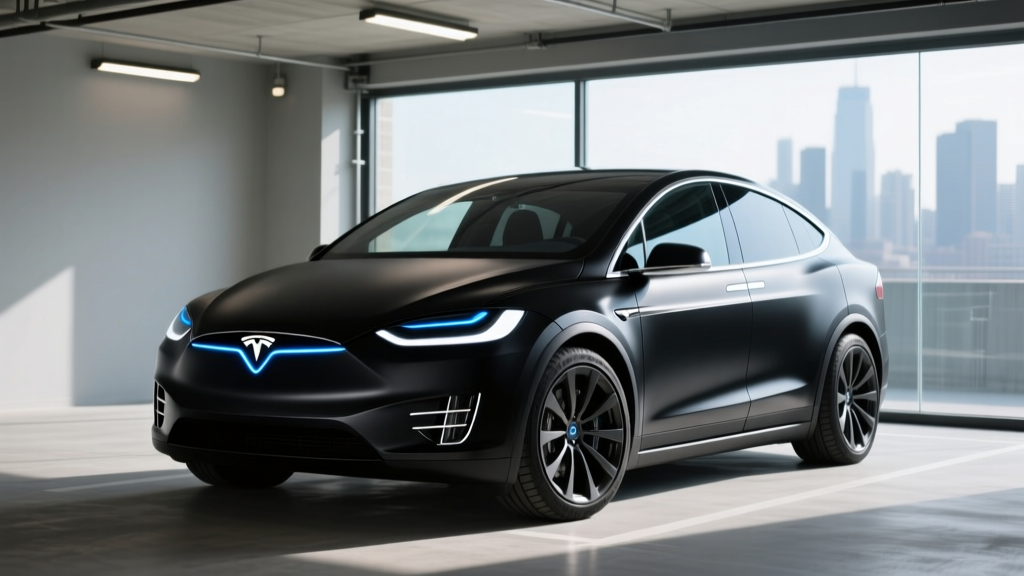
If you've ever stood next to a Tesla Model X in a parking lot, the sheer scale of the thing is unmistakable. The falcon-wing doors swing open, the panoramic windshield stretches overhead, and you get the sense this is a heavy machine. But exactly how much does a Tesla Model X weigh, and what does that mass mean for range, charging, handling, and tire wear? As a three-row electric SUV that doubles as a performance vehicle in Plaid trim, the Model X occupies a unique space — and its curb weight tells a big part of the story.
Below, we break down the 2026 Tesla Model X's weight by trim, then cover everything else a serious buyer needs: real-world range, DC fast-charging curves, battery chemistry, tax credit eligibility, and whether this 5,000-plus-pound SUV is the right electric family hauler for you.
2026 Tesla Model X Curb Weight by Trim
The Model X is built on Tesla's dedicated EV platform with a skateboard battery pack that keeps the center of gravity low despite the vehicle's substantial mass. Curb weight varies meaningfully between the Long Range and Plaid trims due to the Plaid's tri-motor powertrain and additional cooling hardware.
| Specification | Model X Long Range | Model X Plaid |
|---|---|---|
| Curb Weight | 5,185 lbs (2,352 kg) | 5,390 lbs (2,445 kg) |
| Gross Vehicle Weight Rating (GVWR) | 6,768 lbs | 6,768 lbs |
| Drivetrain | Dual-Motor AWD | Tri-Motor AWD |
| Length | 199.1 in | 199.1 in |
| Wheelbase | 116.7 in | 116.7 in |
| Ground Clearance | 8.2 in | 8.2 in |
| Seating | 5, 6, or 7 passengers | 5 or 6 passengers |
For context, the Model X Long Range weighs roughly 600 lbs more than the Model Y Long Range AWD (approximately 4,583 lbs), and the Plaid's 5,390-lb curb weight puts it in the neighborhood of the BMW iX M60 (5,650 lbs) and heavier than the Rivian R1S Dual-Motor (around 5,400 lbs for the Standard battery). That mass has real implications for efficiency, braking distances, and tire consumption — all of which we'll address below.
Battery, Range, and Real-World Efficiency
The 2026 Model X uses a ~100 kWh (usable) battery pack with NMC (nickel manganese cobalt) chemistry across both trims. Tesla does not use LFP (lithium iron phosphate) in the Model X; the higher energy density of NMC is necessary to deliver acceptable range in a vehicle this heavy. LFP's lower energy density makes it better suited to lighter, smaller vehicles like the Model 3 RWD.
Model X Long Range: EPA 335 miles | Real-world highway (~70 mph): ~280–300 miles | Cold weather (below 32°F): ~240–270 miles
Model X Plaid: EPA 311 miles | Real-world highway: ~255–275 miles | Cold weather: ~220–245 miles
The Plaid's tri-motor setup, stickier tires, and 205-lb weight penalty reduce efficiency by roughly 7% versus Long Range. In freezing temperatures, expect a 20–25% range reduction on either trim due to cabin heating demands and increased battery internal resistance.
Efficiency figures from fueleconomy.gov put the Model X Long Range at approximately 102 MPGe combined (33 kWh/100 mi), while the Plaid drops to roughly 98 MPGe combined (34 kWh/100 mi). For a vehicle of this mass, those figures are competitive — the physics of moving 5,185+ lbs simply demand more energy per mile than a sedan.
Charging Speed: DC Fast Charge and Home Level 2
Charging a 100 kWh battery in a 5,200-lb SUV requires both high-power infrastructure and patience. The Model X supports a peak DC fast-charge rate of 250 kW on V3 Superchargers and compatible CCS stations (via the NACS connector, now standard on Tesla vehicles and opening the Supercharger network to other brands).
| Charging Level | Power / Rate | Time or Miles Added |
|---|---|---|
| Level 1 (120V household) | ~1.4 kW | ~3–4 miles per hour |
| Level 2 (240V, 48A Wall Connector) | 11.5 kW | ~34 miles per hour; full charge in ~10 hrs |
| DC Fast Charge (V3 Supercharger) | Peak 250 kW | 10–80% in ~30 min; 175 mi in 15 min |
| DC Fast Charge (V4 Supercharger) | Peak 250 kW (Model X limited) | Similar to V3; V4 hardware supports higher rates for future vehicles |
A critical note on the charge curve: the Model X does not sustain 250 kW for long. Peak rate is achieved roughly between 10–25% State of Charge (SoC), after which the rate tapers progressively. From 50–80%, expect roughly 100–140 kW, and above 80%, charging slows dramatically to protect the NMC cells. This is why Tesla's navigation system will precondition the battery when routing to a Supercharger — warming the pack to optimal temperature so you hit that peak rate immediately upon plugging in. Without preconditioning (for instance, arriving at a charger without navigation routing), you may see peak rates 30–50% lower in cold weather.
For home charging, the Tesla Wall Connector at 48 amps on a 240V/60A circuit delivers 11.5 kW — sufficient to replenish the full pack overnight. Most owners who charge nightly at home never need to visit a public charger except on road trips. Budget $500–$1,500 for a professional Level 2 installation, depending on whether your electrical panel needs an upgrade to support a dedicated 60A circuit.
Performance: 0-60, Horsepower, and Drivetrain
This is where the Model X's weight becomes almost surreal. Despite tipping the scales at over 5,100 lbs, the performance figures rival dedicated sports cars.
| Specification | Long Range | Plaid |
|---|---|---|
| 0–60 mph | 3.8 seconds | 2.5 seconds |
| Top Speed | 155 mph | 163 mph |
| Horsepower | 670 hp | 1,020 hp |
| Drivetrain | Dual-Motor AWD | Tri-Motor AWD |
| Towing Capacity | 5,000 lbs | 5,000 lbs |
The Plaid's tri-motor configuration uses one motor on the front axle and two on the rear, enabling torque vectoring and the kind of launch control that pins you into the seat. That 2.5-second 0-60 time in a 5,390-lb three-row SUV remains one of the most absurd demonstrations of electric powertrain capability on the market. However, the Plaid's additional mass and performance hardware mean slightly shorter brake-pad life and faster tire wear — budget accordingly.
Pricing, Trims, and Federal Tax Credit Eligibility
The Model X has never been a budget vehicle, and the 2026 model year continues that tradition. Here's the current pricing structure:
| Trim | Base MSRP | Typical As-Tested (with options) |
|---|---|---|
| Long Range | $79,990 | $85,000–$92,000 |
| Plaid | $94,990 | $100,000–$110,000 |
Options that push the price up include the six- or seven-seat interior configurations, 22-inch Turbine wheels, enhanced Autopilot or Full Self-Driving (Supervised) packages, and premium paint colors.
The Tesla Model X does not qualify for the $7,500 federal EV tax credit under current IRS §30D rules. Here's why:
- MSRP Cap: The §30D credit applies only to SUVs with an MSRP at or below $80,000. The Model X Long Range at $79,990 technically meets this cap, but any factory options or destination charges that push the sticker above $80,000 disqualify it.
- Buyer Income Cap: Modified adjusted gross income must not exceed $300,000 (joint filers), $225,000 (head of household), or $150,000 (individual).
- Battery Sourcing: Critical minerals and battery component sourcing requirements must be met — Tesla's supply chain compliance varies by production batch and model year. Verify current eligibility on the IRS clean vehicle credit page before purchasing.
Bottom line: Most Model X buyers should not count on the $7,500 credit. Consult a tax professional and check the fueleconomy.gov credit lookup for the specific VIN you're considering.
Cargo, Passenger Space, and Daily Practicality
The Model X's weight partly comes from its generous dimensions. This is a genuine three-row SUV with meaningful cargo volume.
| Measurement | Specification |
|---|---|
| Cargo Volume (behind 3rd row) | ~15.8 cu ft |
| Cargo Volume (3rd row folded) | ~41.1 cu ft |
| Cargo Volume (all rear seats folded) | ~77.5 cu ft |
| Front Trunk (Frunk) | ~6.5 cu ft |
| Front Legroom | 41.2 in |
| Second-Row Legroom | 38.4 in |
| Third-Row Legroom | 32.7 in |
The falcon-wing rear doors are the Model X's signature feature — they open vertically, providing excellent access to the second and third rows in tight parking spaces. However, they require overhead clearance (check your garage height) and are more complex mechanically than conventional doors, which is a long-term reliability consideration. The third row is best suited for children or occasional adult use on shorter trips; legroom is tight for anyone over 5'8".
Tech, Driver Assistance, and Notable Drawbacks
The Model X comes standard with Tesla's 17-inch center touchscreen, a 22-speaker audio system, HEPA air filtration with Bioweapon Defense Mode, and the yoke-style steering wheel (a conventional round wheel is available at no cost). The rear passengers get their own 8-inch touchscreen for climate and entertainment controls.
Tesla Autopilot and Full Self-Driving (Supervised) are SAE Level 2 driver-assistance systems. They require the driver to remain fully attentive, with hands on the wheel and eyes on the road at all times. These systems are not self-driving. Only Level 4 robotaxi services like Waymo operate without a human driver. Never treat Autopilot or FSD as a substitute for active driving supervision.
Standout tech: The Supercharger network remains the most reliable and extensive DC fast-charging network in North America. Over-the-air updates continuously add features. The panoramic windshield offers an unmatched sense of openness. Gaming and streaming capability on the center screen is best-in-class.
- Class-leading Supercharger access and charging infrastructure
- Absurd performance (Plaid: 2.5s 0-60 in a 3-row SUV)
- Falcon-wing doors ease child-seat and third-row access
- 5,000-lb towing capacity
- Over-the-air updates keep software current
- Spacious cargo area with flat-load floor
- Heavy: 5,185–5,390 lbs increases tire wear and energy consumption
- Most buyers won't qualify for the $7,500 federal tax credit
- Falcon-wing doors add mechanical complexity and potential repair cost
- Third row is cramped for adults on long trips
- Panel gaps and interior fit/finish lag behind BMW iX and Mercedes EQS SUV
- Yoke steering takes significant adaptation (round wheel available)
- High insurance premiums relative to competitors
How the Model X Compares to Key Rivals
The luxury three-row EV SUV segment has matured considerably. Here's how the Model X stacks up against its most direct competitors on the metrics that matter:
| Metric | Tesla Model X LR | BMW iX xDrive50 | Rivian R1S Dual-Motor | Mercedes EQS 580 SUV |
|---|---|---|---|---|
| Curb Weight | 5,185 lbs | 5,650 lbs | ~5,400 lbs | 5,888 lbs |
| EPA Range | 335 mi | 324 mi | ~330 mi | 305 mi |
| 0–60 mph | 3.8s | 4.4s | 5.0s | 4.3s |
| Base MSRP | $79,990 | $87,250 | $79,900 | $105,550 |
| Third Row | Yes (optional) | No | Yes (standard) | Yes (optional) |
| Towing | 5,000 lbs | 3,500 lbs | 7,700 lbs | 3,500 lbs |
The Model X wins on performance and charging infrastructure. The Rivian R1S is the clear choice for serious towing and off-road capability. The BMW iX and Mercedes EQS SUV deliver significantly better interior materials and ride refinement but sacrifice the third row (iX) or charge a steep premium (EQS).
Battery and Vehicle Warranty
Tesla provides an 8-year/150,000-mile battery and drive unit warranty on the Model X, with a minimum 70% capacity retention threshold over that period. The basic vehicle limited warranty covers 4 years or 50,000 miles. Given the NMC chemistry and the vehicle's mass (which puts more stress on the drivetrain), the 150,000-mile battery coverage is competitive and reflects Tesla's confidence in its thermal management system. For long-term ownership beyond the warranty period, an NMC pack replacement currently runs $15,000–$22,000 depending on the service center and pack availability — a figure worth factoring into 10-year cost projections.
Who Should Buy the 2026 Tesla Model X?
- You need three rows and frequent Supercharger road trips are part of your life
- You want sports-car acceleration in a family SUV (Plaid)
- You tow a small trailer or boat (5,000-lb capacity)
- Falcon-wing doors solve a real access problem in your garage or parking routine
- You need serious off-road or heavy-towing capability → Rivian R1S
- Interior luxury and ride comfort are top priorities → BMW iX or Mercedes EQS SUV
- You want the $7,500 federal tax credit and your budget is under $80K → Model Y, Ioniq 5, or EV6
- Third-row use is rare and you'd prefer a lighter, more efficient two-row SUV → Model Y or iX
Frequently Asked Questions
What is the real-world range of the Tesla Model X?
The EPA rates the Long Range at 335 miles and the Plaid at 311 miles. In real-world highway driving at 70 mph, expect roughly 280–300 miles (Long Range) or 255–275 miles (Plaid). In freezing temperatures, those figures drop another 20–25% due to cabin heating and battery resistance.
How fast does the Model X charge at home and on the road?
At home on a Level 2 Wall Connector (11.5 kW), you'll add about 34 miles per hour, fully charging overnight. On a V3 Supercharger at peak 250 kW, you can go from 10–80% in approximately 30 minutes, though the charge curve tapers significantly above 50% SoC.
Does the Tesla Model X qualify for the federal EV tax credit?
It's complicated. The Long Range's $79,990 MSRP barely meets the $80,000 SUV cap, but any options that push the sticker above $80,000 disqualify it. The Plaid at $94,990 is well above the cap and never qualifies. Income limits and battery-sourcing requirements add further restrictions. Verify with the IRS and a tax professional before assuming eligibility.
Is the Model X worth buying versus the Rivian R1S or BMW iX?
It depends on your priorities. The Model X leads in charging infrastructure (Supercharger network), acceleration, and tech features. The R1S dominates in towing (7,700 lbs) and off-road ability. The iX wins on ride quality and interior refinement. Test-drive all three before deciding.
Why does the Tesla Model X weigh so much?
The 5,185–5,390 lb curb weight comes from the large ~100 kWh NMC battery pack (which alone weighs roughly 1,200 lbs), the aluminum and steel body structure needed for a three-row SUV, the falcon-wing door mechanisms, and in the Plaid, the tri-motor powertrain with enhanced cooling. The low-mounted battery keeps the center of gravity down, which helps handling, but the mass still impacts tire wear, braking distance, and energy consumption per mile.
How long will the Model X battery last?
Tesla warranties the battery for 8 years or 150,000 miles with at least 70% capacity retention. Real-world data from high-mileage Teslas suggests NMC packs typically retain 80–85% capacity at 150,000 miles when properly maintained — meaning avoiding frequent 100% charges and excessive DC fast charging. Daily charging to 80–90% is recommended for NMC chemistry.