The Tesla Model X has been the polarizing, falcon-winged patriarch of the electric SUV segment since 2015. For 2026, it soldiers on with a refreshed interior, the yoke-or-wheel debate settled (you can have either), and a price tag that still starts above $79,000. But for buyers researching the Tesla Model X trunk space and overall practicality, the real question is whether this three-row electric SUV still justifies its premium against newer rivals like the Rivian R1S, BMW iX, and the three-row Kia EV9.
This review covers the 2026 Model X lineup—Long Range AWD and Plaid—with exact specs on cargo volume, range, charging, pricing, and federal tax-credit eligibility under current IRS §30D rules.
2026 Tesla Model X Trunk Space and Cargo Dimensions
The Model X's cargo story is defined by two numbers and one gimmick. Behind the third row, you get 13.7 cubic feet of space—tight for a vehicle with a 109.8-inch wheelbase. Fold the third row flat (a 60/40 split is standard), and volume expands to 43.9 cubic feet. Drop both rear rows and the Model X reveals its party trick: 88.1 cubic feet of total cargo capacity, aided by a deep sub-trunk well that many competitors lack.
The front trunk (frunk) adds 6.5 cubic feet of enclosed storage—enough for a charging cable bag, a small cooler, or a gym duffel. The frunk on the Model X is power-operated and latched via the touchscreen or app, which is handy but slower than a simple manual release.
| Configuration | Cargo Volume | Real-World Fit |
|---|---|---|
| Behind 3rd row (all seats up) | 13.7 cu ft | 2 carry-on suitcases + a few grocery bags |
| 3rd row folded, 2nd row up | 43.9 cu ft | Stroller, 4 large suitcases, or a week of family gear |
| 2nd & 3rd rows folded | 88.1 cu ft | Furniture, bikes (wheels on), or full camping loadout |
| Front trunk (frunk) | 6.5 cu ft | Charging cables, small cooler, gym bag |
Compared to the Rivian R1S (which offers 17.6 cu ft behind its third row in the dual-motor config, expanding to 104.7 cu ft max), the Model X gives up some third-row-up utility. The Kia EV9 provides 20.2 cu ft behind the third row and 81.7 cu ft max—less total volume but better day-to-day usability with all seats occupied. If you regularly haul six passengers and luggage, the Model X's 13.7 cu ft will feel constrained. If the third row is occasional-use and usually folded, the 43.9/88.1 cu ft split is genuinely useful.
EPA Range, Battery, and Real-World Efficiency
Both trims use a 100 kWh battery pack (approximately 95 kWh usable) with NMC (nickel manganese cobalt) chemistry. Tesla does not offer an LFP option in the Model X—LFP is reserved for the standard-range Model 3 and Model Y. NMC provides higher energy density, which matters in a heavy 5,185-lb SUV, but it also means Tesla recommends charging to 80% for daily use and 100% only for long trips.
| Spec | Long Range AWD | Plaid |
|---|---|---|
| EPA Range | 326 miles | 326 mi (20") / 285 mi (22") |
| Battery (usable) | ~95 kWh, NMC | ~95 kWh, NMC |
| Horsepower | 670 hp | 1,020 hp |
| 0-60 mph | 3.8 seconds | 2.5 seconds |
| Top Speed | 155 mph | 163 mph |
| Drivetrain | Dual-motor AWD | Tri-motor AWD |
| MPGe (combined) | 98 MPGe | 93 MPGe |
| Efficiency | 34 kWh/100 mi | 36 kWh/100 mi |
| Curb Weight | 5,185 lbs | 5,390 lbs |
| Towing Capacity | 5,000 lbs | 5,000 lbs |
| Base MSRP | $79,990 | $94,990 |
The Model X's 98 MPGe combined (Long Range) translates to roughly 34 kWh per 100 miles, per fueleconomy.gov. That's average for a large electric SUV—the Rivian R1S dual-motor achieves 97 MPGe, while the lighter BMW iX xDrive50 posts 86 MPGe combined. For cost context, at the U.S. average electricity rate of ~$0.17/kWh, charging the Model X from 0-100% costs roughly $16.15 at home, or about $0.055 per mile.
Charging Speed: DC Fast and Home Level 2
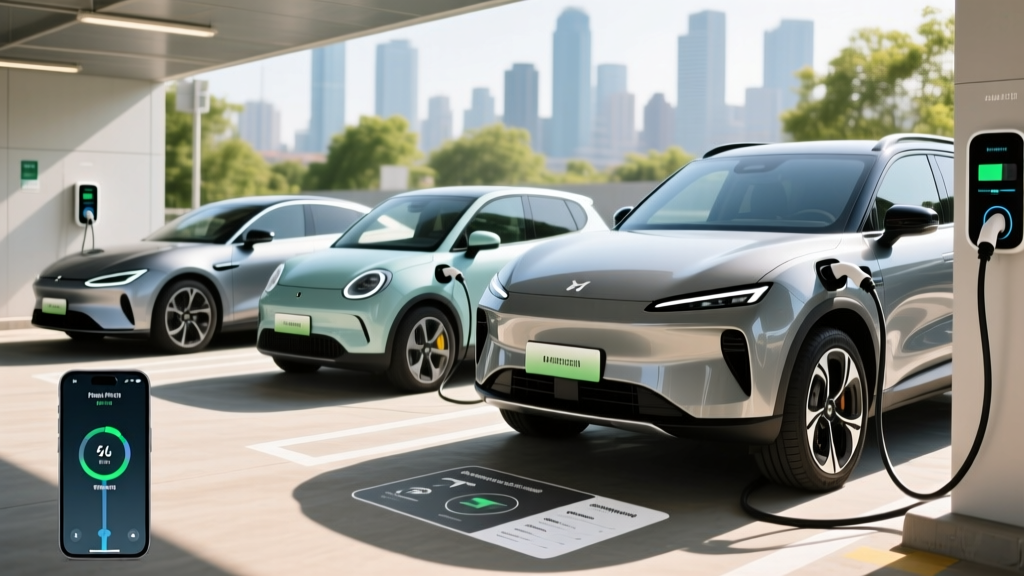
The 2026 Model X supports a maximum DC fast-charge rate of 250 kW on Tesla's V3 Supercharger network and compatible CCS stations (via the NACS port, which is now standard). Tesla quotes a 10-80% charge time of approximately 30 minutes under ideal conditions.
| Charging Method | Power / Rate | Time or Miles Added |
|---|---|---|
| DC Fast Charge (Tesla V3 Supercharger) | Peak 250 kW | 10-80% in ~30 min; ~175 mi in 15 min |
| DC Fast Charge (CCS adapter, 350 kW station) | Limited to 250 kW | Same as V3 Supercharger |
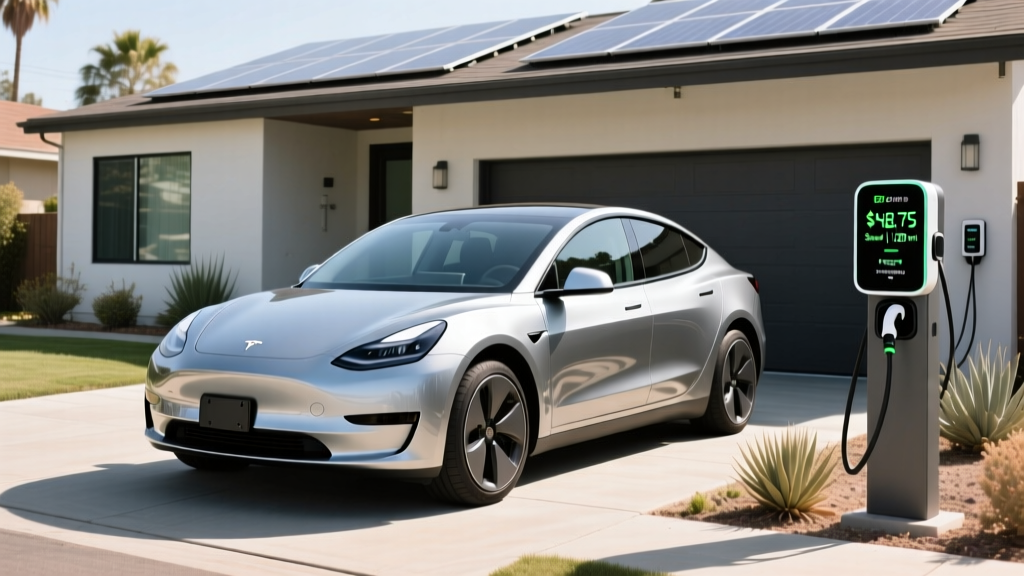
| Home Level 2 (Tesla Wall Connector, 48A/11.5 kW) | 11.5 kW | ~34 miles per hour of charging; 0-100% in ~9 hrs |
| Home Level 2 (32A / 7.7 kW outlet) | 7.7 kW | ~23 miles per hour; 0-100% in ~13 hrs |
| Level 1 (120V standard outlet) | ~1.4 kW | ~4 miles per hour; emergency/top-up only |
For daily ownership, a Tesla Wall Connector on a 60-amp circuit (48 amps continuous) is the sweet spot, adding roughly 34 miles of range per hour. Most owners who plug in overnight return to a full or near-full battery every morning. The Model X's onboard charger accepts up to 11.5 kW on Level 2 AC.
Interior, Tech, and the Falcon Wing Doors
The 2026 Model X interior centers on a 17-inch touchscreen (now tilted toward the driver in a revised center console), a 12.3-inch digital instrument cluster, and a second 8-inch rear entertainment screen for second-row passengers. The infotainment system runs Tesla's proprietary OS—no Apple CarPlay or Android Auto, but native navigation, Spotify, Netflix (while parked), and a surprisingly good 22-speaker audio system.
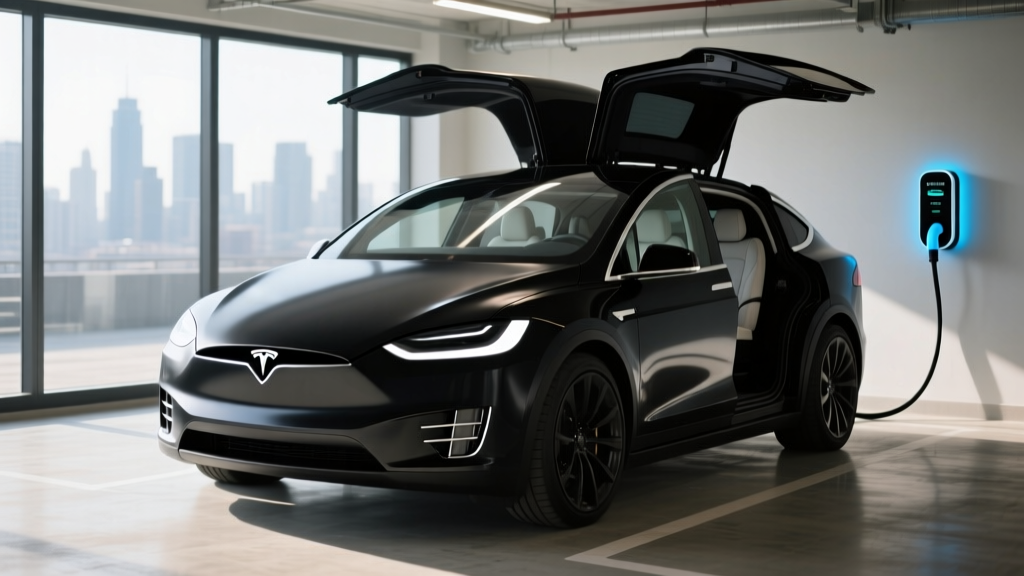
The signature falcon wing rear doors remain the Model X's most polarizing feature. They open upward with dual hinges, requiring only about 12 inches of lateral clearance—genuinely useful in tight parking spaces and excellent for loading children into car seats. However, they are slower to open/close than conventional doors (~6-7 seconds), can struggle in heavy rain (water drips into the cabin as they fold), and their ultrasonic sensors occasionally misread low overhangs or roof racks. They are also a known maintenance item: hinge mechanisms and sensors have been a warranty claim source historically.
Other standout features include:
- Panoramic windshield extending over the front seats—massive, tinted, and no shade included (aftermarket shades are a popular accessory)
- HEPA air filtration with "Bioweapon Defense Mode"—legitimately excellent cabin air quality
- Power-folding second-row seats (on six-seat config) that slide and recline
- Yoke or round steering wheel—your choice at order, no upcharge
Pricing, Tax Credits, and Ownership Costs
The 2026 Tesla Model X starts at $79,990 for the Long Range AWD (before destination). The Plaid starts at $94,990. Key options include:
- Seven-seat configuration: $0 (standard on Long Range; six-seat with captain's chairs is a no-cost alternative)
- Full Self-Driving (Supervised): $8,000 one-time or $99/month
- Premium paint colors: $1,500-$2,500
- 22-inch Turbine wheels (Plaid): $4,500 (reduces range to 285 mi)
| Trim | Base MSRP | Destination | Typical As-Tested |
|---|---|---|---|
| Long Range AWD | $79,990 | $1,390 | $83,000-$88,000 |
| Plaid (Tri-Motor AWD) | $94,990 | $1,390 | $99,000-$107,000 |
Warranty coverage includes:
- Basic vehicle: 4 years / 50,000 miles
- Battery and drive unit: 8 years / 150,000 miles (whichever comes first, with minimum 70% battery capacity retention)
The 150,000-mile battery warranty is competitive. Tesla guarantees the pack will retain at least 70% of its original capacity during the warranty period. Real-world degradation data from Tesla's fleet suggests most Model X packs retain ~88-92% capacity at 100,000 miles, though early 2016-2018 models experienced higher degradation rates and some required replacements under warranty.
Driving Experience and Autopilot
The Model X Long Range's 670 hp and 3.8-second 0-60 time make it absurdly quick for a 5,185-lb family hauler. The Plaid's 1,020 hp and 2.5-second 0-60 is supercar territory, though the weight is felt in corners—this is a straight-line performer, not a canyon carver. The adaptive air suspension provides a comfortable highway ride with adjustable height (useful for scraping clearance or aero efficiency), and the cabin remains impressively quiet at speed.
Standard Autopilot includes traffic-aware cruise control and autosteer (lane centering) on highways. It works well on well-marked interstates. FSD Supervised adds more ambitious capabilities but introduces more situations requiring driver takeover. For most buyers, standard Autopilot is sufficient; FSD remains an optional convenience feature, not a necessity.
Pros and Cons
Pros
- Best-in-class Supercharger network access (17,000+ V3/V4 stalls in North America)
- 88.1 cu ft max cargo volume with a usable frunk
- Falcon wing doors genuinely ease child-seat loading
- Class-leading acceleration in both trims
- Over-the-air updates continue to add features years after purchase
- Strong 8-yr/150,000-mi battery warranty
- 5,000-lb towing capacity (with tow package)
Cons
- Only 13.7 cu ft behind the third row—tight for daily use with 6-7 passengers
- Does not reliably qualify for the $7,500 federal tax credit
- No Apple CarPlay or Android Auto
- Falcon wing doors: slower, noisier, potential maintenance liability
- Panel gaps and interior material quality still trail BMW/Mercedes at this price
- 250 kW peak DC charging is outpaced by Hyundai/Kia's 350 kW E-GMP platform
- FSD ($8,000) is optional and still requires full driver attention
Is the 2026 Tesla Model X Worth It vs. Competitors?
The Model X occupies a specific niche: a three-row electric SUV with exotic acceleration, unmatched charging-network access, and polarizing design. Here's how it stacks up:
Choose the Model X if: You value Supercharger network reliability for frequent road trips, want tri-motor Plaid performance, need falcon wing doors for tight-space child loading, and prioritize Tesla's software ecosystem.
Choose the Rivian R1S if: You need more third-row-up cargo space (17.6 cu ft), want genuine off-road capability, prefer a more conventional SUV design, and value Rivian's adventure-oriented build quality. The R1S Dual-Motor starts around $75,900 with ~330 miles of range.
Choose the Kia EV9 if: Budget is a primary concern (starts ~$54,900), you want 800V architecture for 350 kW DC charging, and you need competitive third-row space. The EV9 GT-Line AWD offers ~270 miles of range at roughly $30,000 less than the Model X.
Choose the BMW iX if: You only need two rows, prioritize interior luxury and ride refinement, and want a quieter, more traditionally premium experience. The iX xDrive50 starts ~$87,250 with 324 miles of range.
Frequently Asked Questions
How much trunk space does the Tesla Model X have with all seats up?
With all three rows in use, the Model X provides 13.7 cubic feet of cargo space behind the third row. This fits roughly two carry-on suitcases and a few soft bags. The additional 6.5 cu ft frunk helps offset this for smaller items.
What is the real-world highway range of the Model X Long Range?
While the EPA rates the Long Range AWD at 326 miles, sustained highway driving at 70-75 mph in moderate temperatures typically yields 270-290 miles. In cold weather (below 30°F), expect 210-240 miles. City driving with regenerative braking often matches or slightly exceeds the EPA figure.
Does the 2026 Model X qualify for the $7,500 federal tax credit?
Generally, no. The Model X's MSRP frequently exceeds the $80,000 SUV cap for §30D eligibility, and battery-sourcing requirements add further complexity. The base Long Range at $79,990 is technically under the cap, but adding any options pushes it over. Always verify on the IRS Clean Vehicle page and consult a tax professional.
How fast does the Model X charge at a Supercharger?
The Model X peaks at 250 kW on a V3 Supercharger, achieving a 10-80% charge in approximately 30 minutes. The peak rate only sustains from ~10-30% SoC; above 50%, charging tapers significantly. Always navigate to the Supercharger using the car's built-in navigation to precondition the battery for optimal speeds.
Is the Model X a good family SUV for road trips?
Yes, with caveats. The Supercharger network makes long-distance travel straightforward, the 326-mile EPA range covers most legs between stops, and the cabin is spacious for passengers. However, third-row-up cargo space is limited for family luggage, and the falcon wing doors can be slow in drive-through lanes or heavy rain. If you take frequent six-passenger road trips, the Rivian R1S offers better cargo flexibility.
What is the battery warranty on the Tesla Model X?
Tesla covers the Model X battery and drive unit for 8 years or 150,000 miles, whichever comes first, with a guaranteed minimum 70% capacity retention. This is one of the more generous battery warranties in the segment, matching or exceeding most competitors.