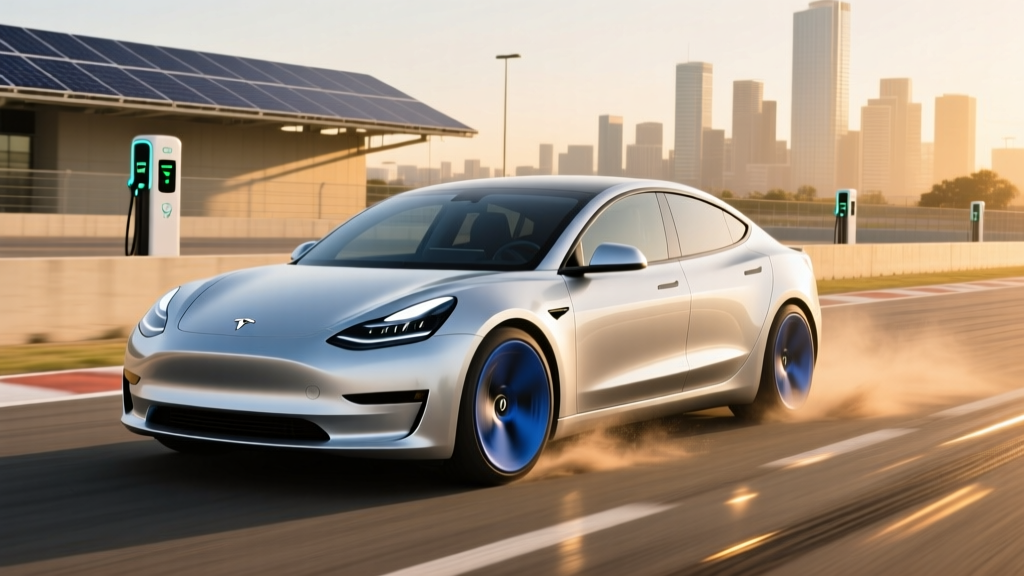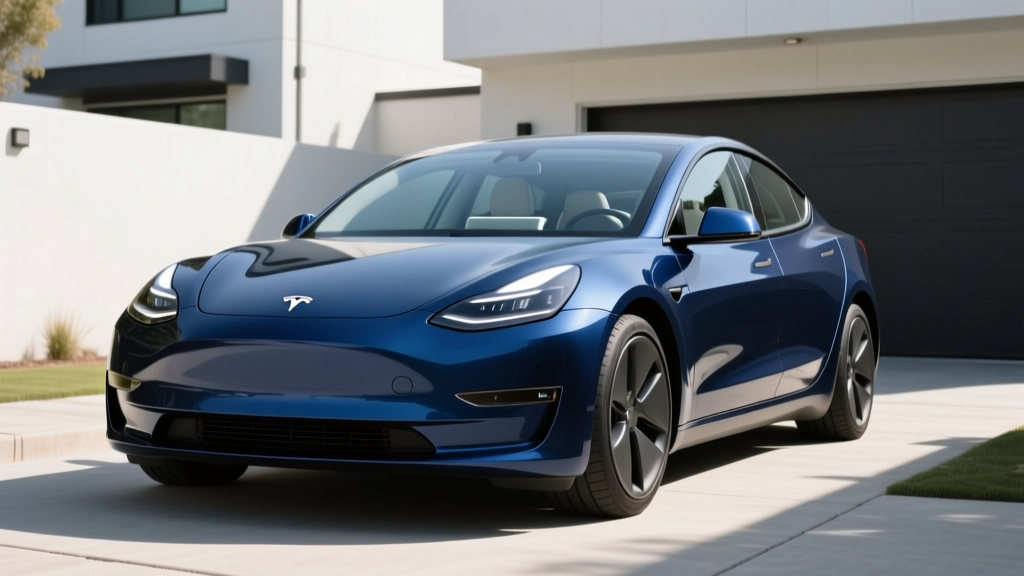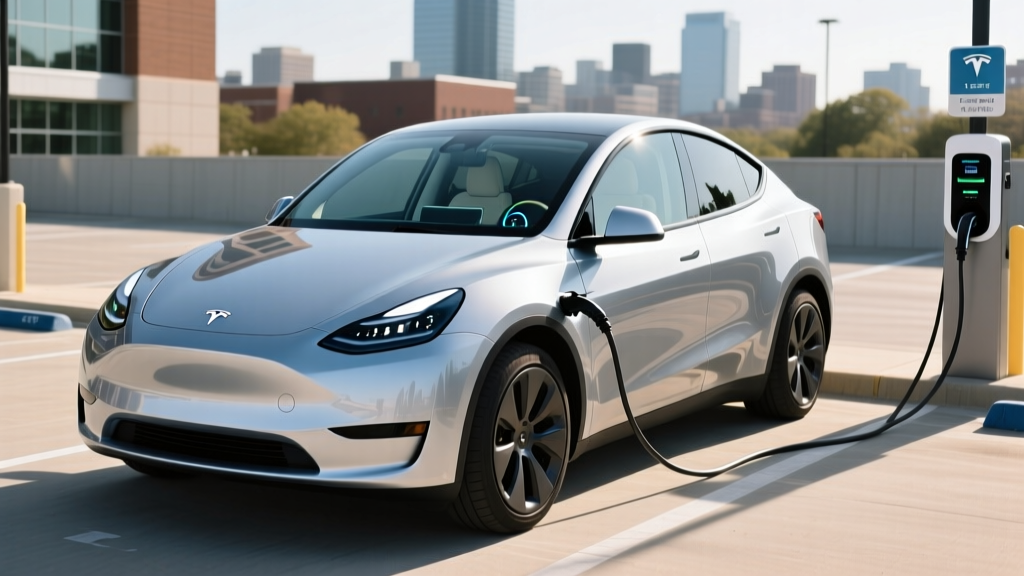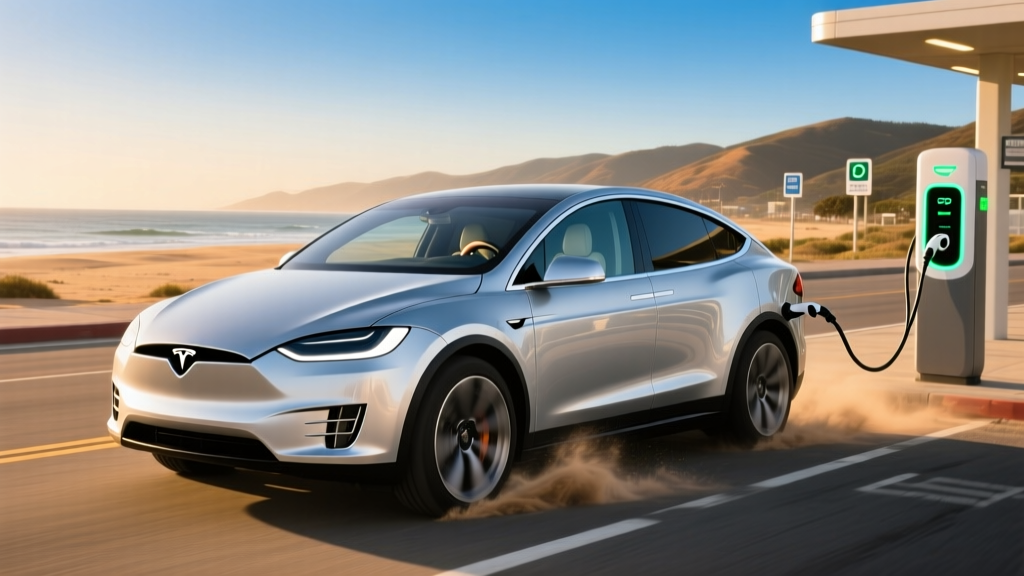
The Tesla Model X occupies a rare position in the EV market: a three-row, falcon-wing-door SUV that can also pull a trailer. For 2026, the Model X continues to offer a 5,000-pound maximum towing capacity — enough for a light camper, a pair of personal watercraft, or a small horse trailer — while delivering up to 335 miles of EPA-estimated range in Long Range trim. But towing with an EV is fundamentally different from towing with a gas truck, and the Model X's efficiency, charging speed, and real-world range all shift dramatically when a load is hitched behind it.
This review covers every number a prospective buyer needs — from battery chemistry and DC fast-charging curves to tax-credit eligibility and the real cost of ownership — with a specific focus on how the Model X performs when asked to tow.
Spec Snapshot: 2026 Tesla Model X at a Glance
| Specification | Long Range (Dual-Motor AWD) | Plaid (Tri-Motor AWD) |
|---|---|---|
| EPA Range | 335 miles | 326 miles |
| Battery (usable) | ~100 kWh (NMC) | ~100 kWh (NMC) |
| Horsepower | 670 hp | 1,020 hp |
| 0–60 mph | 3.8 seconds | 2.5 seconds |
| Top Speed | 155 mph | 163 mph |
| Drivetrain | Dual-Motor AWD | Tri-Motor AWD |
| Max Towing Capacity | 5,000 lbs | 5,000 lbs |
| Max DC Fast Charge | 250 kW | 250 kW |
| 10–80% DC Charge | ~30 minutes | ~30 minutes |
| Level 2 Charge Rate | 11.5 kW (~34 mi/hr) | 11.5 kW (~34 mi/hr) |
| EPA Efficiency | 100 MPGe (combined) | 98 MPGe (combined) |
| Energy Consumption | 34 kWh/100 mi | 35 kWh/100 mi |
| Seating | 5, 6, or 7 passengers | 5 or 6 passengers |
| Cargo (behind 3rd row) | 15.0 cu ft | 15.0 cu ft |
| Cargo (max, seats folded) | 85.1 cu ft | 85.1 cu ft |
| Base MSRP | $79,990 | $94,990 |
| Battery/Drive Unit Warranty | 8 yr / 150,000 mi | 8 yr / 150,000 mi |
Tesla Model X Towing Capacity: The 5,000-lb Reality
Both the Long Range and Plaid trims of the 2026 Model X share a maximum towing capacity of 5,000 pounds when equipped with the factory tow package ($1,000 option). This package includes a 2-inch hitch receiver, integrated trailer brake controller wiring, and Tesla's trailer stability software, which uses the vehicle's individual wheel braking to mitigate trailer sway.
How does that 5,000-lb figure compare to the broader market?
- Rivian R1S (Dual-Motor): 7,700 lbs
- Ford F-150 Lightning: 7,700–10,000 lbs (depending on battery/config)
- BMW iX xDrive50: 3,500 lbs
- Mercedes EQS SUV: 3,500 lbs
- Kia EV9 (GT-Line AWD): 5,000 lbs
The Model X sits squarely in the middle of the pack. It out-tows luxury crossover rivals like the iX and EQS SUV but falls well short of the truck-based Rivian R1S and F-150 Lightning. For most recreational use cases — a 3,500-lb travel trailer, a boat on a single-axle trailer, or a utility trailer loaded with landscaping equipment — 5,000 lbs is adequate. It is not, however, a heavy-duty hauler.
The Range Penalty: Towing With an EV
This is where every EV owner towing a trailer confronts physics. The Model X's aerodynamic advantage — its slippery 0.24 Cd coefficient — is partially negated by a boxy trailer creating a low-pressure wake behind the SUV. In real-world towing tests conducted by independent EV reviewers, range reductions of 40–55% are typical when pulling a 3,000–5,000-lb enclosed trailer at highway speeds.
The practical implication: if your typical towing route has DC fast chargers every 120–150 miles, the Model X is workable. If you're pulling a camper through rural Montana with 200-mile gaps between chargers, you'll need a different strategy — or a different vehicle.
Battery, Chemistry & Long-Term Durability
The 2026 Model X uses an NMC (nickel-manganese-cobalt) lithium-ion battery pack with approximately 100 kWh of usable capacity. Tesla does not publish exact pack-level kWh figures, but independent teardown data and EPA test-cycle calculations consistently point to this number.
Why NMC and not LFP (lithium iron phosphate)? Tesla reserves its LFP chemistry for the standard-range Model 3 and Model Y rear-wheel-drive variants. The Model X, with its heavy curb weight (~5,100 lbs Long Range) and performance targets, requires the higher energy density of NMC cells to achieve 335 miles of range in a package that still fits within the vehicle's floorpan.
NMC trade-offs to understand:
- Higher energy density than LFP — necessary for a large, heavy SUV
- More sensitive to sustained 100% state-of-charge storage; Tesla recommends daily charging to 80–90%
- Typical long-term degradation of 10–15% over 150,000 miles based on aggregated owner fleet data
- Thermal management is critical — the Model X's active liquid cooling system handles this well
Tesla covers the battery and drive units with an 8-year / 150,000-mile warranty (whichever comes first), with a guaranteed minimum capacity retention of 70%. This is among the more generous powertrain warranties in the EV segment, though Rivian matches it at 8 yr / 175,000 mi for its R1S battery.
Charging Speed: DC Fast Charging & Home Level 2
Charging speed is arguably the most consequential spec for any EV used for towing, because the reduced range means more frequent stops. The Model X's 250 kW peak DC fast-charge capability on V3 Superchargers is competent but no longer class-leading in 2026 — Hyundai's Ioniq 5 peaks at 350 kW, and the Porsche Macan EV reaches 270 kW on an 800-volt architecture.
| Charging Level | Power / Voltage | Speed (miles added) | Time |
|---|---|---|---|
| Level 1 (120V household) | ~1.4 kW | ~3–4 mi/hr | ~30+ hours for full charge |
| Level 2 (240V, 48A Wall Connector) | 11.5 kW | ~34 mi/hr | ~10 hours (10–100%) |
| DC Fast Charge (V3 Supercharger) | 250 kW peak | ~175 mi in 15 min | 10–80% in ~30 min |
| DC Fast Charge (CCS adapter at EA/others) | Up to 150 kW (varies) | ~100 mi in 15 min | 10–80% in ~40–45 min |
Charge curve reality check: The Model X does not sustain 250 kW for the entire 10–80% session. Peak power is achieved between approximately 10–30% state of charge, after which the rate tapers progressively. The 10–80% session averages closer to 150–170 kW. This is typical for 400-volt-architecture NMC packs and is why the total 10–80% time is ~30 minutes rather than the ~22 minutes a sustained 250 kW rate would theoretically deliver.
For home charging, Tesla's Wall Connector at 48 amps delivers 11.5 kW on a 240-volt / 60-amp circuit. This adds roughly 34 miles of range per hour and will fully replenish the Model X overnight in about 10 hours — more than adequate for daily use. Installation costs for a dedicated 60-amp circuit typically range from $800 to $2,000 depending on panel proximity and local permitting, though a panel upgrade to 200A service can add $1,500–$3,000 if your home's electrical panel is older or undersized.
Performance: 0–60, Powertrain & Ride Quality
The dual-motor Long Range Model X produces 670 horsepower and reaches 60 mph in 3.8 seconds — quick by any measure, and remarkably so for a 5,100-lb three-row SUV. The tri-motor Plaid variant is in supercar territory at 2.5 seconds and 1,020 hp, though its real-world utility is identical to the Long Range at a $15,000 premium.
Both trims use Tesla's adaptive air suspension, which provides up to 5.5 inches of ground clearance adjustment (from 5.4 to 10.9 inches). This is useful for clearing steep driveways or rough trailhead roads, though the Model X is not designed for off-road use. The suspension firms up noticeably in sport mode and handles highway transitions competently, but the ride quality over sharp impacts is less refined than the BMW iX or Mercedes EQS SUV.
Towing-specific performance note: The instant torque delivery of electric motors is a genuine advantage when merging onto highways with a trailer — there's no downshift delay or turbo lag. The Model X's dual-motor AWD system provides confident traction on wet boat ramps. However, the regenerative braking system, while effective for daily driving, requires the integrated trailer brake controller to handle heavier loads on downhill grades. Always use the trailer brakes; do not rely on regen alone with a loaded trailer.
Interior, Cargo & Technology
The Model X interior remains one of the most debated designs in the segment. The 17-inch center touchscreen is the largest in its class and handles navigation, media, climate, and vehicle settings with responsive performance. The optional yoke steering wheel ($1,000) continues to polarize — some owners appreciate the unobstructed instrument display view, while others find it impractical for low-speed maneuvering and three-point turns.
Passenger and cargo dimensions:
- Front legroom: 41.2 inches
- Second-row legroom: 41.0 inches
- Third-row legroom: 32.7 inches (tight for adults on longer trips)
- Cargo behind 3rd row: 15.0 cu ft
- Cargo behind 2nd row (3rd row folded): 40.0 cu ft
- Max cargo (all rear seats folded): 85.1 cu ft
- Front trunk (frunk): 6.6 cu ft — useful for charging cables and small bags
The falcon-wing rear doors are the Model X's most recognizable feature. They open upward on dual hinges, providing excellent access to the second and third rows in tight parking spaces — but they are slower to open and close than conventional doors (approximately 6–7 seconds for a full cycle), and they can be problematic in low-ceiling garages despite their ultrasonic obstacle sensors. In heavy rain, the upward-opening design means less water ingress into the cabin compared to sliding minivan doors, but the door seals and actuators have historically been a maintenance concern in earlier model years.
Driver assistance: The Model X comes standard with Tesla's Basic Autopilot (adaptive cruise control and lane centering), which is an SAE Level 2 driver-assist system — meaning the driver must remain fully attentive with hands on the wheel at all times. Full Self-Driving (Supervised) is available as an $8,000 option (or $99/month subscription as of 2026). Despite the "Full Self-Driving" name, FSD remains a Level 2 system that requires active driver supervision. It handles city streets, stop signs, and highway lane changes with increasing competence, but it is not autonomous driving and will make errors that require immediate human intervention.
Pricing, Trims & Federal Tax Credit Eligibility
The 2026 Model X lineup consists of two trims:
| Trim | Base MSRP | Destination | Total Before Options | §30D Federal Tax Credit |
|---|---|---|---|---|
| Long Range (Dual-Motor AWD) | $79,990 | $1,390 | $81,380 | Not eligible (MSRP cap exceeded) |
| Plaid (Tri-Motor AWD) | $94,990 | $1,390 | $96,380 | Not eligible (MSRP cap exceeded) |
Why no federal tax credit? Under current IRS §30D rules, the new clean vehicle credit of up to $7,500 applies only to SUVs with an MSRP at or below $80,000. The Model X Long Range's base MSRP of $79,990 technically falls just under the cap, but once destination charges and any factory options are added, the vehicle's manufacturer's suggested retail price exceeds $80,000 — disqualifying it. The Plaid, at $94,990 base, is well above the threshold. Additionally, §30D imposes buyer income caps ($300,000 joint / $150,000 single modified AGI), critical-mineral sourcing requirements, and North American battery-component assembly rules. Always verify current eligibility on the IRS clean vehicle credit page before making a purchase decision, as these rules are subject to legislative change.
As-tested pricing: A well-equipped Long Range Model X with the tow package, 22-inch wheels, six-seat interior, and FSD Supervised typically lands around $93,000–$96,000 before state or local incentives. Some states — notably California, Colorado, and Massachusetts — offer additional rebates of $2,000–$5,000 that are not subject to the federal MSRP cap, so check your state's EV incentive program.
Who Should Buy the Model X — And Who Shouldn't
Pros
- 5,000-lb towing capacity with integrated trailer brake support
- 335-mile EPA range (Long Range) is among the best for 3-row EV SUVs
- Access to the Tesla Supercharger network — the most reliable public DC fast-charging system in the U.S.
- Falcon-wing doors provide excellent second/third-row access in tight spaces
- 670 hp (Long Range) and 1,020 hp (Plaid) deliver effortless towing acceleration
- Over-the-air software updates continuously add features and refinements
- 8-year / 150,000-mile battery and drive unit warranty
Cons
- No federal §30D tax credit due to MSRP cap
- 250 kW peak DC charge rate is falling behind 800V competitors (Ioniq 5 at 350 kW, Macan EV at 270 kW)
- Range drops 40–55% when towing — requiring careful trip planning
- Third-row legroom (32.7 in) is tight for adults
- Falcon-wing door mechanisms have historically required maintenance
- Yoke steering wheel is impractical for some drivers
- Base price near $80K with no credit makes it expensive versus the Rivian R1S or Kia EV9
The Model X is the right choice if: You need a three-row EV with genuine towing capability, you value the Supercharger network for road trips, and you want supercar-level acceleration in a family SUV. It's also a strong pick if you frequently load and unload children or cargo in tight urban parking spots where the falcon-wing doors shine.
Look elsewhere if: You need maximum towing capacity (Rivian R1S at 7,700 lbs or F-150 Lightning at 10,000 lbs), you want the fastest possible DC charging (Ioniq 5 or 800V platforms), or you're budget-conscious and want to capture the $7,500 federal credit (Kia EV9 starts under $55,000 and qualifies for partial credit depending on trim and sourcing).
Real-World Efficiency & Cost to Operate
The Long Range Model X earns an EPA rating of 100 MPGe combined, translating to approximately 34 kWh per 100 miles. At the U.S. average residential electricity rate of ~$0.17/kWh (EIA, 2025 data), that works out to roughly $5.78 per 100 miles driven when charging at home. Compare that to a similarly sized gas SUV averaging 20 MPG at $3.40/gallon: $17.00 per 100 miles. The fuel-cost savings are substantial — approximately $11 per 100 miles, or $1,650 per year at 15,000 miles driven.
Public DC fast charging is more expensive. Supercharger rates in 2026 average $0.35–$0.50/kWh depending on location and time of day, putting road-trip fuel costs closer to $11.90–$17.00 per 100 miles — competitive with gas but not cheaper. For maximum savings, home charging on a time-of-use plan (overnight rates often below $0.10/kWh) is the clear strategy.
Insurance note: The Model X carries higher-than-average insurance premiums due to its repair costs and performance profile. Expect annual premiums of $3,200–$4,800 depending on your state, driving record, and coverage level — roughly 25–40% higher than a comparably priced gas SUV. Get quotes before purchasing.
Frequently Asked Questions
What is the Tesla Model X towing capacity?
The 2026 Tesla Model X has a maximum towing capacity of 5,000 pounds for both the Long Range and Plaid trims, when equipped with the factory tow package. This covers most light recreational trailers, small boats, and utility trailers, but falls short of heavy-duty truck-based EVs like the Rivian R1S (7,700 lbs) or F-150 Lightning (up to 10,000 lbs).
How much range does the Model X lose when towing?
Expect a 40–55% range reduction when towing a loaded trailer at highway speeds. The Long Range Model X's 335-mile EPA range drops to approximately 150–190 miles with a 4,000-lb trailer. Cold weather and hilly terrain further reduce range. Always plan charging stops with a significant buffer.
Does the Model X qualify for the $7,500 federal EV tax credit?
No. Under current IRS §30D rules, the new clean vehicle credit applies only to SUVs priced at or below $80,000 MSRP. The Model X Long Range's base MSRP of $79,990 plus destination charges pushes it above this threshold, and the Plaid at $94,990 is well over it. Additionally, buyer income caps and battery-sourcing requirements apply. Check the IRS website for the latest rules.
How fast does the Model X charge at home?
Using Tesla's Wall Connector on a 240-volt / 60-amp circuit, the Model X charges at 11.5 kW, adding approximately 34 miles of range per hour. A full 10–100% charge takes about 10 hours. Most owners charge overnight and wake up to a full battery every morning.
Is the Model X a good family SUV?
It depends on your priorities. The falcon-wing doors and available six- or seven-seat configurations make loading children and cargo easy. However, the third row is tight for adults (32.7 inches of legroom), the base price is high with no federal tax credit, and the Rivian R1S or Kia EV9 offer more third-row space and, in the EV9's case, a significantly lower entry price. If you value the Supercharger network and performance, the Model X is excellent. If budget and interior space are paramount, cross-shop the competition.
What's the difference between NMC and LFP batteries?
NMC (nickel-manganese-cobalt) batteries offer higher energy density, which is necessary for the Model X to achieve 335 miles of range in a heavy SUV. They should be charged to 80–90% daily for longevity. LFP (lithium iron phosphate) batteries are heavier per kWh but more durable and can be charged to 100% daily without degradation concerns. Tesla uses LFP only in standard-range Model 3/Y variants. For the Model X's size and range targets, NMC is the correct engineering choice.
Can I use non-Tesla DC fast chargers with the Model X?
Yes. The 2026 Model X comes with a NACS (North American Charging Standard) port natively, giving it direct access to the Tesla Supercharger network. Tesla also offers a CCS adapter for use with Electrify America, EVgo, and other CCS-equipped public chargers. Note that peak charge speeds on non-Tesla chargers may be limited to 150 kW depending on the station's hardware.