The Tesla Model X remains one of the few electric SUVs that genuinely attempts to do it all: three-row seating, supercar-rivaling acceleration, and legitimate trailer-pulling capability. For buyers researching the Model X towing capacity, the headline number is 5,000 pounds — but understanding how towing impacts range, charging logistics, and overall ownership cost is where the real decision gets made. This profile covers the 2025/2026 Model X lineup with the exact numbers you need before hitching up.
Tesla Model X Core Specifications at a Glance
| Spec | Model X (Dual-Motor AWD) | Model X Plaid (Tri-Motor AWD) |
|---|---|---|
| EPA Range | 335 miles | 326 miles |
| Battery (usable) | ~100 kWh (NMC) | ~100 kWh (NMC) |
| Horsepower | 670 hp | 1,020 hp |
| 0–60 mph | 3.8 sec | 2.5 sec |
| Max DC Fast Charge | 250 kW | 250 kW |
| 10–80% DC Time | ~32 min | ~32 min |
| Level 2 Home Rate | 11.5 kW (~34 mi/hr) | 11.5 kW (~34 mi/hr) |
| Towing Capacity | 5,000 lbs | 5,000 lbs |
| MPGe (combined) | 103 MPGe | 98 MPGe |
| Cargo (behind 3rd row) | 15.0 cu ft | 15.0 cu ft |
| Cargo (max, seats folded) | 83.1 cu ft | 83.1 cu ft |
| Base MSRP | $79,990 | $94,990 |
Model X Towing Capacity: 5,000 Pounds Explained
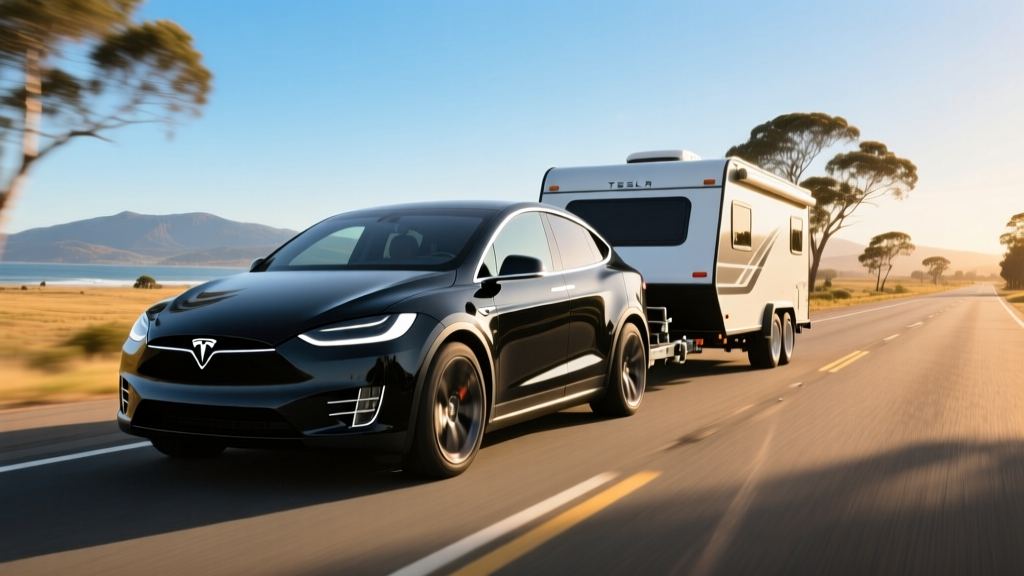
Both the dual-motor Model X and the tri-motor Plaid share a 5,000-pound maximum towing capacity when equipped with Tesla's factory tow package ($1,000 at time of ordering). This includes a Class III hitch receiver and integrated trailer brake controller software accessible through the touchscreen.
What can you realistically tow at 5,000 lbs? Here's a practical breakdown:
- Small travel trailers (e.g., Airstream Bambi, ~3,500 lbs loaded)
- Lightweight boat trailers with 18–20 ft aluminum boats
- Utility trailers carrying ATVs, motorcycles, or landscaping equipment
- Small horse trailers (single-horse, aluminum construction)
This rating falls short of body-on-frame electric trucks like the Ford F-150 Lightning (10,000 lbs) or Rivian R1T (11,000 lbs), but it matches or exceeds most unibody SUV competitors. The Hyundai Ioniq 9 and Kia EV9, for example, max out around 4,500–5,000 lbs depending on configuration.
Real-World Range: Beyond the EPA Sticker
EPA Estimated: 335 miles (Dual-Motor) / 326 miles (Plaid)
Real-World Highway (70 mph, mild weather): ~275–295 miles
Real-World City/Suburban Mixed: ~300–320 miles
Cold Weather (below 32°F, highway): ~220–260 miles
While Towing (~4,500 lbs): ~165–210 miles
The Model X uses a ~100 kWh usable battery pack with NMC (nickel manganese cobalt) chemistry. Tesla does not officially publish usable kWh figures, but teardown data and charging analysis consistently place it in the 98–100 kWh range. NMC provides high energy density — critical for a vehicle this size — though it requires more careful thermal management than LFP chemistry.
The falcon-wing doors add weight and complexity, and the Model X's relatively tall, wide frontal area means highway efficiency suffers more than in sleeker sedans. According to fueleconomy.gov, the dual-motor Model X achieves 103 MPGe combined (33 kWh/100 mi), while the Plaid drops to 98 MPGe (35 kWh/100 mi).
Tesla's heat pump (standard on all current Model X vehicles) significantly reduces cold-weather cabin-heating energy draw compared to older resistive heaters, but you should still budget 20–30% range loss in sustained sub-freezing conditions.
Charging Speed: DC Fast Charge and Home Level 2
| Charging Method | Power / Rate | Time / Speed | Connector |
|---|---|---|---|
| Level 1 (120V household) | ~1.4 kW | ~4 mi/hr | NACS (native) |
| Level 2 (240V home, 48A) | 11.5 kW | ~34 mi/hr (full in ~10 hr) | NACS / J1772 adapter |
| DC Fast (Tesla Supercharger V3/V4) | Peak 250 kW | 10–80% in ~32 min | NACS (native) |
| DC Fast (CCS via adapter) | Peak ~170 kW | 10–80% in ~45 min | CCS1 (with adapter) |
The Model X charges natively via NACS (North American Charging Standard) — Tesla's proprietary connector, now adopted industry-wide. This gives you seamless access to the Tesla Supercharger network, which remains the most reliable DC fast-charging ecosystem in the U.S. with over 20,000 stalls.
At a V3 or V4 Supercharger, the Model X peaks at 250 kW, but like all EVs, it doesn't hold that rate for the entire session. The charge curve is strong from 10–50% SoC (State of Charge), then progressively tapers. Expect roughly 175 miles of range added in the first 15 minutes, with the full 10–80% session taking approximately 32 minutes. Above 80%, charging slows dramatically to protect battery longevity — a universal lithium-ion characteristic, not a Tesla limitation.
For home charging, a Tesla Wall Connector on a 60-amp circuit (48 amps continuous) delivers 11.5 kW, adding roughly 34 miles of range per hour. A full overnight charge from near-empty takes about 10 hours. Installation costs for a Level 2 home setup typically run $500–$2,000 depending on panel proximity and whether a service upgrade is needed. Always consult a licensed electrician for final specifications.
When towing, plan your route around Supercharger locations carefully. Tesla's navigation includes trailer-mode routing that accounts for estimated range with a trailer attached, but we recommend adding a 15–20% safety buffer on top of the car's estimate.
Performance and Drivetrain
The dual-motor Model X produces 670 horsepower with standard all-wheel drive, sprinting to 60 mph in 3.8 seconds. That's remarkable for a three-row SUV weighing over 5,100 lbs.
The Plaid variant adds a third rear motor for 1,020 horsepower and a 2.5-second 0–60 time — genuinely hypercar territory in a family hauler. However, the Plaid's extra weight and power draw slightly reduce efficiency and range (326 vs. 335 EPA miles).
For towing purposes, the dual-motor variant is the more practical choice. The instant torque delivery of electric motors is excellent for trailer launches and merging, and the dual-motor's slightly longer range gives you more buffer when hauling. Adaptive air suspension is standard and automatically levels the vehicle when trailer mode is engaged.
Pricing, Trims, and Federal Tax Credit Eligibility
| Trim | Base MSRP | Typical As-Tested* | §30D Federal Credit |
|---|---|---|---|
| Model X (Dual-Motor AWD) | $79,990 | $85,000–$92,000 | Eligible up to $7,500† |
| Model X Plaid (Tri-Motor AWD) | $94,990 | $100,000–$110,000 | Eligible up to $7,500† |
*As-tested prices reflect common options: tow package ($1,000), enhanced Autopilot or FSD, premium wheels, and destination fees.
- MSRP Cap: SUVs/vans must be ≤$80,000 MSRP. The dual-motor Model X at $79,990 qualifies. The Plaid at $94,990 does not.
- Buyer Income Cap: AGI ≤$300,000 (married filing jointly), ≤$225,000 (head of household), ≤$150,000 (single).
- Battery Sourcing: Critical minerals and battery components must meet phased-in domestic/free-trade sourcing requirements. Verify current-year compliance at irs.gov.
- Point-of-Sale Transfer: Eligible buyers can transfer the credit to the dealer at purchase for an immediate price reduction.
† Tax credit eligibility depends on your individual tax situation, current-year sourcing rules, and MSRP compliance. Consult a tax professional before relying on credit amounts. Rules subject to legislative change.
The critical pricing insight: the dual-motor Model X squeaks under the $80,000 SUV MSRP cap for the §30D credit, but adding options that push the total MSRP above $80,000 may disqualify it. The tow package and destination charge are included in MSRP calculations. Confirm the exact window-sticker MSRP before purchase.
Interior Space, Cargo, and Daily Livability
The Model X offers seating for up to seven passengers in a 2-3-2 configuration, or six with optional second-row captain's chairs. Key interior dimensions:
- Front legroom: 41.2 inches
- Second-row legroom: 40.9 inches
- Third-row legroom: 32.7 inches (tight for adults on longer trips)
- Cargo behind 3rd row: 15.0 cu ft
- Cargo (2nd + 3rd row folded): 83.1 cu ft
- Front trunk (frunk): 6.6 cu ft
The falcon-wing rear doors are the Model X's defining feature. They open vertically with articulating hinges, making second- and third-row access exceptionally easy — especially when loading children into car seats. However, they add mechanical complexity, can be slow to operate in rain, and require overhead clearance (they need about 12 inches of side clearance and adequate overhead space).
The 17-inch center touchscreen runs Tesla's latest software with native navigation, streaming, and gaming. A rear-seat 8-inch screen controls climate and entertainment for second-row passengers. The yoke steering wheel remains standard, though a conventional round wheel is available at no extra charge.
Driver Assistance, Warranty, and Ownership
Tesla's Autopilot (standard) and Full Self-Driving Supervised ($8,000 option) are SAE Level 2 driver-assistance systems. The driver must remain fully engaged, hands on the wheel (or providing torque input), and eyes on the road at all times. These systems do not make the vehicle self-driving. Only Level 4 services like Waymo operate without driver supervision in geofenced areas.
Warranty coverage for the Model X:
- Basic Vehicle: 4 years / 50,000 miles
- Battery & Drive Unit: 8 years / 150,000 miles (whichever comes first, with minimum 70% capacity retention)
The 150,000-mile battery warranty is generous and reflects Tesla's confidence in its NMC pack longevity. Real-world data from high-mileage Tesla owners suggests typical degradation of 10–15% over 150,000 miles, though individual results vary based on charging habits and climate. Tesla recommends daily charging to 80–90% for NMC batteries and occasional charges to 100% for calibration.
Insurance costs for the Model X are notably higher than average. Expect annual premiums in the $2,800–$4,500 range depending on location, driving record, and coverage level — a factor frequently cited by owners as a pain point.
Pros and Cons
✅ Pros
- 5,000-lb towing capacity with integrated trailer software
- Supercharger network access (most reliable DC charging in the U.S.)
- Class-leading acceleration in both dual-motor and Plaid trims
- Falcon-wing doors ease child-seat and third-row access
- 335-mile EPA range handles most road trips comfortably
- Over-the-air updates continuously add features
- Generous 8-year/150,000-mile battery warranty
❌ Cons
- Towing cuts range by 35–50%, requiring frequent charging stops
- Plaid trim exceeds $80K MSRP cap — ineligible for §30D credit
- High insurance premiums ($2,800–$4,500/yr typical)
- Falcon-wing doors can be slow and need overhead clearance
- Third-row legroom (32.7 in) is tight for adults
- No CCS native port (adapter required for non-Tesla DC chargers)
- Yoke steering wheel has a learning curve
- Build quality inconsistencies reported by some owners
How the Model X Compares for Towing
If towing is your primary concern, here's how the Model X stacks up against key electric competitors:
- vs. Rivian R1S: The R1S tows 7,700 lbs and offers more rugged off-road capability, but starts at ~$75,900 and has slightly less range (~316 mi EPA for the Dual-Motor Max). Better for heavy trailers.
- vs. Kia EV9: The EV9 tows up to 5,000 lbs (AWD with tow package) at a far lower price (~$56,000–$74,000). Better value, but 230–304 mi range and slower charging.
- vs. BMW iX: The iX tows only 3,500 lbs, making it less suitable. Better interior luxury but less utility.
- vs. Ford F-150 Lightning: 10,000-lb towing, truck bed, and lower price — but it's a pickup, not a three-row SUV.
Choose the Model X if: You need a premium three-row electric SUV with 5,000-lb towing for light-to-moderate trailers, value Supercharger network reliability on road trips, and want rapid acceleration. The dual-motor trim at $79,990 MSRP is the sweet spot for tax-credit eligibility.
Look elsewhere if: You regularly tow over 5,000 lbs (consider the Rivian R1S or an electric truck), you're on a tighter budget (Kia EV9 offers similar towing at lower cost), or you prioritize third-row adult comfort.
Frequently Asked Questions
What is the Tesla Model X towing capacity?
The Tesla Model X has a maximum towing capacity of 5,000 pounds when equipped with the factory tow package. This applies to both the dual-motor and Plaid variants.
How much range do I lose when towing with the Model X?
Expect a 35–50% range reduction when towing near the 5,000-lb maximum at highway speeds. A 335-mile EPA range drops to approximately 165–210 real-world miles with a loaded trailer. Aerodynamic profile of the trailer matters significantly — a boxy travel trailer reduces range more than a low boat.
Does the Model X qualify for the $7,500 federal EV tax credit?
The dual-motor Model X at $79,990 MSRP qualifies under the §30D SUV cap of $80,000, provided the buyer meets income limits (≤$300,000 AGI for joint filers) and the vehicle meets current-year battery sourcing requirements. The Plaid at $94,990 MSRP exceeds the cap and does not qualify. Verify current rules at irs.gov and consult a tax professional.
How fast does the Model X charge at home?
On a Level 2 Tesla Wall Connector (11.5 kW / 48 amps), the Model X gains approximately 34 miles of range per hour, fully charging from near-empty in about 10 hours. A standard 120V outlet (Level 1) adds only ~4 miles per hour and is impractical for regular use with a 100 kWh battery.
Can I use non-Tesla chargers with the Model X?
Yes. The Model X uses the NACS connector natively, which is becoming the industry standard. For CCS-equipped public chargers (Electrify America, EVgo, etc.), Tesla sells a CCS adapter. Charging speeds on CCS networks may be lower than on Superchargers due to adapter overhead and network-specific charge curves.
Is the Model X a good tow vehicle for long road trips?
It's viable but requires planning. The Supercharger network makes route planning easier than with competing EVs, and Tesla's trailer-mode navigation accounts for towing range estimates. However, 150–200 miles between charging stops when towing means longer trip times. For frequent long-distance towing, a larger-battery electric truck or a diesel SUV may be more practical.
What battery chemistry does the Model X use?
The Model X uses NMC (nickel manganese cobalt) lithium-ion cells. NMC provides high energy density suited to a heavy, performance-oriented SUV. For longevity, Tesla recommends charging to 80–90% daily and only charging to 100% when needed for long trips or periodic calibration.