Quick Verdict: The Fastest SUV Money Can Buy
The Tesla Model X occupies a strange and increasingly lonely corner of the EV market: a three-row electric SUV that can out-accelerate most supercars while still hauling kids, cargo, and a week's worth of groceries. For 2026, the Model X continues in two trims — Long Range and Plaid — with the Plaid variant delivering a top speed of 163 mph and a 0-60 mph time of 2.5 seconds. That headline-grabbing performance is paired with an EPA-estimated 311 miles of range (Long Range), access to Tesla's Supercharger network, and a starting price that pushes well past the federal tax credit's MSRP cap.
But is the Model X still the right choice in 2026, as competitors like the Rivian R1S, BMW iX, and Mercedes EQS SUV close the gap on interior quality and comfort? This review breaks down every spec that matters — from real-world range to charging curves to tax credit eligibility — so you can decide with data, not marketing.
| Spec | Long Range | Plaid |
|---|---|---|
| EPA Range | 311 miles | 285 miles |
| Battery (usable) | ~100 kWh (NMC) | ~100 kWh (NMC) |
| Drivetrain | Dual-Motor AWD | Tri-Motor AWD |
| Horsepower | 670 hp | 1,020 hp |
| 0-60 mph | 3.8 sec | 2.5 sec |
| Top Speed | 149 mph | 163 mph |
| Max DC Fast Charge | 250 kW | 250 kW |
| 10-80% DC Charge | ~32 min | ~32 min |
| MPGe (combined) | 103 MPGe | 98 MPGe |
| Base MSRP | $79,990 | $94,990 |
Range, Efficiency & Real-World Expectations
The Model X Long Range carries an EPA-estimated 311 miles of range, while the Plaid drops to 285 miles — the trade-off for three motors and significantly more power draw. Both trims use a ~100 kWh usable battery pack with NMC (nickel manganese cobalt) chemistry, which offers high energy density but is more sensitive to sustained 100% state-of-charge storage than LFP packs.
EPA Sticker: 311 miles (Long Range) / 285 miles (Plaid)
Highway driving (70-80 mph): Expect 260-280 miles in warm weather; the Model X's large frontal area and boxy SUV profile hurt efficiency at speed compared to the Model S sedan.
Cold weather (below 32°F): Plan for 20-30% range loss, bringing usable range down to roughly 200-230 miles on the Long Range. Battery preconditioning helps but cannot eliminate cold-weather chemistry limitations.
Efficiency: 103 MPGe combined (Long Range) translates to approximately 32 kWh/100 miles — thirstier than a Model Y or Model 3 due to weight and aerodynamics.
According to fueleconomy.gov, the Model X Long Range achieves 103 MPGe combined (109 city / 97 highway). The Plaid drops to roughly 98 MPGe. These are middling figures for a modern EV — the aerodynamic penalty of an SUV form factor is real and unavoidable. For context, the Tesla Model S Long Range achieves 124 MPGe combined on a similar platform.
Charging Speed: DC Fast, Level 2 & Supercharger Access
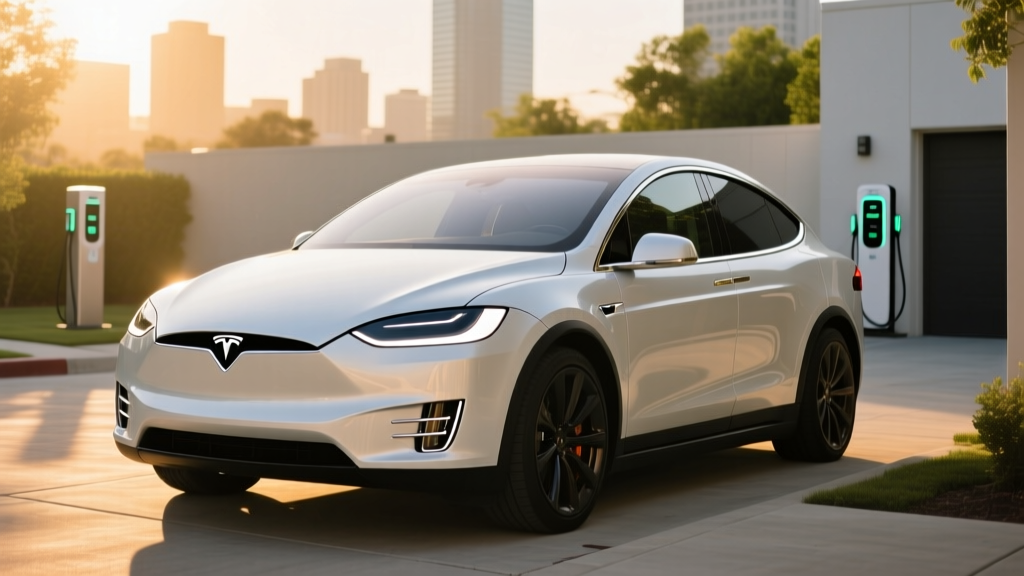
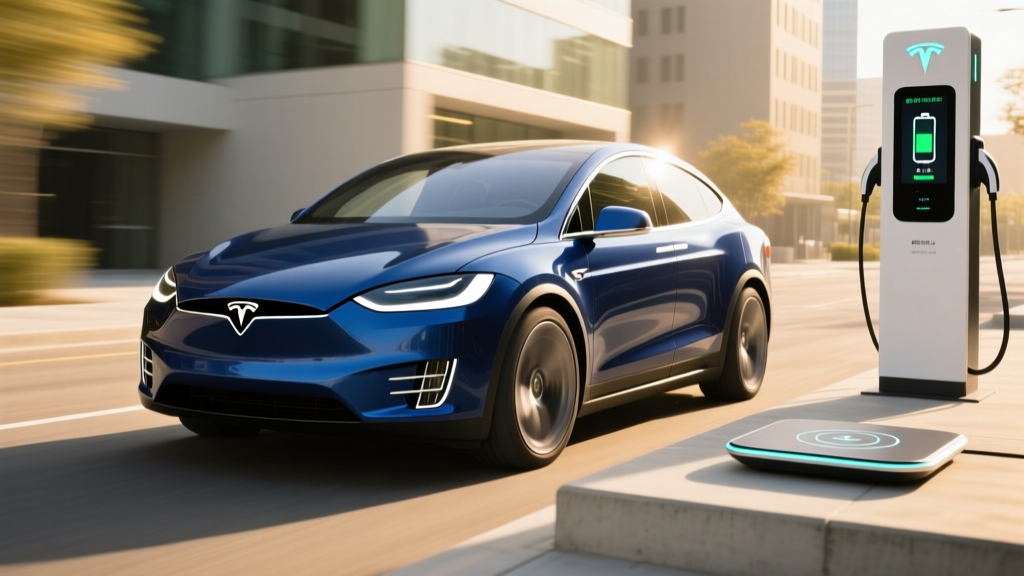
Charging infrastructure remains one of Tesla's strongest advantages. The Model X uses the NACS (North American Charging Standard) connector natively and has full access to Tesla's Supercharger network — the most reliable and widespread DC fast-charging network in North America.
| Charging Level | Power | Speed / Time | Notes |
|---|---|---|---|
| Level 1 (120V household) | ~1.4 kW | ~3-4 miles per hour | Emergency/trickle only; not practical for daily use |
| Level 2 (240V home) | 11.5 kW (48A) | ~30-34 miles per hour | Full charge in ~10-12 hours; Wall Connector recommended |
| DC Fast Charge (V3 Supercharger) | Peak 250 kW | 10-80% in ~32 min | Peak rate only below 30% SoC; tapers significantly above 60% |
| DC Fast Charge (V4 Supercharger) | Up to 250 kW | Similar to V3 | Model X architecture caps at ~250 kW; cannot use full V4 potential |
Charging curve reality: The Model X peaks at 250 kW only at a low state of charge (roughly 10-30%). By 50% SoC, the rate drops to approximately 150 kW, and above 80% it falls below 60 kW. This is why Tesla — and every other manufacturer — quotes 10-80% charge times rather than 0-100%. If you arrive at a Supercharger with 10% battery, expect roughly 175 miles of range added in 15 minutes under ideal thermal conditions.
For home charging, Tesla's Wall Connector delivers up to 11.5 kW on a 60-amp circuit (48 amps continuous). This adds roughly 30-34 miles of range per hour, meaning a typical overnight charge from 20% to 80% takes about 6-7 hours. Home installation costs vary widely — expect $800-$2,500 for the electrician work depending on panel capacity and run length. Always consult a licensed electrician for a site-specific quote.
Performance: Top Speed, Acceleration & Drivetrain
This is where the Model X justifies its premium pricing — and where the keyword that brought you here comes into focus. The Tesla Model X top speed varies by trim:
- Long Range: 149 mph (electronically limited)
- Plaid: 163 mph (electronically limited)
The Plaid's 1,020 horsepower and tri-motor all-wheel-drive system deliver a 2.5-second 0-60 mph time — a figure that was exotic-supercar territory just five years ago, now available in a vehicle with falcon-wing rear doors and seating for up to seven. The Long Range is hardly slow at 3.8 seconds to 60 mph with 670 hp from its dual-motor setup.
On the road, the Model X Plaid's acceleration is genuinely startling. The tri-motor configuration (one front, two rear) enables torque vectoring across the rear axle, which improves cornering stability and traction in wet conditions. However, the Model X's 5,185-pound curb weight is always present — you feel it in braking distances and in energy consumption during aggressive driving. Sustained track use will also trigger thermal management limits, reducing available power to protect the battery and motors.
For daily driving, both trims offer smooth, silent acceleration with strong regenerative braking that enables one-pedal driving in most conditions. The air suspension provides adjustable ride height — useful for clearing speed bumps, loading cargo, or reducing drag at highway speeds.
Interior, Cargo & Technology
The Model X offers seating configurations for five, six, or seven passengers. The six-seat layout with second-row captain's chairs is the most popular and provides a center aisle for third-row access.
- Cargo volume: Up to 88.1 cu ft behind the first row (seats folded); 42.5 cu ft behind the second row
- Frunk (front trunk): 6.5 cu ft — useful for charging cables or a small bag
- Second-row legroom: 40.9 inches
- Third-row legroom: 32.7 inches (best suited for children on longer trips)
The falcon-wing rear doors remain the Model X's most distinctive feature. They open upward with dual-hinged articulation, allowing them to clear tight parking spaces (Tesla claims as little as 11 inches of side clearance). In practice, they're genuinely useful for loading child seats and provide excellent headroom access. However, they add mechanical complexity, can be slow to operate in rain (exposing the interior), and have historically been a source of reliability complaints.
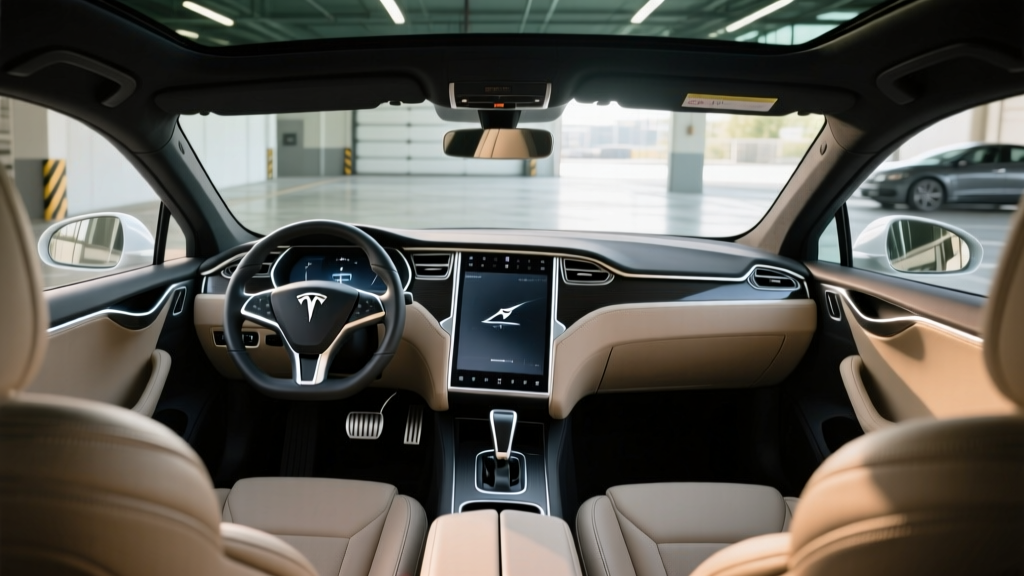
Infotainment: The 17-inch center touchscreen runs Tesla's proprietary OS with navigation, streaming media, and a full web browser. A second 8-inch screen for rear passengers controls climate and media. The yoke steering wheel (now optional alongside a conventional round wheel) remains polarizing. Wireless phone charging, USB-C ports throughout, and a 22-speaker audio system are standard.
Driver Assistance: Tesla's Autopilot comes standard with adaptive cruise control, lane centering, and automatic emergency braking. Full Self-Driving (Supervised) is a $8,000 add-on that enables automatic lane changes, navigation-guided on/off-ramp transitions, and parking assistance.
Despite the "Full Self-Driving" name, Tesla's FSD (Supervised) is an SAE Level 2 driver-assistance system. The driver must remain fully attentive, keep hands on the wheel (or demonstrate engagement via the cabin camera), and be prepared to take over at any moment. This is not a self-driving system. Only Level 4 robotaxi services like Waymo operate without a human driver in defined areas.
Pricing, Trims & Federal Tax Credit Eligibility
The 2026 Tesla Model X is available in two trims. Pricing has shifted multiple times over the past two years; here are the current figures:
| Trim | Base MSRP | As-Tested (typical) | §30D Tax Credit | Effective Price |
|---|---|---|---|---|
| Long Range | $79,990 | $84,000-$88,000 | Not eligible (MSRP cap) | $79,990+ |
| Plaid | $94,990 | $99,000-$105,000 | Not eligible (MSRP cap) | $94,990+ |
The IRS §30D clean vehicle credit offers up to $7,500 for eligible new EVs. However, the Model X fails the MSRP cap test:
- MSRP cap for SUVs/pickups/vans: $80,000
- Model X Long Range MSRP: $79,990 — technically under the cap, but any destination fee or mandatory option pushes it over. As configured with standard options, it typically exceeds $80,000.
- Model X Plaid MSRP: $94,990 — well above the cap.
- Buyer income caps: AGI must not exceed $300,000 (joint) / $225,000 (head of household) / $150,000 (individual)
- Battery sourcing requirements: Critical minerals and battery component sourcing must meet phased thresholds — Tesla's supply chain compliance varies by production batch.
Bottom line: Do not count on the $7,500 federal credit when budgeting for a Model X. Consult IRS.gov §30D guidelines and a tax professional for your specific situation. State-level incentives may still apply — check your local DMV or energy office.
Destination charges add approximately $1,390. Common options that raise the price include FSD ($8,000), premium paint colors ($1,500-$2,500), and 22-inch turbine wheels ($5,500). A realistically equipped Long Range with FSD lands near $90,000-$93,000 before taxes.
Warranty, Battery Longevity & Ownership Costs
Tesla provides the following warranty coverage for the 2026 Model X:
- Basic vehicle: 4 years / 50,000 miles
- Battery & drive unit: 8 years / 150,000 miles (whichever comes first), with a minimum 70% capacity retention guarantee
- Roadside assistance: 4 years / 50,000 miles
The NMC battery in the Model X is proven technology with extensive real-world data. Based on Tesla's own fleet data and independent analysis, Model X/S batteries typically retain 85-90% of original capacity at 150,000 miles. Degradation is most pronounced in the first 20,000-30,000 miles (roughly 3-5% loss), then slows to a gradual linear decline. Battery replacement, if needed out of warranty, currently costs between $15,000-$22,000 depending on the pack — a figure to keep in mind for long-term ownership planning.
Insurance: The Model X carries higher-than-average insurance premiums due to its repair costs, aluminum-intensive construction, and performance capability. Expect annual premiums of $2,800-$4,500 depending on your profile, location, and coverage level — roughly 40-60% more than a Model Y.
Maintenance: EVs eliminate oil changes, spark plugs, and transmission fluid. Expect to budget for tire replacement (the Model X's weight and torque wear tires faster than ICE vehicles — expect 25,000-35,000 miles per set), cabin air filter replacement, brake fluid checks, and wiper fluid. Annual maintenance costs average $300-$500.
How the Model X Compares: Key Competitors
The three-row luxury electric SUV segment has grown considerably. Here's how the Model X stacks up against its most direct rivals:
| Vehicle | EPA Range | 0-60 mph | Base Price | Max DC Charge |
|---|---|---|---|---|
| Tesla Model X LR | 311 mi | 3.8 sec | $79,990 | 250 kW |
| Rivian R1S (Dual-Motor Max) | 352 mi | 4.5 sec | $79,900 | 200 kW |
| BMW iX xDrive50 | 324 mi | 4.4 sec | $87,250 | 200 kW |
| Mercedes EQS 580 SUV | 305 mi | 4.5 sec | $105,550 | 200 kW |
| Kia EV9 GT-Line AWD | 270 mi | 5.0 sec | $73,900 | 210 kW |
Where the Model X wins: Performance (no competitor comes close to the Plaid's 2.5-second 0-60), Supercharger network access, and over-the-air software updates that continue to add features years after purchase.
Where the Model X loses: Interior materials and build quality (Rivian and BMW are noticeably more premium), third-row comfort (the Rivian R1S and EQS SUV offer more usable third-row space), and ride refinement (the Model X's air suspension is competent but not as plush as the Mercedes). The Model X's platform dates to 2015, and despite updates, competitors riding on newer architectures show it in noise isolation and structural rigidity.
- Choose the Model X if: You need supercar-level acceleration in a three-row SUV, you rely on the Tesla Supercharger network for frequent road trips, and you value OTA software updates and tech-forward features above traditional luxury materials.
- Choose the Rivian R1S if: You prioritize off-road capability, interior build quality, and maximum range (with the Max battery pack), and you don't mind slower DC charging.
- Choose the BMW iX if: You want a premium two-row electric SUV with a quieter cabin, better materials, and strong efficiency — and you don't need a third row.
- Choose the Kia EV9 if: You want three-row EV practicality at a significantly lower price point and can accept less range and slower acceleration.
Pros & Cons
- Class-leading acceleration and top speed (Plaid: 2.5 sec, 163 mph)
- Full Supercharger network access — best-in-class road-trip charging
- Distinctive falcon-wing doors improve child-seat and cargo access
- Spacious frunk + cargo area (88.1 cu ft max)
- Strong OTA update track record adds features post-purchase
- HEPA air filtration with Bioweapon Defense Mode
- Does not qualify for $7,500 federal tax credit (MSRP cap)
- Interior quality lags BMW, Mercedes, and Rivian at this price
- Aging platform (2015 origin) shows in NVH and structural refinement
- Falcon-wing doors can be slow and problematic in heavy rain/snow
- High insurance premiums ($2,800-$4,500/yr typical)
- Third row is tight for adults on longer trips
- 250 kW DC peak charge rate trails newer 800V architectures (Hyundai/Kia/Porsche)
Frequently Asked Questions
What is the Tesla Model X top speed?
The 2026 Tesla Model X Plaid has an electronically limited top speed of 163 mph. The Long Range trim is limited to 149 mph. Both figures are well above any legal US speed limit and are relevant primarily for track or closed-course use.
What is the real-world range of the Tesla Model X?
The EPA rates the Long Range at 311 miles and the Plaid at 285 miles. In real-world highway driving at 70-80 mph in moderate temperatures, expect 260-280 miles (Long Range) and 240-260 miles (Plaid). In cold weather below freezing, reduce those figures by 20-30%.
How fast does the Model X charge at home and on the road?
At home on a Level 2 Tesla Wall Connector (11.5 kW), the Model X gains roughly 30-34 miles of range per hour, achieving a full charge in about 10-12 hours. On a V3 Supercharger (250 kW peak), a 10-80% charge takes approximately 32 minutes, though the rate tapers significantly above 60% SoC.
Does the Tesla Model X qualify for the federal EV tax credit?
Effectively, no. While the Long Range's base MSRP of $79,990 technically sits at the $80,000 SUV cap, destination fees and standard options push it above the threshold. The Plaid at $94,990 is well above the cap. Additionally, battery sourcing requirements and buyer income limits may further restrict eligibility. Always verify current rules at IRS.gov.
Is the Tesla Model X worth buying over the Rivian R1S or BMW iX?
The Model X is worth buying if performance is your top priority — nothing in this segment matches the Plaid's 2.5-second 0-60 mph or the Supercharger network's road-trip convenience. If you prioritize interior luxury, ride comfort, or off-road capability, the BMW iX or Rivian R1S are stronger choices. If budget matters most, the Kia EV9 delivers three-row EV practicality for $15,000-$20,000 less.
What is the Model X battery warranty?
Tesla covers the Model X battery and drive unit for 8 years or 150,000 miles (whichever comes first), guaranteeing a minimum of 70% capacity retention over that period. This is competitive with BMW's 8-year/100,000-mile coverage and slightly better than some rivals on mileage.
Can the Model X tow?
Yes. The Model X has a maximum towing capacity of 5,000 pounds when properly equipped with the factory tow package. Towing significantly reduces range — expect a 40-50% reduction at highway speeds with a loaded trailer.
Sources: EPA fuel economy data via fueleconomy.gov; Tesla official specifications; IRS §30D clean vehicle credit guidelines via irs.gov; NHTSA safety ratings via nhtsa.gov.