Tesla Model X Seating: 5, 6, or 7 Passengers?
The short answer to "how many seats in a Tesla Model X" is: it depends on which configuration you choose. For the 2026 model year, Tesla offers the Model X in three interior layouts — a five-seat (two rows), six-seat (three rows with second-row captain's chairs), and seven-seat (three rows with a second-row bench). Each layout affects cargo space, third-row usability, and pricing differently.
The five-seat layout is standard on the base Long Range trim and maximizes rear cargo volume at 85.1 cubic feet behind the second row. The six-seat configuration replaces the second-row bench with two individual captain's chairs separated by a center console, offering superior comfort for four adults and easier third-row access via a walk-through gap. The seven-seat option ($4,000 add-on) uses a three-across second-row bench but compresses third-row legroom to a tight 32.7 inches — best reserved for small children on short trips.
| Metric | 5-Seat | 6-Seat | 7-Seat |
|---|---|---|---|
| Rows | 2 | 3 | 3 |
| Second-Row Type | Bench | Captain's Chairs | Bench |
| Headroom (1st/2nd/3rd) | 41.7 / 40.9 / — | 41.7 / 40.9 / 38.4 in | 41.7 / 40.9 / 38.4 in |
| Legroom (1st/2nd/3rd) | 41.2 / 38.4 / — | 41.2 / 38.4 / 32.7 in | 41.2 / 36.5 / 32.7 in |
| Cargo Behind Row 2 | 85.1 cu ft | 42.5 cu ft | 42.5 cu ft |
| Cargo Behind Row 3 | — | 15.8 cu ft | 15.8 cu ft |
| Front Trunk (Frunk) | 6.6 cu ft (all configs) | ||
| Config Price | Included | $6,500 | $4,000 |
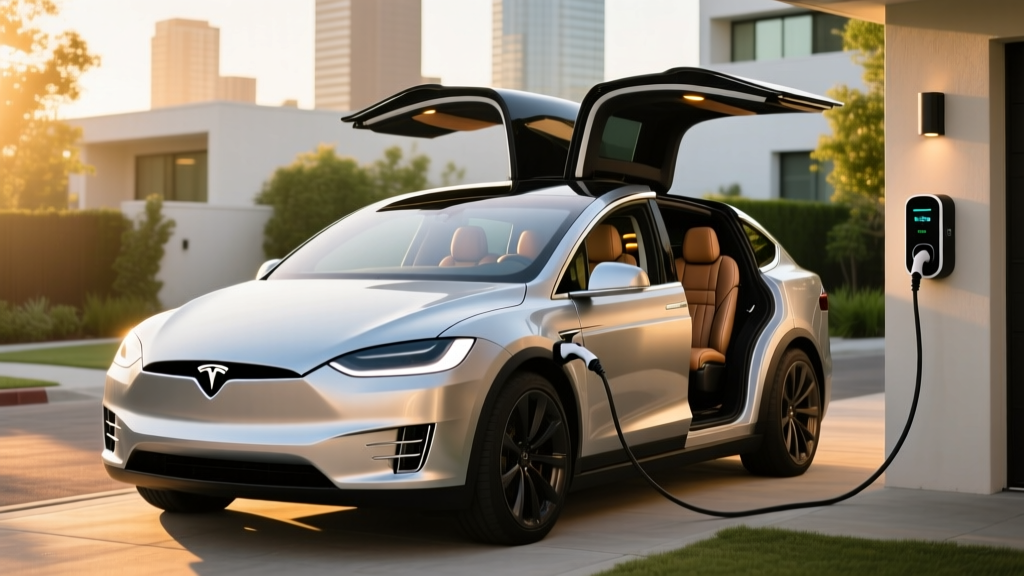
The Falcon Wing rear doors — which hinge upward from the roof — are a genuine advantage in tight parking spaces, requiring only about 12 inches of side clearance to open. However, they add mechanical complexity and can be slow to operate in heavy rain or snow.
Range, Battery, and Efficiency: The Real Numbers
Every 2026 Model X variant uses a ~100 kWh usable battery pack built on NMC (nickel manganese cobalt) chemistry, which prioritizes energy density over the cycle-life longevity of LFP cells found in the Model 3/Y Standard Range. Tesla has not published an official cell-level chemistry update for 2026, but teardown data from prior model years confirms 2170-format NMC cells supplied by Panasonic.
EPA Range vs. Real-World Expectations
Model X Long Range (AWD): EPA-estimated 335 miles. Expect ~270–290 miles on sustained highway driving at 70–75 mph, and ~235–255 miles in sub-30°F winter conditions with cabin heat active.
Model X Plaid (Tri-Motor AWD): EPA-estimated 311 miles. Expect ~250–270 miles highway, ~215–235 miles in cold weather.
Source: EPA / fueleconomy.gov
Efficiency varies meaningfully between trims. The Long Range achieves approximately 100 MPGe combined (34 kWh/100 mi), while the Plaid's additional motor and performance tuning drops it to roughly 95 MPGe combined (36 kWh/100 mi). For a vehicle this large — 5,185 lbs curb weight for Long Range — those figures are competitive with the BMW iX xDrive50 but trail the more aerodynamic Lucid Air Grand Touring.
Charging Speed: DC Fast, Level 2, and What to Expect
The Model X supports up to 250 kW peak DC fast charging on Tesla's V3 and V4 Supercharger stalls via its native NACS connector. However, peak rate is not sustained rate. The charging curve tapers significantly above 50% state of charge (SoC), and thermal management plays a major role in session speed.
| Charging Level | Power / Rate | Time or Miles Added |
|---|---|---|
| DC Fast Charge (Peak) | 250 kW (NACS) | 10–80% in ~32 min (Long Range), ~34 min (Plaid) |
| DC Sustained (20–60%) | ~170–200 kW avg | ~175 mi added in 15 min (preconditioned) |
| Level 2 Home (48A) | 11.5 kW (240V) | ~34 mi/hr of charging |
| Level 2 Home (32A) | 7.7 kW (240V) | ~23 mi/hr of charging |
| Level 1 (120V) | ~1.4 kW | ~4 mi/hr (emergency only) |
Home charging on a 48-amp Level 2 circuit (requiring a 60-amp breaker) replenishes the battery from 10% to 90% overnight in roughly 9–10 hours — adequate for daily use. Tesla's Wall Connector retails for $475, and a full professional installation with panel assessment typically runs $800–$2,500 depending on your electrical panel's capacity and the run distance to your garage.
Preconditioning matters. If you navigate to a Supercharger using the car's built-in routing, the battery thermal management system begins warming the pack 10–15 minutes before arrival, enabling faster charge acceptance. Without preconditioning — say, plugging into a third-party DC charger on a cold morning — expect peak rates closer to 120–150 kW until the pack warms.
With Tesla opening the Supercharger network to NACS-equipped non-Tesla EVs, the Model X benefits from continued network expansion. As of early 2026, there are over 6,500 Supercharger stations and 70,000+ connectors in North America.
Performance: Long Range vs. Plaid
The Model X Long Range uses a dual-motor AWD setup producing 670 horsepower and achieving a 3.8-second 0–60 mph time — quick for any SUV, let alone one that seats up to seven. The Plaid variant swaps in a tri-motor AWD configuration (one front, two rear) generating 1,020 horsepower and a staggering 2.5-second 0–60 mph run. Top speed is electronically limited to 155 mph (Long Range) and 163 mph (Plaid).
Towing capacity is rated at 5,000 pounds for both trims when equipped with the optional tow package ($1,500), sufficient for a small boat trailer or lightweight camper but below the Rivian R1S's 7,700-pound rating.
Air suspension is standard and provides up to 9 inches of ground clearance in its highest setting, helpful for steep driveways and light off-road paths. The adaptive damping system adjusts firmness based on road conditions, though the ride quality on 22-inch wheels (Plaid standard) can feel firm over broken pavement compared to the 20-inch setup on the Long Range.
Pricing, Tax Credits, and Ownership Costs
The 2026 Model X lineup is priced at a premium that reflects its position as Tesla's flagship SUV. Here's how the trims break down:
| Trim | Base MSRP | As-Tested (6-seat, common options) | Federal §30D Credit |
|---|---|---|---|
| Long Range AWD | $79,990 | $92,490 | See eligibility note below |
| Plaid Tri-Motor AWD | $94,990 | $109,990 | See eligibility note below |
Federal tax credit eligibility (§30D): The Model X faces a significant hurdle. Under current IRS rules, the SUV MSRP cap for the §30D new-vehicle credit is $80,000. The Long Range base price of $79,990 technically falls just under this cap, but adding virtually any option — including the $6,500 six-seat configuration, any premium paint color ($1,500–$2,500), or Enhanced Autopilot ($6,000) — pushes the adjusted MSRP above $80,000 and disqualifies the vehicle. The Plaid, at $94,990 base, does not qualify regardless of configuration.
Additionally, buyers must meet income thresholds (AGI ≤ $300,000 joint / $225,000 head of household / $150,000 single) and the vehicle must satisfy critical-mineral and battery-component sourcing requirements. Tesla's supply chain sourcing compliance varies by production batch — confirm current eligibility on the IRS qualified vehicles list before purchase.
The point-of-sale transfer option (available since January 2024) lets dealers apply the credit as an upfront discount if all criteria are met, but given the MSRP cap issue, most Model X buyers will not qualify for the full $7,500 federal credit. Some state incentives (California, Colorado, New York) may still apply — check your state's energy office.
Tech, Autopilot, and Standout Features
The Model X centers its interior around a 17-inch landscape touchscreen with a 22-speaker audio system, wireless phone charging, and a second-row 8-inch display for rear passengers (six-seat config). The yoke steering wheel remains optional; a conventional round wheel is standard and, in our assessment, more practical for daily driving and low-speed maneuvers.
Tesla's Autopilot comes standard and includes adaptive cruise control, lane-keeping assist, and automatic emergency braking. Full Self-Driving (Supervised) — a $8,000 option or $99/month subscription — adds city-street navigation, traffic-light recognition, and parking-lot maneuvering. However, this remains an SAE Level 2 system: the driver must maintain visual attention and keep hands on the wheel at all times. It is not autonomous driving.
⚠️ Driver-Assist Limitation Notice
Tesla FSD (Supervised) is an SAE Level 2 driver-assistance system, not a self-driving system. The driver is legally responsible for all vehicle operation. Hands-on-wheel monitoring is enforced, and the system can disengage unexpectedly at construction zones, faded lane markings, or unmapped intersections. Only Level 4 services like Waymo operate without a human driver in geofenced areas.
Unique Model X features include the aforementioned Falcon Wing doors, a panoramic windshield that extends over the front seats (tinted but not retractable), a HEPA air filtration system with Bioweapon Defense Mode, and a power-folding tow hitch. The rear-seat entertainment screen supports gaming and streaming when parked.
How It Compares: Model X vs. Key Rivals
The Model X competes in the premium electric SUV segment against the Rivian R1S, BMW iX, Kia EV9 GT-Line, and the Lucid Air (sedan, but similar price bracket). Here's how it stacks up on the metrics buyers care about most:
| Spec | Tesla Model X LR | Rivian R1S Dual-Motor | BMW iX xDrive50 | Kia EV9 GT-Line AWD |
|---|---|---|---|---|
| EPA Range | 335 mi | 352 mi (Max Pack) | 324 mi | 279 mi |
| Max Seats | 7 | 7 | 5 | 7 |
| 0–60 mph | 3.8 sec | 4.5 sec | 4.4 sec | 4.9 sec |
| DC Fast Charge | 250 kW | 220 kW | 200 kW | 236 kW |
| Towing | 5,000 lb | 7,700 lb | 3,500 lb | 5,000 lb |
| Base MSRP | $79,990 | $79,900 | $87,250 | $73,900 |
The Rivian R1S is the stronger pick for towing, off-road capability, and seven-seat practicality, though its charging speed trails. The BMW iX offers a more refined interior but seats only five. The Kia EV9 delivers the best value for three-row families willing to accept shorter range. The Model X wins on Supercharger network access, acceleration, and software integration — but its third row and MSRP-cap tax-credit issue are real drawbacks.
Warranty and Long-Term Ownership
Tesla covers the Model X with a 4-year/50,000-mile basic vehicle warranty and an 8-year/150,000-mile battery and drive unit warranty (whichever comes first). The battery warranty guarantees retention of at least 70% of original capacity during the coverage period. Based on fleet data from Tesla's Impact Report and third-party analyses, NMC packs in the Model X/S typically degrade 10–15% over the first 100,000 miles, with degradation slowing significantly after the initial break-in period.
Out-of-warranty battery replacement for the Model X has historically ranged from $15,000 to $22,000 depending on pack configuration, though Tesla's remanufacturing program has reduced costs in some cases. Insurance premiums for the Model X run 20–35% higher than comparable ICE SUVs due to repair costs, aluminum body panels, and sensor density — get quotes before committing.
✅ Pros
- Class-leading 0–60 performance (especially Plaid)
- Access to 70,000+ Tesla Supercharger connectors
- Falcon Wing doors ease third-row access in tight spaces
- Standard air suspension with adjustable ride height
- Best-in-class software, OTA updates, and app ecosystem
❌ Cons
- Third-row legroom (32.7 in) is tight for adults
- Most configurations exceed $80K MSRP cap — no federal tax credit
- Falcon Wing doors can be slow and problematic in ice/snow
- Higher insurance premiums than segment average
- Panel gaps and interior material quality trail BMW/Rivian at this price
Who Should Buy the 2026 Tesla Model X?
The Verdict
Choose the Model X if: You need three rows occasionally (not daily), prioritize acceleration and Supercharger access for road trips, and can absorb the premium price without relying on the federal tax credit. The six-seat configuration is the sweet spot for comfort and practicality.
Look elsewhere if: You regularly carry six or seven adults (Rivian R1S or Kia EV9 are better), need maximum towing capacity, or require the $7,500 federal credit to make the math work. The MSRP cap disqualifies nearly every real-world Model X build.
Frequently Asked Questions
How many seats does the Tesla Model X have?
The 2026 Model X offers 5, 6, or 7 seats depending on configuration. The five-seat layout is standard (two rows). The six-seat layout adds a third row with second-row captain's chairs ($6,500). The seven-seat layout adds a third row with a second-row bench ($4,000).
What is the real-world range of the Tesla Model X?
The EPA rates the Long Range at 335 miles and the Plaid at 311 miles. In real-world highway driving at 70–75 mph, expect 270–290 miles (Long Range) and 250–270 miles (Plaid). Cold weather below 30°F reduces range an additional 15–25%.
How fast does the Model X charge at home and on the road?
On DC fast charging, the Model X peaks at 250 kW and charges from 10–80% in approximately 32 minutes (Long Range) with battery preconditioning. At home on a 48-amp Level 2 charger (11.5 kW), it adds roughly 34 miles of range per hour, fully replenishing overnight.
Does the 2026 Model X qualify for the federal EV tax credit?
Only in the narrowest case: a base Long Range at $79,990 MSRP with zero options, purchased by a buyer meeting IRS income caps (§30D), and only if Tesla's battery sourcing meets current critical-mineral requirements. Any option — paint, seats, Autopilot — pushes the price above the $80,000 SUV cap. The Plaid does not qualify. Verify on the IRS qualified vehicles list.
Is the Model X worth buying over the Rivian R1S or BMW iX?
The Model X wins on acceleration, Supercharger access, and tech integration. The Rivian R1S is superior for towing (7,700 lb), off-road capability, and genuine seven-adult seating. The BMW iX offers a more luxurious interior but seats only five. Your choice depends on whether performance and charging infrastructure (Tesla) or practicality and build quality (Rivian/BMW) matter more.
What is the battery warranty on the Model X?
Tesla covers the battery and drive unit for 8 years or 150,000 miles, whichever comes first, guaranteeing at least 70% capacity retention. The basic vehicle warranty is 4 years / 50,000 miles.