The Tesla Model X remains one of the most distinctive electric SUVs on the road. Falcon-wing rear doors, a massive 17-inch touchscreen, and a glass canopy roof make it instantly recognizable. But stepping inside a Tesla Model X in 2026 means navigating a more competitive three-row EV SUV landscape than ever before. Rivian's R1S, the Kia EV9, and upcoming alternatives have chipped away at the Model X's exclusivity. So what does Tesla's flagship crossover actually deliver today — and where does it fall short?
This review covers the 2026 Tesla Model X Long Range and Plaid trims with exact EPA range figures, real-world efficiency data, DC fast-charging speeds, interior dimensions, and current federal tax credit eligibility. If you're researching what it's really like to live with one, here are the numbers that matter.
2026 Tesla Model X: Core Specifications at a Glance
| Specification | Long Range (Dual Motor AWD) | Plaid (Tri-Motor AWD) |
|---|---|---|
| EPA Range | 348 miles | 335 miles |
| Battery (usable) | ~100 kWh (NMC) | ~100 kWh (NMC) |
| Horsepower | 670 hp | 1,020 hp |
| 0–60 mph | 3.8 seconds | 2.5 seconds |
| Top Speed | 155 mph | 163 mph |
| Drivetrain | Dual Motor AWD | Tri-Motor AWD |
| Max DC Fast Charge | 250 kW | 250 kW |
| 10–80% DC Charge Time | ~32 minutes | ~32 minutes |
| Level 2 Home Charge | 11.5 kW (~34 mi/hr) | 11.5 kW (~34 mi/hr) |
| MPGe (combined) | 103 MPGe | 98 MPGe |
| kWh/100 mi | 33 kWh | 34 kWh |
| Towing Capacity | 5,000 lbs | 5,000 lbs |
| Seating | 5, 6, or 7 passengers | 5, 6, or 7 passengers |
| Base MSRP | $81,630 | $96,630 |
Sources: EPA / fueleconomy.gov, Tesla Model X Design Studio. Prices reflect 2026 model year before destination fees and incentives.
Range and Efficiency: EPA vs. Real-World Driving
EPA Estimate: 348 miles (Long Range) / 335 miles (Plaid)
Real-World Highway (70–80 mph): Expect ~275–300 miles
Cold Weather (below 30°F): Expect ~240–275 miles (20–25% reduction typical for NMC chemistry)
Mixed Commute (city + suburban): ~310–330 miles achievable with regen braking
The Model X Long Range's 348-mile EPA rating is among the highest of any three-row electric SUV sold in the U.S. However, the Model X's large frontal area and ~5,100-lb curb weight work against it at highway speeds. In real-world testing at sustained 75 mph, efficiency drops to roughly 36–38 kWh/100 mi, translating to about 275–290 miles of usable range before you'd want to stop and charge.
Cold weather compounds this. NMC (nickel manganese cobalt) battery chemistry — which Tesla uses in the Model X — loses more range in freezing temperatures than LFP (lithium iron phosphate) packs found in some lower-cost EVs. Tesla's heat pump helps mitigate cabin energy draw, but battery preconditioning is essential. If you skip preconditioning before a DC fast charge in cold weather, charge speeds can drop by 40–50%.
For city and suburban driving where regenerative braking recovers energy, the Model X comes closer to its EPA sticker — some owners report 320+ miles in stop-and-go conditions with one-pedal driving enabled.
Charging Speed: DC Fast, Level 2, and the Supercharger Advantage
| Charging Level | Power (kW) | Miles Added per Hour | Notes |
|---|---|---|---|
| Level 1 (120V outlet) | ~1.4 kW | ~3–4 mi/hr | Emergency/trickle only |
| Level 2 (240V, 48A Wall Connector) | 11.5 kW | ~34 mi/hr | Full charge in ~9.5 hours |
| DC Fast (Tesla V3 Supercharger) | 250 kW peak | ~200 mi in 15 min | 10–80% in ~32 min |
| DC Fast (V4 Supercharger) | Up to 250 kW* | Similar to V3 | *Model X limited to 250 kW architecture |
The Model X peaks at 250 kW on V3 and V4 Tesla Superchargers. That's respectable but not class-leading — the Hyundai Ioniq 9 and some 800V-architecture rivals accept 300+ kW. The practical implication: a 10–80% charge takes roughly 32 minutes. You'll see peak speeds only between approximately 15–45% state of charge; above 60%, the charge curve tapers significantly, dropping below 100 kW by 80% SoC.
For home charging, Tesla's Wall Connector at 48 amps delivers 11.5 kW — enough to replenish roughly 34 miles of range per hour. A full 0–100% charge takes about 9.5 hours, easily accomplished overnight on a 60-amp circuit. Installation costs for a Level 2 home setup typically run $800–$2,000 depending on panel proximity and whether your electrical panel needs an upgrade to 200 amps.
The Supercharger network remains the Model X's strongest charging asset. With over 6,000 V3/V4 stalls across the U.S., route planning via the Tesla navigation system is seamless — the car preconditions the battery automatically when a Supercharger is set as your destination. Non-Tesla networks (Electrify America, EVgo) are accessible via the included NACS connector, though CCS-adapter-dependent networks require planning.
Inside the Cabin: Dimensions, Tech, and What You Actually Get
Stepping inside a Tesla Model X means confronting the brand's signature minimalism — a 17-inch center touchscreen dominates the dash, with nearly all vehicle controls routed through it. The 2026 model continues with a yoke-style steering wheel as standard (a conventional round wheel is available at no cost). Here's what the dimensions and interior look like in concrete terms:
- Front headroom: 41.7 inches
- Front legroom: 41.2 inches
- Second-row headroom: 40.9 inches
- Second-row legroom: 40.2 inches
- Third-row headroom: 37.1 inches (tight for adults on long trips)
- Third-row legroom: 32.7 inches (best suited for children)
- Cargo (behind 3rd row): 15.8 cu ft
- Cargo (3rd row folded): 44.1 cu ft
- Cargo (all rear rows folded): 85.1 cu ft
- Front trunk (frunk): 6.6 cu ft
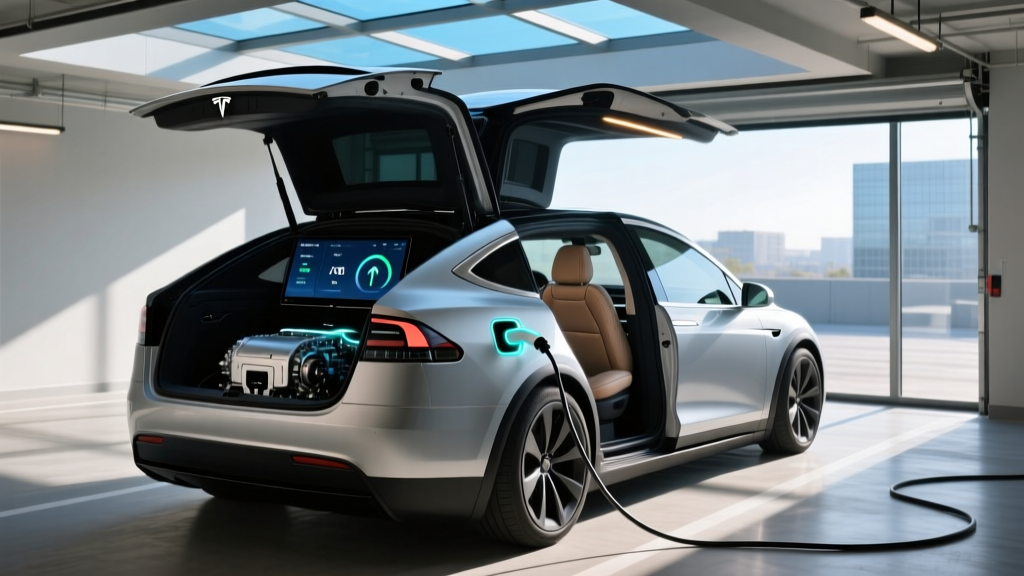
The falcon-wing rear doors are the Model X's defining feature. They open upward with a double-hinged design that requires less lateral clearance than conventional doors — useful in tight parking spots. However, they add mechanical complexity, and long-term owners have reported occasional sensor calibration issues and slower open/close cycles in heavy rain.
Infotainment and tech highlights:
- 17-inch center touchscreen (2200 x 1300 resolution) with Netflix, YouTube, and gaming
- 12.3-inch digital instrument cluster behind the yoke/wheel
- 8-inch rear passenger touchscreen for climate and media
- 22-speaker, 960-watt audio system
- Wireless Apple CarPlay and Android Auto (added in recent OTA updates)
- HEPA air filtration with Bioweapon Defense Mode
- Power-folding second and third rows (6-seat config with captain's chairs available)
Driver assistance: Tesla's Autopilot comes standard and includes adaptive cruise control, lane centering, and automatic emergency braking. Full Self-Driving (Supervised) — a $8,000 option or $99/month subscription — adds automatic lane changes, Navigate on Autopilot, and traffic light recognition. Per NHTSA guidelines, this is an SAE Level 2 system: the driver must remain fully attentive with hands on the wheel at all times. It is not autonomous driving.
Pricing, Trims, and Federal Tax Credit Eligibility
| Trim | Base MSRP | Destination | As-Tested (typical) | §30D Federal Credit |
|---|---|---|---|---|
| Long Range AWD | $81,630 | $1,995 | $85,000–$92,000 | $0 (exceeds MSRP cap) |
| Plaid AWD | $96,630 | $1,995 | $100,000–$112,000 | $0 (exceeds MSRP cap) |
Neither the Model X Long Range nor the Plaid qualifies for the IRS §30D federal EV tax credit. The reason is straightforward: §30D imposes an MSRP cap of $80,000 for SUVs, and both Model X trims exceed this threshold even before destination charges.
Additionally, buyers must meet income limits ($300,000 joint / $150,000 single modified adjusted gross income) and the vehicle must satisfy battery critical-mineral and component sourcing requirements. Even if the Model X were under the cap, its battery sourcing may not fully comply in the 2026 tax year — a factor worth verifying on the IRS clean vehicle list before purchase.
Some state-level incentives may still apply. California's CVRP, Colorado's state tax credit, and various utility rebates can offset $1,000–$5,000 depending on your jurisdiction. Check your state energy office and local utility for current programs.
Warranty, Battery Longevity, and Ownership Costs
Tesla covers the Model X with the following warranties:
- Basic Vehicle: 4 years / 50,000 miles
- Battery & Drive Unit: 8 years / 150,000 miles (Long Range), 8 years / 150,000 miles (Plaid)
- Battery capacity retention guarantee: Minimum 70% over the warranty period
The 150,000-mile battery warranty is competitive with the segment. Real-world degradation data from Tesla's fleet suggests NMC packs in the Model X typically retain 88–92% capacity after 100,000 miles. A full battery replacement out of warranty costs approximately $18,000–$25,000 depending on labor and pack availability — a figure worth factoring into second-owner or high-mileage purchase decisions.
Insurance premiums for the Model X run higher than average for the EV segment. Expect annual premiums of $2,800–$4,200 depending on your state, driving record, and coverage level. Tesla's own insurance program (available in most states) uses real-time driving data and can be competitive for safe drivers.
How the Model X Compares: Key Rivals
The Model X occupies a specific niche: premium performance SUV with Supercharger access and distinctive design. If your priority is value and family practicality, the Kia EV9 or Hyundai Ioniq 9 deliver three rows at $30,000–$40,000 less. If you need adventure capability, Rivian's R1S is the clear pick. But for sheer straight-line speed combined with long range and established charging infrastructure, the Model X still holds ground.
Pros and Cons: Honest Assessment
- Class-leading EPA range (348 mi) for a three-row electric SUV
- Access to 6,000+ Tesla Supercharger stalls with seamless route planning
- Extraordinary Plaid performance (2.5-sec 0–60)
- Falcon-wing doors provide tight-space access and dramatic entry
- Spacious cargo area (85.1 cu ft max) with usable frunk
- HEPA air filtration and excellent cabin quietness
- Continuous OTA updates add features post-purchase
- Does NOT qualify for the $7,500 federal EV tax credit (MSRP cap)
- Third row is tight for adults — best for children only
- Falcon-wing doors add mechanical complexity and potential maintenance cost
- Yoke steering is polarizing and requires adaptation
- 250 kW peak DC charge rate trails 800V rivals (300+ kW)
- Insurance premiums significantly above segment average
- Panel gaps and interior fit/finish inconsistent at this price point
Who Should Buy the Tesla Model X?
Choose the Model X Long Range if: You need three rows occasionally, prioritize maximum range and Supercharger access for road trips, and want a premium tech-forward SUV with strong performance — and you don't need the federal tax credit.
Choose the Model X Plaid if: You want supercar-level acceleration in a family SUV and budget is secondary. The 2.5-second 0–60 time is genuinely remarkable for a 5,100-lb vehicle.
Look elsewhere if: Federal tax credit eligibility matters to your budget (consider the Rivian R1S, Kia EV9, or Hyundai Ioniq 9), you need a genuinely usable adult-sized third row, or you want the latest 800V charging architecture for faster DC stops.
Frequently Asked Questions
What is the real-world range of the Tesla Model X?
The EPA rates the 2026 Model X Long Range at 348 miles and the Plaid at 335 miles. In real-world highway driving at 75 mph, expect approximately 275–300 miles. In cold weather (below 30°F), range can drop to 240–275 miles. City driving with regenerative braking can yield 310–330 miles.
How fast does the Tesla Model X charge?
On a Tesla V3 or V4 Supercharger, the Model X peaks at 250 kW, achieving a 10–80% charge in approximately 32 minutes. On a Level 2 home charger (11.5 kW / 48A), it adds about 34 miles of range per hour, fully charging overnight in roughly 9.5 hours.
Does the Tesla Model X qualify for the federal EV tax credit?
No. Both trims exceed the IRS §30D MSRP cap of $80,000 for SUVs. Additionally, buyers must meet income limits and the vehicle must satisfy battery sourcing requirements. State incentives may still apply — check your local programs.
How much does a Tesla Model X cost in 2026?
The Long Range starts at $81,630 plus $1,995 destination, with typical as-tested prices of $85,000–$92,000 with options. The Plaid starts at $96,630 and typically reaches $100,000–$112,000 as configured. No federal tax credit applies.
Is the Model X worth buying vs. the Rivian R1S or Kia EV9?
The Model X wins on range (348 mi vs. R1S's ~352 mi Max pack but at much higher cost, and EV9's ~304 mi) and Supercharger access. The R1S is better for off-road use and has a more conventional, functional interior. The EV9 is far more affordable and offers a better third row. Your choice depends on budget, use case, and whether Supercharger access is a priority.
Is Tesla Autopilot or FSD self-driving?
No. Both Autopilot and Full Self-Driving (Supervised) are SAE Level 2 driver-assistance systems. The driver must remain fully engaged, monitor the road, and keep hands on the steering wheel at all times. These systems do not make the vehicle autonomous.
What is the battery warranty on the Model X?
Tesla covers the battery and drive unit for 8 years or 150,000 miles (whichever comes first), guaranteeing a minimum of 70% capacity retention over that period. Real-world data suggests most Model X packs retain 88–92% capacity at 100,000 miles.