Quick Verdict: The Model X in 2026
The 2026 Tesla Model X remains one of the most recognizable electric SUVs on the road — and not just because of those signature falcon wing doors. It's a three-row, dual- or tri-motor electric crossover with up to 335 miles of EPA-estimated range, blistering acceleration, and access to Tesla's Supercharger network. But at a starting MSRP north of $79,000, buyers need to weigh whether the tech spectacle and practicality justify the premium over rivals like the Rivian R1S, BMW iX, and Mercedes EQS SUV.
This review covers every number that matters: real-world range, charging curves, cargo space, tax credit eligibility, and whether those falcon wing doors are a daily blessing or an expensive liability.
Range, Battery, and Real-World Efficiency
The 2026 Model X Long Range AWD carries a usable battery capacity of approximately 95 kWh using NMC (nickel manganese cobalt) chemistry. Tesla does not officially publish usable kWh figures, but third-party teardowns and EPA data from fueleconomy.gov confirm this pack size delivers the rated 335 miles in the Long Range trim.
- EPA Estimated: 335 miles (Long Range AWD)
- Real-World Highway (70 mph): ~270–295 miles
- Cold Weather (below 32°F): ~220–260 miles depending on cabin heating use
- Mixed Commute: ~300–320 miles with regenerative braking
The Model X's large frontal area and ~5,100-lb curb weight penalize highway efficiency more than sedans. Expect a 10–18% drop from the EPA sticker on sustained interstate driving. The standard heat pump helps mitigate cold-weather losses compared to older EVs without one, but sub-freezing temps still meaningfully reduce range.
| Spec | Long Range AWD | Plaid (Tri-Motor) |
|---|---|---|
| EPA Range | 335 mi | 326 mi |
| Usable Battery | ~95 kWh (NMC) | ~95 kWh (NMC) |
| Efficiency | 100 MPGe / 34 kWh/100mi | 98 MPGe / 35 kWh/100mi |
| Drivetrain | Dual-Motor AWD | Tri-Motor AWD |
| Horsepower | 670 hp | 1,020 hp |
| 0–60 mph | 3.8 sec | 2.5 sec |
| Max DC Fast Charge | 250 kW | 250 kW |
| 10–80% DC Charge | ~30 min | ~30 min |
| Level 2 Home Charge | 11.5 kW (~34 mi/hr) | 11.5 kW (~34 mi/hr) |
| Base MSRP | $79,990 | $94,990 |
| Seating | 5, 6, or 7 passengers | 5 or 6 passengers |
| Cargo (behind 3rd row) | 15.0 cu ft | 15.0 cu ft |
| Cargo (all rows folded) | 77.5 cu ft | 77.5 cu ft |
Charging Speed: DC Fast, Level 2, and the Charge Curve
The Model X supports a maximum DC fast-charge rate of 250 kW at V3/V4 Tesla Superchargers. In practice, the charging curve tells a more nuanced story than the peak number suggests.
| Charging Level | Power | Miles Added per Hour | Notes |
|---|---|---|---|
| Level 1 (120V outlet) | ~1.4 kW | ~3–4 mi/hr | Emergency/trickle only |
| Level 2 (240V, 48A) | 11.5 kW | ~34 mi/hr | Full charge in ~9 hours |
| DC Fast (Tesla V3/V4) | Up to 250 kW | ~175 mi in 15 min | Peak rate below 50% SoC |
| DC Fast (CCS adapter) | Up to 250 kW | ~175 mi in 15 min | Requires Tesla CCS adapter |
Charging curve reality: The 250 kW peak is only sustained roughly from 10% to 35% State of Charge (SoC). From 35–60%, the rate tapers to ~150 kW. Above 80%, it drops sharply to under 50 kW. This is why Tesla quotes 10–80% in approximately 30 minutes — the last 20% takes disproportionately longer. Preconditioning the battery (automatic when navigating to a Supercharger) is essential to achieving peak rates, especially in cold weather.
The Falcon Wing Doors: How They Open, Clearance, and Daily Use
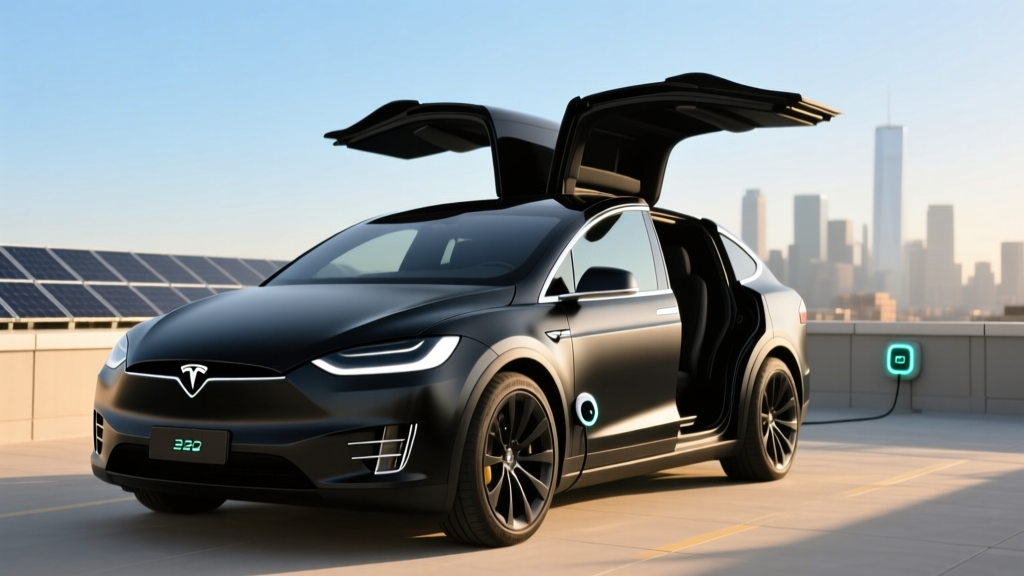
Searches for "Tesla Model X doors open" spike for a reason — the rear falcon wing doors are the vehicle's most polarizing feature. Here's what ownership actually looks like.
How they work: The rear doors are double-hinged, articulating upward and outward with an electric motor. Ultrasonic sensors on the roof and door edges scan for overhead and side obstacles, adjusting the opening arc accordingly. Tesla claims they need as little as 12 inches of side clearance — less than a conventional door swing — making them functional in tight parking spaces.
Opening methods:
- Key fob button press
- Tesla mobile app (remote open/close)
- Interior door button
- Exterior touch handle
- Voice command: "Open rear doors"
Real-world caveats: The sensors are generally reliable but not infallible. Low-hanging garage shelving, roof racks on adjacent vehicles, and heavy snow accumulation can trigger overly cautious partial openings. In freezing rain, the door seals and hinges can ice up — a known issue that Tesla has addressed with improved seal designs in recent model years, but one that still surfaces in extreme conditions. Repair costs for a single falcon wing door mechanism are significantly higher than a conventional door, which factors into insurance premiums.
The practical upside: For parents loading children into car seats, the upward-opening doors create a massive entry aperture. You can stand nearly upright beside the second-row seats — a genuine ergonomic advantage that no conventional SUV door offers.
Performance, Drivetrain, and Ride Quality
The Long Range AWD pairs dual motors (one front, one rear) for 670 combined horsepower and a 3.8-second 0–60 mph time. That's sports-car territory in a 5,100-pound three-row SUV. The tri-motor Plaid variant pushes 1,020 hp and 2.5 seconds — largely a vanity spec at this price point, but it demonstrates Tesla's engineering capability.
Ride quality has improved with the adaptive air suspension standard on all trims. The system offers adjustable ride height (useful for garage clearance and rough roads) and automatically lowers at highway speeds for aerodynamic efficiency. Steering is precise but numb — typical of Tesla's electric power steering tuning. Body roll is well-controlled for the weight, though the Rivian R1S feels more composed on twisty back roads.
Pricing, Trims, and Federal Tax Credit Eligibility
| Trim | Base MSRP | Destination | As-Tested (Typical) | §30D Credit Eligible? |
|---|---|---|---|---|
| Long Range AWD (5-seat) | $79,990 | $1,390 | $84,000–$92,000 | See below |
| Long Range AWD (6-seat) | $83,490 | $1,390 | $87,000–$95,000 | See below |
| Long Range AWD (7-seat) | $83,490 | $1,390 | $87,000–$94,000 | See below |
| Plaid (Tri-Motor) | $94,990 | $1,390 | $99,000–$110,000 | See below |
Federal tax credit status (§30D, 2026 rules): The Model X faces a significant hurdle. Under current IRS guidelines, the §30D new clean vehicle credit has an SUV MSRP cap of $80,000. The Long Range 5-seat base MSRP of $79,990 technically falls under this cap, but adding any options (paint color, larger wheels, Enhanced Autopilot) pushes the transaction above the limit. The 6- and 7-seat configurations and the Plaid trim exceed the cap outright.
Additional eligibility requirements:
- Buyer income cap: Modified AGI ≤ $300,000 (joint), $225,000 (head of household), $150,000 (single)
- MSRP cap: ≤ $80,000 for SUVs/vans/pickups
- Battery sourcing: Critical minerals and battery components must meet escalating domestic-content thresholds (2026 requirements are stricter than 2024)
- Point-of-sale transfer: Eligible buyers can apply the credit at purchase rather than waiting for tax filing
Bottom line: Most Model X buyers will not qualify for the full $7,500 federal credit. A bare-bones Long Range 5-seat configuration might scrape under the MSRP cap, but battery-sourcing compliance is the wildcard — Tesla's supply chain has shifted significantly, and the credit eligibility for specific build weeks can change. Always verify on the fueleconomy.gov tax credit lookup tool before purchasing, and consult a tax professional for your specific situation.
Interior, Cargo, and Technology
The Model X interior is dominated by a 17-inch landscape-oriented center touchscreen running Tesla's proprietary infotainment OS. There are no physical buttons for climate or media — everything routes through the screen, including the glovebox release. A secondary 8-inch screen serves rear-seat passengers for climate and entertainment.
Passenger space (Long Range, EPA):
- Front headroom: 41.7 in | legroom: 41.2 in
- Second-row headroom: 40.9 in | legroom: 41.1 in
- Third-row headroom: 37.1 in | legroom: 32.7 in
The third row is best suited for children on longer trips — adults will find the 32.7 inches of legroom tight beyond 20-minute rides. Cargo behind the third row is 15.0 cubic feet, expanding to 77.5 cu ft with both rear rows folded. The front trunk (frunk) adds 6.5 cu ft of secure storage.
Driver assistance — Autopilot and FSD (Supervised):
Tesla Autopilot (standard) and Full Self-Driving (Supervised) are SAE Level 2 driver-assistance systems. The driver must remain fully engaged, hands on or near the wheel, and eyes on the road at all times. This is not autonomous or self-driving capability. Only Level 4 systems (like Waymo's geofenced robotaxi service) operate without a human driver.
Autopilot includes adaptive cruise control and lane centering. FSD (Supervised), a $8,000 add-on or $99/month subscription, adds automatic lane changes, navigate-on-autopilot for highway interchanges, and traffic light/stop sign recognition. Real-world FSD performance in 2026 is impressively smooth on highways but still requires active supervision — particularly on undivided roads and in construction zones.
Warranty, Ownership Costs, and Reliability
Tesla's warranty coverage for the 2026 Model X:
- Basic vehicle: 4 years / 50,000 miles
- Battery & drive unit: 8 years / 150,000 miles (Long Range), 8 years / 150,000 miles (Plaid)
- Battery degradation threshold: Warranty covers replacement if capacity drops below 70% during the coverage period
The 150,000-mile battery warranty is competitive with the segment. NMC chemistry in Tesla's packs has shown an average degradation of approximately 10–12% over 150,000 miles based on fleet data, meaning most owners should retain well above the 70% threshold. A full battery replacement outside warranty currently runs $18,000–$25,000 depending on pack configuration — a figure to keep in mind for second-ownership planning.
Insurance premiums for the Model X are among the highest in the EV SUV segment, averaging $3,200–$4,500 annually depending on state, driving record, and coverage level. The falcon wing doors, aluminum body panels, and high repair costs for Tesla-specific components drive these rates. Get quotes before committing to a purchase.
Pros
- Class-leading Supercharger network access (17,000+ stalls in North America)
- Falcon wing doors genuinely improve car-seat loading ergonomics
- 335-mile EPA range covers most road-trip legs comfortably
- Tri-motor Plaid offers absurd performance for the segment
- Over-the-air updates continuously add features
- Standard heat pump for cold-weather efficiency
Cons
- Federal tax credit eligibility is unlikely for most configurations
- Falcon wing doors are expensive to repair and can ice up in winter
- Third-row space is tight for adults
- No Apple CarPlay or Android Auto
- Insurance premiums are significantly above segment average
- Panel gap consistency and interior material quality lag luxury rivals (BMW iX, Mercedes EQS SUV)
Who Should Buy the 2026 Model X?
The Model X fits a specific buyer profile: a family that values three-row electric utility, fast charging on road trips, and Tesla's software ecosystem — and is willing to pay a premium for it. If you regularly load children into car seats, the falcon wing doors are a functional advantage, not a gimmick. If you road-trip frequently, the Supercharger network's reliability is a genuine differentiator over Electrify America or third-party CCS networks.
Consider the Rivian R1S instead if you prioritize off-road capability, interior build quality, or want a more conventional door design. Look at the BMW iX if you only need two rows and value interior luxury. The Kia EV9 offers three rows starting under $55,000 — a compelling value play if 270+ miles of range suffices.
Frequently Asked Questions
What is the real-world range of the 2026 Tesla Model X?
The EPA estimates 335 miles for the Long Range AWD. In real-world highway driving at 70 mph, expect approximately 270–295 miles. In cold weather (below freezing), range can drop to 220–260 miles depending on cabin heating usage and whether you precondition the battery.
How fast does the Model X charge at home and on the road?
At home on a Level 2 (240V, 48A) charger, the Model X adds roughly 34 miles of range per hour, reaching a full charge in about 9 hours. On a Tesla V3/V4 Supercharger, it peaks at 250 kW and can add up to 175 miles in 15 minutes, with a 10–80% charge taking approximately 30 minutes.
Does the Tesla Model X qualify for the $7,500 federal EV tax credit?
It's unlikely for most buyers. The §30D credit has an $80,000 MSRP cap for SUVs, and while the base Long Range 5-seat ($79,990) technically qualifies, adding any options exceeds the cap. Battery sourcing requirements further complicate eligibility. Verify on fueleconomy.gov and consult a tax professional before relying on the credit.
How do the falcon wing doors handle in tight garages and bad weather?
The ultrasonic sensors adjust the door opening arc to avoid overhead obstacles, and they require only ~12 inches of side clearance. However, heavy ice accumulation on the door seals can impede operation, and low garage shelving may trigger partial openings. Repair costs for the articulating hinge mechanism are significantly higher than conventional doors.
Is the Model X worth buying over the Rivian R1S or BMW iX?
Choose the Model X if you need three rows, want the longest range in the segment, and value Supercharger network access. Choose the Rivian R1S for superior off-road capability and interior quality. Choose the BMW iX if you only need two rows and prioritize luxury materials and ride refinement.
What is the battery warranty on the 2026 Model X?
Tesla covers the battery and drive unit for 8 years or 150,000 miles (whichever comes first), with a capacity retention threshold of 70%. If the battery degrades below 70% within that window, Tesla will replace or refurbish it at no cost.