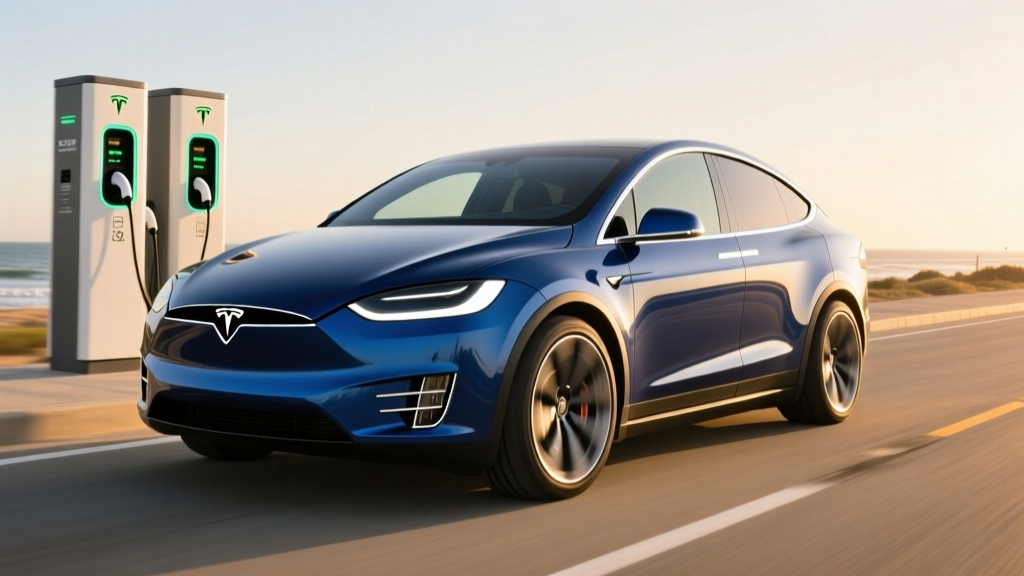
The Tesla Model X Plaid remains one of the most polarizing vehicles in the luxury electric SUV segment. It pairs supercar-rivaling acceleration with three-row practicality and access to the most reliable DC fast-charging network in North America. But at a starting price well above six figures, buyers need to know exactly what they're getting — and where the Plaid falls short against increasingly capable rivals like the Rivian R1S, BMW iX M70, and Mercedes EQS SUV.
This review covers the 2026 Tesla Model X Plaid SUV with real-world range data, charging benchmarks, ownership costs, and a clear verdict on who should — and shouldn't — buy it.
Quick Verdict: Who Is the Model X Plaid For?
The Model X Plaid is built for a narrow but enthusiastic buyer: someone who wants sub-2.5-second 0-60 mph performance, needs three rows of seating, and values the Supercharger network for frequent road trips. It is not the most efficient luxury EV SUV, nor the most luxurious interior in its class. But no competitor matches its combination of straight-line speed, over-the-air updates, and charging infrastructure access.
Choose the Model X Plaid if: You prioritize blistering acceleration, need access to 6,000+ Superchargers nationwide, and want a three-row EV with a frunk.
Look elsewhere if: Interior material quality, ride comfort, or maximum range per dollar are your top priorities — the Rivian R1S or BMW iX may serve you better.
Range, Efficiency, and Real-World Expectations
The EPA rates the 2026 Tesla Model X Plaid at 326 miles of combined range on its 100 kWh (usable) battery pack. Efficiency comes in at 98 MPGe combined, or roughly 34 kWh per 100 miles, according to fueleconomy.gov. That's respectable for a 5,100-pound tri-motor AWD performance SUV, but it trails the dual-motor Long Range Model X (352 miles EPA) and competitors like the BMW iX xDrive50 (324 miles on a smaller battery, thanks to lower weight).
EPA Range: 326 miles
Real-World Expectation: Plan for approximately 260–285 miles during sustained 75 mph highway driving in moderate temperatures. In cold weather (below 30°F), expect range to drop to 220–250 miles due to cabin heating demands and increased battery resistance, even with the Model X's standard heat pump. City driving with regenerative braking recovers some efficiency, often exceeding the EPA combined figure in stop-and-go traffic.
The battery uses NMC (nickel manganese cobalt) chemistry, which offers higher energy density than LFP but requires different long-term care. Tesla recommends daily charging to 80–90% for NMC packs and reserving 100% charges for road trips to minimize degradation.
| Spec | Value |
|---|---|
| EPA Range | 326 miles |
| Battery (usable) | ~100 kWh, NMC chemistry |
| Drivetrain | Tri-Motor AWD |
| Horsepower | 1,020 hp |
| 0–60 mph | 2.5 seconds |
| Top Speed | 163 mph |
| Efficiency | 98 MPGe / 34 kWh/100mi |
| Cargo (behind 3rd row) | ~15 cu ft |
| Cargo (max, seats folded) | ~88 cu ft |
| Frunk | ~6.6 cu ft |
| Base MSRP | $114,990 |
| Battery Warranty | 8 years / 150,000 miles |
Charging Speed: DC Fast, Level 2, and the Supercharger Advantage
The Model X Plaid supports a peak DC fast-charge rate of 250 kW on V3 Superchargers and compatible CCS stations (via the NACS connector, which Tesla uses natively). In controlled testing, the 10–80% charge takes approximately 30 minutes. However, real-world charging curves matter: the Plaid sustains peak rates only briefly between roughly 15–40% SoC, then tapers progressively. Expect 150–175 kW sustained through the middle of the curve, dropping below 100 kW past 70%.
Preconditioning is critical. Navigate to a Supercharger using the built-in navigation, and the battery thermal management system will warm or cool the pack en route, ensuring you hit peak charge rates on arrival. Skipping preconditioning — especially in cold weather — can add 10–15 minutes to a charging stop.
| Level | Power / Rate | Miles Added per Hour | Notes |
|---|---|---|---|
| Level 1 (120V) | ~1.4 kW | ~3–4 mi/hr | Emergency/trickle only |
| Level 2 (240V, 48A) | 11.5 kW | ~30–34 mi/hr | Home Wall Connector; full charge in ~10 hrs |
| Level 2 (240V, 32A) | 7.7 kW | ~20–22 mi/hr | Common portable/mobile connector setup |
| DC Fast (V3 Supercharger) | 250 kW peak | ~175 mi in 15 min | 10–80% in ~30 min; tapers above 60% |
| DC Fast (V4 Supercharger) | 250 kW peak* | Similar to V3 | *Model X currently capped at 250 kW on V4 |
For home charging, Tesla's Wall Connector at 48 amps delivers roughly 30–34 miles of range per hour — enough to fully replenish the pack overnight. Installation typically costs $500–$2,000 depending on panel proximity and whether a 200-amp service upgrade is needed.
Performance: 1,020 Horsepower in a Family SUV
The tri-motor powertrain (one front, two rear) produces 1,020 horsepower and launches the Model X Plaid from 0–60 mph in 2.5 seconds. That figure is repeatable thanks to Tesla's launch control and sophisticated traction management, though consecutive launches will thermally throttle the system. The quarter-mile passes in roughly 9.9 seconds at 150 mph — territory previously reserved from hypercars, not 5,100-pound SUVs with falcon-wing doors.
Adaptive air suspension is standard, offering adjustable ride height and damping. The Plaid's tuning is firmer than the Long Range variant, which improves cornering composure but transmits more road imperfections into the cabin. For daily commuting on imperfect pavement, the ride quality is a noticeable trade-off.
Interior, Technology, and Cargo Practicality
The Model X interior centers on a 17-inch landscape touchscreen running Tesla's proprietary infotainment OS. The yoke steering wheel is standard on Plaid trims (a conventional round wheel is available as a no-cost option). A rear 8-inch screen serves second-row passengers for climate and entertainment controls.
Standout tech features:
- Gaming-capable infotainment (AMD Ryzen processor) — handles AAA titles while parked
- HEPA air filtration with "Bioweapon Defense Mode"
- Falcon-wing rear doors with ultrasonic obstacle sensing
- Over-the-air software updates adding features post-purchase
- Sentry Mode dashcam surveillance while parked
Notable drawbacks:
- No Apple CarPlay or Android Auto — Tesla's ecosystem is closed
- Falcon-wing doors can be slow to open/close and struggle in tight garages with low ceilings (minimum ~84 inches clearance needed)
- Panel gap consistency and interior material quality lag behind BMW, Mercedes, and Rivian at this price point
- Yoke steering requires an adjustment period and is controversial for low-speed maneuvering
Passenger space accommodates up to seven (2-3-2 configuration) or six (2-2-2 with captain's chairs). Third-row legroom is tight at roughly 32.7 inches — adequate for children but cramped for adults on longer trips. Cargo behind the third row measures about 15 cubic feet, expanding to 88 cubic feet with both rear rows folded. The front trunk (frunk) adds 6.6 cubic feet.
Pricing, Trims, and Federal Tax Credit Eligibility
The 2026 Tesla Model X Plaid starts at $114,990 (including destination). Common options push as-tested prices to $120,000–$130,000:
- Full Self-Driving (Supervised): $8,000
- 22-inch Turbine wheels: $5,500 (reduces range to ~304 mi EPA)
- Six-seat interior with captain's chairs: $6,500
- Premium paint colors: $2,000–$3,000
| Item | Amount |
|---|---|
| Base MSRP | $114,990 |
| Typical As-Tested | $120,000–$130,000 |
| Federal §30D Tax Credit (New EV) | $0 — MSRP exceeds $80,000 SUV cap |
| Point-of-Sale Transfer | Not applicable (credit not available) |
Does the Model X Plaid qualify for the federal EV tax credit? No. Under current IRS §30D rules, new SUVs must have an MSRP at or below $80,000 to qualify for up to $7,500 in federal credits. The Model X Plaid at $114,990 exceeds this cap. Additionally, buyer income limits apply ($300,000 joint / $150,000 single for new EVs), and battery critical-mineral and component sourcing requirements must be met. Even if the price cap were waived, the Plaid would not qualify. Buyers should consult a tax professional for state-level incentives, which vary by jurisdiction.
Autopilot, FSD (Supervised), and Safety
SAE Automation Level: Tesla Autopilot and Full Self-Driving (Supervised) are Level 2 driver-assistance systems. The driver must remain fully engaged, hands on the wheel (or torque-applied with the yoke), and eyes on the road at all times. These are not autonomous or "self-driving" systems.
Standard Autopilot includes Traffic-Aware Cruise Control and Autosteer (lane centering on marked highways). The optional FSD (Supervised) package adds automated lane changes, Navigate on Autopilot (highway on/off-ramp routing), Autopark, and Smart Summon. Tesla's vision-only approach uses eight cameras with no LiDAR or radar.
Safety ratings: The Model X earned a 5-star overall rating from NHTSA and has historically performed well in IIHS crashworthiness testing, though headlight and LATCH ease-of-use ratings have varied by model year.
FSD (Supervised) Limitations: Does not stop at all traffic controls reliably in every scenario. Requires driver confirmation for lane changes on many maneuvers. Performance degrades in heavy rain, construction zones, and faded lane markings. The driver is legally responsible for all vehicle actions at all times.
Ownership Costs, Warranty, and Longevity
Tesla covers the Model X battery and drive unit for 8 years or 150,000 miles (whichever comes first), with a guaranteed minimum 70% capacity retention during that period. The basic vehicle limited warranty is 4 years / 50,000 miles.
NMC battery degradation data from Tesla's fleet indicates an average capacity loss of roughly 10–12% over the first 150,000 miles, with the curve flattening significantly after the initial break-in period. Out-of-warranty battery replacement costs remain high — estimated between $15,000–$22,000 depending on pack availability and labor.
Insurance premiums for the Plaid are among the highest in the EV segment due to repair costs, performance classification, and parts pricing. Expect annual premiums of $3,500–$5,500+ depending on driver profile and state.
| Category | Estimated Cost |
|---|---|
| Depreciation | $45,000–$55,000 |
| Insurance | $20,000–$27,000 |
| Electricity (charging) | $5,500–$7,500 |
| Maintenance | $2,000–$3,000 |
| Tires (high-performance) | $3,000–$4,500 |
| Total Estimated | $75,500–$97,000 |
Model X Plaid vs. Key Competitors
| Spec | Tesla Model X Plaid | Rivian R1S Tri-Motor | BMW iX M70 |
|---|---|---|---|
| Base MSRP | $114,990 | ~$110,000 | ~$111,500 |
| EPA Range | 326 mi | ~320 mi (est.) | ~290 mi |
| 0–60 mph | 2.5 sec | ~2.9 sec | 3.7 sec |
| Horsepower | 1,020 hp | ~850 hp | 619 hp |
| Seating | 6 or 7 | 7 | 5 |
| Max DC Charge | 250 kW | ~200+ kW | ~200 kW |
| Fed. Tax Credit | No (MSRP cap) | No (MSRP cap) | No (MSRP cap) |
| Best For | Speed + Supercharger network | Off-road + adventure | Luxury refinement |
Pros and Cons
Pros
- 2.5-second 0–60 mph — hypercar acceleration in a 7-seat SUV
- Access to 6,000+ Tesla Superchargers with native NACS plug
- Over-the-air updates continuously add features
- HEPA cabin air filtration is class-leading
- 250 kW peak DC charging with battery preconditioning
- Frunk adds practical cargo flexibility
Cons
- $114,990+ starting price; no federal tax credit eligibility
- Interior build quality inconsistent at this price point
- Falcon-wing doors problematic in low-clearance or tight spaces
- No Apple CarPlay or Android Auto
- Firm ride quality on imperfect roads
- High insurance premiums and tire replacement costs
- Third row cramped for adults
Frequently Asked Questions
What is the real-world range of the Tesla Model X Plaid?
The EPA rates it at 326 miles combined. In real-world highway driving at 75 mph, expect 260–285 miles. Cold weather (below 30°F) can reduce range to 220–250 miles. City driving with regen braking may slightly exceed the EPA figure.
How fast does the Model X Plaid charge?
On a V3 or V4 Supercharger, it peaks at 250 kW and charges from 10–80% in roughly 30 minutes. At home on a 48-amp Level 2 Wall Connector, it adds about 30–34 miles per hour, fully charging overnight in approximately 10 hours.
Does the Model X Plaid qualify for the federal EV tax credit?
No. The IRS §30D credit caps eligible SUVs at $80,000 MSRP. The Plaid starts at $114,990 and does not qualify. State and local incentives may apply — check your jurisdiction's official resources.
How much does the Model X Plaid cost after tax credits?
Since it does not qualify for the $7,500 federal credit, the effective starting price remains $114,990 before state incentives, dealer fees, or options. Typical as-tested pricing lands between $120,000 and $130,000.
Is the Model X Plaid worth buying vs. competitors?
If maximum acceleration and Supercharger access are non-negotiable, the Plaid has no equal. If interior luxury, off-road capability, or a lower entry price matter more, the BMW iX M70 or Rivian R1S are strong alternatives. None of these competitors qualify for the federal credit at their performance trims either.
Is Full Self-Driving (Supervised) actually self-driving?
No. FSD (Supervised) is an SAE Level 2 driver-assistance system. The driver must remain fully attentive, with hands applying torque to the yoke and eyes on the road. It does not make the vehicle autonomous.
What is the battery warranty?
Tesla covers the battery and drive unit for 8 years or 150,000 miles with a minimum 70% capacity retention guarantee. Out-of-warranty replacement is estimated at $15,000–$22,000.
Can the Model X Plaid tow?
Yes. When properly equipped, the Model X has a maximum towing capacity of 5,000 pounds. Towing significantly reduces range — expect a 30–50% reduction depending on trailer weight, speed, and terrain.