Quick Verdict: The Fastest Family Hauler Money Can Buy
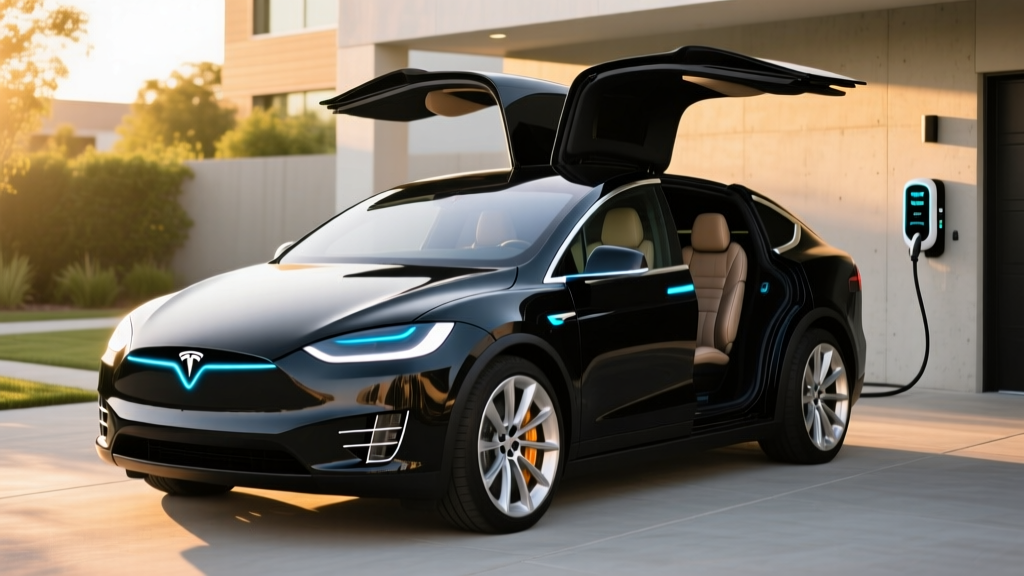
The Tesla Model X Plaid occupies a bizarre and fascinating corner of the EV market. It's a three-row SUV that hits 60 mph in 2.5 seconds, carries up to seven passengers, and still delivers over 300 miles of EPA-rated range. For the 2026 model year, the Plaid remains the performance flagship of Tesla's lineup — a 1,020-horsepower, tri-motor all-wheel-drive beast wrapped in a practical (if polarizing) falcon-wing package.
But at a starting MSRP of $94,990, and with the federal tax credit largely out of reach for this price bracket, the Model X Plaid is less a rational purchase and more a statement. This review breaks down the real numbers — range, charging speeds, efficiency, ownership costs — so you can decide whether the Plaid's absurd performance justifies its premium over the dual-motor Model X and rivals like the Rivian R1S or BMW iX M70.
| Spec | Value |
|---|---|
| EPA Range | 326 miles |
| Battery (usable) | ~100 kWh (NMC) |
| Drivetrain | Tri-Motor AWD |
| Horsepower | 1,020 hp |
| 0–60 mph | 2.5 seconds |
| Top Speed | 163 mph |
| Peak DC Fast Charge | 250 kW |
| 10–80% DC Charge Time | ~30 minutes |
| Level 2 Home Charge | 11.5 kW (~30 mi/hr) |
| MPGe (combined) | 101 MPGe |
| Efficiency | 33 kWh/100 mi |
| Cargo (behind 3rd row) | 43.0 cu ft |
| Cargo (max, seats folded) | 91.6 cu ft |
| Seating | 5, 6, or 7 passengers |
| Base MSRP | $94,990 |
| Battery Warranty | 8 yr / 150,000 mi |
| Basic Warranty | 4 yr / 50,000 mi |
Range and Efficiency: EPA Sticker vs. Real-World Reality
The EPA rates the 2026 Tesla Model X Plaid at 326 miles of combined range on its ~100 kWh (usable) NMC battery pack. That number is competitive for a performance SUV of this weight and power, but as any experienced EV owner knows, the sticker is only the starting point.
- Mild weather, mixed driving: ~290–310 miles achievable with moderate regen use
- Highway (75–80 mph sustained): ~250–275 miles — the Plaid's wide tires and 5,185-lb curb weight hurt efficiency at speed
- Cold weather (below 32°F): Expect 220–260 miles; Tesla's heat pump helps, but cabin heating and battery conditioning still draw significant energy
- Performance driving: Aggressive acceleration can cut range by 40%+ — launch control is fun but thirsty
The Plaid's efficiency of 33 kWh/100 miles (101 MPGe combined, per fueleconomy.gov) is reasonable given its mass and tri-motor setup, but it trails the dual-motor Model X Long Range, which achieves roughly 104 MPGe and 348 miles of EPA range. The trade-off for 1,020 horsepower is roughly 5–7% less range and slightly higher energy consumption.
For road trips, the 326-mile rating means realistic 250-mile legs between Supercharger stops when driving highway speeds — still comfortable given Tesla's charging network density, but plan accordingly in rural corridors.
Charging Speed: Supercharger Network Advantage
The Model X Plaid supports a peak DC fast-charge rate of 250 kW on V3 Tesla Superchargers. In practice, Tesla's battery preconditioning (which activates automatically when you navigate to a charger) enables the pack to hit peak charge rate quickly and sustain it through the critical 10–50% state-of-charge window.
| Charging Level | Power | Speed / Time |
|---|---|---|
| Level 1 (120V standard outlet) | ~1.4 kW | ~3–4 miles per hour |
| Level 2 (240V home, Wall Connector) | 11.5 kW | ~30 miles per hour (~10 hrs for full charge) |
| DC Fast (V3 Supercharger) | Peak 250 kW | ~175 miles in 15 min; 10–80% in ~30 min |
| DC Fast (V4 Supercharger) | Peak 250 kW | Same peak; V4 offers improved cable handling |
| CCS Adapter (non-Tesla networks) | Up to ~150–175 kW typical | 10–80% in ~40–50 min (varies by station) |
Charging curve reality: The Plaid peaks at 250 kW around 15–25% SoC, then progressively tapers. By 60% SoC, expect ~120–140 kW; above 80%, the rate drops to under 50 kW as the battery management system protects cell longevity. This is standard NMC behavior — if you're road-tripping, charging to 80% and driving on is significantly faster than waiting for 100%.
At home, Tesla's Gen 3 Wall Connector delivers up to 11.5 kW on a 48-amp circuit (requiring a 60-amp breaker). That translates to roughly 30 miles of range per hour of charging — more than enough to replenish a day's driving overnight. A full Level 2 installation typically costs $800–$2,000 including the $475 Wall Connector unit, electrician labor, and permits, assuming your electrical panel doesn't need an upgrade.
Performance: 1,020 Horsepower in a Family SUV
Let's not bury the lede: the Model X Plaid hits 60 mph in 2.5 seconds. That puts it in supercar territory — a number that still feels surreal when you're sitting in a vehicle with three rows of seats, a 17-inch touchscreen, and falcon-wing rear doors.
The tri-motor powertrain features one front motor and two rear motors, delivering precise torque vectoring and relentless all-wheel-drive traction. The Plaid uses carbon-sleeved rotors in its permanent-magnet motors to sustain high-RPM output without overheating — the engineering reason it can hold peak power longer than most EVs during repeated hard launches.
Beyond straight-line speed, the Plaid's adaptive air suspension lowers the vehicle at highway speeds for improved aerodynamics, and the torque-vectoring rear axle helps rotate this 5,185-lb SUV through corners with surprising composure. It's not a track car, but it defies its mass in a way no rival three-row SUV can match.
For context, the dual-motor Model X Long Range does 0–60 in about 3.8 seconds — still quick by any measure. The Plaid's 1.3-second advantage is the kind of gap you feel viscerally, not just see on a spec sheet.
Interior, Tech, and Cargo: Practicality Meets the Yoke
The Model X interior remains a study in minimalism and maximum screen real estate. The 17-inch center touchscreen handles virtually every vehicle function, from climate to suspension height to media. A secondary 8-inch screen for rear passengers controls climate and entertainment. The 12.3-inch driver cluster and available yoke steering (a no-cost option) define the cockpit.
Standout tech features:
- Tesla Supercharger network: Over 50,000+ Superchargers globally, with native navigation integration and automatic preconditioning
- Autopilot (standard): Adaptive cruise control, lane centering, automatic emergency braking — SAE Level 2 driver-assist, requiring continuous driver attention
- Full Self-Driving (Supervised): $8,000 option adding automatic lane changes, Navigate on Autopilot, traffic light/stop sign recognition, and parking assist. Still Level 2 — not autonomous driving
- HEPA air filtration: "Bioweapon Defense Mode" with hospital-grade cabin air filtration
- Gaming and media: 10-teraflop compute for in-car gaming, Netflix, YouTube, and Spotify
- Power-folding second and third rows: One-touch fold for cargo flexibility
Tesla Autopilot and FSD (Supervised) are SAE Level 2 driver-assistance systems. They do not make the Model X a self-driving vehicle. You must keep your hands on the wheel (or yoke) and remain fully engaged at all times. The driver is legally responsible for all vehicle operation. FSD (Supervised) does not yet meet SAE Level 3 or Level 4 autonomy.
Notable drawbacks:
- Falcon-wing doors: Dramatic but mechanically complex; they require overhead clearance to open fully and have historically been a reliability concern
- Yoke steering: Controversial — some owners love it, others find it impractical for parking lots and tight turns where hand-over-hand is natural
- Build quality variance: Panel gaps and interior trim inconsistencies have improved but remain a common owner complaint relative to the price
- No Apple CarPlay or Android Auto: Tesla's proprietary infotainment is capable but closed; no phone projection
- Third-row space: Usable for children and short trips but tight for adults on longer drives (31.2 inches of third-row legroom)
Pricing, Tax Credit Eligibility, and Ownership Costs
The 2026 Tesla Model X Plaid starts at $94,990 (including destination). Options can push the price significantly higher:
| Item | Cost |
|---|---|
| Base MSRP (Plaid AWD) | $94,990 |
| FSD (Supervised) option | +$8,000 |
| 6-seat interior (captain's chairs) | +$6,500 |
| 22" Turbine wheels | +$5,500 |
| Premium paint (e.g., Ultra Red) | +$2,500–$3,000 |
| As-tested (loaded example) | ~$115,000–$120,000 |
| Federal EV Tax Credit (§30D) | $0 (see below) |
Federal Tax Credit: Does the Model X Plaid Qualify?
Short answer: No — for most buyers, the Model X Plaid does not qualify for the §30D federal EV tax credit.
Under current IRS rules, the §30D credit imposes an MSRP cap of $80,000 for SUVs. The Model X Plaid's $94,990 starting price exceeds this cap, making it ineligible regardless of buyer income or battery sourcing. Even the dual-motor Model X Long Range, starting around $79,990, sits at the razor's edge of this threshold depending on options and model-year adjustments.
- MSRP cap (SUVs): $80,000 — Model X Plaid exceeds this
- Buyer income cap: $150K single / $300K joint filers — irrelevant here since MSRP already disqualifies
- Battery sourcing / critical minerals: Must meet phase-in thresholds for North American content — moot at this price
- Point-of-sale transfer: Available for qualifying vehicles — not applicable to the Plaid
For the latest rules, consult IRS §30D guidance or speak with a tax professional. State-level incentives may still apply depending on your jurisdiction — check your local DMV or energy office.
5-Year Ownership Cost Snapshot
Even without the tax credit, the Model X Plaid offers fuel-cost savings over comparable gas SUVs. Charging at home at the national average of ~$0.16/kWh, the Plaid costs roughly $5.28 per 100 miles to fuel — compared to approximately $14–$16 per 100 miles for a gas SUV averaging 18 mpg at $3.50/gallon. Over 5 years and 75,000 miles, that's roughly $7,000–$8,000 in fuel savings.
However, offset that against higher insurance premiums (the Plaid typically costs 25–40% more to insure than the Model X Long Range), faster tire wear (performance tires on a heavy, high-torque SUV), and limited depreciation data for the tri-motor variant. Plan for total 5-year ownership costs in the $85,000–$100,000 range depending on financing, insurance, and maintenance.
How the Model X Plaid Compares
The Plaid's closest rivals aren't really in its performance league, but they compete for the same buyer's wallet in the luxury electric SUV space:
| Spec | Tesla Model X Plaid | Rivian R1S Quad-Motor | BMW iX M70 |
|---|---|---|---|
| Price | $94,990 | ~$99,900 | ~$111,500 |
| EPA Range | 326 mi | ~321 mi (Max Pack) | ~296 mi |
| 0–60 mph | 2.5 sec | 3.0 sec | 3.6 sec |
| Horsepower | 1,020 hp | 830 hp | 610 hp |
| Seating | 5/6/7 | 7 | 5 |
| Peak DC Charge | 250 kW | ~200 kW | ~200 kW |
| Charging Network | Supercharger (native) | Supercharger (NACS adapter) + public | CCS public networks |
| Tax Credit Eligible | No (MSRP cap) | No (MSRP cap) | No (MSRP cap) |
- You want the absolute fastest-accelerating production SUV available
- Tesla's Supercharger network is your primary road-trip infrastructure
- You value over-the-air updates and Tesla's software ecosystem
- Third-row seating for up to 7 is a must-have
- You need genuine off-road capability (Rivian R1S is far more capable off-pavement)
- Build quality and interior refinement are top priorities (BMW iX excels here)
- You want to tow more than 5,000 lbs (Model X tows up to 5,000 lbs; R1S tows 7,700 lbs)
- Federal tax credit eligibility is a dealbreaker — none of these qualify at this price point
Pros and Cons
- 2.5-second 0–60 mph — fastest production SUV on the market
- 326-mile EPA range despite tri-motor performance
- Access to Tesla Supercharger network (most reliable DC fast-charging in the US)
- Spacious interior with 5/6/7-seat configurations and up to 91.6 cu ft cargo
- Standard Autopilot with robust ADAS feature set
- Over-the-air updates continuously add features
- HEPA cabin air filtration standard
- 8-year / 150,000-mile battery and drive unit warranty
- $94,990 starting price with no federal tax credit eligibility
- Falcon-wing doors add mechanical complexity and overhead clearance constraints
- Build quality still inconsistent at this price point
- Yoke steering is impractical for some drivers
- No Apple CarPlay or Android Auto support
- Third row is tight for adults on long trips
- Real-world highway range drops to ~250–275 miles
- Higher insurance and tire costs vs. dual-motor Model X
Who the Model X Plaid Is Really For
The Model X Plaid is not a rational purchase — it's an emotional one with practical underpinnings. It makes the most sense for:
- Performance enthusiasts with families who refuse to sacrifice speed for practicality and want a single vehicle that can do school runs, road trips, and quarter-mile passes
- Existing Tesla ecosystem owners who rely on the Supercharger network and Tesla's software integration and want the ultimate Tesla SUV
- Buyers in the $100K+ luxury SUV market cross-shopping the Porsche Cayenne Turbo E-Hybrid, BMW X7, or Mercedes GLS but who want full electric and unmatched acceleration
It's not the right choice if you prioritize interior luxury over raw speed, need serious off-road capability, or want to maximize value per dollar — the dual-motor Model X Long Range delivers 95% of the practicality for roughly $15,000 less.
Frequently Asked Questions
What is the real-world range of the Tesla Model X Plaid?
The EPA rates the Plaid at 326 miles combined. In real-world driving, expect approximately 290–310 miles in mild mixed conditions, 250–275 miles on sustained highway driving at 75+ mph, and 220–260 miles in freezing temperatures. Performance driving will reduce range significantly — aggressive acceleration can cut it by 40% or more.
How fast does the Model X Plaid charge at home and on the road?
On a V3 Supercharger, the Plaid peaks at 250 kW and can add roughly 175 miles in 15 minutes, with a 10–80% charge taking about 30 minutes. At home on a Level 2 Tesla Wall Connector (11.5 kW), expect about 30 miles of range per hour — a full charge from empty takes roughly 10 hours overnight.
Does the Tesla Model X Plaid qualify for the federal EV tax credit?
No. The IRS §30D credit caps SUV eligibility at $80,000 MSRP. The Model X Plaid starts at $94,990, making it ineligible regardless of buyer income or battery sourcing. State-level incentives may still apply — check your local energy office or DMV for details. Consult a tax professional for personalized advice.
Is the Model X Plaid worth buying over the dual-motor Model X?
If raw performance is your priority and budget allows, the Plaid's 2.5-second 0–60 and tri-motor torque vectoring are unmatched. However, the dual-motor Model X Long Range offers more range (348 miles EPA), lower cost (~$79,990), potentially lower insurance, and still delivers a 3.8-second 0–60. For most buyers, the Long Range is the smarter value proposition.
How does the Model X Plaid compare to the Rivian R1S?
The Plaid is faster (2.5s vs. 3.0s to 60) and has access to the native Supercharger network. The R1S offers superior off-road capability, higher towing capacity (7,700 lbs vs. 5,000 lbs), a more traditional interior, and a larger battery option. Both exceed the $80K tax credit cap. Choose the Plaid for speed and charging infrastructure; choose the R1S for adventure and utility.
What is the battery warranty on the Model X Plaid?
Tesla covers the Plaid's battery and drive units for 8 years or 150,000 miles, whichever comes first, with a guaranteed minimum 70% capacity retention over that period. The basic vehicle warranty is 4 years / 50,000 miles. Tesla's NMC battery packs have demonstrated strong longevity in real-world fleet data, with most vehicles retaining 90%+ capacity at 100,000 miles.
Can the Model X Plaid tow, and how much?
Yes. The Model X Plaid has a maximum towing capacity of 5,000 pounds when properly equipped with the factory tow package. This is sufficient for a small boat, light utility trailer, or a pair of jet skis, but falls short of the Rivian R1S (7,700 lbs) for heavier loads. Note that towing significantly reduces range — expect a 30–50% reduction depending on trailer weight and aerodynamics.