Verdict: The Fastest SUV Ever Built — With Caveats
If you search for "Model X Plaid 1/4 mile" you're likely chasing one number: 9.4 seconds at roughly 150 mph. That quarter-mile figure makes the three-motor Tesla Model X Plaid the quickest production SUV on the planet, outpacing the Lamborghini Urus Performante and every other internal-combustion rival. But the 1,020-horsepower tri-motor powertrain is only half the story.
The 2026 Model X Plaid still delivers a 326-mile EPA range estimate, seats up to six, tows 5,000 pounds, and charges at up to 250 kW on Tesla's Supercharger network. It also carries a six-figure price tag, a yoke steering wheel that divides opinion, and no federal EV tax credit eligibility thanks to MSRP caps. Here's every number that matters before you configure one.
| Spec | Value |
|---|---|
| EPA Range | 326 miles (20" wheels) |
| Battery (usable) | ~100 kWh, NMC chemistry |
| Drivetrain | Tri-Motor AWD (1 front, 2 rear) |
| Horsepower | 1,020 hp |
| 0-60 mph | 2.5 seconds |
| 1/4 Mile | 9.4 sec @ ~150 mph |
| Top Speed | 163 mph |
| Max DC Fast Charge | 250 kW (V3 Supercharger) |
| 10-80% DC Time | ~32 minutes |
| Level 2 Home Charge | 11.5 kW (~30 mi/hr) |
| Efficiency | 101 MPGe combined / 33 kWh/100mi |
| Cargo (behind 3rd row) | 15.0 cu ft |
| Cargo (max, seats folded) | 85.1 cu ft |
| Towing Capacity | 5,000 lbs |
| Base MSRP | $94,990 |
| Federal Tax Credit (§30D) | Not eligible (exceeds MSRP cap) |
| Battery Warranty | 8 years / 150,000 miles |
Range and Efficiency: Real-World Expectations
Real-World Highway (70 mph, moderate weather): ~265-285 miles
Cold Weather (below 32°F, highway): ~220-250 miles
Mixed Commute (city + suburban): ~290-310 miles
The Model X Plaid's ~100 kWh NMC (nickel-manganese-cobalt) battery pack provides substantial energy reserves, but the tri-motor setup and 5,000+ pound curb weight demand more electrons per mile than a dual-motor EV. According to the EPA, the Plaid achieves 101 MPGe combined, translating to 33 kWh per 100 miles — roughly 15% less efficient than the dual-motor Long Range variant.
On a 300-mile highway road trip at 70 mph in 65°F weather, expect to arrive with approximately 10-15% state of charge remaining. In sub-freezing temperatures, battery resistance increases and cabin heating draws additional power; plan for 220-250 miles of usable range and precondition the battery before every DC fast-charge stop. Tesla's heat pump helps mitigate cold-weather losses compared to resistive heaters, but physics still wins.
Choosing the optional 22-inch wheels reduces EPA range to 311 miles due to increased rolling resistance and weight. For maximum range, stick with the standard 20-inch setup.
Charging: 250 kW Peak, But Read the Curve
| Level | Power | Speed (miles added) | Typical Use |
|---|---|---|---|
| Level 1 (120V outlet) | ~1.4 kW | ~3-4 mi/hr | Emergency / trickle |
| Level 2 (240V, 48A Wall Connector) | 11.5 kW | ~30 mi/hr | Home overnight |
| DC Fast (V3 Supercharger) | Peak 250 kW | ~200 mi in 15 min | Road trips |
| DC Fast (V4 Supercharger) | Peak 250 kW* | ~200 mi in 15 min | Newer stations |
*The Model X Plaid's onboard architecture limits DC intake to 250 kW even at V4 posts capable of higher output.
Tesla advertises "200 miles in 15 minutes" at a V3 Supercharger, and that's achievable — but only from a low state of charge (around 5-10%). The charge curve matters: the Plaid pulls its peak 250 kW only between roughly 5% and 25% SoC. From 25-50%, power tapers to approximately 175 kW. From 50-80%, expect 100-130 kW. Above 80%, charging slows dramatically to protect the NMC cells, dropping below 50 kW. A full 10-80% session takes approximately 32 minutes at a V3 Supercharger with a preconditioned battery.
For home charging, Tesla's Wall Connector at 48 amps delivers 11.5 kW, adding roughly 30 miles of range per hour. A full overnight session (8-10 hours) easily replenishes a depleted pack. Installation typically requires a 60-amp dedicated circuit; budget $800-$2,500 for a licensed electrician depending on panel proximity and local permit requirements. Always have a licensed electrician assess your panel capacity before installation.
With Tesla's NACS connector now the industry standard, Model X owners benefit from access to the full Supercharger network (20,000+ stalls in North America) plus growing CCS-adapter compatibility at third-party networks like Electrify America.
The Model X Plaid 1/4 Mile and Performance Numbers
The headline stat: the Model X Plaid runs the 1/4 mile in approximately 9.4 seconds at 150 mph on a prepped surface. That figure places it in hypercar territory — ahead of the Ferrari F8 Tributo and alongside the McLaren 720S — in a three-row family SUV weighing over 5,100 pounds.
The tri-motor powertrain uses one permanent-magnet motor up front and two induction motors at the rear, with torque vectoring across the rear axle. Combined output is 1,020 horsepower. Tesla's claimed 0-60 mph time of 2.5 seconds (with rollout subtracted) is repeatable on P-zero tires with Launch Mode engaged and the battery above 90% SoC. Independent testing by Motor Trend and Car and Driver has validated 2.6-second runs under real-world conditions.
Beyond straight-line speed, the Plaid's adaptive air suspension lowers the vehicle at speed, and the carbon-ceramic brake package (a $15,000 option) provides fade-resistant stopping power from triple-digit speeds. Without the carbon ceramics, repeated hard launches will overheat the standard steel rotors quickly. Track use demands that option.
Pricing, Trims, and Federal Tax Credit Eligibility
| Item | Cost |
|---|---|
| Base MSRP (Model X Plaid) | $94,990 |
| Destination Fee | $1,995 |
| 22" Sonic Carbon Wheels | $5,500 |
| Carbon Ceramic Brakes | $15,000 |
| FSD (Supervised) Purchase | $8,000 |
| Six-Seat Interior | $6,500 |
| Typical As-Tested Price | $115,000 - $131,000 |
| Federal Tax Credit (§30D) | $0 — Exceeds $80,000 SUV MSRP cap |
| Estimated State Incentives | Varies by jurisdiction |
The Model X Plaid does not qualify for the $7,500 federal EV tax credit under IRS §30D rules. The law caps eligible SUVs at $80,000 MSRP, and the Plaid starts at $94,990 before any options. Even the base dual-motor Model X Long Range ($79,990 in 2026) sits right at the threshold, and adding any factory option pushes it over.
Additionally, §30D imposes buyer income limits ($300,000 joint / $150,000 single for new vehicles), critical-mineral sourcing requirements, and North American battery assembly rules. Since the Plaid exceeds the MSRP cap regardless of your income or the battery's origin, the credit is simply unavailable. Some states offer separate rebates or tax incentives — check your local DMV or energy office for current programs.
Interior, Cargo, and Technology
The Model X Plaid seats five standard (two-row bench) or six with the optional second-row captain's chairs. Third-row access comes via the power-folding second row, though the rear seats suit children best — adults will find legroom tight at 32.7 inches in the third row. Second-row passengers enjoy 40.9 inches of legroom, and front occupants get 41.2 inches.
Cargo volume measures 15.0 cubic feet behind the third row, 37.1 cubic feet behind the second row, and 85.1 cubic feet with both rear rows folded. The front trunk (frunk) adds approximately 6.5 cubic feet for charging cables or a carry-on bag.
The 17-inch center touchscreen runs Tesla's latest software, featuring a PlayStation-grade gaming system (Cyberpunk 2077 runs at full detail), Netflix/YouTube streaming while parked, and over-the-air updates that periodically add features. The yoke steering wheel is standard on the Plaid — a round wheel is not available. The yoke takes roughly two weeks of adaptation and remains controversial for parking-lot maneuvering where hand-over-hand input is natural.
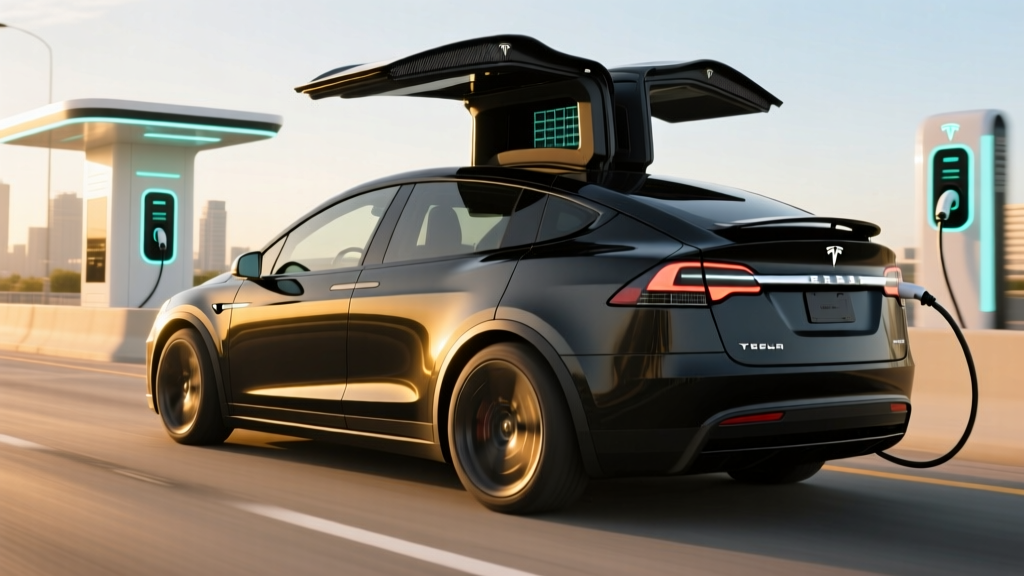
A 22-speaker audio system, HEPA air filtration (with Bioweapon Defense Mode), and power-falcon-wing rear doors round out the notable features. The falcon-wing doors provide dramatic curb appeal and easier third-row loading in tight spaces, but they add mechanical complexity and have historically been a source of sensor and seal issues. Tesla has improved reliability in recent model years, but they remain a unique maintenance consideration.
Ownership Costs, Warranty, and Long-Term Outlook
Tesla covers the Model X battery and drive unit for 8 years or 150,000 miles (whichever comes first), with a guaranteed minimum 70% capacity retention during that period. The limited vehicle warranty runs 4 years / 50,000 miles. These terms are competitive with Rivian, BMW, and Mercedes-Benz EV warranties, though Hyundai's 10-year/100,000-mile battery coverage is more generous.
NMC battery chemistry offers excellent energy density (enabling the 326-mile range in a package this size) but degrades slightly faster than LFP chemistry over very high cycle counts. Best practices for longevity: keep daily charging to 80-90%, avoid prolonged storage at 100%, and use DC fast charging sparingly (road trips, not daily). Tesla's battery management system is among the most sophisticated in the industry, and real-world data from high-mileage Model S/X owners shows typical degradation of 10-15% over 100,000 miles.
Insurance premiums for the Model X Plaid are substantial — expect $3,500-$5,500 annually depending on your location, age, and driving record. The combination of a $100,000+ vehicle, 1,020 horsepower, and Tesla-specific repair costs drives premiums higher than most luxury SUVs. Get quotes before ordering.
Electricity costs for charging vary dramatically by region. At the national average of $0.16/kWh, a full home charge (100 kWh) costs roughly $16, providing about 280 real-world miles — equivalent to $2.50/gallon gasoline. Supercharger rates average $0.30-$0.35/kWh, bringing road-trip fuel costs closer to $4.00/gallon-equivalent.
How the Model X Plaid Compares
The Plaid's competitive set is narrow because nothing else matches its speed in an SUV body. But buyers cross-shop it anyway:
- Tesla Model X Long Range ($79,990): Same body, 348-mile EPA range, 3.8-second 0-60, potentially tax-credit eligible. The rational choice unless you need 2.5-second launches.
- Rivian R1S Quad-Motor ($99,900+): 1,025 hp, superior off-road capability, more traditional SUV styling, 5,000-lb towing. Less Supercharger convenience, newer company with shorter reliability track record.
- BMW iX M60 ($111,500): 610 hp, 296-mile range, exceptional interior luxury, more refined ride. Significantly slower, but quieter and more comfortable as a daily driver.
- Mercedes EQS SUV 580 ($104,400): 536 hp, 305-mile range, first-class interior. Not a performance rival; chosen for comfort over speed.
Choose the Model X Long Range instead if: You want 95% of the utility, 22 more miles of EPA range, a $15,000 savings, and potential tax credit eligibility.
Look at Rivian R1S if: You need genuine off-road capability, prefer conventional styling, or want to support a challenger brand.
Pros and Cons
- 9.4-second 1/4 mile — fastest production SUV
- 326-mile EPA range is strong for a 1,000+ hp vehicle
- Access to 20,000+ Tesla Superchargers
- 5,000-lb towing with a full-size SUV's cargo space
- Continuous OTA updates add new features post-purchase
- Tri-motor torque vectoring provides exceptional all-weather traction
- No federal tax credit eligibility (MSRP exceeds cap)
- Yoke steering is standard — no round wheel option
- Falcon-wing doors add complexity and potential maintenance cost
- Insurance premiums are among the highest of any SUV
- Third-row legroom is tight for adults (32.7")
- Carbon ceramic brakes are a $15,000 necessity for track use
- Efficiency drops significantly vs. Long Range (33 vs ~29 kWh/100mi)
Frequently Asked Questions
What is the Tesla Model X Plaid 1/4 mile time?
The Model X Plaid runs the quarter mile in approximately 9.4 seconds at roughly 150 mph on a prepped drag surface with Launch Mode engaged and the battery above 90% state of charge. This makes it the quickest production SUV ever recorded.
What is the real-world range of the Model X Plaid?
The EPA rates it at 326 miles on 20-inch wheels. In real-world highway driving at 70 mph, expect 265-285 miles. In cold weather (below freezing), plan for 220-250 miles. City driving with regenerative braking can approach or slightly exceed the EPA number.
How fast does the Model X Plaid charge?
At a Tesla V3 Supercharger, it peaks at 250 kW and charges from 10-80% in approximately 32 minutes with a preconditioned battery. At home on a 48-amp Level 2 Wall Connector, it adds about 30 miles of range per hour (11.5 kW).
Does the Model X Plaid qualify for the federal EV tax credit?
No. Under IRS §30D, SUVs must have an MSRP at or below $80,000 to qualify. The Model X Plaid starts at $94,990, making it ineligible regardless of buyer income or battery sourcing. State incentives may still apply — check your local jurisdiction.
Is the Model X Plaid worth buying over the Long Range?
If you value 2.5-second 0-60 times, torque-vectoring AWD, and the prestige of the fastest SUV badge, the $15,000 premium is justifiable. For most families, the Long Range offers nearly identical space, more range (348 miles), and significant savings — plus potential tax credit eligibility. The Plaid is an enthusiast purchase, not a rational one.
How long will the Model X Plaid battery last?
Tesla warranties the battery for 8 years or 150,000 miles with at least 70% capacity retention. Real-world data from high-mileage Teslas suggests 10-15% degradation at 100,000 miles with proper charging habits (daily limit of 80-90%, minimal DC fast charging). The pack should comfortably last 200,000+ miles before approaching the warranty threshold.
Can I tow with the Model X Plaid?
Yes. The Model X Plaid is rated to tow 5,000 pounds when properly equipped with Tesla's tow hitch. Expect range to decrease by 30-50% while towing a loaded trailer, depending on weight, aerodynamics, and terrain.