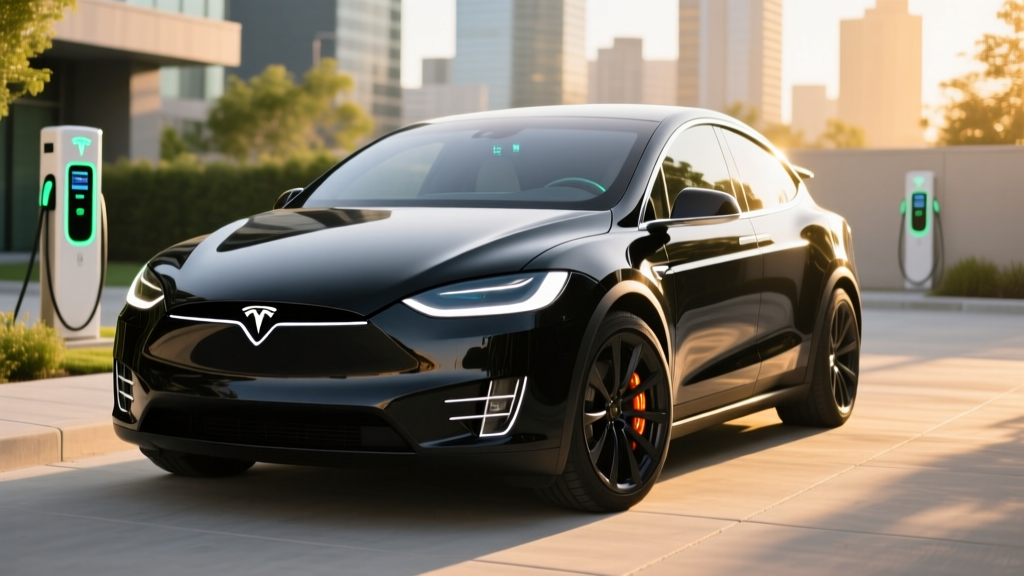
The Tesla Model X Plaid occupies a strange corner of the EV market: a three-row family hauler that accelerates like a hypercar. With 1,020 horsepower on tap and a 0–60 mph time of 2.5 seconds, it defies the physics you'd expect from a 5,185-pound SUV. But beyond the headline-grabting Tesla Model X Plaid horsepower figure, buyers need to know about real-world range, charging speed, interior practicality, and whether the federal tax credit applies. This review covers every spec that matters for a 2026 purchase decision.
Quick Verdict: Who Should Buy the Model X Plaid?
The Model X Plaid is best suited for high-income families or enthusiasts who want supercar acceleration wrapped in a practical three-row SUV with access to Tesla's Supercharger network. It's a strong pick for road-trippers who value charging infrastructure, tech-forward commuters who want Autopilot/FSD capability, and buyers who need towing capacity (up to 5,000 lbs). It's less ideal for budget-conscious shoppers, buyers who prioritize interior material quality, or those who need maximum third-row space for adults.
Spec Table: Tesla Model X Plaid at a Glance
| Specification | 2026 Tesla Model X Plaid |
|---|---|
| Drivetrain | Tri-Motor AWD |
| Horsepower | 1,020 hp |
| 0–60 mph | 2.5 seconds |
| Top Speed | 163 mph |
| Battery Capacity (usable) | ~100 kWh (NMC) |
| EPA Range | 326 miles (20" wheels) / 311 miles (22" wheels) |
| Efficiency | 101 MPGe combined / 33 kWh/100mi |
| Max DC Fast Charge | 250 kW (peak) |
| 10–80% DC Charge Time | ~32 minutes |
| Level 2 Home Charging | 11.5 kW (~36 mi/hr) |
| Base MSRP | ~$94,990 |
| Battery Warranty | 8 years / 150,000 miles |
| Seating | 5, 6, or 7 passengers |
| Cargo (behind 3rd row) | ~15 cu ft |
| Max Cargo (all rows folded) | ~85.1 cu ft |
| Towing Capacity | 5,000 lbs |
Range & Efficiency: Real-World Expectations vs. EPA Sticker
EPA Estimate: 326 miles (20" wheels) / 311 miles (22" wheels)
Expect in real-world highway driving: ~270–290 miles at 75 mph
Cold-weather highway (below 32°F): ~230–260 miles
City/regenerative driving: Closer to EPA sticker, ~300–320 miles
The Model X Plaid uses a ~100 kWh usable battery pack with NMC (nickel manganese cobalt) chemistry, which prioritizes energy density and performance over the cycle longevity of LFP cells. The EPA rates it at 326 miles with the standard 20-inch wheels, dropping to 311 miles with the optional 22-inch turbine wheels due to increased rolling resistance and weight.
According to fueleconomy.gov, the Plaid achieves 101 MPGe combined (33 kWh per 100 miles). In practice, efficiency degrades significantly at sustained highway speeds. The Model X's large frontal area and falcon-wing door sealing gaps create aerodynamic drag that becomes pronounced above 70 mph. On a 300-mile highway trip at 75 mph in moderate temperatures, plan for roughly 270–290 miles of usable range before needing to stop.
Cold weather compounds this. Below freezing, NMC chemistry experiences increased internal resistance, and cabin/battery heating draws additional power. Expect a 20–30% range reduction in winter highway conditions. Tesla's heat pump and battery preconditioning help mitigate this, but physics is physics — a 326-mile sticker becomes roughly 230–260 miles on a cold January interstate run.
Charging Speed: DC Fast Charging and Home Level 2
The Model X Plaid charges via Tesla's proprietary NACS connector and has full access to the Tesla Supercharger network — currently the most reliable and extensive DC fast-charging ecosystem in North America. With the included NACS-to-CCS adapter (or native NACS on newer vehicles), it can also access Electrify America and other CCS networks, though reliability varies.
| Charging Method | Power (kW) | Speed / Notes |
|---|---|---|
| Tesla Supercharger V3 (DC) | Up to 250 kW (peak) | ~175 miles in 15 min; 10–80% in ~32 min |
| Tesla Supercharger V4 (DC) | Up to 250 kW | Same as V3 for Model X; cable length improved |
| CCS Station (via adapter) | Up to ~150–175 kW (typical) | Varies by station; 10–80% in ~40 min |
| Tesla Wall Connector (Level 2) | 11.5 kW (48A) | ~36 miles per hour of charging |
| Standard 240V Outlet (Level 2) | ~7.2 kW (30A) | ~22 miles per hour |
| 120V Outlet (Level 1) | ~1.4 kW (12A) | ~4 miles per hour — emergency only |
Understanding the charge curve: The 250 kW peak only applies at low state-of-charge (roughly 10–30%). As the battery fills, the charge rate tapers to protect cell health. By 60% SoC, you're typically seeing 120–150 kW. Above 80%, charging slows dramatically to under 50 kW. This is why the 10–80% time (~32 minutes) is the most useful metric — the final 20% can take another 25+ minutes and is rarely worth waiting for on a road trip.
For home charging, Tesla's Wall Connector at 48 amps (11.5 kW) adds about 36 miles of range per hour. A full overnight charge from 20% to 90% takes roughly 8–9 hours, which is ideal for daily use. Installation typically requires a 60-amp dedicated circuit; budget $500–$2,000 for a licensed electrician depending on your panel capacity and conduit run. If your home has a 200-amp panel with spare capacity, installation is straightforward. Older 100-amp panels may require an upgrade ($1,500–$3,000+).
Performance: 1,020 Horsepower and What It Actually Feels Like
The headline number is 1,020 horsepower, generated by Tesla's tri-motor powertrain: one motor on the front axle and two on the rear (with torque vectoring). This setup delivers all-wheel drive with independent rear-wheel torque distribution, which is critical for putting this much power to the ground without excessive wheelspin.
The 0–60 mph time of 2.5 seconds (with rollout subtracted) makes the Model X Plaid one of the quickest production SUVs ever built. For context, that's faster than a Lamborghini Huracán and comparable to a Bugatti Chiron from a standstill. The instant torque delivery of electric motors means there's no turbo lag or transmission shift delay — the acceleration is immediate and relentless through about 50 mph, after which it tapers but remains forceful.
Top speed is electronically limited to 163 mph. The adaptive air suspension lowers the vehicle at speed for aerodynamic efficiency and can raise it for rough roads or steep driveways. Brake feel is typical of heavy EVs with regenerative braking: the transition between regen and friction brakes can feel slightly abrupt, though Tesla has refined this over successive OTA updates.
One practical note: launching the Plaid repeatedly will heat-soak the battery and motors, triggering power-reduction protections. This is a track limitation, not a daily-driving concern. The thermal management system is robust for normal use, including highway merging and passing.
Interior, Tech, and Standout Features
The Model X interior is defined by its 17-inch landscape touchscreen, which controls virtually every vehicle function — climate, media, navigation, vehicle settings, and even the glovebox. A secondary 8-inch screen in the rear serves second-row passengers. The latest Model X refresh includes a yoke-style steering wheel (a conventional round wheel is available at no extra charge, though availability varies by order configuration).
Standout features:
- Falcon Wing rear doors: Power-operated gullwing-style doors with ultrasonic sensors that adjust opening arc for low ceilings and tight parking spaces. Genuinely useful for loading child seats.
- Autopilot (standard) / FSD Supervised (optional ~$8,000): SAE Level 2 driver-assistance. Autopilot handles lane-centering and adaptive cruise. FSD adds automatic lane changes, traffic light/stop sign recognition, and parking assist. The driver must remain fully engaged at all times — this is not self-driving.
- Gaming and entertainment: The front screen supports gaming (including titles like Cyberpunk 2077) while parked, and streaming services. A 22-speaker audio system is included.
- HEPA air filtration: The "Bioweapon Defense Mode" uses a hospital-grade HEPA filter — genuinely excellent for wildfire smoke and allergy sufferers.
- Over-the-air updates: Tesla continuously pushes software updates that add features, refine performance, and improve efficiency.
Notable drawbacks:
- Interior material quality still lags behind Mercedes, BMW, and Lucid at this price point. Hard plastics are visible on lower door panels and the center console.
- The yoke steering wheel is polarizing and can be impractical for low-speed maneuvering and parking (Tesla has added variable-ratio steering to compensate, but it takes acclimation).
- Third-row space is tight for adults — best suited for children on longer trips. Legroom in the third row is approximately 32.7 inches.
- Panel gaps and build-quality inconsistencies, while improved from earlier years, remain a known concern among owners.
- No Apple CarPlay or Android Auto — Tesla's proprietary system is the only interface.
Tesla Autopilot and Full Self-Driving (Supervised) are SAE Level 2 systems. This means the vehicle can assist with steering and acceleration/braking under specific conditions, but the driver must remain attentive, keep hands on the wheel (or demonstrate attention via the cabin camera), and be prepared to take over instantly. These systems do NOT make the vehicle autonomous. Misuse has led to NHTSA investigations and crashes. Always drive as though no assistance system is active.
Pricing, Trims, and Federal Tax Credit Eligibility
| Trim | Base MSRP (2026 est.) | Typical As-Tested |
|---|---|---|
| Model X (Dual-Motor AWD) | ~$74,990 | $78,000–$85,000 |
| Model X Plaid (Tri-Motor AWD) | ~$94,990 | $98,000–$110,000+ |
The Model X Plaid starts at approximately $94,990 before destination fees. Options that push the price higher include the 22-inch wheels (~$5,500), FSD Supervised (~$8,000), premium interior colors, and the six- or seven-seat configurations. A fully loaded Plaid can reach $110,000–$115,000.
Federal Tax Credit: Does the Model X Plaid Qualify?
This is where the Model X Plaid faces a significant headwind under current IRS §30D rules. According to irs.gov, the federal clean vehicle credit has strict eligibility requirements:
- MSRP Cap for SUVs/Vans/Pickups: $80,000 maximum. The Model X Plaid at ~$94,990 exceeds this cap and does not qualify for the $7,500 federal tax credit.
- Buyer Income Cap: Modified AGI must not exceed $300,000 (married filing jointly), $225,000 (head of household), or $150,000 (single). Even if the price qualified, many Plaid buyers would exceed these thresholds.
- Battery Sourcing Requirements: Critical minerals and battery components must meet escalating domestic/free-trade-partner sourcing percentages. Tesla's supply chain has been adapting, but this is a moving target.
- Point-of-Sale Transfer: Eligible buyers can transfer the credit to the dealer at purchase for an instant price reduction — but this only matters if the vehicle qualifies.
Bottom line: The Model X Plaid does not qualify for the federal §30D tax credit due to its MSRP exceeding the $80,000 SUV cap. The standard dual-motor Model X may also exceed the cap depending on configuration. Buyers should consult a tax professional and verify current-year rules at irs.gov before assuming any credit eligibility.
Some states offer additional incentives that are not bound by the federal MSRP cap — check your state's energy office or DMV for details, as these vary significantly by jurisdiction.
Warranty and Long-Term Ownership
Tesla provides the following warranty coverage for the Model X Plaid:
- Basic Vehicle Limited Warranty: 4 years / 50,000 miles
- Battery & Drive Unit Warranty: 8 years / 150,000 miles, with retention of at least 70% battery capacity during the warranty period
The 150,000-mile battery warranty is more generous than the 120,000-mile coverage on the standard Model X, reflecting Tesla's confidence in the Plaid's thermal management under high-performance use. NMC chemistry typically degrades faster than LFP in the first 20,000–30,000 miles (roughly 5–8% loss), then stabilizes. Most Tesla owners report 10–15% total degradation at 100,000 miles based on aggregated fleet data, which would still leave the Plaid with roughly 280+ miles of range at that milestone.
Battery replacement out of warranty is a significant cost — estimated at $15,000–$22,000+ for a 100 kWh pack including labor. However, complete pack failures are rare; most degradation is gradual capacity loss rather than catastrophic failure.
Model X Plaid vs. Competitors: Is It Worth Buying?
The Model X Plaid competes in a narrow segment of high-performance electric SUVs. Here's how it stacks up against key rivals:
| Metric | Tesla Model X Plaid | BMW iX M60 | Mercedes EQS SUV 580 | Lotus Eletre R |
|---|---|---|---|---|
| Horsepower | 1,020 hp | 610 hp | 536 hp | 905 hp |
| 0–60 mph | 2.5 sec | 3.6 sec | 4.4 sec | 2.95 sec |
| EPA Range | 326 mi | ~296 mi | ~305 mi | ~270 mi (est.) |
| Max DC Charge | 250 kW | ~195 kW | ~200 kW | ~350 kW |
| Seating Rows | Up to 3 | 2 | Up to 3 | 2 |
| Base Price | ~$94,990 | ~$111,500 | ~$105,550 | ~$107,000 |
| Charging Network | Tesla Supercharger | CCS/NACS | CCS/NACS | CCS/NACS |
Choose the Tesla Model X Plaid if:
- You want the quickest-accelerating production SUV available
- Access to the Tesla Supercharger network is a priority for road trips
- You need a third row for occasional child/family use
- You value OTA software updates and Tesla's tech ecosystem
- Interior luxury and material quality are your top priorities (BMW iX, Mercedes EQS SUV)
- You want Apple CarPlay/Android Auto (every competitor offers this)
- You prefer a conventional steering wheel and traditional controls
- You need a longer battery warranty or dealer-service-network convenience
Pros and Cons
- 1,020 hp and 2.5-sec 0–60 — unrivaled SUV acceleration
- 326-mile EPA range is competitive for the class
- Tesla Supercharger network access (best-in-class reliability)
- Falcon wing doors genuinely aid child-seat loading
- HEPA air filtration is class-leading
- OTA updates continuously add features
- 5,000-lb towing capacity
- ~$95K+ starting price; no federal tax credit eligibility
- Interior quality lags BMW/Mercedes at this price point
- Third row is tight for adults
- No Apple CarPlay or Android Auto
- Yoke steering is divisive (round wheel availability varies)
- Panel gap and build consistency concerns persist
- Service center wait times can be lengthy in some markets
Frequently Asked Questions
What is the real-world range of the Tesla Model X Plaid?
The EPA rates the Model X Plaid at 326 miles (20" wheels). In real-world highway driving at 75 mph, expect roughly 270–290 miles. In cold weather (below freezing) on the highway, plan for 230–260 miles. City driving with regenerative braking gets you closer to the EPA sticker.
How fast does the Model X Plaid charge at home and on the road?
On a Tesla V3 Supercharger, it peaks at 250 kW and charges from 10–80% in approximately 32 minutes. At home with a Tesla Wall Connector (48A/11.5 kW), it adds about 36 miles of range per hour — a full overnight session easily replenishes daily driving.
Does the Tesla Model X Plaid qualify for the $7,500 federal EV tax credit?
No. Under current IRS §30D rules, the Model X Plaid's MSRP (~$94,990) exceeds the $80,000 cap for SUVs/vans/pickups. It does not qualify for the federal clean vehicle credit regardless of buyer income. State-level incentives may still apply — check your state's energy office.
Is the Model X Plaid worth buying over the BMW iX M60 or Mercedes EQS SUV?
If raw performance and Supercharger access are your priorities, yes — nothing matches the Plaid's 1,020 hp and 2.5-second 0–60. If interior luxury, traditional controls, and CarPlay matter more, the BMW iX M60 or Mercedes EQS SUV offer a more refined experience at similar or higher prices.
How long will the Model X Plaid battery last?
Tesla warranties the Plaid's battery for 8 years / 150,000 miles with at least 70% capacity retention. Based on fleet data, NMC packs in Teslas typically lose 10–15% capacity at 100,000 miles, then degrade more slowly. With proper care (avoiding frequent 100% charges, using preconditioning), the pack should outlast 200,000 miles with usable range.
Can the Model X Plaid tow, and does towing affect range?
Yes, it's rated for 5,000 lbs of towing capacity. Towing a trailer near that limit will reduce range by approximately 40–50%, bringing effective range down to roughly 150–180 miles. Plan charging stops accordingly.