Quick Verdict: The P90D's Place in Tesla's SUV Lineup
The Tesla Model X P90D occupies a specific niche in the electric SUV market: it's the used-market performance bargain for buyers who want Ludicrous-mode acceleration in a three-row family hauler. Produced primarily for the 2016–2017 model years, the P90D pairs a 90 kWh battery pack with Tesla's dual-motor all-wheel-drive system and the performance-oriented "P" rear motor. With an EPA-estimated 250 miles of range and a 0–60 mph time of 3.2 seconds (with Ludicrous Mode enabled), it remains one of the quickest SUVs ever sold — electric or otherwise.
But buying a P90D in 2026 means navigating the used EV market, understanding battery degradation on an 8–9 year-old pack, and accepting that Tesla no longer sells this configuration new. This review breaks down what the P90D delivers, what it costs on the secondary market, and whether it still holds up against modern competitors like the refreshed Model X, Rivian R1S, and BMW iX.
Range, Battery, and Real-World Efficiency
The P90D's 90 kWh battery pack uses NMC (nickel-manganese-cobalt) lithium-ion chemistry — the standard Tesla used before the company began offering LFP (lithium iron phosphate) packs in some Model 3 and Model Y variants. NMC offers higher energy density than LFP, which is how Tesla fit 90 kWh into the Model X platform, but it is more sensitive to sustained high state-of-charge storage and extreme temperatures.
Real-World Expectation: Plan for 210–230 miles in mixed driving. Highway cruising at 75+ mph drops efficiency to roughly 200–215 miles effective range. In cold weather (below 32°F), expect a 15–25% reduction, putting effective range at 185–210 miles. Battery degradation on a 2016–2017 pack typically removes 10–18% of original capacity depending on charging history, further reducing usable range.
| Spec | Value |
|---|---|
| Battery Capacity | 90 kWh (NMC chemistry) |
| EPA Range | 250 miles |
| EPA Efficiency | 89 MPGe (combined) / 38 kWh/100 mi |
| Real-World Range (mixed) | 210–230 miles |
| Real-World Range (highway) | 200–215 miles |
| Real-World Range (cold weather) | 185–210 miles |
| Drivetrain | Dual-motor AWD |
| 0–60 mph (Ludicrous) | 3.2 seconds |
| Horsepower | ~532 hp (combined) |
| Cargo Volume (behind 3rd row) | 26.6 cu ft |
| Cargo Volume (all seats folded) | 88.1 cu ft |
| Seating | 5, 6, or 7 passengers |
The P90D's efficiency of roughly 38 kWh per 100 miles reflects its weight — the Model X tips the scales at approximately 5,100 lbs — and its aerodynamic drag from the tall SUV profile. For comparison, the 2025 Model X Long Range achieves about 102 MPGe combined, thanks to improved motors, a heat pump, and a more refined battery pack.
Charging Speed: DC Fast Charge and Home Level 2
Charging infrastructure has evolved dramatically since the P90D was new, but the vehicle's onboard charging hardware limits how much of that progress you can actually use.
| Charging Level | Power | Speed | Notes |
|---|---|---|---|
| Level 1 (120V) | ~1.4 kW | ~3–4 miles/hour | Emergency/trickle only; full charge in ~60+ hours |
| Level 2 (240V, 48A) | 11.5 kW | ~29 miles/hour | Full charge in ~8.5 hours; requires Wall Connector or equivalent |
| Level 2 (240V, 40A) | 9.6 kW | ~24 miles/hour | Common with older HPWC or third-party EVSEs |
| DC Fast Charge (Supercharger V2) | Peak ~120 kW | 10–80% in ~40 min | Sustained rate tapers significantly after 60% SoC |
| DC Fast Charge (Supercharger V3/V4) | Limited to ~120 kW | 10–80% in ~40 min | V3/V4 stalls can deliver 250+ kW, but P90D hardware caps at ~120 kW |
The P90D's DC fast-charging architecture tops out around 120 kW. While Tesla's V3 and V4 Superchargers can deliver 250 kW or more, the P90D's battery management system and pack architecture simply cannot accept that rate. Expect a realistic 10–80% charge in approximately 40 minutes at a V2 or V3 Supercharger stall.
Charging curve reality: The P90D will pull close to its 120 kW peak only between roughly 10–30% state of charge. Above 50%, the rate tapers to 60–80 kW, and above 80% it drops further to protect the NMC cells. This taper is more pronounced than on newer Tesla packs, so plan road-trip stops accordingly — the last 20% takes disproportionately long.
At home on a Level 2 Tesla Wall Connector (48 amps / 11.5 kW), the P90D adds about 29 miles of range per hour, meaning an overnight session of 7–8 hours easily replenishes a full day's driving. If your home electrical panel supports only a 40-amp circuit (common in older homes), you'll see about 24 miles per hour — still sufficient for most daily needs.
Performance and Driving Dynamics
The P90D's headline feature is Ludicrous Mode, which Tesla introduced as an upgrade over the standard "Insane" acceleration of the base 90D. With Ludicrous engaged, the P90D hits 0–60 mph in 3.2 seconds — a figure that embarrassed supercars at stoplights and remains genuinely startling in a 5,100-pound SUV with three rows of seats.
The dual-motor setup provides one AC induction motor on each axle, delivering full-time all-wheel drive with torque vectoring. Total system output is approximately 532 horsepower. The instant torque delivery characteristic of electric motors means there's no turbo lag or transmission hesitation — you press the pedal, and the P90D simply surges forward.
Ride quality is firm but controlled, thanks to the Model X's standard air suspension, which also provides adjustable ride height (useful for clearing steep driveways or light off-road situations). Steering is precise if somewhat numb, and the low center of gravity from the floor-mounted battery pack keeps body roll surprisingly contained for a vehicle this tall.
The P90D predates Tesla's current heat-pump-equipped thermal management system. Instead, it uses resistive cabin heating, which draws significantly more energy from the battery in cold weather — contributing to the 15–25% winter range loss noted above. Preconditioning the battery before Supercharging (by navigating to a Supercharger in the navigation system) warms the pack and improves charge acceptance, but the P90D's preconditioning is less aggressive than that of newer Teslas.
Tech, Interior, and Driver Assistance
The P90D-era Model X centers around a 17-inch portrait touchscreen running Tesla's software stack. While the hardware is slower than current Tesla infotainment processors, the interface remains responsive and receives periodic over-the-air updates (though major feature additions have slowed for legacy hardware).
Driver assistance: P90D vehicles shipped with either Autopilot Hardware 1 (HW1, MobilEye-based) or Hardware 2 (HW2, Tesla's custom neural network processor, introduced late 2016). HW1 vehicles have basic adaptive cruise control and lane-keeping. HW2 vehicles support Enhanced Autopilot and, with additional purchase, Full Self-Driving (Supervised) capability — though FSD on HW2 hardware has functional limitations compared to HW3/HW4 vehicles.
Standout features:
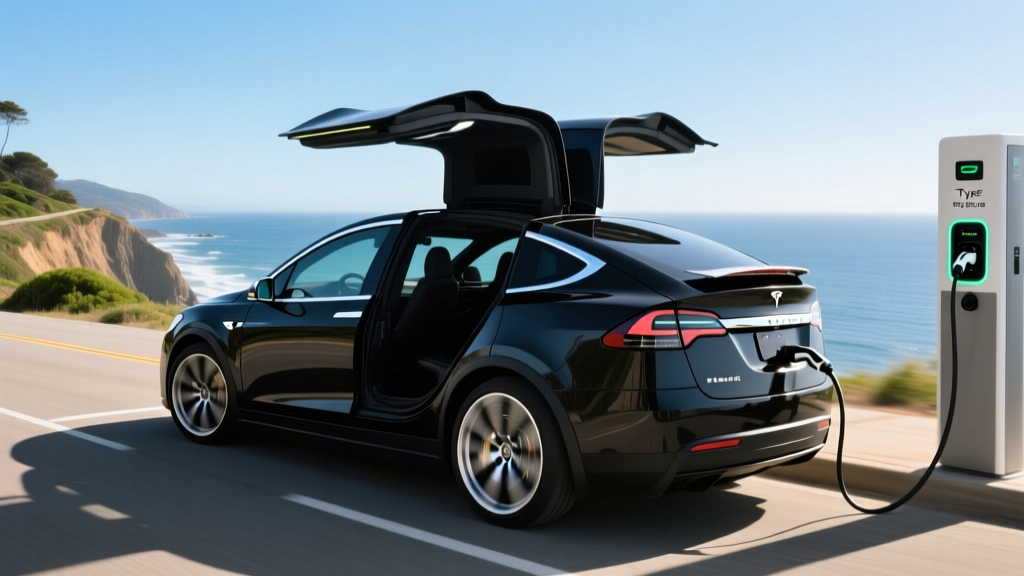
- Falcon Wing rear doors — dramatic, functional in tight parking spaces (with ultrasonic sensors to avoid overhead obstacles), but mechanically complex and a known source of maintenance issues
- Panoramic windshield extending over the front seats — excellent visibility and cabin openness
- HEPA air filtration with "Bioweapon Defense Mode" — genuinely effective cabin air quality
- Available towing package rated for up to 5,000 lbs
- Frunk (front trunk) providing additional cargo space
Notable drawbacks:
- Falcon Wing doors: seal leaks, sensor glitches, and expensive repairs are well-documented across early Model X production
- Panel gaps and interior build quality on 2016–2017 vehicles are inconsistent — some examples are excellent, others show noticeable misalignment
- No heat pump — cold-weather efficiency suffers compared to 2021+ Model X refresh
- Second-row seats in 6-passenger config don't fold flat, limiting cargo flexibility
- Aging MCU1 (Media Control Unit) in early 2016 builds — some owners have upgraded to MCU2 for better performance and to address the known eMMC flash memory failure issue
Pricing, Tax Credits, and Used-Market Value
Tesla does not sell the P90D new. On the used market in early 2026, a Model X P90D typically trades between $22,000 and $35,000, depending on mileage, battery health, Autopilot hardware version, and overall condition. Low-mileage examples with HW2 and documented battery replacements command the upper end of that range.
| Cost Factor | Details |
|---|---|
| Used Market Price (2026) | $22,000–$35,000 |
| Original MSRP (2016, as-tested typical) | $110,000–$135,000 |
| Federal Used EV Credit (§25E) | Up to $4,000 (30% of sale price, capped) — income limits apply |
| Federal New EV Credit (§30D) | Not applicable — vehicle is discontinued/not sold new |
| Estimated Annual Insurance | $2,200–$3,400 (varies by state, driver, coverage) |
Federal used-EV tax credit (§25E): The Inflation Reduction Act created a credit for purchasing a used electric vehicle from a licensed dealer. The credit equals 30% of the sale price, up to a maximum of $4,000. Eligibility requirements include:
- Sale price must be $25,000 or less
- Buyer adjusted gross income: ≤$75,000 (single), ≤$112,500 (head of household), ≤$150,000 (joint)
- Vehicle must be at least two model years old
- Purchase must be from a licensed dealer (private-party sales don't qualify)
- Credit is non-refundable — it can reduce your tax liability to zero but won't generate a refund beyond that
Because many P90D examples list above $25,000, not every purchase will qualify. Buyers should verify current IRS rules at irs.gov and consult a tax professional, as rules and dealer reporting requirements can change.
Battery Health, Warranty, and Long-Term Ownership
The P90D shipped with Tesla's battery and drive unit warranty of 8 years / 150,000 miles (whichever comes first), with a capacity retention threshold of 70%. For a 2016 model, that warranty has expired or is expiring in 2024–2025 depending on the original delivery date. A 2017 example may still have a few months of coverage remaining if mileage is low.
Battery degradation reality: NMC packs in the 90 kWh Model X typically lose 10–18% of original capacity over 8–9 years, depending on charging habits. Frequent Supercharging, regular charging to 100%, and exposure to extreme heat accelerate degradation. A P90D with 12% degradation would show approximately 220 miles of range at full charge (down from the original 250). Some owners report higher degradation on early 90 kWh packs, particularly those subjected to repeated Ludicrous Mode launches, which generate significant battery heat.
Battery replacement cost: Out of warranty, a Tesla Model X battery replacement in 2026 runs approximately $14,000–$20,000 depending on whether Tesla installs a new, remanufactured, or refurbished pack. This is a critical factor when evaluating a used P90D — a vehicle with a recently replaced battery under warranty is significantly more valuable than one on its original, degraded pack with no coverage remaining.
Ownership cost considerations:
- No oil changes, spark plugs, or transmission fluid — EV maintenance savings are real
- Brake pad life is extended significantly by regenerative braking (many owners report 80,000+ miles on original pads)
- Tire wear is higher than comparable ICE SUVs due to the Model X's weight and instant torque — budget for replacement every 25,000–35,000 miles
- Air suspension components and Falcon Wing door actuators are known wear items with expensive out-of-warranty repairs
- Home charging at $0.13/kWh national average yields roughly $0.05/mile in energy cost vs. $0.14/mile for a comparable gasoline SUV at $3.50/gallon and 20 MPG
How the P90D Compares to Modern Alternatives
| Attribute | Model X P90D (2016–2017) | Model X Long Range (2025) | Rivian R1S Dual-Motor (2025) | BMW iX xDrive50 (2025) |
|---|---|---|---|---|
| EPA Range | 250 mi | 335 mi | 316 mi | 324 mi |
| Battery | 90 kWh NMC | 100 kWh NMC | 128.9 kWh NMC | 111.5 kWh NMC |
| 0–60 mph | 3.2s (Ludicrous) | 3.8s | 5.0s | 4.4s |
| Peak DC Charge | ~120 kW | 250 kW | ~200 kW | 200 kW |
| 10–80% DC Time | ~40 min | ~25 min | ~35 min | ~31 min |
| Heat Pump | No | Yes | Yes | Yes |
| Used/New Price (2026) | $22K–$35K (used) | ~$80K+ (new) | ~$76K+ (new) | ~$87K+ (new) |
| 3rd Row | Yes | Yes | Yes (optional) | No |
The P90D's clear advantage is price. At $22,000–$35,000, it delivers supercar-rivaling acceleration, three-row seating, and Supercharger network access for a fraction of a new electric SUV. The trade-offs are range (85–100 fewer miles than modern competitors), slower charging, no heat pump, and the looming risk of out-of-warranty battery and suspension repairs.
Who Should Buy the Model X P90D?
- You want a 3-row electric SUV on a budget under $35,000
- Performance matters — you'll actually use Ludicrous Mode and appreciate the dual-motor AWD
- Your daily commute is under 80 miles round-trip, making the 210–230 mile real-world range sufficient
- You have home Level 2 charging and access to Tesla Superchargers for road trips
- You're comfortable buying used and budgeting for potential air suspension or battery service
- You need 300+ miles of range for frequent long road trips
- You live in a cold climate and can't tolerate 185-mile winter range
- You want current-generation driver-assist hardware (HW3/HW4) for FSD
- You want a full new-vehicle warranty and zero maintenance risk
- You need fast DC charging for regular 400+ mile trips
- 3.2-second 0–60 mph is extraordinary for any SUV
- Supercharger network access (NACS connector native)
- Three rows of seating with falcon-wing rear door convenience
- Used pricing represents massive depreciation discount from $130K+ original MSRP
- OTA software updates still delivered (though limited)
- HEPA cabin filtration is best-in-class
- 250-mile EPA range is below modern standards; real-world is lower
- 120 kW DC fast-charge cap means longer road-trip stops
- No heat pump — cold-weather range and efficiency suffer
- Falcon Wing doors are a maintenance liability
- Original battery warranty expired or expiring
- Build quality inconsistency on early production
- Aging HW1/HW2 Autopilot hardware limits FSD capability
Frequently Asked Questions
What is the real-world range of the Tesla Model X P90D?
The EPA rates the P90D at 250 miles. In real-world mixed driving, expect 210–230 miles. Highway driving at 75+ mph reduces this to about 200–215 miles. In freezing temperatures, range drops to approximately 185–210 miles. Battery degradation on a 2016–2017 vehicle further reduces these numbers by 10–18%, depending on the pack's charging history and current state of health.
How fast does the P90D charge at home and on DC fast chargers?
On a Level 2 home charger at 48 amps (11.5 kW), the P90D adds about 29 miles of range per hour — a full overnight session replenishes the pack. On DC fast charging (Tesla Supercharger), the P90D peaks at approximately 120 kW and charges from 10–80% in about 40 minutes. It cannot take advantage of V3/V4 Supercharger stalls' higher 250 kW output due to its older pack architecture.
Does the Tesla Model X P90D qualify for any federal tax credit?
The P90D does not qualify for the new-vehicle §30D credit because it is no longer sold new. However, if you purchase a used P90D from a licensed dealer for $25,000 or less, and your income falls within IRS limits ($75K single / $150K joint), you may qualify for the §25E used-EV credit of up to $4,000. Verify current rules at irs.gov before purchasing.
Is the P90D worth buying vs. a new Model X or Rivian R1S?
It depends entirely on budget and use case. The P90D at $22,000–$35,000 offers incredible performance-per-dollar, but you accept shorter range, slower charging, no heat pump, and potential out-of-warranty repair costs. If you can afford $75,000+, a new Model X Long Range or Rivian R1S delivers more range, faster charging, modern driver-assist hardware, and a full warranty. The P90D is the right call for budget-conscious buyers who prioritize acceleration and Tesla's Supercharger network over range and tech freshness.
What are the biggest maintenance concerns on a used P90D?
The top concerns are: (1) battery degradation and potential replacement cost ($14K–$20K out of warranty), (2) air suspension failure ($2,000–$4,000 per corner), (3) Falcon Wing door actuator and seal issues ($1,500–$3,000 per door), and (4) MCU1 eMMC flash memory failure on early 2016 builds (Tesla offered a recall/upgrade program — verify if it was completed). Drive units (motors) are generally reliable but have been replaced under warranty on some vehicles.
What Autopilot hardware does the P90D have?
Early 2016 P90D vehicles have Autopilot Hardware 1 (HW1), based on MobilEye technology, with basic adaptive cruise and lane-keeping. Late 2016 and 2017 P90D vehicles may have Hardware 2 (HW2), which supports Enhanced Autopilot and FSD (Supervised) — though HW2's processing capability is limited compared to HW3/HW4, and some FSD features may not function on HW2. Tesla offered a HW3 upgrade program for some HW2 vehicles — check the vehicle's Autopilot settings to confirm which hardware is installed.
Sources: EPA fuel economy data via fueleconomy.gov; IRS used clean vehicle credit rules via irs.gov; Tesla Model X specifications and owner documentation via tesla.com.