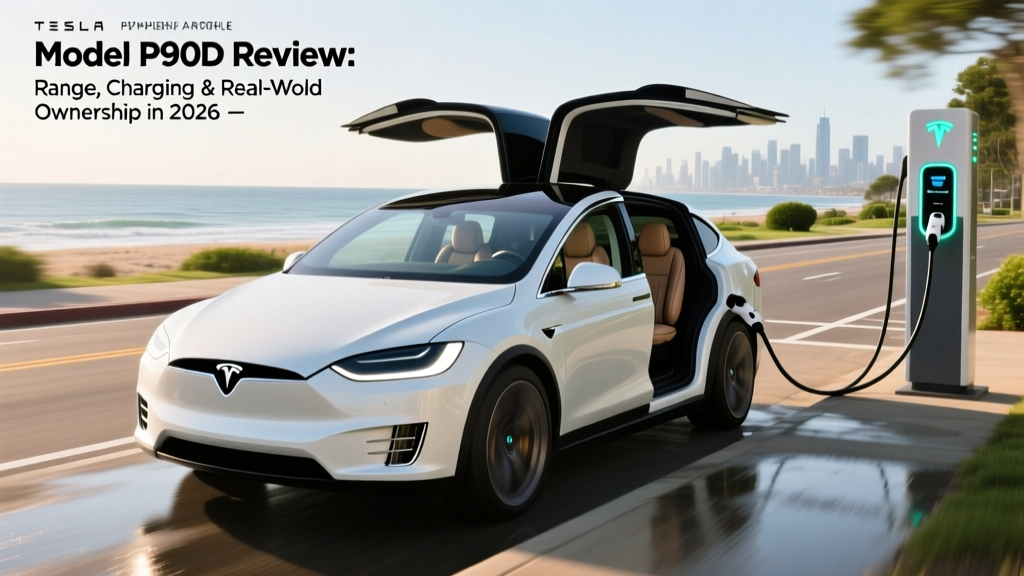
If you are shopping the used luxury electric SUV market, the Tesla Model X P90D remains one of the most recognizable nameplates you will encounter. Originally sold between late 2015 and 2016, the P90D was Tesla's flagship performance variant before the P100D replaced it. With its dual-motor all-wheel-drive layout, Ludicrous mode acceleration, and falcon-wing rear doors, the P90D carved out a unique niche that still resonates with buyers hunting for a high-performance three-row EV at a depreciated price.
This review evaluates the Model X P90D from a 2026 ownership perspective — covering real-world range expectations, charging infrastructure compatibility, battery longevity concerns for a pack approaching a decade old, and whether this early flagship still makes sense against modern competition.
Model X P90D at a Glance: Core Specifications
| Specification | Value |
|---|---|
| EPA Estimated Range | 250 miles |
| Battery Capacity (Usable) | ~85.5 kWh (90 kWh nominal, NMC) |
| Battery Chemistry | NMC (Nickel Manganese Cobalt) |
| Drivetrain | Dual-Motor AWD |
| 0-60 mph (Ludicrous) | 3.2 seconds |
| Horsepower | ~532 hp (combined) |
| Peak DC Fast-Charge Rate | ~120 kW (Supercharger V2) |
| 10-80% DC Charge Time | ~45 minutes |
| Level 2 Home Charging | Up to 17.2 kW (dual chargers), ~48 mi/hr |
| EPA Efficiency | 92 MPGe combined (36 kWh/100 mi) |
| Cargo Volume (behind 3rd row / max) | 26.6 cu ft / 88.1 cu ft |
| Seating | 5, 6, or 7 passengers |
| Battery Warranty (Original) | 8 years / unlimited miles |
Real-World Range: What to Actually Expect
EPA Sticker: 250 miles
Real-World Highway (65-75 mph): ~195-215 miles
Real-World City/Mixed: ~220-240 miles
Cold Weather (below 32°F): ~165-190 miles
The EPA-rated 250-mile range was impressive when the P90D launched, but real-world conditions tell a more nuanced story. Highway driving at sustained speeds of 70 mph or above pushes energy consumption well beyond the combined cycle, typically yielding between 195 and 215 miles on a full charge. The Model X's large frontal area and poor drag coefficient relative to sedans work against it at speed.
Cold weather compounds the issue. The P90D predates Tesla's heat pump adoption (introduced with the Model Y and refreshed Model 3), relying instead on resistive cabin heating and a less sophisticated battery thermal management system. Expect a 25-35% range reduction in freezing temperatures, dropping effective range to roughly 165-190 miles. Battery preconditioning helps mitigate charging-speed losses in cold weather but does not recover the range hit from cabin heating.
For a 2026 used buyer, the critical variable is battery degradation. A P90D with 80,000-120,000 miles on its original NMC pack will likely show 10-18% degradation depending on charging history and climate exposure. A car that originally delivered 250 EPA miles may now show 205-225 miles at 100% State of Charge. Always request a battery health reading or third-party diagnostic before purchase.
Charging Speed and Infrastructure Compatibility
| Charging Level | Power (kW) | Rate (mi/hr added) | Notes |
|---|---|---|---|
| Level 1 (120V household) | ~1.4 kW | ~3-4 mi/hr | Emergency/trickle only |
| Level 2 (240V, single charger) | ~11.5 kW | ~29 mi/hr | Standard home setup |
| Level 2 (240V, dual chargers) | ~17.2 kW | ~48 mi/hr | Optional; requires 100A circuit |
| DC Fast (Tesla Supercharger V2) | Up to 120 kW | ~250 mi/hr (peak) | ~45 min for 10-80% |
| DC Fast (CCS via adapter) | Up to ~120 kW | Varies | Tesla CCS adapter required |
The P90D's charging architecture reflects its era. On DC fast charging, the car peaks around 120 kW on Tesla's V2 Superchargers — respectable but far below the 250 kW peak that V3 and V4 Superchargers deliver to newer Teslas. The charge curve tapers significantly above 60% State of Charge, and the 10-80% session takes approximately 45 minutes. By comparison, a 2026 Model X Long Range on a V4 Supercharger can achieve 10-80% in roughly 25-30 minutes.
For home Level 2 charging, the P90D was available with optional dual onboard chargers, enabling up to 17.2 kW (requiring a 100-amp dedicated circuit). Most examples have the single charger at 11.5 kW, which adds roughly 29 miles per hour of charging — sufficient for overnight replenishment on a NEMA 14-50 outlet or Wall Connector.
One important compatibility note: the P90D uses Tesla's proprietary connector. As of 2026, Tesla provides a CCS1 adapter for legacy vehicles, allowing access to third-party DC fast-charging networks like Electrify America and EVgo. However, the P90D's onboard charge acceptance caps its benefit — you will not see faster speeds on a 350 kW CCS station than on a V2 Supercharger.
Performance and Driving Dynamics
The P90D's headline achievement was its Ludicrous mode, which enabled a 3.2-second 0-60 mph sprint — a figure that embarrassed supercars costing three times as much when it debuted. Even in 2026, that acceleration remains thrilling and usable. The dual-motor AWD system provides confident traction in rain and light snow, and the low center of gravity from the floor-mounted battery pack limits body roll better than most three-row SUVs.
However, the P90D is not a corner-carver. At roughly 5,300 pounds, mass is always present. Steering feel is numb by sports-SUV standards, and the air suspension — while offering adjustable ride height — can develop costly leaks as the vehicle ages. Budget $1,500-$3,000 for air strut replacement if the previous owner has not addressed them.
Regenerative braking on the P90D is strong but not as aggressive as newer Teslas, and the car does not offer true one-pedal driving to a complete stop. You will still use the friction brakes at low speeds.
Interior, Cargo, and Technology
The P90D's interior is defined by the 17-inch center touchscreen, which was class-leading in 2016 but now feels dated in resolution and responsiveness compared to modern Tesla interiors. Over-the-air software updates have kept the infotainment reasonably current — you still get navigation, streaming, and Tesla's app ecosystem — but the hardware is a generation behind.
The falcon-wing rear doors are the Model X's signature feature. They provide excellent access to the second and third rows in tight parking spaces, thanks to their double-hinged design. However, they are also a known source of rattles, sensor errors, and water leaks. Many owners report repeated service visits for door calibration. Check operation carefully during any pre-purchase inspection.
Cargo space is generous: 26.6 cubic feet behind the third row and 88.1 cubic feet with both rear rows folded. The front trunk (frunk) adds additional storage. Legroom is adequate in the second row (38.4 inches) but tight in the third row (32.7 inches), which is best suited for children.
Driver-assistance technology includes Tesla Autopilot, which is an SAE Level 2 system requiring continuous driver supervision. Full Self-Driving (FSD) capability may or may not transfer with a used P90D purchase — Tesla's transfer policy has changed repeatedly, and FSD purchased by the original owner does not always carry over to subsequent buyers. Verify FSD status directly with Tesla before committing.
Automation Level Clarification: Tesla Autopilot and FSD (Supervised) are SAE Level 2 driver-assistance systems. The driver must remain fully engaged, hands on or near the wheel, and eyes on the road at all times. These systems do not make the vehicle self-driving.
Pricing, Tax Credits, and Ownership Costs
As a used vehicle, the Model X P90D does not qualify for the new-vehicle federal tax credit under IRS §30D. However, it may qualify for the used clean vehicle credit (up to $4,000 or 30% of the sale price, whichever is less) if purchased from a licensed dealer and meeting income requirements.
| Item | Estimated Value |
|---|---|
| Used Market Price (2026, ~80k-100k mi) | $22,000 - $30,000 |
| Max Used-EV Tax Credit (30% of sale price) | Up to $4,000 |
| Effective Price After Credit | $18,000 - $26,000 |
| Average Annual Insurance | $2,200 - $3,400 |
| Estimated Annual Maintenance | $800 - $1,500 |
- Income Caps (Used Credit): AGI must not exceed $75,000 (single), $112,500 (head of household), or $150,000 (joint filers)
- Sale Price Cap: Vehicle must sell for $25,000 or less to qualify
- Dealer Requirement: Must be purchased from a licensed dealer, not private party
- Model Year Rule: Vehicle must be at least two model years old (P90D qualifies)
- One-Time Use: Buyer cannot have claimed the used-EV credit in the prior 3 years
Note: The $25,000 sale-price cap is a significant constraint. A P90D priced above $25,000 will not qualify for the used credit. Negotiating the sale price to or below this threshold is critical for capturing the $4,000 credit. Consult a tax professional and review current IRS guidance on the used clean vehicle credit before finalizing your purchase.
Battery Longevity and Warranty Considerations
The P90D's 90 kWh NMC battery pack was covered by Tesla's 8-year/unlimited-mile warranty against defects and degradation below 70% capacity retention. For a 2016 model, that 8-year window has now closed. This means any battery replacement or repair will be an out-of-pocket expense unless you purchase an extended warranty from a third-party provider.
Tesla's out-of-warranty battery replacement for the Model X has historically ranged from $14,000 to $22,000 depending on the pack configuration and service center. This is a critical risk factor when budgeting for a used P90D. Request a State of Health (SoH) report and look for packs showing less than 15% degradation.
The NMC chemistry in the P90D is more susceptible to calendar degradation from sustained high State of Charge and DC fast charging than the LFP packs Tesla now uses in base Model 3/Y variants. A P90D that was regularly charged to 100% and frequently Supercharged will show more wear than one kept between 20-80% on Level 2 charging.
Pros, Cons, and the Verdict
Pros
- Supercar-rivaling 3.2s 0-60 mph in Ludicrous mode
- Falcon-wing doors offer unique access and curb appeal
- Generous cargo space (88.1 cu ft max)
- Access to Tesla Supercharger network
- OTA software updates keep features current
- Strong used-value depreciation already absorbed
Cons
- Original battery warranty has expired (out-of-pocket risk)
- Real-world range of ~200 mi highway falls short of modern EVs
- Falcon-wing doors are a known reliability/maintenance issue
- 120 kW DC fast-charge peak is slow by 2026 standards
- No heat pump — cold-weather range loss is significant
- Dated interior hardware and screen resolution
Who the P90D suits best: The Model X P90D is best suited for buyers who want a high-performance three-row EV at a steep discount, can charge at home, and are prepared for potential out-of-warranty repair costs. It works well as a family hauler for daily commutes under 40 miles round-trip with home charging. It is less ideal for frequent road trippers (range and charge speed limitations) or those in cold climates without garage parking.
Is it worth buying vs. competitors? Against a used 2020-2022 Model Y Long Range ($30,000-$38,000), the P90D offers more cargo room and faster acceleration but sacrifices range, charging speed, and warranty coverage. A used Rivian R1S (2022+, ~$50,000) offers superior off-road capability and a fresher battery but at a higher entry price. The P90D occupies a narrow lane: maximum performance per dollar for buyers willing to accept the maintenance gamble.
Frequently Asked Questions
What is the real-world range of the Tesla Model X P90D?
The EPA rates the P90D at 250 miles, but real-world highway driving yields approximately 195-215 miles. City driving is closer to 220-240 miles. In cold weather below freezing, expect 165-190 miles. A used P90D with battery degradation may see these figures reduced by an additional 10-18%.
How fast does the Model X P90D charge?
On a Tesla V2 Supercharger, the P90D peaks at approximately 120 kW DC, achieving a 10-80% charge in about 45 minutes. At home on a Level 2 charger (11.5 kW), it adds roughly 29 miles per hour, fully recharging overnight in 8-9 hours.
Does the Tesla Model X P90D qualify for the federal EV tax credit?
The P90D does not qualify for the new-vehicle §30D credit. It may qualify for the used clean vehicle credit (up to $4,000) if the sale price is $25,000 or less, purchased from a licensed dealer, and the buyer meets income caps. See IRS used-EV credit rules for details.
How much does a battery replacement cost for the P90D?
Out-of-warranty Tesla battery replacements for the Model X typically range from $14,000 to $22,000. Third-party EV repair shops may offer refurbished pack swaps for $10,000-$15,000. Always check State of Health before purchase.
Is the P90D better than a newer Model Y?
The P90D offers more cargo space, a third row, and faster acceleration than a Model Y Long Range. However, the Model Y delivers superior range (~310-330 mi EPA), faster charging (250 kW peak), a heat pump, and likely remaining warranty coverage. For most buyers, a newer Model Y is the more practical choice; the P90D appeals to those prioritizing performance and three-row seating at a lower entry price.
Can the P90D use non-Tesla charging networks?
Yes, with Tesla's CCS1 adapter, the P90D can access Electrify America, EVgo, and other CCS-equipped networks. However, its charge acceptance is capped at roughly 120 kW, so it will not benefit from 350 kW chargers any more than it does from a V2 Supercharger.