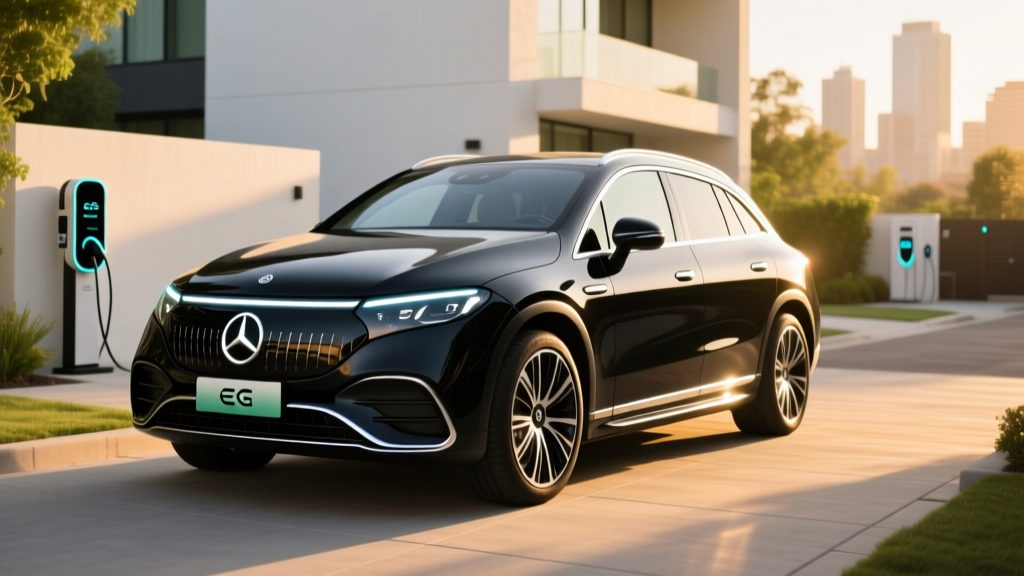
The Mercedes-Benz EQS SUV occupies a rare position in the electric-vehicle market: a full-size, three-row luxury hauler that actually delivers on range. With an EPA-estimated 305 miles on the EQS 580 4MATIC variant and a battery pack large enough to shrug off most road trips, it answers the question many luxury EV buyers have been asking — can I have premium comfort and genuine long-distance capability? The short answer is yes, but the nuances around charging behavior, tax-credit eligibility, and real-world efficiency deserve a closer look before you sign a six-figure purchase order.
Spec Table: 2026 EQS SUV at a Glance
| Specification | EQS 450+ (RWD) | EQS 450 4MATIC (AWD) | EQS 580 4MATIC (AWD) |
|---|---|---|---|
| EPA Range | 305 mi | 285 mi | 305 mi |
| Battery (Usable) | 108.4 kWh (NMC) | 108.4 kWh (NMC) | 108.4 kWh (NMC) |
| Horsepower | 355 hp | 355 hp | 536 hp |
| 0–60 mph | 6.5 sec | 5.8 sec | 4.4 sec |
| Drivetrain | Rear-Wheel Drive | Dual-Motor AWD | Dual-Motor AWD |
| MPGe (Combined) | 85 MPGe | 80 MPGe | 84 MPGe |
| Efficiency | 40 kWh/100 mi | 42 kWh/100 mi | 40 kWh/100 mi |
| Max DC Charge Rate | 200 kW | 200 kW | 200 kW |
| 10–80% DCFC Time | ~31 min | ~31 min | ~31 min |
| Level 2 Charge Rate | 9.6 kW (~26 mi/hr) | 9.6 kW (~26 mi/hr) | 9.6 kW (~26 mi/hr) |
| Cargo (Behind 3rd Row) | 14.0 cu ft | ||
| Cargo (Behind 2nd Row) | 42.0 cu ft | ||
| Cargo (Max, Rows Folded) | 80.0 cu ft | ||
| Base MSRP | $105,550 | $108,550 | $127,550 |
| Battery Warranty | 10 yr / 155,000 mi | ||
Range and Efficiency: What the EPA Number Doesn't Tell You
The EQS 450+ and EQS 580 4MATIC both carry an EPA-estimated 305 miles of range, while the 450 4MATIC drops to 285 miles due to the energy cost of powering both axles. That 108.4 kWh usable battery — one of the largest in any production SUV — gives this vehicle genuine cross-country legs. For context, that's roughly Los Angeles to Las Vegas on a single charge, or the full length of I-95 from Boston to Washington, D.C., with a single top-up.
EPA 305 mi (450+ and 580 4MATIC) — but expect approximately 250–275 miles at sustained highway speeds (70–80 mph) in moderate temperatures. In cold weather (below 32°F), plan for 210–240 miles of usable range before you need to stop. The EQS SUV's heat pump helps mitigate winter losses, but physics is physics: a 7,000-lb vehicle pushing through dense, cold air will consume more energy. City driving with regenerative braking recovers some of that gap — owners who commute primarily in stop-and-go traffic often report meeting or slightly exceeding the EPA figure.
Efficiency ratings land at 84–85 MPGe combined (roughly 40 kWh per 100 miles), which is respectable for a vehicle of this size but trails the more aerodynamic EQS sedan. The SUV's taller profile and greater frontal area create more drag, which matters most at highway speeds. If you're a highway-heavy driver, expect to visit chargers more often than the sticker suggests.
Charging Speed: 200 kW Peak, but Mind the Curve
All EQS SUV trims accept a maximum DC fast-charge rate of 200 kW via CCS1 connector (or NACS with adapter for Tesla Supercharger access). Mercedes quotes a 10–80% charge time of approximately 31 minutes under ideal conditions — meaning a preconditioned battery, a functioning 350 kW charger, and moderate ambient temperatures.
| Charging Level | Power / Rate | Miles Added per Hour | Typical Use Case |
|---|---|---|---|
| Level 1 (120V) | ~1.4 kW | ~3–4 mi/hr | Emergency / overnight trickle |
| Level 2 (240V, 40A) | 9.6 kW | ~26 mi/hr | Home daily charging |
| DC Fast Charge | Peak 200 kW | ~180 mi in 15 min (peak) | Road trips |
Here's where real-world ownership diverges from the spec sheet. The 200 kW figure is a peak, not a sustained rate. The EQS SUV's charging curve is aggressive in the 10–40% state-of-charge window, where it can pull close to its maximum rate. Above 60% SoC, the rate tapers significantly — often dropping below 80 kW — as the battery management system protects the NMC cells. This means the back half of your 10–80% session takes noticeably longer than the front half.
For home charging, the onboard 9.6 kW Level 2 charger is adequate. Plugging in overnight at a 40-amp Level 2 station (the most common home setup) adds roughly 26 miles of range per hour, meaning a full 0–100% charge takes about 11–12 hours. Most owners will never drain the battery completely, so a typical overnight session from 30% to 80% takes roughly 5–6 hours — perfectly manageable.
Preconditioning matters. The EQS SUV will warm or cool its battery pack automatically when you set a DC fast-charger as your navigation destination. Skipping this step — for example, pulling into a charger without routing through MBUX — can add 5–10 minutes to your session, especially in cold weather. Always navigate to your charger.
Performance and Driving Dynamics
The EQS 580 4MATIC is the performance flagship: 536 horsepower, 4.4 seconds to 60 mph, and a dual-motor AWD system that provides confident traction in rain and light snow. The 450 4MATIC offers the same AWD security with 355 hp and a 5.8-second sprint, while the 450+ sends 355 hp to the rear wheels only, reaching 60 mph in 6.5 seconds.
None of these are slow, but the EQS SUV is tuned for luxury, not sport. The air suspension soaks up road imperfections with the composure you'd expect from a Mercedes flagship, and the cabin isolation is among the best in any EV. Wind noise is minimal thanks to acoustic glass, and the low center of gravity (battery pack under the floor) keeps body roll controlled despite the vehicle's height. Rear-axle steering (standard on 580, optional on 450 trims) dramatically improves low-speed maneuverability — the turning circle shrinks to a surprisingly car-like dimension, making parking-lot navigation far less stressful than the EQS SUV's 207-inch length would suggest.
Interior, Tech, and the Hyperscreen Question
The MBUX Hyperscreen — a 56-inch curved glass panel spanning the entire dashboard — remains the EQS SUV's most polarizing feature. It integrates a 17.7-inch central OLED display, a 12.3-inch driver cluster, and a 12.3-inch passenger screen into a single seamless surface. The visual impact is stunning, and the system's processing power means animations and navigation render without lag. However, the all-touch interface requires a learning curve. Climate controls, seat adjustments, and even the glovebox release live behind menus, which some drivers find distracting.
Space is generous. Second-row passengers enjoy 40.3 inches of legroom, and the third row accommodates adults on shorter trips (29.1 inches of legroom — tight for anyone over 5'8" on longer drives). Cargo volume behind the third row is 14.0 cubic feet — enough for groceries or a couple of carry-ons but not a full family road trip without folding the third row. Fold both rear rows flat and you get 80.0 cubic feet, competitive with the BMW iX and slightly ahead of the Rivian R1S.
The driver-assistance suite includes Active Distance Assist DISTRONIC (adaptive cruise with stop-and-go), Active Steering Assist (lane centering), and Active Lane Change Assist. These systems constitute SAE Level 2 automation — the driver must remain engaged and hands must stay on or near the wheel. This is not autonomous driving. It's excellent highway assistance that reduces fatigue on long trips, but it will not navigate complex construction zones or unmapped roads without intervention.
Pricing, Tax Credits, and Total Cost of Ownership
The 2026 EQS SUV starts at $105,550 for the 450+ (including destination), $108,550 for the 450 4MATIC, and $127,550 for the 580 4MATIC. Well-optioned 580 models with the AMG Line package, rear-axle steering, and premium leather can push past $140,000.
The EQS SUV faces a significant hurdle: the IRS §30D federal tax credit has an MSRP cap of $80,000 for SUVs. Every EQS SUV trim exceeds this cap, making it ineligible for the $7,500 federal tax credit. Additionally, buyers must meet income thresholds ($300,000 MFJ / $150,000 single) and the vehicle's battery must meet critical-mineral and component sourcing requirements. Since the EQS SUV's MSRP disqualifies it outright, these other criteria are moot for this model. Always verify current rules at irs.gov before purchasing, as regulations can change.
Without the federal credit, the value proposition shifts. Consider a five-year ownership comparison against the BMW iX xDrive50 (starting ~$87,000, also over the MSRP cap) and the Rivian R1S Dual-Motor (starting ~$79,900, potentially credit-eligible). The EQS SUV commands a premium, but offsets it with lower projected maintenance costs versus ICE luxury SUVs, strong range reducing charging frequency, and Mercedes' brand residual values.
| Cost Factor (5-Year Estimate) | EQS 450+ SUV | BMW iX xDrive50 | Rivian R1S Dual-Motor |
|---|---|---|---|
| Purchase Price (base) | $105,550 | $87,250 | $79,900 |
| Federal Tax Credit | $0 | $0 | Up to $7,500* |
| Est. Charging Cost (5 yr) | ~$4,200 | ~$4,000 | ~$4,800 |
| Est. Maintenance (5 yr) | ~$1,800 | ~$2,200 | ~$1,500 |
| Est. Insurance (5 yr) | ~$14,500 | ~$12,800 | ~$11,200 |
*Rivian R1S eligibility depends on trim MSRP, buyer income, and battery sourcing. Verify at irs.gov.
Warranty and Battery Longevity
Mercedes-Benz provides a battery warranty of 10 years or 155,000 miles (whichever comes first), guaranteeing the pack will retain a minimum state of health. The standard vehicle warranty covers 4 years / 50,000 miles, which is typical for the luxury segment but trails Hyundai/Kia's 10-year powertrain coverage.
The NMC (nickel manganese cobalt) chemistry in the EQS SUV offers high energy density — that's how Mercedes fits 305 miles into a vehicle this size — but it's more sensitive to sustained high-state-of-charge storage than LFP (lithium iron phosphate) packs found in some competitors. Best practice: set your daily charge limit to 80% and only charge to 100% when you're departing on a road trip within a few hours. Following this guideline, NMC packs in vehicles of this generation are projected to retain 85–90% of original capacity after 150,000 miles based on current degradation data from similar platforms.
Pros, Cons, and Who Should Buy
- Class-leading 305-mile EPA range (450+ and 580)
- Exceptional ride comfort and cabin quietness
- Massive 108.4 kWh battery for road-trip confidence
- Rear-axle steering for tight-space maneuverability
- Strong Level 2 driver-assist suite for highway driving
- 10-year / 155,000-mile battery warranty
- $105k+ starting price; no federal tax credit eligibility
- 200 kW peak DC charge rate trails 800V competitors (Ioniq 5, Taycan)
- Third row is cramped for adults on longer trips
- Hyperscreen touch-only interface requires adjustment
- High insurance premiums typical of luxury EVs
- CCS1-native; NACS Supercharger access requires adapter
The EQS SUV is ideal for luxury-oriented families who prioritize ride comfort and range over sporty driving dynamics, need occasional third-row seating, and have reliable home Level 2 charging. It excels as a daily commuter for professionals who cover 40–80 miles per day and want to charge just once or twice a week. Road-trippers will appreciate the 305-mile range, though the 200 kW charge ceiling means stops take a few minutes longer than in 800V-architecture rivals. If you need maximum third-row space or sub-$80k pricing, look at the Rivian R1S or Kia EV9 instead.
Frequently Asked Questions
What is the real-world range of the EQS SUV?
The EPA rates the EQS 450+ and 580 4MATIC at 305 miles. In real-world highway driving at 70–80 mph, expect 250–275 miles. In cold weather (below freezing), plan for 210–240 miles. City driving with regenerative braking can match or slightly exceed the EPA figure.
How fast does the EQS SUV charge?
At a DC fast charger, it peaks at 200 kW and charges from 10–80% in approximately 31 minutes under ideal conditions. At home on a Level 2 (240V, 40A) charger, it adds about 26 miles per hour, taking roughly 11–12 hours for a full charge from empty.
Does the EQS SUV qualify for the federal EV tax credit?
No. The IRS §30D credit has an $80,000 MSRP cap for SUVs, and every EQS SUV trim starts above $105,000. It does not qualify for the $7,500 federal credit regardless of buyer income or battery sourcing. Check irs.gov for the latest rules.
Is the EQS SUV worth buying versus the BMW iX or Rivian R1S?
Choose the EQS SUV if you want maximum range, the most luxurious ride quality, and don't mind the premium price without a tax credit. Choose the BMW iX if you want a sportier drive and a lower entry price. Choose the Rivian R1S if you need a genuinely usable third row, want off-road capability, and may qualify for the federal credit on lower trims.
What's the biggest drawback of the EQS SUV?
The price-to-credit mismatch is the most significant issue: you're paying $105,000+ without access to the $7,500 federal incentive. Secondary concerns include the 200 kW charge ceiling (slower than 800V rivals), a cramped third row, and a touch-heavy interface that not all drivers enjoy.
How long will the EQS SUV battery last?
Mercedes warranties the battery for 10 years / 155,000 miles. NMC chemistry, when properly managed (daily charge limit set to 80%, avoiding prolonged 100% storage), is projected to retain 85–90% capacity at 150,000 miles based on degradation data from similar platforms. Full battery replacement, if needed out of warranty, typically costs $15,000–$25,000 at current rates.