The P90D Model X in 2026: Still a Benchmark or Showing Its Age?
If you've been researching the P90D Model X — Tesla's dual-motor, performance-tuned electric SUV from the 2016–2017 model years — you're likely weighing whether a used example still makes sense against today's newer EVs. The P90D badge signaled Tesla's 90 kWh battery pack paired with a performance rear motor, delivering supercar-rivaling acceleration in a three-row family hauler. Nearly a decade on, the P90D Model X remains a compelling used-EV proposition, but its real-world range, charging behavior, and battery health demand a hard look before you sign any paperwork.
This review breaks down every number that matters: EPA range versus what you'll actually see on the highway in January, DC fast-charge curves on Tesla's V3 and V4 Superchargers, Level 2 home charging economics, and the federal used-EV tax credit that can knock up to $4,000 off the purchase price. We'll also stack the P90D against current competitors like the Rivian R1S, Hyundai Ioniq 9, and the refreshed 2026 Tesla Model X to help you decide where your money goes furthest.
| Spec | Value |
|---|---|
| EPA Range (original sticker) | 250 miles |
| Battery Capacity (usable) | ~90 kWh (NMC chemistry) |
| Drivetrain | Dual-motor AWD |
| Horsepower | ~532 hp (combined) |
| 0–60 mph | 3.2 seconds (with Ludicrous mode) |
| Max DC Fast Charge | ~120 kW peak (Supercharger) |
| Level 2 Charge Rate | Up to 17.2 kW (48A on HPWC/Gen 2 Wall Connector) |
| MPGe (combined, EPA) | 92 MPGe |
| Efficiency | 36 kWh/100 mi |
| Seating | 5, 6, or 7 passengers |
| Cargo (behind 3rd row / max) | 26.6 cu ft / 88.1 cu ft |
| Battery Warranty (original) | 8 years / unlimited miles (70% retention) |
| Original MSRP (2016) | ~$115,000–$135,000 depending on options |
| Typical Used Price (2026) | $28,000–$42,000 depending on mileage & battery health |
Real-World Range: What the 250-Mile EPA Sticker Doesn't Tell You
The P90D Model X left the factory with an EPA-estimated 250 miles of range. That figure assumed a mix of city and highway driving at moderate temperatures. In 2026, with most P90D examples carrying 80,000–140,000 miles, actual range depends heavily on two factors: battery degradation and driving conditions.
- EPA sticker (new): 250 miles
- Expected 2026 range (healthy pack, 70°F): 195–225 miles depending on SoH
- Highway at 75 mph: ~175–200 miles (aerodynamic drag hits the Model X hard at speed)
- Cold weather (below 32°F): 150–180 miles — NMC packs lose 20–30% range in deep cold, and the Model X's resistive cabin heater (pre-heat-pump generation) compounds the loss
- City / stop-and-go with regen: Closest to EPA — 200–230 miles on a healthy pack
The 90 kWh NMC (nickel-manganese-cobalt) pack in the P90D was among Tesla's best at the time, but NMC chemistry degrades faster in the first 50,000 miles before leveling off. Expect a well-maintained P90D at 100,000 miles to retain roughly 80–88% of original capacity — translating to about 200–220 miles of mixed-driving range. Always request a battery health report (accessible via the Tesla app or third-party tools like Tessie or Recurrent) before purchase.
The Model X's large frontal area and falcon-wing door mechanisms add weight and drag. At highway speeds above 70 mph, efficiency drops noticeably compared to the sedan-platform Model S P90D, which EPA-rated at 268 miles with the same pack. If your commute is mostly interstate, budget for 180-mile practical range and plan charging stops accordingly.
Charging the P90D: Supercharger Speeds, Home Setup, and the 80% Taper
Charging speed is the P90D Model X's most dated characteristic. While 2026 EVs routinely accept 200–350 kW on DC fast chargers, the P90D's battery management system caps DC charging at roughly 120 kW peak — and that peak only holds between approximately 10% and 40% state of charge before tapering significantly.
| Charging Level | Power (kW) | Speed (miles of range per hour) | 10–80% Time |
|---|---|---|---|
| Level 1 (120V / 12A) | ~1.4 kW | ~3–4 mi/hr | N/A (50+ hours) |
| Level 2 (240V / 48A, Tesla Wall Connector) | ~11.5 kW | ~30–34 mi/hr | ~6.5 hours |
| Level 2 (240V / 32A, Mobile Connector) | ~7.7 kW | ~20–23 mi/hr | ~9 hours |
| DC Fast (Tesla V3 Supercharger, 250 kW stall) | ~120 kW peak | ~280 mi/hr (at peak) | ~45–55 minutes |
| DC Fast (Tesla V2 Supercharger, 150 kW stall) | ~105 kW peak | ~240 mi/hr (at peak) | ~55–65 minutes |
Understanding the charge curve: Lithium-ion batteries accept charge fastest at low states of charge and slow dramatically as they fill — much like pouring water into a glass without spilling. The P90D hits its ~120 kW peak around 15–35% SoC, then drops to ~80 kW by 50%, ~45 kW by 70%, and trickles below 20 kW past 85%. A 10–80% session on a V3 Supercharger takes roughly 45–55 minutes, which is competitive for road trips but noticeably slower than a 2026 Hyundai Ioniq 5 (10–80% in ~18 minutes at 240 kW).
Home charging: The P90D's onboard charger supports up to 48 amps on a 240-volt circuit using a Tesla High Power Wall Connector (HPWC) or Gen 2 Wall Connector. That delivers roughly 30–34 miles of range per hour — enough to fully replenish a depleted pack overnight. Installation of a NEMA 14-50 outlet or hardwired Wall Connector typically runs $800–$2,500 depending on your electrical panel's capacity and proximity to the garage. A licensed electrician should verify your panel has at least 60 amps of spare capacity before committing to a 48-amp circuit.
Connector note: The P90D uses Tesla's proprietary connector (now standardized as NACS). With Tesla opening its Supercharger network to non-Tesla EVs via the Magic Dock adapter, the P90D retains native access to the largest fast-charging network in North America — a significant ownership advantage. For CCS-equipped public chargers (Electrify America, EVgo), you'll need a Tesla CCS adapter, which Tesla sells for approximately $250.
Performance and Driving Dynamics: 532 HP in a 5,000-lb SUV
The P90D's dual-motor all-wheel-drive powertrain pairs a 259-hp front motor with a 503-hp rear motor (peak outputs don't add linearly due to battery current limits, yielding ~532 hp system output). In standard mode, 0–60 mph takes about 4.8 seconds — already quick for any SUV. Engage Ludicrous mode (a $10,000 option when new), and the P90D drops to 3.2 seconds, which still embarrasses most performance SUVs in 2026.
Driving dynamics are a mixed story. The air suspension delivers a comfortable highway ride and allows ride-height adjustment for snow clearance or aerodynamic efficiency. But the Model X's 5,000+ lb curb weight is noticeable through corners — body roll is well-controlled but present, and the steering feels detached compared to a Porsche Cayenne or BMW X5. Where the P90D shines is straight-line passing power, confident AWD traction in rain and snow, and one-pedal driving courtesy of aggressive regenerative braking.
Efficiency registers at 92 MPGe combined, or 36 kWh per 100 miles. That's thirstier than a 2026 Model X Long Range (~105 MPGe) and considerably less efficient than a smaller EV like the Tesla Model Y (122 MPGe). At the national average electricity rate of ~$0.16/kWh, fueling the P90D costs roughly $5.76 per 100 miles — still a fraction of the $14–$16 a comparable gas SUV would burn.
Interior, Cargo, and Tech: Falcon Wings, 17-Inch Screens, and Aging Software
The Model X's cabin was futuristic in 2016 and still turns heads. The centerpiece is a 17-inch touchscreen (portrait orientation on pre-refresh models) controlling virtually every vehicle function. The P90D originally shipped with Tesla's MCU1 (first-generation media control unit), which is sluggish by 2026 standards. Many owners have paid for Tesla's MCU2 infotainment upgrade (~$2,000–$2,500 at a service center), which adds faster processing, improved navigation, and support for newer software features. Verify whether a used P90D has received this upgrade — it materially affects daily usability.
Seating and cargo: The Model X offers five-, six-, or seven-seat configurations. The second row in six-seat models features individual captain's chairs with a center pass-through to the third row. Cargo space measures 26.6 cubic feet behind the third row and 88.1 cubic feet with both rear rows folded. The front trunk (frunk) adds 6.6 cubic feet — useful for groceries or a charging cable bag. Second-row legroom is generous at 41.1 inches, though the third row is best suited for children (32.7 inches of legroom).
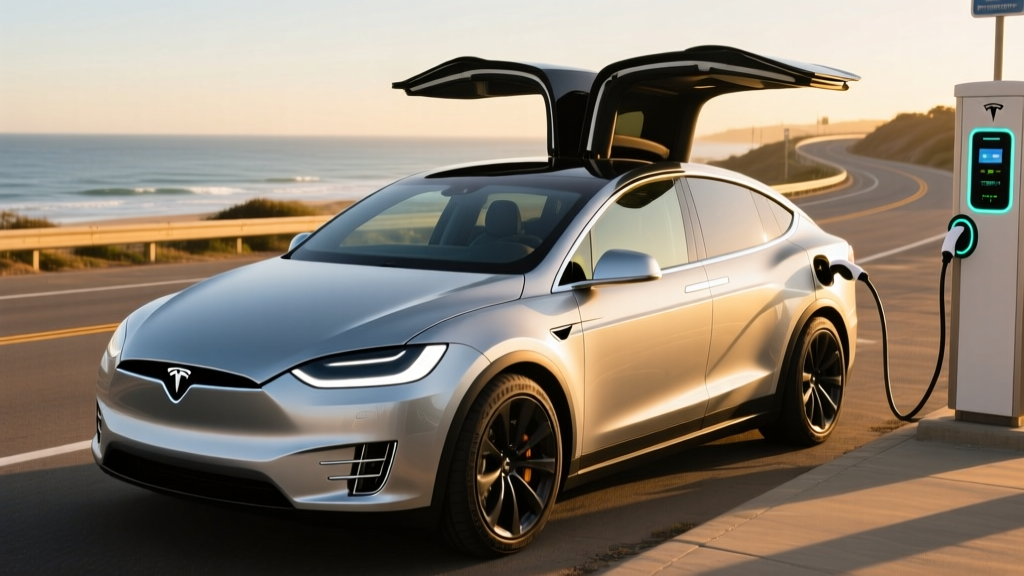
Falcon-wing rear doors are the Model X's party trick and its most polarizing feature. They open upward via double-hinged joints, allowing easy access to the second and third rows in tight parking spaces (Tesla claims just 11 inches of lateral clearance needed). However, the complex hydraulic mechanisms have been a reliability pain point — sensor malfunctions, seal leaks, and motor failures are documented across owner forums. Budget for occasional door-related service.
Driver assistance: The P90D came equipped with Tesla's Enhanced Autopilot hardware (HW2 or HW2.5 depending on build date). This supports adaptive cruise control, lane-keeping assist, and automatic lane changes. Note that Autopilot is an SAE Level 2 driver-assist system — it requires continuous driver supervision and does not make the vehicle self-driving. Full Self-Driving (FSD) capability was available as a software purchase, though its value on a used P90D depends on whether the subscription transferred with the vehicle. Tesla's current FSD (Supervised) software works on older hardware, but performance is noticeably better on HW3/HW4-equipped vehicles.
Pricing, Tax Credits, and Total Cost of Ownership
The P90D Model X originally stickered between $115,000 and $135,000 depending on options like Ludicrous mode, the Premium Interior package, and the Subzero Weather package. Depreciation has been steep: in early 2026, used P90D examples typically list between $28,000 and $42,000, with lower-mileage, high-SoH examples commanding the top of that range.
| Item | Amount |
|---|---|
| Used P90D (avg. market price) | $32,000–$40,000 |
| Federal Used Clean Vehicle Credit (§25E) | Up to $4,000 (30% of sale price, max $4,000) |
| Effective price after credit | $28,000–$36,000 |
| Home Level 2 charger install (typical) | $800–$2,500 |
| Annual insurance (national avg.) | $2,400–$3,600 |
| Estimated annual electricity (12,000 mi/yr) | $690–$820 |
Federal tax credit — critical details: The P90D Model X is not eligible for the $7,500 new-vehicle credit under IRS §30D, since it's a used vehicle and no longer in production. However, it may qualify for the Used Clean Vehicle Credit under IRC §25E, which provides 30% of the sale price up to a maximum of $4,000. Eligibility requirements include:
- Sale price must be $25,000 or less (this disqualifies many P90D listings — you'll need to negotiate below the $25K threshold)
- Buyer income caps: $75,000 single / $112,500 head of household / $150,000 married filing jointly (modified AGI)
- Vehicle must be at least two model years old (easily met)
- Must be purchased from a licensed dealer (private-party sales don't qualify)
- Buyer can only claim the used-vehicle credit once every three years
Because the $25,000 sale-price cap is the main barrier, finding a P90D Model X that qualifies requires targeting higher-mileage examples or those needing cosmetic work. Always confirm credit eligibility with a tax professional before relying on it in your budget.
Ongoing costs: Tesla's battery and drive unit warranty on the P90D was 8 years with unlimited miles, guaranteeing 70% capacity retention. By 2026, most P90D examples have aged out of this warranty (the newest are 2017 models, now 9 years old). A replacement battery pack from Tesla runs approximately $14,000–$20,000 including labor — a significant contingency to budget for, though third-party EV battery shops increasingly offer cell-level repairs for $3,000–$7,000. Drive unit replacements typically cost $4,000–$7,000 if needed.
P90D Model X vs. 2026 Competitors: Where Does It Stand?
At $28,000–$42,000, the used P90D competes with several new and used electrified SUVs. Here's how it stacks up:
| Vehicle | Price Range | Range (EPA) | 0–60 mph | DC Charge (10–80%) |
|---|---|---|---|---|
| Tesla Model X P90D (used, 2016–17) | $28K–$42K | 250 mi (new) | 3.2s | ~50 min |
| 2026 Tesla Model X Long Range | $79,990+ | 348 mi | 3.8s | ~27 min (250 kW) |
| Rivian R1S Dual-Motor (used 2023–24) | $48K–$62K | 321 mi | 4.5s | ~22 min (200+ kW) |
| 2026 Hyundai Ioniq 9 Long Range AWD | $56,000+ | 335 mi | 5.1s | ~20 min (350 kW) |
| Kia EV9 GT-Line AWD (used 2024–25) | $42K–$52K | 280 mi | 4.9s | ~18 min (236 kW) |
The P90D's advantage is raw acceleration and Tesla's Supercharger network access at a sub-$40K entry point. Its disadvantages are clear: older charging hardware, no active warranty, aging infotainment, and falcon-wing reliability concerns. If performance is secondary to daily practicality, a used Kia EV9 or Hyundai Ioniq 9 offers newer tech, faster charging, and remaining factory warranty at a modest price premium.
- 3.2-second 0–60 mph still world-class for an SUV
- Access to Tesla Supercharger network (largest in North America)
- Spacious three-row cabin with 88 cu ft max cargo
- Over-the-air software updates continue (with MCU2)
- Air suspension with adjustable ride height
- Strong regenerative braking enables one-pedal driving
- DC fast charging capped at ~120 kW — slow by 2026 standards
- Falcon-wing door mechanisms are a known reliability risk
- Original 8-yr battery warranty has expired on all examples
- MCU1 infotainment is painfully slow without the $2K+ upgrade
- Cold-weather range drops 25–30% (resistive heating, no heat pump)
- Used EV tax credit (§25E) requires sub-$25K sale price — hard to find
- Insurance premiums run $200–$300/month in most states
Who Should Buy the P90D Model X in 2026?
The P90D Model X fits a specific buyer profile: you want three-row electric SUV capability, crave supercar acceleration, and can accept the risks of an out-of-warranty luxury EV. It's best suited for:
- Performance-minded families who need the third row but refuse to drive something slow
- Tesla Supercharger loyalists who road-trip frequently and value network reliability
- Budget-conscious EV buyers who'd rather spend $35K on a depreciated flagship than $60K+ on a new mid-range SUV
It's not ideal for buyers who prioritize the latest charging speeds, want remaining factory warranty, or lack access to home charging (the P90D's efficiency and range make frequent public-charging dependence expensive and time-consuming).
Look elsewhere if: You need reliable daily range above 250 miles, want sub-25-minute road-trip charging, or can't budget $3,000–$5,000 annually for potential out-of-warranty repairs.
Frequently Asked Questions
What is the real-world range of the P90D Model X in 2026?
Expect 195–225 miles in mixed driving at moderate temperatures, assuming a battery with 80–88% state of health. Highway driving at 75 mph drops this to roughly 175–200 miles. In sub-freezing cold, plan for 150–180 miles due to NMC chemistry losses and the energy-hungry resistive cabin heater.
How fast does the P90D Model X charge at home and on road trips?
On a home Level 2 Tesla Wall Connector (48A/240V), the P90D adds about 30–34 miles of range per hour, fully charging overnight in roughly 6.5 hours. On Tesla V3 Superchargers, a 10–80% session takes approximately 45–55 minutes, limited by the pack's ~120 kW peak charge rate.
Does the P90D Model X qualify for any federal tax credit?
Not the $7,500 new-vehicle credit (§30D). It may qualify for the Used Clean Vehicle Credit (§25E) — up to $4,000 — but only if the dealer sale price is $25,000 or less and the buyer meets income caps ($75K single / $150K married). Most P90D listings exceed the $25K threshold, making this credit difficult to claim.
Is the P90D Model X worth buying over a newer EV SUV?
It depends on priorities. The P90D offers unmatched acceleration at its price point and Supercharger access, but trades away modern charging speed, active warranty, and current-generation software. If you value performance and can accept repair risk, it's compelling. If you want hassle-free daily driving with fast road-trip charging, a used Kia EV9 or new Hyundai Ioniq 9 is a safer bet.
What are the biggest maintenance risks with a used P90D Model X?
The three highest-cost risks are: (1) battery degradation or cell failure outside warranty ($14,000–$20,000 for Tesla replacement), (2) falcon-wing door mechanism repairs ($1,500–$4,000 per door), and (3) drive unit replacement ($4,000–$7,000). Always get a pre-purchase inspection from a Tesla-qualified independent shop and review the battery health percentage before buying.
Can I still get software updates on a 2016–2017 Model X?
Yes — Tesla continues to push over-the-air updates to older hardware, though feature availability depends on whether the vehicle has the MCU2 infotainment upgrade and HW2.5 or later autopilot computer. Vehicles still on MCU1 receive fewer updates and run noticeably slower software.