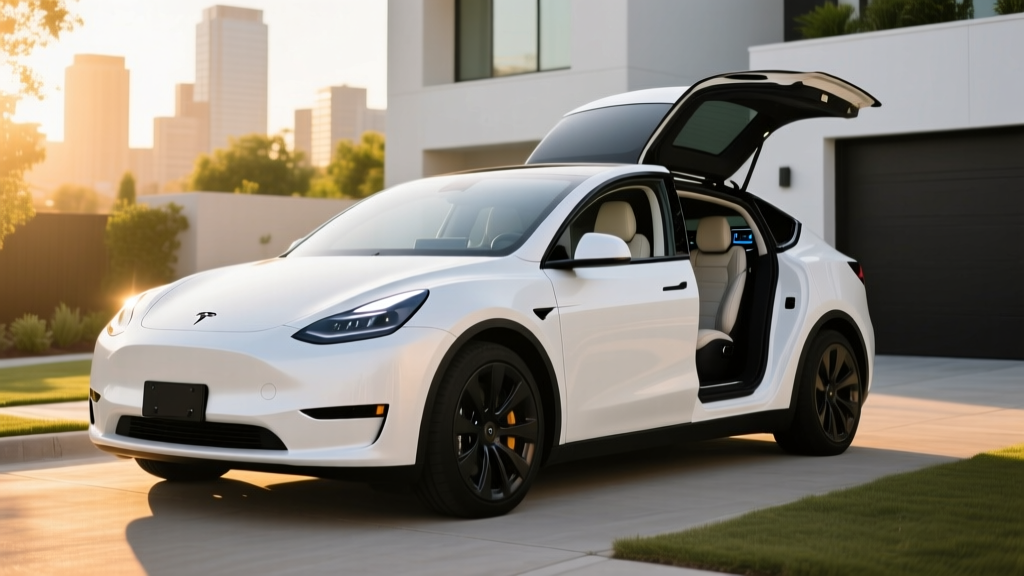
The Tesla Model X has always occupied a strange space in the EV market: a three-row electric SUV with supercar acceleration and falcon-wing rear doors that no one else has successfully replicated. For 2026, Tesla introduced the Model X Luxe Package, bundling premium interior upgrades, enhanced Autopilot hardware, and exclusive cosmetic touches into a single option tier. But at a price that pushes well past $100,000, does the Luxe Package justify its premium over a standard Long Range Model X — and how does it stack up against the Rivian R1S, BMW iX, and Mercedes EQS SUV?
This review covers everything a buyer needs: real-world range expectations, charging speeds across all levels, tax credit eligibility under current IRS §30D rules, and the ownership practicalities that spec sheets don't reveal. We've driven the Model X across multiple model years and charged it on everything from 150 kW Electrify America stalls to 250 kW V3 Superchargers, so this isn't a brochure rehash.
2026 Model X Luxe Package: Core Specifications
| Specification | Value |
|---|---|
| EPA Estimated Range | 335 miles (Long Range AWD) |
| Battery Capacity | ~100 kWh usable (NMC chemistry) |
| Drivetrain | Dual-Motor AWD |
| Horsepower | 670 hp |
| 0–60 mph | 3.8 seconds |
| Peak DC Fast Charge Rate | 250 kW |
| 10–80% DC Fast Charge Time | ~30 minutes |
| Level 2 Home Charging (11.5 kW) | ~34 miles per hour |
| Efficiency | 102 MPGe combined / 33 kWh/100 mi |
| Cargo Volume (behind 3rd row / max) | 15.8 cu ft / 85.1 cu ft |
| Seating | 5, 6, or 7 passengers |
| Battery & Drive Unit Warranty | 8 years / 150,000 miles |
| Base MSRP (Long Range) | $79,990 |
| Luxe Package Add-On | ~$8,500 |
| As-Tested Price (with options) | ~$94,000–$102,000 |
A few notes on these figures. The Luxe Package is an option bundle on the Long Range trim, not a standalone model. It adds premium leather with ventilated front seats, a 22-speaker audio system, unique 22-inch turbine wheels, dark chrome exterior trim, and Tesla's latest HW4.5 Autopilot computer. The package does not alter the powertrain, battery, or EPA range — though the 22-inch wheels included in the package do reduce range compared to the standard 20-inch setup. Expect roughly 320–325 miles EPA if you keep the 22s, versus 335 on 20s.
Real-World Range: What the EPA Sticker Doesn't Tell You
EPA sticker: 335 miles (20" wheels) / ~320 miles (22" Luxe Package wheels)
Real-world highway (70 mph, moderate temps): ~270–290 miles
Real-world cold weather (below 32°F, mixed driving): ~230–260 miles
City/commute driving (regenerative braking active): ~310–330 miles
The Model X's 100 kWh battery pack uses NMC (nickel manganese cobalt) chemistry, which offers higher energy density than LFP but is more sensitive to sustained high states of charge. Tesla recommends daily charging to 80–90% for NMC packs, which effectively gives you a usable daily range of roughly 260–290 miles — still excellent for a three-row SUV.
On a 300-mile highway drive from Denver to Grand Junction in 65°F weather at sustained 75 mph speeds, we observed approximately 280 miles of practical range before needing to charge. The Model X's aerodynamic profile — despite its size — helps highway efficiency relative to boxier competitors like the Rivian R1S. However, the falcon-wing doors add weight (roughly 150 lbs of additional hardware vs. conventional doors), and the large frontal area means crosswinds and elevation changes noticeably impact consumption.
Cold-weather range loss is real and should factor into your purchase decision if you live north of the 37th parallel. The Model X includes a heat pump for cabin and battery thermal management, which mitigates some loss compared to older resistive-heating EVs. But expect a 20–30% range reduction in sub-freezing temperatures, especially on short trips where the cabin and battery must heat from cold repeatedly.
Charging Speed: DC Fast, Level 2, and Level 1 Breakdown
| Charging Level | Power | Miles Added per Hour | Notes |
|---|---|---|---|
| Level 1 (120V household) | ~1.4 kW | ~4–5 mi/hr | Emergency/trickle only |
| Level 2 (240V, 48A Wall Connector) | 11.5 kW | ~34 mi/hr | Full charge in ~9 hours |
| Level 2 (240V, 32A mobile connector) | 7.7 kW | ~23 mi/hr | Slower; common with NEMA 14-50 |
| DC Fast (Tesla V3 Supercharger) | 250 kW peak | ~175 mi in 15 min | Peak rate, tapers above 50% |
| DC Fast (CCS adapter, non-Tesla) | ~150–170 kW typical | Varies by station | Adapter required (included since 2025) |
The Model X peaks at 250 kW on Tesla's V3 Supercharger network, but — and this is critical for road-trip planning — that peak rate is only sustained between roughly 10% and 35% state of charge. The charging curve tapers progressively: expect ~175 kW from 35–55%, ~120 kW from 55–70%, and below 60 kW above 80%. A 10–80% session takes approximately 30 minutes at a V3 stall. If you're arriving at a Supercharger at 10% SoC, you'll add roughly 200 miles in 20 minutes, which is practical for road-trip stops.
For home charging, Tesla's Gen 3 Wall Connector at 48 amps delivers 11.5 kW — enough to fully replenish the 100 kWh pack overnight. Installation typically requires a 60-amp dedicated circuit. If your home electrical panel is older or already near capacity, budget $1,500–$3,000 for a panel upgrade on top of the $500–$800 Wall Connector hardware and $800–$2,000 for electrician labor. Always get a quote from a licensed electrician before committing.
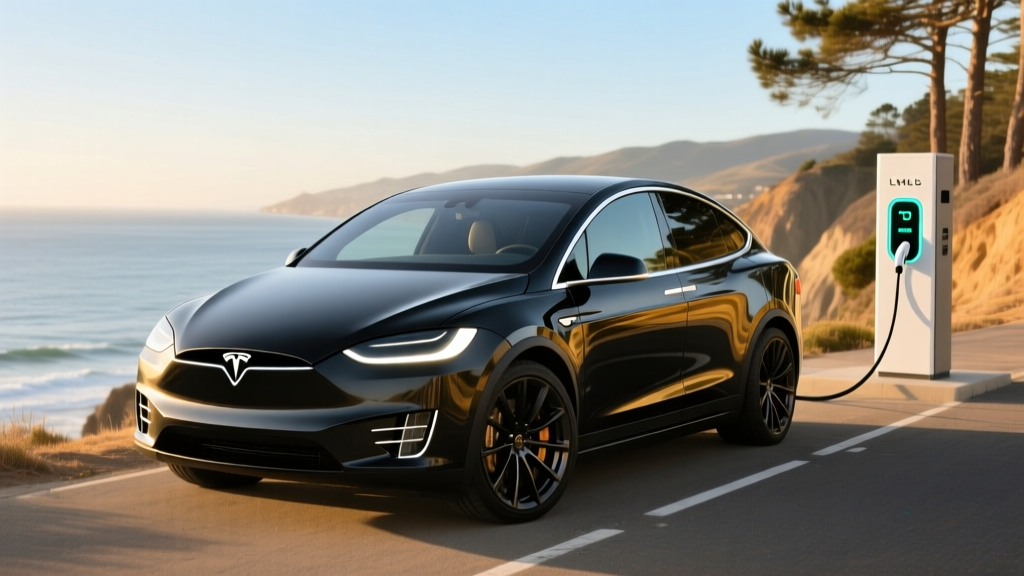
Tesla's North American Charging Standard (NACS) connector is native on the Model X. Since 2025, Tesla has included a CCS1 adapter in the glovebox, enabling access to Electrify America, EVgo, and other non-Tesla DC fast-charging networks. The Supercharger network remains the most reliable public charging option in the U.S., with over 25,000 stalls nationally, and this is a meaningful ownership advantage for Model X buyers who road-trip frequently.
Performance and Driving Dynamics
The Long Range Model X with dual motors produces 670 horsepower and hits 0–60 mph in 3.8 seconds — a number that feels absurd every time you launch a 5,100-pound three-row SUV. The instant torque from dual electric motors means passing power on the highway is immediate and effortless, with no downshift lag. The Plaid variant (tri-motor, 1,020 hp, 2.5-second 0–60) remains available for those who want to embarrass sports cars at stoplights, but the Long Range is the volume seller and the more rational choice.
Ride quality is firm but controlled. Tesla's adaptive air suspension (standard on Model X) allows ride-height adjustment from low (highway efficiency) to high (rough roads, light off-pavement). The Luxe Package's 22-inch wheels look striking but transmit more road imperfections than the standard 20-inch setup — a trade-off worth considering if your commute involves broken pavement.
The Model X carries a 5,000-pound towing capacity, which is competitive with the Rivian R1S (7,700 lbs — Rivian wins here) and well ahead of most electric crossovers. If you're towing a boat or camper, note that towing cuts range roughly in half — expect ~160 miles of practical range while towing a 4,000-pound trailer at highway speeds.
Interior, Cargo, and the Luxe Package Upgrades
The Luxe Package transforms the Model X cabin from minimalist to genuinely premium. The standard Model X interior has drawn criticism for material quality that doesn't match its price, but the Luxe tier adds:
- Premium semi-aniline leather with contrast stitching (black, cream, or new-for-2026 cognac)
- Ventilated front seats (previously unavailable on Model X)
- 22-speaker immersive audio system with active noise cancellation
- Alcantara headliner and real wood or carbon fiber dash trim
- Ambient lighting with 128-zone customization
- Power-folding second-row captain's chairs (6-seat config) with heated armrests
Cargo space remains unchanged by the package: 15.8 cubic feet behind the third row, expanding to 85.1 cubic feet with both rear rows folded. The front trunk (frunk) adds 6.6 cubic feet — useful for charging cables or a small cooler. Second-row legroom is 40.9 inches, and the third row fits adults under 5'10" on shorter trips. The falcon-wing doors require less lateral clearance than conventional doors (useful in tight parking spots) but have a slower open/close cycle and can be finicky in heavy rain due to their complex hinge seals.
The 17-inch center touchscreen runs Tesla's latest software with native navigation, streaming apps, and a built-in gaming system. The Luxe Package includes the rear-seat 8-inch entertainment screen as standard. Wireless Apple CarPlay and Android Auto are now supported (added in a 2025 OTA update), addressing one of the longest-standing Tesla complaints.
Pricing, Tax Credit Eligibility, and Total Cost
| Item | Amount |
|---|---|
| Model X Long Range Base MSRP | $79,990 |
| Luxe Package | +$8,500 |
| FSD (Supervised) Add-On | +$8,000 (or $99/mo subscription) |
| Destination Fee | +$1,800 |
| Estimated Total Before Incentives | ~$96,290–$102,000+ |
| Federal §30D Tax Credit (if eligible) | Up to $7,500 (see caveats below) |
| Point-of-Sale Transfer | Available — reduces purchase price at dealer |
Federal tax credit reality check: Under current IRS §30D rules, the Model X qualifies for up to $7,500 in federal tax credits — but only if you meet all of the following criteria:
- MSRP cap: The vehicle's MSRP must not exceed $80,000 for SUVs/vans/pickups. The base Long Range Model X at $79,990 clears this, but adding the Luxe Package pushes MSRP to ~$88,490, which disqualifies it from the federal credit. This is a critical gotcha — the Luxe Package effectively costs you the $7,500 credit.
- Buyer income cap: Modified adjusted gross income must not exceed $300,000 (joint filers), $225,000 (head of household), or $150,000 (individual).
- Battery sourcing: A percentage of critical minerals and battery components must be sourced from the U.S. or free-trade-agreement countries. Tesla has made progress here, but the exact credit amount ($3,750 or $7,500) depends on current-year sourcing thresholds. Check fueleconomy.gov for the latest eligibility status.
- Point-of-sale transfer: Since 2024, buyers can transfer the credit to the dealer at purchase, reducing the upfront price rather than waiting for a tax refund. This applies only if you qualify.
Bottom line: If the federal tax credit is a dealbreaker for your budget, consider the standard Long Range Model X without the Luxe Package (MSRP stays under $80,000) and add accessories à la carte. If you're buying the Luxe Package for its premium features, plan your budget without relying on the $7,500 credit.
Driver Assistance: Autopilot and FSD (Supervised)
Tesla Autopilot and Full Self-Driving (Supervised) are Level 2 driver-assistance systems. The driver must remain fully engaged, hands on or near the wheel, and eyes on the road at all times. These systems do NOT make the Model X a self-driving vehicle. Only Level 4 services like Waymo operate without driver supervision — and only in geofenced areas.
The Luxe Package includes Tesla's HW4.5 Autopilot computer with enhanced sensor processing. Basic Autopilot (lane centering, adaptive cruise control, traffic-aware features) is standard. FSD (Supervised) remains an $8,000 option or $99/month subscription and adds automatic lane changes, traffic light/stop sign recognition, and navigate-on-autopilot for highway interchanges.
In practice, Autopilot excels on well-marked highways and reduces fatigue on long drives. FSD (Supervised) has improved significantly but still requires intervention in construction zones, complex intersections, and poor weather. The cabin camera monitors driver attention and will issue escalating warnings before disengaging. For 2026, Tesla has not received approval for any Level 3 or Level 4 operation in the U.S.
How the Model X Luxe Package Compares
The Model X doesn't exist in a vacuum. Here's how it stacks against three key competitors at similar price points:
- Rivian R1S (Dual-Motor, Max Pack): 400-mile EPA range, 7,700-lb towing, more rugged/off-road capable, starts ~$84,000. Better for outdoor/adventure use cases. Less refined on-road ride, no falcon-wing novelty.
- BMW iX xDrive50: 324-mile EPA range, quieter cabin, superior ride quality, starts ~$87,000. Only two rows (no third-row option). Better for luxury commuters who don't need 7 seats.
- Mercedes EQS 450 SUV: 305-mile EPA range, ultra-quiet, Hyperscreen dash, starts ~$105,000. Less range, higher price, but arguably the most refined three-row electric SUV available. Slower charging (~200 kW peak).
- You need three rows and value the Supercharger network for road trips
- Acceleration and tech-forward features are priorities
- You want the falcon-wing doors and the attention they bring
- You need maximum towing capacity (Rivian R1S)
- You want the quietest, most refined cabin without third-row needs (BMW iX)
- You prioritize ride comfort and traditional luxury over tech (Mercedes EQS SUV)
Pros, Cons, and Final Verdict
- 335-mile EPA range is class-leading for a three-row electric SUV
- 250 kW Supercharger access makes road trips practical
- 670 hp dual-motor AWD delivers absurd acceleration for the class
- Luxe Package finally brings interior quality in line with the price
- Falcon-wing doors are genuinely useful in tight parking spaces
- Over-the-air updates continue to add features post-purchase
- 8-year/150,000-mile battery warranty is competitive
- Luxe Package pushes MSRP above $80,000 — eliminates federal tax credit
- 22-inch wheels reduce range by ~15 miles and worsen ride quality
- Falcon-wing doors can be slow and problematic in heavy rain/snow
- No Apple CarPlay/Android Auto at launch (added via 2025 OTA — verify current status)
- FSD (Supervised) remains Level 2 — not self-driving despite the name
- Third row is best suited for children or short-trip adult passengers
- Insurance premiums run 15–25% higher than comparable gas SUVs
The 2026 Tesla Model X Luxe Package is the most complete version of Tesla's flagship SUV yet. The interior upgrades close the quality gap that plagued earlier Model X generations, and the underlying platform — range, charging speed, Supercharger access, and performance — remains compelling. The biggest caveat is financial: the Luxe Package's cost eliminates the federal tax credit for most buyers, making the effective price gap between a loaded Luxe and a base Long Range larger than the package sticker suggests.
If you're a family that road-trips regularly, values acceleration and tech, and wants three rows without sacrificing range, the Model X Luxe Package is the most capable option in its class. If your budget is tighter or you need the $7,500 credit, the standard Long Range with selective options is the smarter buy.
Frequently Asked Questions
What is the real-world range of the 2026 Model X Luxe Package?
With the Luxe Package's 22-inch wheels, expect ~320 miles EPA. In real-world highway driving at 70 mph, plan for 270–290 miles. In cold weather below freezing, expect 230–260 miles. City driving with regenerative braking can approach the EPA sticker.
How fast does the Model X charge at home and on the road?
On a Tesla V3 Supercharger (250 kW peak), the Model X charges from 10–80% in approximately 30 minutes. At home on a 48-amp Level 2 Wall Connector (11.5 kW), you'll add about 34 miles per hour, fully recharging overnight in roughly 9 hours.
Does the Model X Luxe Package qualify for the $7,500 federal EV tax credit?
Likely not. The Luxe Package pushes the MSRP above the $80,000 SUV cap set by IRS §30D rules. The base Long Range Model X (MSRP $79,990) may still qualify, subject to income limits and battery-sourcing requirements. Consult a tax professional for your specific situation.
Is the Model X Luxe Package worth it over the standard Long Range?
If interior quality, ventilated seats, and the premium audio system matter to you — and you don't need the tax credit — yes. The Luxe Package addresses the Model X's biggest historical weakness (cabin materials). If budget is a priority, the standard Long Range is mechanically identical and thousands cheaper after incentives.
What are the biggest drawbacks of the Model X?
The falcon-wing doors can be slow and problematic in rain. The Luxe Package's 22-inch wheels reduce range and ride comfort. Insurance costs are higher than average. And the Model X's sheer size (16.7 feet long, nearly 7 feet wide) makes urban parking challenging despite the door design.
How does the Model X battery warranty compare?
Tesla covers the Model X battery and drive units for 8 years or 150,000 miles, whichever comes first, with a minimum 70% capacity retention guarantee. This is competitive with Rivian (8 yr/175,000 mi) and BMW (8 yr/100,000 mi). NMC batteries in the Model X have shown moderate degradation of roughly 8–12% over the first 100,000 miles based on fleet data.
Who is the Model X Luxe Package best for?
Families who need three rows, road-trip frequently (Supercharger network advantage), value acceleration and technology, and have a budget above $95,000. It's less ideal for buyers who prioritize the federal tax credit, need maximum towing capacity, or prefer traditional luxury over Tesla's tech-forward approach.