Tesla Model X Dimensions: Exactly How Big Is It?
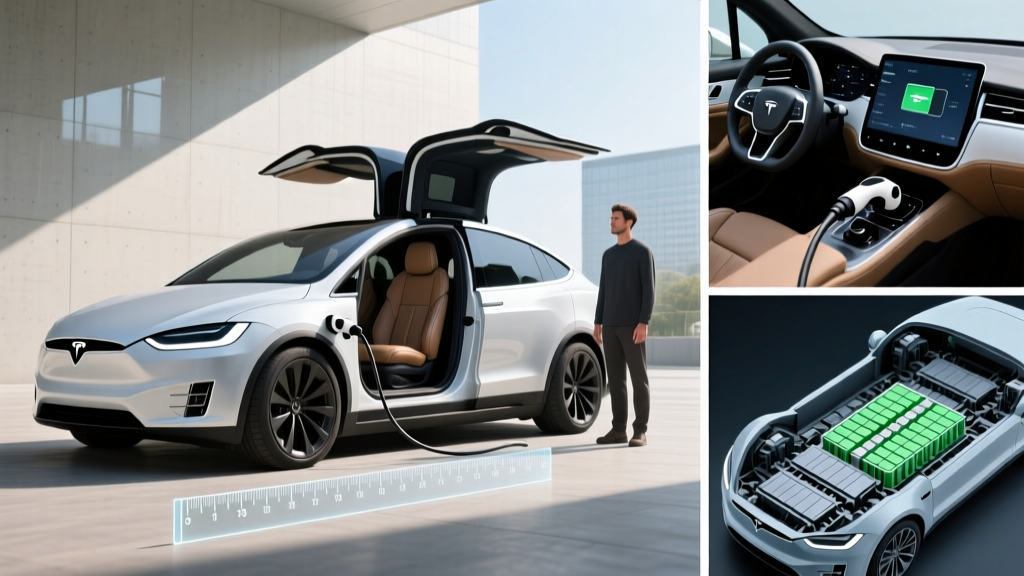
If you've been searching for Tesla Model X length and exterior dimensions to see whether this three-row electric SUV fits your garage, your parking spot, or your family's needs, you've landed in the right place. The 2026 Tesla Model X measures 199.1 inches (5,057 mm) long, 78.7 inches (1,999 mm) wide with mirrors folded, and 66.9 inches (1,699 mm) tall. That puts it squarely in full-size luxury SUV territory — longer than a BMW X5 (194.3 in) and nearly identical to the Mercedes-Benz EQS SUV (201.8 in).
But dimensions tell only part of the story. Below, we break down every spec that matters to real buyers: EPA range vs. real-world range, DC fast-charging curves, battery chemistry, cargo volume with seats folded, second-row legroom, tax-credit eligibility under IRS §30D, and whether the Model X still justifies its six-figure price tag against newer rivals like the Rivian R1S and BMW iX.
| Spec | Long Range (Dual-Motor AWD) | Plaid (Tri-Motor AWD) |
|---|---|---|
| Length | 199.1 in (5,057 mm) | |
| Width (mirrors folded) | 78.7 in (1,999 mm) | |
| Height | 66.9 in (1,699 mm) | |
| Wheelbase | 116.7 in (2,964 mm) | |
| Curb Weight | 5,185 lbs | 5,390 lbs |
| Battery (usable) | ~100 kWh (NMC) | |
| EPA Range | 335 mi | 326 mi |
| MPGe (combined) | 102 MPGe | 98 MPGe |
| Efficiency | 33 kWh/100 mi | 34 kWh/100 mi |
| Peak DC Charge Rate | 250 kW | |
| 10–80% DC Time | ~32 min | |
| Level 2 Rate | 11.5 kW / ~34 mi/hr | |
| 0–60 mph | 3.8 sec | 2.5 sec |
| Horsepower | 670 hp | 1,020 hp |
| Drivetrain | Dual-Motor AWD | Tri-Motor AWD |
| Towing Capacity | 5,000 lbs | |
| Base MSRP | $79,990 | $94,990 |
| Battery Warranty | 8 yr / 150,000 mi | |
Real-World Range vs. the EPA Sticker
The EPA rates the 2026 Model X Long Range at 335 miles on a full charge, while the Plaid drops slightly to 326 miles thanks to its thirstier tri-motor setup. Those numbers come from the U.S. EPA's fueleconomy.gov database, which uses a standardized multi-cycle test.
EPA sticker: 335 mi (Long Range) / 326 mi (Plaid)
Mixed highway driving (70–75 mph): expect ~270–295 mi
Cold weather (below 32°F, highway): ~230–260 mi — a 20–30% reduction is typical for NMC packs without aggressive preconditioning
City/regenerative driving: 310–335 mi — regen recovers energy in stop-and-go traffic, getting you closer to the sticker
The Model X's large frontal area and tall ride height create more aerodynamic drag than a sedan, which is why highway efficiency drops noticeably above 70 mph. Tesla's heat pump helps mitigate cold-weather cabin energy draw, but battery chemistry still loses usable capacity in freezing temps. If you regularly drive in sub-zero conditions, budget for a 25% range reduction and plan charging stops accordingly.
Charging Speed: DC Fast, Level 2, and the Charge Curve
Tesla equips the 2026 Model X with a maximum DC fast-charge rate of 250 kW at V3 Superchargers. In practice, the large ~100 kWh NMC pack sustains strong charging speeds through the mid-state-of-charge range, then tapers significantly above 80% — as all lithium-ion packs do to protect cell longevity.
| Charging Level | Power / Voltage | Speed | Typical Use Case |
|---|---|---|---|
| Level 1 (120V) | ~1.4 kW | ~4 mi/hr | Emergency / trickle top-off |
| Level 2 (240V, 48A) | 11.5 kW | ~34 mi/hr | Home overnight charging (Wall Connector) |
| DC Fast (V3 Supercharger) | Up to 250 kW | ~175 mi in 15 min (peak) | Road trips; 10–80% in ~32 min |
| DC Fast (V4 Supercharger) | Up to 250 kW (vehicle-limited) | Same as V3 for Model X | Future V4 stalls; car caps at 250 kW |
Understanding the charge curve: The Model X hits its peak 250 kW only when the battery is preconditioned (navigate to a Supercharger via the onboard nav and the car warms the pack automatically) and the state of charge is below ~30%. As SoC climbs past 50%, the rate drops to roughly 150 kW; above 80%, it falls to under 50 kW. That means a 10–80% session takes roughly 32 minutes, but pushing from 80–100% adds another 25–30 minutes. On road trips, plan to leave at 80% and keep moving.
For home charging, a Tesla Wall Connector on a 60-amp circuit delivers 11.5 kW, recovering about 34 miles of range per hour. A full overnight session (10 hours) adds ~340 miles — more than enough to replenish the pack. Installation typically costs $800–$2,000 depending on your electrical panel and run length; a 200-amp panel upgrade can add $1,500–$3,000.
Performance: 0–60, Horsepower, and the Plaid Question
The dual-motor Long Range Model X produces 670 horsepower and hits 60 mph in 3.8 seconds — already supercar-rivaling acceleration for a three-row family SUV. Step up to the Plaid and its tri-motor powertrain delivers 1,020 horsepower with a 0–60 time of 2.5 seconds.
Both trims use all-wheel drive with independent front and rear motors. The Plaid adds a second rear motor for torque vectoring across the rear axle. In real-world driving, the difference between 3.8 and 2.5 seconds is more about bragging rights than daily usability — the Long Range already demolishes freeway merges and passes with authority.
Towing capacity is rated at 5,000 pounds across both trims. Keep in mind that towing a loaded trailer will slash range by 30–50%, depending on speed, grade, and trailer aerodynamics. If you tow frequently, expect real-world range closer to 170–220 miles per charge.
Battery Chemistry, Degradation, and Warranty
The 2026 Model X uses an NMC (nickel manganese cobalt) lithium-ion battery pack with approximately 100 kWh of usable capacity. Tesla does not offer an LFP (lithium iron phosphate) option for the Model X — LFP is currently reserved for the Model 3 and Model Y Standard Range variants due to its lower energy density, which would add unacceptable weight to the already-heavy Model X.
NMC trade-offs: Higher energy density (more range per pound) but slightly faster long-term degradation compared to LFP. Tesla recommends daily charging to 80–90% for NMC packs and saving 100% for trips. Following this guideline, real-world degradation data from high-mileage Tesla owners suggests roughly 8–12% capacity loss over 100,000 miles, with the curve flattening significantly after the first 30,000 miles.
Tesla's battery and drive unit warranty covers 8 years or 150,000 miles (whichever comes first) with a minimum 70% capacity retention threshold. If the pack degrades below 70% within the warranty period, Tesla will repair or replace it. For context, the basic vehicle limited warranty covers 4 years or 50,000 miles.
Interior Space, Cargo Volume, and Passenger Comfort
The Model X is available in five-, six-, and seven-seat configurations. The six-seat layout (second-row captain's chairs) is the most popular and offers the best balance of passenger comfort and cargo access.
Cargo volume:
- Behind third row: 14.4 cu ft (enough for a few grocery bags or a compact stroller)
- Behind second row (third row folded): 37.1 cu ft
- Behind front seats (all rear rows folded): 75.4 cu ft
- Front trunk (frunk): 6.6 cu ft
Passenger dimensions:
- Front legroom: 41.2 in
- Second-row legroom: 38.4 in
- Third-row legroom: 32.7 in — usable for children or short trips, tight for adults on longer drives
The Model X's signature falcon-wing rear doors open vertically, providing excellent access to the second and third rows in tight parking spots. However, they require overhead clearance (Tesla specifies a minimum of ~6.5 feet with the door's ultrasonic sensors adjusting the arc) and can be slower to open/close than conventional doors. Low garages and carports can be problematic.
Pricing, Trim Levels, and Federal Tax Credit Eligibility
The 2026 Tesla Model X starts at $79,990 for the Long Range and $94,990 for the Plaid, before destination fees and options. Popular add-ons include the six-seat interior ($6,500), Full Self-Driving (Supervised) capability ($8,000), and premium paint colors ($1,500–$2,500).
| Trim | Base MSRP | Federal §30D Credit | Effective Price (if eligible) |
|---|---|---|---|
| Long Range AWD | $79,990 | $0 (exceeds MSRP cap) | $79,990 |
| Plaid AWD | $94,990 | $0 (exceeds MSRP cap) | $94,990 |
The 2026 Tesla Model X does NOT qualify for the federal §30D new clean vehicle credit. The reason is straightforward: IRS rules cap eligible SUVs at an MSRP of $80,000. The Long Range starts at $79,990, but once the mandatory $1,390 destination fee is included, the effective price exceeds the cap. The Plaid is well above the threshold at $94,990.
Additionally, §30D has buyer income caps (AGI ≤ $300,000 joint / $150,000 single) and critical-mineral and battery-component sourcing requirements that phase in through 2026. Always verify current eligibility on IRS.gov or consult a tax professional before relying on any credit amount.
Some states offer additional rebates or incentives that are not subject to the federal MSRP cap — check your state energy office or DMV for current programs. Tesla also occasionally offers referral discounts or inventory reductions that can bring the Long Range closer to the $80,000 threshold, but these are unpredictable.
Technology, Driver Assistance, and Standout Features
The Model X's 17-inch center touchscreen runs Tesla's proprietary infotainment system, which includes navigation, streaming media, a full web browser, and over-the-air software updates. A secondary 8-inch rear touchscreen controls climate and entertainment for second-row passengers. The driver faces a 12.3-inch instrument cluster.
Standard driver assistance includes Tesla Autopilot — an SAE Level 2 system providing adaptive cruise control, lane centering, automatic emergency braking, and blind-spot monitoring. The driver must keep hands on the wheel and remain fully engaged at all times.
Tesla's Autopilot and available Full Self-Driving (Supervised) are SAE Level 2 driver-assist systems. They can steer, accelerate, and brake under certain conditions, but the human driver is responsible for monitoring the road and must intervene at any moment. FSD (Supervised) adds features like automatic lane changes, traffic-light recognition, and city-street navigation, but it does not make the vehicle autonomous. Only Level 4 services like Waymo operate without a human driver, and those are limited to geofenced urban areas.
Standout features:
- Falcon-wing doors with ultrasonic obstacle detection for vertical opening in tight spaces
- HEPA air filtration with "Bioweapon Defense Mode" — hospital-grade cabin filtration
- Yoke or round steering wheel option (yoke is controversial; test before committing)
- Tow mode with integrated trailer sway control and range estimation while towing
- Sentry Mode — uses exterior cameras to record and alert when the parked vehicle is disturbed
Notable drawbacks:
- No Apple CarPlay or Android Auto — Tesla's ecosystem is closed
- Falcon-wing doors can be slow to operate and may struggle in very low garages
- Panel-gap consistency has improved but still trails German competitors
- Third-row space is limited for adults
- No federal tax credit eligibility due to MSRP cap
How the Model X Compares to Key Rivals
The Model X occupies a unique position: a performance-oriented, three-row electric SUV with access to the Tesla Supercharger network. But it faces real competition:
- Rivian R1S: More off-road capable, quad-motor option, similar starting price (~$79,900). Smaller Supercharger-style network (Rivian Adventure Network is growing but not comparable in scale). Better third-row space. Range: ~352 mi (Max Pack).
- BMW iX xDrive50: Only two rows, but superior interior materials and refinement. EPA range: 324 mi. Starts ~$87,250. Does not qualify for federal credit (MSRP cap + sourcing).
- Mercedes EQS 580 SUV: Three rows, 305 mi EPA range, starts ~$105,550. More luxurious cabin but heavier and less efficient.
- Kia EV9 GT-Line AWD: Much more affordable (~$73,990), three rows, 270 mi EPA range. Slower charging (peak ~210 kW, but 10–80% in ~24 min on 350 kW chargers). Qualifies for §30D credit when built in the U.S.
The Model X wins on Supercharger access (the most reliable DC fast-charging network in the U.S.), acceleration, and software features. It loses on interior luxury (vs. BMW/Mercedes), off-road capability (vs. Rivian), and value (vs. Kia EV9).
Pros, Cons, and the Verdict
- 335-mi EPA range is class-leading for a three-row electric SUV
- Access to the 6,000+ stall Tesla Supercharger network (NACS connector, no adapter needed)
- Supercar acceleration even in the base Long Range trim
- Over-the-air updates continuously add features
- Falcon-wing doors offer genuine utility for child-seat loading
- 5,000-lb towing with integrated trailer software
- Does not qualify for the $7,500 federal EV tax credit (MSRP cap)
- Third row is tight for adults — best for children or short trips
- Falcon-wing doors need overhead clearance; problematic in low garages
- No Apple CarPlay / Android Auto
- Insurance costs run 20–40% higher than comparable gas SUVs
- 250 kW peak DC charge rate trails 800V rivals (Hyundai Ioniq 9, Kia EV9 can accept 350 kW on capable chargers)
Who Should Buy the 2026 Tesla Model X?
The Model X is the right choice if you need three rows, strong range, Supercharger network access for frequent road trips, and performance — and you're willing to pay a premium without expecting a federal tax credit to soften the blow.
Choose the Model X if:
- You road-trip often and value the reliability and density of the Supercharger network
- You need a third row occasionally but don't want a minivan
- You want EV performance (3.8-sec or 2.5-sec 0–60) without sacrificing practicality
- You already own a Tesla and want to stay in the ecosystem
Look elsewhere if:
- You want the $7,500 federal credit — consider the Kia EV9 or a configured Rivian R1S (if eligible trims fall under $80,000)
- You need a genuinely adult-friendly third row — check the Rivian R1S or Mercedes EQS SUV
- You prioritize interior luxury and materials over performance — the BMW iX or Mercedes EQS SUV deliver more refinement
- You live in a low-clearance garage where falcon-wing doors are impractical
Frequently Asked Questions
What is the exact length of the Tesla Model X?
The 2026 Tesla Model X is 199.1 inches (5,057 mm) long. That's roughly 16.6 feet — plan for a garage that's at least 20 feet deep to allow room for walking around the vehicle with the liftgate open.
What is the real-world range of the Model X on a road trip?
On highway road trips at 70–75 mph in moderate weather, expect 270–295 miles from the Long Range trim (EPA-rated at 335 mi). In cold weather (below freezing), plan for 230–260 miles. Always use Tesla's trip planner or A Better Route Planner to map Supercharger stops.
How fast does the Model X charge at home?
Using a Tesla Wall Connector on a 240V/60A circuit, the Model X charges at 11.5 kW, adding approximately 34 miles of range per hour. A full charge from 10% to 100% takes roughly 9–10 hours — easily done overnight. Installation costs vary from $800 to $2,000+ depending on your home's electrical setup.
Does the 2026 Tesla Model X qualify for the federal EV tax credit?
No. The Model X does not qualify for the §30D new clean vehicle credit because its MSRP exceeds the $80,000 cap for SUVs (the Long Range's $79,990 base price plus destination pushes it over). Buyer income limits and battery-sourcing rules add further restrictions. Consult IRS.gov for the latest rules.
Is the Model X worth it vs. the Rivian R1S or Kia EV9?
It depends on your priorities. The Model X wins on Supercharger access, acceleration, and range. The Rivian R1S offers better off-road capability, more third-row space, and a more adventurous design. The Kia EV9 is the value pick — it's significantly cheaper, qualifies for the federal credit (on U.S.-built trims), and offers competitive three-row practicality, though with less range (~270 mi) and a smaller charging network. Test-drive all three before deciding.
What is the Model X battery warranty?
Tesla covers the battery and drive unit for 8 years or 150,000 miles, whichever comes first, with a guaranteed minimum of 70% capacity retention. The basic vehicle warranty is 4 years or 50,000 miles.
Can the Model X tow, and how does towing affect range?
Yes — the Model X is rated to tow 5,000 pounds. Towing a loaded trailer typically reduces range by 30–50%, depending on speed, terrain, and trailer aerodynamics. Expect 170–220 real-world miles when towing near the maximum capacity.