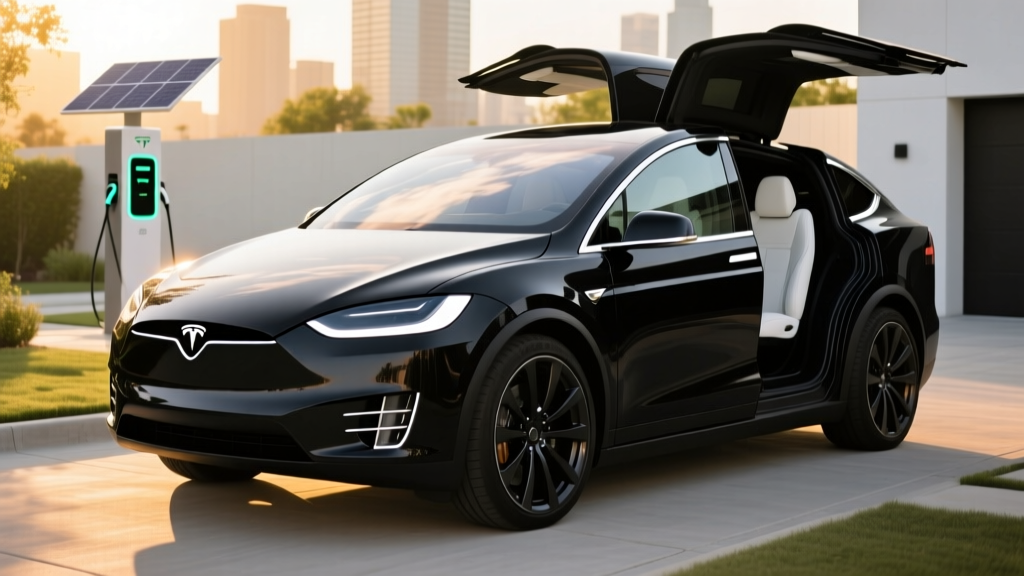
If you're searching for a Tesla large SUV, the Model X remains the only nameplate in Tesla's lineup that fits the bill. With seating for up to seven, standard all-wheel drive, and access to the Supercharger network, it targets families and road-trippers who need three rows of seats and serious cargo space. But at nearly $80,000 to start, buyers need to know exactly what they're getting — and where the Model X falls short against newer competitors like the Rivian R1S and the BMW iX.
This review covers the 2026 Tesla Model X with exact specs on range, charging speed, performance, pricing, and federal tax credit eligibility — plus the real-world ownership details that spec sheets leave out.
2026 Tesla Model X: At-a-Glance Specs
| Spec | Model X Long Range | Model X Plaid |
|---|---|---|
| EPA Range | 320 mi | 303 mi |
| Battery (usable) | ~95 kWh (NMC) | ~95 kWh (NMC) |
| Drivetrain | Dual-Motor AWD | Tri-Motor AWD |
| Horsepower | 670 hp | 1,020 hp |
| 0-60 mph | 3.8 sec | 2.5 sec |
| Peak DC Fast Charge | 250 kW | 250 kW |
| 10-80% DC Time | ~30 min | ~30 min |
| Level 2 Home Charge | 11.5 kW (~34 mi/hr) | 11.5 kW (~34 mi/hr) |
| MPGe (combined) | 98 MPGe | 95 MPGe |
| Efficiency | 34 kWh/100 mi | 35 kWh/100 mi |
| Base MSRP | $79,990 | $94,990 |
| Federal Tax Credit (§30D) | $7,500 (if eligible) | $7,500 (if eligible) |
Range and Efficiency: EPA vs. the Real World
EPA sticker: 320 miles (Long Range).
Expect ~265-285 miles at sustained 75 mph highway speeds in mild weather. In cold conditions (below 32°F), range drops to roughly 230-250 miles due to cabin heating demands and increased battery resistance. City driving with regenerative braking can push closer to or slightly above the EPA figure.
The Model X Long Range carries a roughly 95 kWh usable battery using nickel-manganese-cobalt (NMC) chemistry. Tesla does not publish exact usable capacity, but independent teardown and charging data consistently place it in the 93-95 kWh range. NMC offers higher energy density than LFP (lithium iron phosphate), which is necessary in a heavy, three-row SUV — but it also means Tesla recommends daily charging to 80% to preserve long-term battery health, reserving 100% for road trips.
Efficiency sits at 34 kWh per 100 miles for the Long Range trim, per fueleconomy.gov. That's competitive for a 5,185-pound SUV but noticeably thirstier than the smaller Model Y (28 kWh/100 mi). Aerodynamic drag is the main culprit at highway speeds — the Model X is tall and wide, and its falcon-wing doors add weight without improving efficiency.
Charging Speed: Home, Destination, and DC Fast Charging
Charging speed is where Model X ownership either clicks or frustrates, depending on your setup. Here's what each level delivers:
| Charging Level | Power | Speed (approx.) | Best For |
|---|---|---|---|
| Level 1 (120V outlet) | ~1.4 kW | ~4 mi/hr | Emergency/overnight top-off |
| Level 2 (240V, 48A Wall Connector) | 11.5 kW | ~34 mi/hr | Daily home charging |
| DC Fast (Supercharger V3/V4) | 250 kW peak | ~175 mi in 15 min | Road trips |
DC fast charging reality check: The 250 kW peak only holds briefly at low state of charge (roughly 10-30%). The charge curve tapers significantly above 50% SoC, and by 80% you're pulling well under 100 kW. A 10-80% session takes approximately 30 minutes at a V3 Supercharger — not the 15-minute figure Tesla sometimes references, which applies to a narrower SoC window. Preconditioning the battery by navigating to a Supercharger in the car's nav system is essential; arriving cold can cut charge speeds by 40-50%.
At home, the Tesla Wall Connector at 48 amps delivers 11.5 kW, adding about 34 miles of range per hour. An overnight 10-hour session nets roughly 340 miles — more than enough to replenish any day's driving. Most Model X owners will need a 60-amp dedicated circuit; expect a home installation cost of $800-$2,000 depending on panel capacity and run distance, before any local utility rebates.
Performance and Driving Dynamics
The Long Range Model X hits 0-60 mph in 3.8 seconds with 670 horsepower from its dual-motor AWD setup. That's supercar territory from a decade ago, in a three-row family SUV. The Plaid trim's tri-motor, 1,020-hp configuration drops the 0-60 time to 2.5 seconds — genuinely absurd acceleration that few owners will ever use but all will enjoy merging onto highways.
Driving dynamics are a mixed bag. The air suspension provides a comfortable ride and adjustable ground clearance (useful for speed bumps and light off-road), but the Model X's 5,185-pound curb weight is apparent in corners. Body roll is well-controlled for its class, but this is not a sporty SUV in the way a BMW iX or Porsche Cayenne EV feels. It's a straight-line cruiser first.
Regenerative braking is strong and enables near-one-pedal driving in most conditions, though Tesla removed the user-adjustable regen setting years ago — you get Tesla's chosen level, which is aggressive by default.
Interior, Cargo, and Technology
The Model X offers three seating configurations: 5-seat (two rows), 6-seat (captain's chairs in the second row with a center aisle), and 7-seat (bench second row). The 6-seat layout is the most practical for families, offering easy third-row access and comfortable middle-row passengers.
Cargo volume:
- Behind third row: 37.1 cu ft
- Behind second row (third row folded): 72.3 cu ft
- Behind first row (all rear seats folded): 85.1 cu ft
- Front trunk (frunk): 6.5 cu ft
Second-row legroom measures 40.9 inches; third-row legroom is 32.7 inches — adequate for children on longer trips but tight for adults beyond 30-minute drives. The falcon-wing rear doors are genuinely useful in tight parking spaces (they need only 12 inches of side clearance) but add mechanical complexity and have been a reliability concern in earlier model years.
The 17-inch center touchscreen runs Tesla's proprietary infotainment system — fast, responsive, and feature-rich, but with no Apple CarPlay or Android Auto. A second 8-inch screen serves rear-seat passengers for climate and entertainment. The yoke steering wheel remains standard, and opinions remain polarized: some owners adapt quickly; others find it impractical for low-speed maneuvering and parking.
Driver assistance: Basic Autopilot (lane centering + adaptive cruise) is standard. Full Self-Driving (Supervised) is a $8,000 add-on. Per SAE classification, both are Level 2 systems — the driver must remain fully engaged, hands on the wheel (or torque-applied with the yoke), and eyes on the road. FSD Supervised handles city streets and highway interchanges with increasing competence but is not autonomous driving and requires constant supervision.
Pricing, Trims, and Federal Tax Credit Eligibility
| Trim | Base MSRP | Est. After §30D Credit* | Destination |
|---|---|---|---|
| Long Range (5-seat) | $79,990 | $72,490 | Included |
| Plaid (5-seat) | $94,990 | $87,490 | Included |
| 6-seat config adder | +$6,500 | — | — |
| 7-seat config adder | +$4,000 | — | — |
| FSD (Supervised) | +$8,000 | — | — |
*Federal tax credit (§30D) eligibility is NOT guaranteed. The Model X's MSRP falls under the $80,000 SUV cap for the Long Range trim, but the Plaid exceeds it and is ineligible. Additional requirements per IRS rules include:
- Buyer income caps: AGI ≤ $300,000 (joint), $225,000 (head of household), $150,000 (single)
- Battery component sourcing: A percentage of battery components must be manufactured or assembled in North America (threshold increases annually)
- Critical minerals: A percentage of critical minerals must be sourced from the U.S. or FTA partners
- Point-of-sale transfer: Eligible buyers can apply the $7,500 credit as a down-payment reduction at purchase rather than waiting for tax filing
The Long Range Model X at $79,990 sits just under the $80,000 MSRP cap for SUVs, making it potentially eligible for the full $7,500 credit if all sourcing and income requirements are met. The Plaid at $94,990 exceeds the cap and does not qualify. Always verify current-year eligibility on the IRS website or with a tax professional before purchasing — battery sourcing rules tighten annually and can change mid-year.
Warranty and Long-Term Battery Outlook
Tesla covers the Model X with:
- Basic vehicle warranty: 4 years / 50,000 miles
- Battery and drive unit warranty: 8 years / 150,000 miles (whichever comes first), with a guaranteed minimum 70% capacity retention over that period
The 8-year/150,000-mile battery warranty is competitive. Real-world degradation data from high-mileage Tesla owners suggests NMC packs typically lose 10-15% capacity in the first 100,000 miles before leveling off. Tesla does not publish official cycle-life projections, but the warranty threshold provides a reasonable floor.
Out-of-warranty battery replacement for the Model X currently runs $15,000-$22,000 at Tesla Service Centers, depending on pack availability and labor. Third-party options exist but remain limited for Tesla's proprietary pack architecture.
Model X vs. Key Competitors
| Attribute | Tesla Model X LR | Rivian R1S (Dual Max) | BMW iX xDrive50 |
|---|---|---|---|
| EPA Range | 320 mi | ~340 mi | 324 mi |
| 3rd Row | Yes | Yes | No (2-row only) |
| 0-60 mph | 3.8 sec | 4.5 sec | 4.4 sec |
| Peak DC Charge | 250 kW | 200 kW | 200 kW |
| Base MSRP | $79,990 | $79,900 | $87,250 |
| Supercharger Access | Native | NACS adapter available | NACS adapter available |
| Towing Capacity | 5,000 lbs | 7,700 lbs | 3,500 lbs |
- You want native Supercharger access with no adapters
- Performance is a priority (3.8s 0-60 in a 3-row SUV)
- You value Tesla's software ecosystem and OTA updates
- You want falcon-wing doors for tight urban parking
- You need serious towing capacity (Rivian R1S: 7,700 lbs)
- You prefer a traditional steering wheel over a yoke
- Interior material quality is a priority (BMW iX is notably more luxurious)
- You want Apple CarPlay/Android Auto
Who the Tesla Model X Is For
The Model X is best suited for tech-forward families who prioritize performance, Supercharger convenience, and Tesla's software ecosystem over traditional luxury materials or towing capability. It's an excellent daily driver for school runs and commutes, and the Supercharger network makes it the most road-trip-friendly large electric SUV available — even if the Rivian R1S now has adapter-based access to the same stations.
It's less ideal for buyers who need heavy towing (boat or large trailer), prefer conventional luxury interiors, or want a third row that comfortably fits adults for extended trips. For those use cases, the Rivian R1S or a large PHEV like the Toyota Grand Highlander Hybrid may serve better.
Frequently Asked Questions
What is the real-world range of the Tesla Model X?
The EPA rates the 2026 Model X Long Range at 320 miles. In real-world highway driving at 75 mph, expect 265-285 miles. In freezing temperatures, plan for 230-250 miles. City driving with regenerative braking can match or slightly exceed the EPA figure.
How fast does the Model X charge at home and on the road?
At home on a Level 2 Wall Connector (11.5 kW), the Model X adds about 34 miles of range per hour — a full overnight charge covers any day's driving. On DC fast chargers, it peaks at 250 kW and charges from 10-80% in approximately 30 minutes, though the charge curve tapers significantly above 50% SoC.
How much does the Tesla Model X cost after the federal tax credit?
The Long Range starts at $79,990 and can drop to approximately $72,490 if you qualify for the full $7,500 §30D credit. Eligibility depends on your income, the vehicle's MSRP (must be under $80,000 for SUVs), and battery-sourcing requirements that change annually. The Plaid trim at $94,990 exceeds the MSRP cap and is not eligible for the credit.
Does the Tesla Model X qualify for the federal EV tax credit?
The Long Range trim (MSRP $79,990) falls under the $80,000 SUV cap and is potentially eligible. However, you must also meet income limits ($300K joint / $150K single), and the battery must meet critical-mineral and component-sourcing thresholds that tighten each year. Verify current eligibility at IRS.gov before purchasing.
Is the Tesla Model X worth buying vs. the Rivian R1S?
It depends on your priorities. The Model X wins on acceleration, native Supercharger access, and software. The R1S wins on towing capacity (7,700 lbs vs. 5,000 lbs), off-road capability, more conventional interior design, and comparable range. Both now access the Supercharger network (Rivian via NACS adapter), narrowing Tesla's charging advantage. If you tow or go off-road, the R1S is the stronger pick. If you want the fastest, most tech-integrated large EV SUV, the Model X holds its ground.
What are the biggest drawbacks of the Model X?
The yoke steering wheel is impractical for some drivers. The falcon-wing doors, while useful in tight spaces, add mechanical complexity. There's no Apple CarPlay or Android Auto. Third-row space is tight for adults. And the $80,000+ price puts it in competition with significantly more luxurious alternatives that offer similar or better range.