Quick Verdict: The Model X HW4 in 2026
The 2026 Tesla Model X equipped with Hardware 4 (HW4) Autopilot sensors remains the benchmark electric three-row SUV for buyers who need family-hauler space, Supercharger network access, and over-the-air software evolution. With an EPA-rated 335 miles of range on the Long Range AWD trim, a 100 kWh (usable) NMC battery, and peak DC fast-charging at 250 kW, it covers road-trip duty credibly — though its $79,990 starting price and ineligibility for the full §30D federal tax credit on higher trims narrow the buyer pool. The HW4 suite brings sharper camera resolution and improved object detection for Autopilot and Full Self-Driving (Supervised), but it remains an SAE Level 2 driver-assist system requiring constant driver engagement.
| Spec | Value |
|---|---|
| EPA Range | 335 miles |
| Real-World Range (highway, 70 mph) | ~275–295 miles |
| Real-World Range (cold weather, 30°F) | ~240–270 miles |
| Battery (usable) | ~100 kWh, NMC chemistry |
| Peak DC Fast Charge | 250 kW (V3 Supercharger) |
| 10–80% DC Charge Time | ~30 minutes |
| Level 2 Home Charge Rate | 11.5 kW (~34 mi/hr) |
| 0–60 mph | 3.8 seconds |
| Horsepower | 670 hp (dual-motor AWD) |
| MPGe (combined) | 102 MPGe |
| Efficiency | 33 kWh/100 mi |
| Cargo (behind 3rd row / max) | 37.1 / 85.1 cu ft |
| Seating | 5, 6, or 7 passengers |
| Towing Capacity | 5,000 lbs |
| Battery Warranty | 8 years / 150,000 miles (70% retention) |
| Base MSRP | $79,990 |
| As-Tested (Plaid) | $94,990 |
Range & Efficiency: EPA vs. Reality
Real-World Highway (70 mph, moderate temps): ~275–295 miles
Real-World Cold Weather (30°F, mixed driving): ~240–270 miles
Note: Opting for 22" wheels reduces EPA range to approximately 311 miles. Plaid trim drops to ~326 miles (20" wheels).
The Model X Long Range AWD's 335-mile EPA estimate positions it among the longest-range three-row electric SUVs available. However, as with every EV, the sticker number reflects a specific laboratory test cycle — not a 75 mph interstate run in January. Per fueleconomy.gov, the combined efficiency rating is 102 MPGe (33 kWh per 100 miles), which is respectable for a 5,100-lb SUV with all-wheel drive.
In sustained highway driving at 70–75 mph, expect approximately 15–18% less than the EPA figure, yielding 275–295 miles before the battery is fully depleted. Cold weather compounds this: lithium-ion cells operate less efficiently below 40°F, and cabin heating draws significant energy even with the Model X's heat pump system. Plan for 240–270 miles of usable range in freezing conditions. The heat pump, standard since the 2021 refresh, mitigates cold-weather loss compared to resistive heating, but physics still wins.
For daily commuting under 80 miles round-trip, the Model X rarely needs more than an overnight Level 2 top-up. Road trippers should plan Supercharger stops every 200–240 miles to maintain a comfort buffer and avoid the steep charge-curve taper above 80% state of charge.
Charging: Supercharger Access and Home Setup
| Level | Power | Speed | Typical Use |
|---|---|---|---|
| Level 1 (120V) | ~1.4 kW | ~3–4 mi/hr | Emergency / trickle |
| Level 2 (240V, 48A) | 11.5 kW | ~34 mi/hr | Home overnight |
| DC Fast (V3 Supercharger) | 250 kW peak | 10–80% in ~30 min | Road trips |
| DC Fast (V4 Supercharger) | Up to 250 kW* | Similar to V3 | Newer corridors |
*The Model X architecture is limited to ~250 kW peak regardless of charger capability. V4 posts rated above 250 kW do not charge the Model X faster than V3.
Tesla's NACS (North American Charging Standard) connector is native to the Model X, giving it seamless access to the Supercharger network — now over 6,500 stalls across North America. At a V3 Supercharger (250 kW capable), the Model X peaks near 250 kW at low state of charge but tapers progressively: expect roughly 175 kW average from 10–50%, dropping to ~80 kW by 70%, and ~40 kW approaching 80%. The total 10–80% session takes approximately 30 minutes, which is competitive but not class-leading — the Hyundai Ioniq 9 and Rivian R1S (gen 2) achieve similar or slightly faster sessions on 800V architectures.
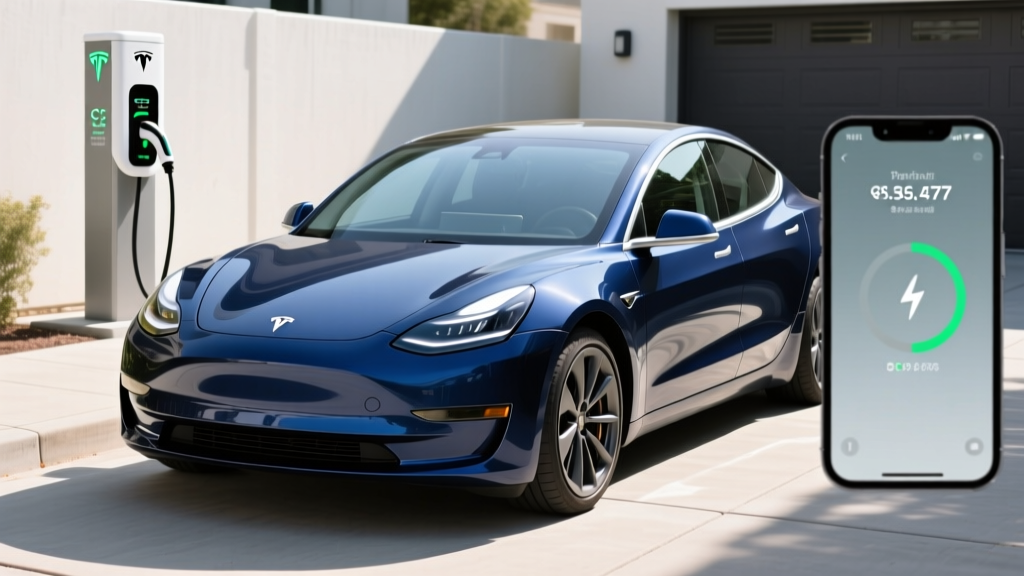
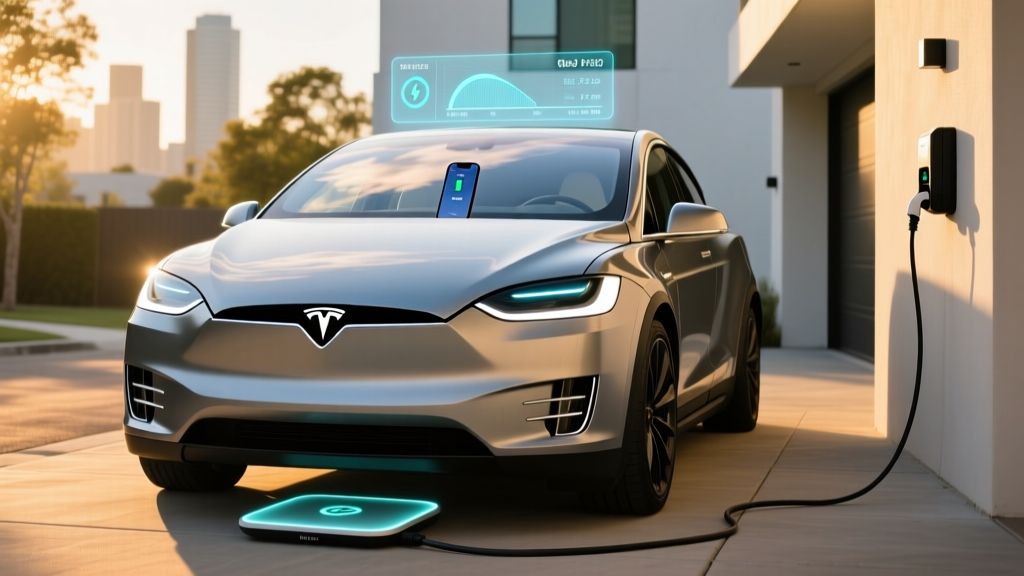
At home, the onboard charger accepts up to 11.5 kW on a 240V / 60A circuit (48A continuous). That translates to roughly 34 miles of range per hour of charging, meaning a full 0–100% replenishment takes about 10 hours. Most owners charging overnight from 20% to 80% will wake to a full daily buffer in under 7 hours. A Tesla Wall Connector costs approximately $420, and professional installation on an existing 200A panel typically runs $500–$1,500. Homes with older 100A panels may require a $2,000–$4,000 service upgrade — factor this into your purchase budget.
Preconditioning matters: When navigating to a Supercharger, the Model X automatically warms the battery to optimal temperature, enabling the full 250 kW peak upon arrival. Without preconditioning (e.g., arriving at a non-navigated charger in cold weather), peak power may be limited to 100–150 kW until the battery warms, adding 10–15 minutes to your session.
Performance: Dual-Motor AWD and the Plaid Option
The Long Range AWD pairs a permanent-magnet motor on the rear axle with an induction motor up front, producing a combined 670 horsepower. The 0–60 mph sprint clocks in at 3.8 seconds — astonishing for a 5,100-lb three-row SUV that can tow 5,000 pounds. The dual-motor setup provides true all-wheel drive with torque vectoring, and the low center of gravity (battery pack under the floor) keeps body roll surprisingly controlled through corners.
Step up to the Model X Plaid ($94,990) and Tesla's tri-motor configuration delivers 1,020 hp and a 2.5-second 0–60 time. While thrilling, the Plaid sacrifices roughly 9 miles of EPA range (326 vs. 335) and commands a premium that's hard to justify for family duty. The Long Range AWD's 3.8-second run is more than adequate for highway merging and passing.
Regenerative braking in the Model X is strong and predictable. Tesla removed the user-adjustable regen setting in recent years, locking it to a firm one-pedal-driving calibration. Most EV-adapted drivers prefer this, but newcomers from ICE vehicles should budget a week of adjustment. The stop mode brings the vehicle to a complete hold without touching the brake pedal in most traffic scenarios.
Interior, Cargo, and Technology
The Model X interior centers on a 17-inch landscape touchscreen running Tesla's proprietary infotainment OS — responsive, graphically rich, and constantly updated over-the-air. A second 8-inch screen serves rear passengers for climate and entertainment control. The yoke-style steering wheel is standard (a conventional round wheel can be requested at no cost). Build quality on 2025–2026 models has improved measurably over the 2021–2023 production: panel gaps are tighter, and the cabin materials — vegan leather, Alcantara headliner, open-pore wood — match the price point more convincingly.
Cargo space is generous: 37.1 cubic feet behind the third row, expanding to 85.1 cubic feet with both rear rows folded. The front trunk (frunk) adds approximately 6.5 cubic feet for charging cables or a small bag. Second-row legroom measures 40.9 inches; third-row legroom is 32.7 inches — adequate for children or short-trip adults but tight for six-footers on long drives.
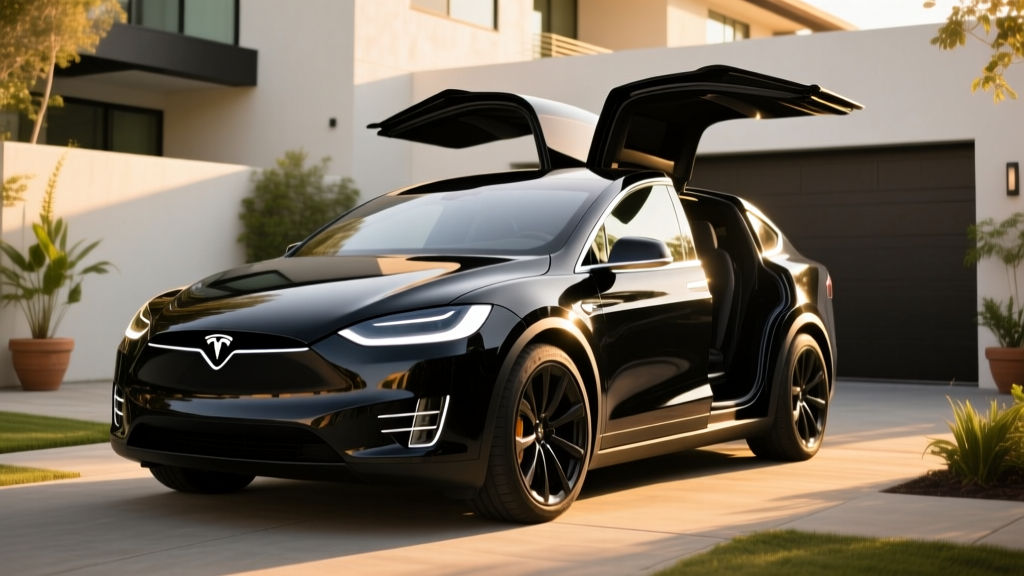
The signature Falcon Wing rear doors open vertically via electric actuators and ultrasonic obstacle sensors. They provide excellent curb-side access to child seats and third-row entry in tight parking spaces, but the mechanical complexity has historically been a maintenance concern. Tesla's 2024+ revisions to the hinge and sensor systems have reduced warranty claims, though the doors remain a polarizing feature.
HW4 Autopilot and FSD (Supervised)
The Model X HW4 system — whether running basic Autopilot or the optional Full Self-Driving (Supervised) package — is an SAE Level 2 driver-assist system. The driver must remain fully engaged, monitor the road, and be prepared to take over at any moment. This is not autonomous driving.
Hardware 4 (HW4), introduced in 2023 and standard on all 2026 Model X vehicles, replaces the HW3 sensor suite with higher-resolution cameras (5 megapixel vs. 1.2 megapixel), a wider field of view, and improved neural-net processing on Tesla's custom silicon. The result is noticeably better detection of small objects (cones, debris, pedestrians at distance), smoother lane-centering on faded markings, and more confident merging behavior in FSD Supervised mode.
Basic Autopilot (included) provides adaptive cruise control and lane-keeping. FSD (Supervised), available as a $8,000 one-time purchase or $99/month subscription, adds automatic lane changes, navigate-on-autopilot for highway exits, traffic light and stop sign recognition, and city-street autosteering. Real-world FSD performance in 2025–2026 has improved substantially in structured environments but still requires active supervision — construction zones, unprotected left turns, and complex multi-lane intersections demand driver readiness. Per NHTSA, Tesla Autopilot/FSD-related incidents remain under active regulatory review.
- Drive without a licensed, attentive driver in the seat
- Handle all weather conditions (heavy rain, snow, fog degrade camera performance)
- Navigate unmapped construction zones or temporary traffic patterns reliably
- Replace the driver's legal and safety responsibility
Pricing, Trims, and Federal Tax Credit Eligibility
| Trim | Base MSRP | §30D Credit | Effective Price |
|---|---|---|---|
| Long Range AWD | $79,990 | $0* | $79,990 |
| Plaid (Tri-Motor AWD) | $94,990 | $0* | $94,990 |
*The Model X Long Range exceeds the IRS §30D MSRP cap of $80,000 for SUVs. The Plaid also exceeds the cap. As of 2026, neither trim qualifies for the new-vehicle federal EV tax credit. State and utility incentives may still apply — check IRS §30D guidelines and your local programs.
The 2026 Model X Long Range AWD starts at $79,990 (including destination), placing it exactly at — or $1 below — the IRS §30D MSRP cap of $80,000 for SUVs, vans, and pickups. However, the base configuration ships with 20" wheels and minimal options. Adding any package (six-seat interior, tow hitch, FSD, premium paint) pushes the transaction price above $80,000, disqualifying the vehicle from the $7,500 federal credit. As a result, virtually no Model X configuration qualifies for §30D in practice.
Additional eligibility barriers include buyer income caps ($300,000 joint / $150,000 single modified AGI) and stringent battery critical-mineral and component sourcing requirements that shift annually. Always confirm eligibility with a tax professional before relying on the credit in your purchase decision.
For context, key competitors like the BMW iX xDrive50 (~$87,000) and Rivian R1S Dual-Motor (~$79,900) face similar credit limitations at higher trims, while the Kia EV9 GT-Line (~$73,000) can qualify for partial credits depending on battery sourcing and buyer income.
Ownership Costs and Warranty
Tesla covers the Model X battery and drive unit for 8 years or 150,000 miles, whichever comes first, with a minimum 70% capacity retention guarantee. The basic vehicle limited warranty is 4 years / 50,000 miles. These terms are competitive with the industry (Rivian offers 8/175,000 on battery; BMW offers 8/100,000).
Electricity costs vary by region, but at the national average of $0.16/kWh, charging a Model X from 0–100% costs approximately $16 at home. At 33 kWh/100 miles, fuel cost runs about $5.28 per 100 miles — roughly 60% less than a comparable gas SUV averaging 20 mpg at $3.50/gallon. Supercharger pricing averages $0.28–$0.36/kWh in 2026, making road-trip fuel costs closer to $9–$12 per 100 miles.
Insurance premiums for the Model X remain elevated relative to non-luxury EVs. Expect annual premiums of $2,800–$4,200 depending on state, driving record, and coverage level. Tesla's own insurance product (available in select states) uses real-time driving data and can be 15–25% cheaper for clean-record drivers.
Pros and Cons
Pros
- 335-mile EPA range — among the longest for a 3-row electric SUV
- Native Supercharger access — most reliable public charging network in North America
- 670 hp dual-motor AWD with 3.8s 0–60 and 5,000-lb towing
- Falcon Wing doors ease child-seat and 3rd-row access in tight spaces
- HW4 Autopilot/FSD hardware is current-generation, with OTA improvement potential
- Generous cargo: 85.1 cu ft max, plus front trunk
- Heat pump standard for improved cold-weather efficiency
Cons
- Does not qualify for §30D federal tax credit at most configurations
- $79,990+ starting price — premium over Kia EV9, Hyundai Ioniq 9
- 250 kW peak DC charge rate trails 800V competitors (Ioniq 9 at ~350 kW capable)
- FSD (Supervised) still requires full driver attention despite $8,000 cost
- Falcon Wing doors add mechanical complexity and potential long-term maintenance cost
- Third-row legroom (32.7") is tight for adults on long trips
- Insurance premiums 20–40% higher than comparable ICE SUVs
Who Should Buy the 2026 Model X HW4?
- You need three-row seating and frequent Supercharger road-trip capability
- You value OTA software updates and Tesla's tech ecosystem
- You tow up to 5,000 lbs and want dual-motor AWD traction
- Falcon Wing doors solve a real parking/access problem for your family
- Federal tax credit eligibility is a deal-breaker (look at Kia EV9, partial credit possible)
- You want the fastest DC charging available (Hyundai Ioniq 9 with 800V architecture)
- Third-row adult comfort is a priority (Rivian R1S offers more third-row space)
- Budget is under $65,000 (the Model X is firmly in luxury-SUV territory)
Frequently Asked Questions
What is the real-world range of the 2026 Tesla Model X?
The EPA rates the Long Range AWD at 335 miles. In real-world highway driving at 70 mph, expect 275–295 miles. In cold weather (below 30°F), plan for 240–270 miles. Choosing 22" wheels reduces EPA range to approximately 311 miles.
How fast does the Model X charge at home and on the road?
On a Level 2 home charger (240V, 48A), the Model X gains about 34 miles of range per hour, fully charging overnight in ~10 hours. On a V3 Supercharger (250 kW peak), a 10–80% session takes approximately 30 minutes, though the charge curve tapers significantly above 70% SoC.
Does the 2026 Model X qualify for the federal EV tax credit?
In most configurations, no. The base Long Range AWD at $79,990 sits at the §30D MSRP cap for SUVs ($80,000), but adding any option pushes it above the limit. The Plaid at $94,990 exceeds it outright. Additionally, buyer income caps and battery-sourcing rules further restrict eligibility. Consult IRS §30D resources and a tax professional.
Is the Model X worth buying vs. the Rivian R1S or Kia EV9?
The Model X wins on range (335 mi vs. R1S ~321 mi, EV9 ~304 mi), Supercharger network access, and raw performance. The Rivian R1S offers a more rugged build, better third-row space, and competitive tech. The Kia EV9 costs $15,000–$20,000 less and may qualify for partial tax credits. Your priority — network, space, price, or performance — determines the right choice.
What does HW4 add over the older HW3 system?
HW4 uses 5-megapixel cameras (vs. 1.2 MP on HW3) with a wider field of view and improved neural-net processing. This yields better small-object detection, smoother lane-keeping on degraded markings, and more confident behavior in FSD Supervised city-street driving. HW3 vehicles cannot be retrofitted to HW4.
Is Tesla Full Self-Driving actually self-driving?
No. FSD (Supervised) is an SAE Level 2 driver-assist system. Despite its name, it requires the driver to remain fully attentive, monitor surroundings, and intervene at any time. Only Level 4 services like Waymo operate without a human driver — and those are limited to geofenced urban areas, not available in a consumer vehicle.