Quick Verdict: The Tesla Model X in 2026
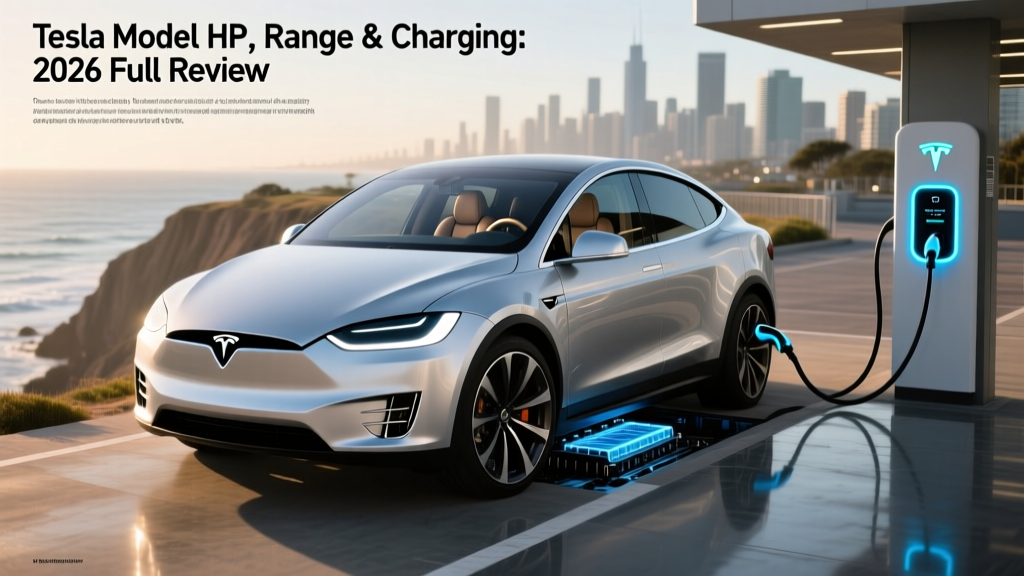
If you're searching for Tesla Model X hp figures, you're likely weighing one of the most powerful three-row electric SUVs on the market against rivals like the Rivian R1S, BMW iX, and Mercedes EQS SUV. The 2026 Model X continues to offer two distinct powertrain flavors: the dual-motor Long Range with a combined 670 horsepower, and the tri-motor Plaid pushing an astonishing 1,020 hp. Both sit on a ~100 kWh (usable) NMC battery pack, deliver class-leading Supercharger network access, and seat up to seven passengers with falcon-wing rear doors that remain genuinely practical for car-seat loading.
But raw horsepower tells only part of the story. This review digs into what those numbers mean for real-world driving — including EPA range versus what you'll actually see on a highway road trip, how the charging curve behaves at a V4 Supercharger, whether you'll qualify for the federal EV tax credit under current IRS §30D rules, and where the Model X falls short against newer competitors.
Tesla Model X HP, 0-60, and Drivetrain Breakdown
The Model X's headline power figures differ dramatically by trim, and that gap shows up everywhere from stoplight launches to highway passing confidence.
| Spec | Long Range (Dual Motor) | Plaid (Tri Motor) |
|---|---|---|
| Horsepower (combined) | 670 hp | 1,020 hp |
| Torque (lb-ft) | ~590 | ~1,050 |
| 0-60 mph | 3.8 seconds | 2.5 seconds |
| Top Speed | 155 mph | 163 mph |
| Drivetrain | AWD (dual motor) | AWD (tri motor) |
| Towing Capacity | 5,000 lbs | 5,000 lbs |
The Long Range's 670 hp is more than sufficient for a 5,100-pound SUV — it hits 60 mph faster than most sports sedans from a decade ago. The Plaid's 1,020 hp is, frankly, absurd in a family hauler, but it delivers a party trick that never gets old and genuine utility when merging onto fast-moving freeways with a full load of passengers and cargo.
Both trims use Tesla's permanent-magnet synchronous motors with silicon-carbide inverters. The tri-motor Plaid adds a rear dual-motor setup with torque vectoring across the rear axle, which you can feel during hard cornering — the inside rear wheel brakes subtly while the outside wheel pushes, keeping the heavy SUV surprisingly flat through sweeps.
EPA Range vs. Real-World Driving
According to fueleconomy.gov, the Model X Long Range achieves 103 MPGe combined (33 kWh/100mi), while the Plaid drops to 98 MPGe combined (34 kWh/100mi). These efficiency numbers are respectable for a 5,100-pound, three-row SUV, but they trail the more aerodynamic sedan siblings and newer competitors like the BMW iX xDrive50 (which achieves 86 MPGe combined but is smaller and lighter).
The real-world range gap comes down to three factors: the Model X's relatively tall and wide profile creates more aerodynamic drag at highway speeds than sleeker crossovers; the heavy battery pack demands more energy during repeated acceleration; and the falcon-wing door seals and large glass roof introduce minor thermal losses in extreme temperatures. If your commute is primarily city driving with frequent regenerative braking opportunities, you'll skew closer to — or even slightly above — the EPA sticker.
Battery Chemistry, Capacity, and Longevity
The 2026 Model X uses a ~100 kWh usable battery pack with NMC (nickel manganese cobalt) chemistry across both trims. Tesla has not switched the Model X to LFP (lithium iron phosphate), which is reserved for the lower-cost Standard Range Model 3 and Model Y variants. NMC offers higher energy density — critical for fitting enough cells into the Model X's platform to clear 300+ miles — but it requires more careful state-of-charge management for long-term health.
Tesla recommends daily charging to 80-90% for NMC packs and reserving 100% charges for road trips. The battery management system includes a robust thermal management loop with active liquid cooling and heating, which helps mitigate degradation. Based on long-term fleet data from high-mileage Model S and X owners, NMC packs in Tesla's large-vehicle platform typically retain 85-90% capacity after 100,000 miles, with the curve flattening significantly after the initial 10-15% drop in the first 20,000-30,000 miles.
| Attribute | Specification |
|---|---|
| Usable Capacity | ~100 kWh |
| Chemistry | NMC (Nickel Manganese Cobalt) |
| Battery Warranty | 8 years / 150,000 miles |
| Warranty Threshold | 70% capacity retention |
| Drive Unit Warranty | 8 years / 150,000 miles |
| Basic Vehicle Warranty | 4 years / 50,000 miles |
The 8-year/150,000-mile battery and drive unit warranty is competitive and matches what Tesla offers on the Model S. The 70% retention threshold is industry-standard, though some competitors like Hyundai offer a more generous 80% threshold on their smaller packs.
Charging Speeds: DC Fast, Level 2, and Home Setup
Charging speed is where the Model X's access to the Tesla Supercharger network — now the gold standard for reliability and coverage — becomes a decisive ownership advantage. With the 2026 model year, all new Teslas ship with the native NACS (North American Charging Standard) port, eliminating the need for adapters at Tesla stalls.
| Charging Level | Power / Rate | Time / Range Added |
|---|---|---|
| DC Fast Charge (V4 Supercharger, peak) | 250 kW peak | 10-80% in ~30 minutes |
| DC Fast Charge (sustained average) | ~150-170 kW avg | ~175 miles in 15 minutes |
| Level 2 (Tesla Wall Connector, 48A) | 11.5 kW | ~34 miles per hour |
| Level 2 (generic J1772/NACS, 32A) | 7.7 kW | ~23 miles per hour |
| Level 1 (120V household) | ~1.4 kW | ~4 miles per hour |
The Model X peaks at 250 kW on a V3 or V4 Supercharger, but as with all EVs, that peak is not sustained. The charge curve tapers significantly above 50% state of charge and drops sharply past 80%. In practice, a 10-80% session takes approximately 30 minutes when the battery is preconditioned (which the navigation system does automatically when you route to a Supercharger). Without preconditioning — say, arriving at a charger with a cold-soaked battery in winter — that same session can stretch to 45+ minutes.
For home charging, Tesla's Wall Connector at 48 amps on a 240V/60A circuit delivers 11.5 kW, adding roughly 34 miles of range per hour. An overnight charge from 20% to 80% takes about 5-6 hours, which is practical for virtually all daily driving patterns. Expect to pay between $500 and $1,500 for professional home charger installation depending on your electrical panel capacity and run distance — and potentially $2,000-$4,000 more if your home needs a panel upgrade to 200A service.
Pricing, Trims, and Federal Tax Credit Eligibility
The 2026 Model X starts at a premium price point, and tax credit eligibility is a critical factor that many luxury EV buyers overlook until purchase day.
| Trim | Base MSRP | As-Tested (typical options) |
|---|---|---|
| Long Range (Dual Motor, 5-seat) | $79,990 | $85,000-$92,000 |
| Plaid (Tri Motor, 5-seat) | $94,990 | $100,000-$108,000 |
| Six-seat interior (+$6,500) | — | Adds captain's chairs, 2nd row |
| Seven-seat interior (+$4,500) | — | Adds 3rd-row bench |
Under current IRS §30D rules, the federal clean vehicle credit offers up to $7,500 — split into two $3,750 halves based on battery-component sourcing and critical-minerals requirements. However, the Model X faces a significant obstacle: the MSRP cap for SUVs is $80,000. The Long Range at $79,990 squeaks under the cap at base price, but adding virtually any option (FSD, premium paint, larger wheels, six- or seven-seat configurations) pushes the MSRP above $80,000 and eliminates credit eligibility entirely. The Plaid, at $94,990 base, is well above the cap and does not qualify regardless of options.
- MSRP Cap (SUVs): ≤ $80,000 — Long Range base only; any options disqualify
- Buyer Income Cap: AGI ≤ $300,000 (joint) / $225,000 (head of household) / $150,000 (single)
- Battery Components: Must meet North American manufacturing/assembly thresholds (phasing in through 2026)
- Critical Minerals: Must meet sourcing thresholds for lithium, cobalt, nickel, etc.
- Point-of-Sale Transfer: Eligible buyers can transfer the credit to the dealer for an upfront price reduction
- Consult a tax professional — eligibility depends on your specific situation and rules update frequently
For most Model X buyers, the realistic answer on tax credits is: the base Long Range may qualify if your income is under the cap and battery sourcing requirements are met for the specific VIN, but optioned-up vehicles and all Plaid models will not. Always verify eligibility for your specific vehicle on the IRS clean vehicle portal before committing.
Interior Space, Cargo, and Technology
The Model X's interior is where Tesla's minimalist philosophy meets the practical demands of a three-row family SUV — with mixed results.
| Measurement | Specification |
|---|---|
| Cargo (behind 3rd row) | ~15 cu ft |
| Cargo (3rd row folded) | ~40 cu ft |
| Cargo (all rear rows folded) | ~75 cu ft |
| Front trunk (frunk) | ~6.6 cu ft |
| Front legroom | 41.2 inches |
| 2nd-row legroom | 38.4 inches |
| 3rd-row legroom | 32.7 inches |
The falcon-wing rear doors are the Model X's signature feature, and they're more than a gimmick. The articulated hinges and sensors allow the doors to open in tight parking spaces (as little as 11 inches of side clearance), and the massive opening they create makes loading car seats and reaching third-row passengers dramatically easier than in any conventional SUV. In rain, the doors channel water away from the cabin opening — a small but appreciated detail.
The 17-inch center touchscreen runs Tesla's latest software with a responsive interface, integrated navigation with Supercharger routing, Netflix/YouTube streaming while parked, and a genuinely useful trip planner that accounts for elevation, temperature, and traffic when estimating range. The yoke steering wheel (standard) takes adjustment — most owners adapt within a week, but some find three-point turns and parking-lot maneuvers frustrating without a full round wheel. A conventional round wheel is available as a no-cost option.
On the tech front, the Model X includes Basic Autopilot standard, which provides SAE Level 2 adaptive cruise control and lane-centering on highways. Tesla's Full Self-Driving (Supervised) package, available as a $8,000 add-on or $99/month subscription, adds automated lane changes, city-street navigation, traffic-light recognition, and parking assist. It's critical to understand that FSD Supervised remains an SAE Level 2 system — the driver must remain fully engaged and ready to take over at all times. It is not autonomous driving.
How It Compares: Model X vs. Key Competitors
- Class-leading Supercharger network access
- Falcon-wing doors genuinely practical for families
- Plaid's 1,020 hp / 2.5s 0-60 is unmatched in the segment
- Over-the-air updates continuously add features
- Strong towing capacity (5,000 lbs)
- Spacious frunk adds versatile cargo options
- Base price exceeds $80K — most trims ineligible for tax credit
- Panel gaps and interior material quality lag behind BMW/Mercedes
- Third row is tight for adults on long trips
- 250 kW peak DC charging trails 800V competitors (Hyundai/Kia/Porsche at 350 kW)
- Yoke steering is polarizing and takes adaptation
- High insurance premiums relative to segment
Against the Rivian R1S, the Model X wins on charging infrastructure (Supercharger vs. Rivian's growing but smaller network) and raw performance in the Plaid trim. The R1S counters with a more adventure-oriented design, better off-road capability, a more traditional interior layout, and a starting price that keeps more configurations under the $80,000 MSRP cap for tax credit eligibility.
The BMW iX xDrive50 offers a more luxurious interior with higher-quality materials, a quieter cabin, and competitive range (324 miles EPA), but it seats only five and lacks a third row entirely. The Mercedes EQS 580 SUV matches the Model X on luxury and offers three rows, but its real-world efficiency is lower, and its charging network access relies on Electrify America and third-party providers that are less reliable than Tesla's proprietary network.
Who Should Buy the 2026 Tesla Model X?
- You need a three-row electric SUV with the most reliable fast-charging network
- You regularly haul kids and car seats (falcon-wing doors are a genuine advantage)
- You tow up to 5,000 lbs (boat, small trailer, camper)
- You want 300+ miles of EPA range for road trips with Supercharger stops every 2.5 hours
- You want supercar-rivaling acceleration in a practical family SUV and budget is flexible
- The $94,990+ price and tax-credit ineligibility are not dealbreakers
- You value the tri-motor torque vectoring for spirited driving on back roads
- You want a luxury-grade interior with premium materials — consider the BMW iX or Mercedes EQS SUV
- You need a usable third row for adults — consider the Rivian R1S or Kia EV9
- Tax credit eligibility is essential to your budget — the base Long Range is your only option, and even that is conditional
Frequently Asked Questions
What is the real-world range of the Tesla Model X?
The EPA rates the Long Range at 335 miles and the Plaid at 311 miles. In real-world highway driving at 70-75 mph, expect 270-290 miles (Long Range) and 250-270 miles (Plaid). Cold weather below freezing can reduce range by 20-30%, bringing effective highway range to 190-230 miles. City driving with regenerative braking will push you closer to the EPA sticker.
How fast does the Model X charge at home and on the road?
On a V3/V4 Supercharger, the Model X peaks at 250 kW and charges from 10-80% in approximately 30 minutes with battery preconditioning. At home on a Tesla Wall Connector (48A, 240V), it charges at 11.5 kW, adding about 34 miles per hour — a full overnight session replenishes most daily driving. Level 1 (120V) trickle charging adds only about 4 miles per hour and is suitable only for emergency top-ups.
Does the 2026 Tesla Model X qualify for the $7,500 federal tax credit?
It depends. The Long Range at its $79,990 base MSRP sits just under the $80,000 SUV cap, but adding any options (premium paint, FSD, six- or seven-seat layouts) pushes the price above the cap and eliminates eligibility. The Plaid at $94,990 does not qualify. Even the base Long Range must meet battery-sourcing and critical-minerals requirements under §30D, and the buyer must fall under the income caps ($300K joint / $150K single). Always check the IRS clean vehicle portal for your specific VIN before purchasing.
How much horsepower does the Tesla Model X have?
The dual-motor Long Range produces 670 combined horsepower with a 3.8-second 0-60 mph time. The tri-motor Plaid produces 1,020 combined horsepower with a 2.5-second 0-60 mph time — making it one of the quickest production SUVs ever built.
Is the Model X worth buying over the Rivian R1S or BMW iX?
The Model X wins on Supercharger network reliability, falcon-wing door practicality for families, and raw performance (Plaid). The Rivian R1S is better for off-road use, has a more conventional interior, and more trims qualify for the tax credit. The BMW iX offers a significantly more luxurious cabin but seats only five. Your decision should hinge on whether you need three rows, value charging infrastructure over interior luxury, and whether tax credit eligibility matters for your budget.
What is the battery warranty on the Model X?
Tesla covers the battery and drive unit for 8 years or 150,000 miles, whichever comes first, with a minimum 70% capacity retention guarantee. The basic vehicle warranty is 4 years / 50,000 miles. Based on fleet data, Tesla's NMC packs in the Model S/X platform typically retain 85-90% capacity at 100,000 miles.