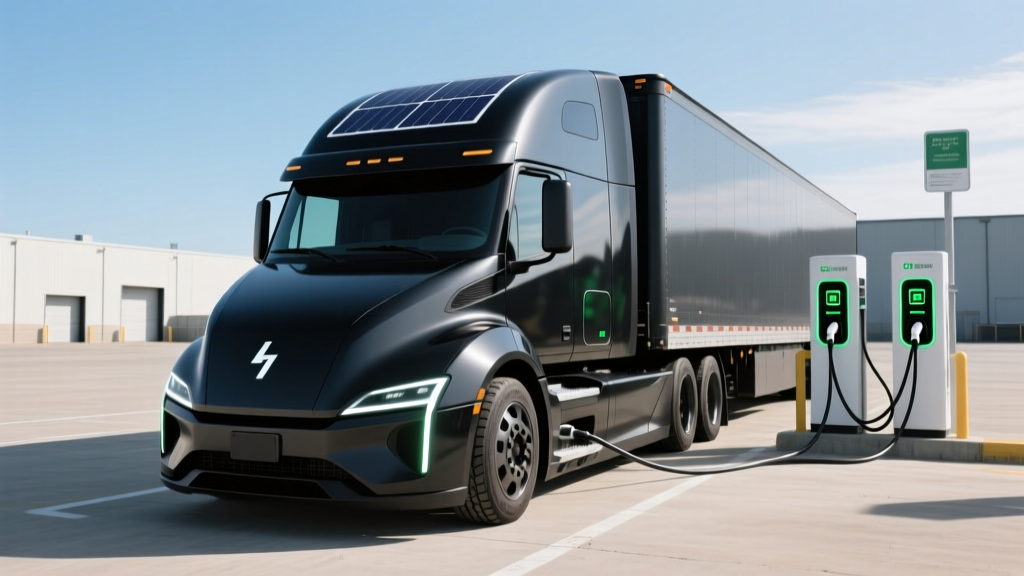
The Short Answer on Fully Electric Semi Trucks in 2026
A fully electric semi truck makes financial sense today for fleet operators running regional haul routes under 250 miles round-trip with predictable depot-return patterns. Class 8 electric semis like the Freightliner eCascadia, Volvo VNR Electric, and Tesla Semi deliver 150–500 miles of real-world range depending on battery configuration and payload, with per-mile energy costs roughly 50–65% lower than diesel at current commercial electricity and fuel prices. Purchase prices remain 2–3× higher than diesel equivalents ($250,000–$400,000 before incentives), but total cost of ownership (TCO) parity is achievable within 3–5 years on high-utilization routes thanks to dramatically lower fuel and maintenance spend. Long-haul operators (500+ mi/day) should wait: charging infrastructure and battery energy density are not there yet.
Class 8 Electric Semi Trucks Available in 2026
The heavy-duty EV market has matured past the pilot-program stage. Several OEMs now sell production fully electric semi trucks with real delivery schedules and dealer support networks. Here is how the major platforms stack up on the specs that matter to fleet buyers:
| Spec | Tesla Semi | Freightliner eCascadia | Volvo VNR Electric |
|---|---|---|---|
| GVWR Class | Class 8 | Class 8 | Class 8 |
| Battery Capacity (usable) | ~900 kWh (est.) | 438 kWh (44T config) | 375 kWh (6× pack) |
| Chemistry | NMC (est.) | NMC | NMC |
| EPA / Claimed Range (loaded) | 500 mi (80k lb GVW) | 230 mi (82k lb GVW) | 175 mi (66k lb GVW) |
| Real-World Range Expectation | ~375–450 mi | ~150–200 mi | ~120–160 mi |
| Peak DC Charge Rate | ~1,200 kW (est., MCS) | 400 kW (CCS2/MCS) | 250 kW (CCS2) |
| 10–80% Charge Time (est.) | ~45–60 min | ~60–90 min | ~70–90 min |
| Motor Output | ~1,000+ HP (tri-motor) | 470 HP (eAxle) | 455 HP (dual motor) |
| Base MSRP (est. 2026) | $250,000 (300 mi) / $290,000 (500 mi) | $300,000–$350,000 | $300,000–$340,000 |
| Warranty (battery) | 8 yr / 1,000,000 mi | 5 yr / 300,000 mi | 5 yr / 300,000 mi |
Real-world range caveat: Manufacturer range claims assume moderate speeds, flat terrain, and temperate weather. Expect a 15–25% reduction in cold weather (below 32°F) due to cabin heating, battery thermal management loads, and increased rolling resistance. Highway speeds above 65 mph also erode range significantly — aerodynamic drag on a box trailer at 70 mph can cut effective range by 20% or more versus 55 mph operation. Always spec battery capacity against your worst-case route, not the average.
Electric Semi vs. Diesel: Operating Cost Comparison
The purchase price of a fully electric semi truck is undeniably steep. The business case rests entirely on operating cost advantages over a 7–10 year service life. Here is a data-driven comparison based on a regional-haul duty cycle of 150 miles/day, 260 operating days/year:
| Cost Factor | Diesel Class 8 | Electric Class 8 | Notes |
|---|---|---|---|
| Purchase Price (base) | $130,000–$160,000 | $280,000–$350,000 | Electric premium: ~$150k–$200k |
| Fuel/Energy per Mile | $0.65–$0.80/mi | $0.22–$0.35/mi | Based on $4.00/gal diesel, $0.12–0.18/kWh commercial |
| Annual Fuel/Energy (39k mi/yr) | $25,350–$31,200 | $8,580–$13,650 | Savings: $12,000–$22,000/yr |
| Maintenance per Mile | $0.15–$0.20/mi | $0.05–$0.08/mi | No oil, DEF, DPF, fewer brake jobs (regen) |
| Annual Maintenance | $5,850–$7,800 | $1,950–$3,120 | Savings: ~$3,500–$5,000/yr |
| Depot Charging Infrastructure | N/A | $80,000–$200,000 per charger | DC fast (150–400 kW) depot install, shared across fleet |
| Federal Tax Credit (§45W) | $0 | Up to $40,000 | Commercial clean vehicle credit for Class 8 |
| Estimated 7-Year TCO | $1,150,000–$1,350,000 | $1,050,000–$1,300,000 | Includes purchase, energy, maintenance, infra amortized |
The critical variable is energy cost per kWh. Fleets that negotiate off-peak depot charging rates of $0.08–$0.12/kWh see the most aggressive payback. Fleets reliant on public DC fast charging at $0.35–$0.50/kWh will see fuel savings evaporate. This is why nearly every successful electric semi deployment operates on a depot-charging model — overnight Level 2 or scheduled DC fast sessions at the fleet yard.
Sources: fueleconomy.gov for efficiency baselines; IRS §45W Commercial Clean Vehicle Credit for incentive details.
Charging Infrastructure: The Real Bottleneck
Charging a fully electric semi truck is fundamentally different from charging a passenger EV. The energy volumes are enormous — replenishing a 438 kWh battery pack from 20% to 80% requires pushing roughly 260 kWh into the pack. Even at 400 kW peak charge rates, that takes an hour or more, and sustained rates are lower due to charge-curve taper above 80% state of charge (SoC).
| Charging Method | Power (kW) | Miles Added per Hour (est.) | Use Case |
|---|---|---|---|
| Depot AC Level 2 (per truck) | 19–48 kW | ~20–55 mi/hr | Overnight top-off; 8–10 hr dwell |
| Depot DC Fast (150 kW) | 150 kW | ~170 mi/hr | Mid-day opportunity charge |
| Depot DC Fast (350–400 kW) | 350–400 kW | ~380–450 mi/hr (peak) | High-utilization fleet turnaround |
| Megawatt Charging System (MCS) | Up to 1,200 kW | ~1,000+ mi/hr (peak) | Emerging standard for long-haul; limited availability |
Depot electrical upgrades are the hidden cost. Installing even two 350 kW DC dispensers may require a utility service upgrade to 1–2 MW of transformer capacity, which can cost $200,000–$500,000 and take 12–18 months for utility approval. Smart charge management software (e.g., staggered charging schedules, power sharing across dispensers) can reduce peak demand charges and avoid the most expensive utility upgrades. Budget at least $100,000–$250,000 per truck in charging infrastructure for a small fleet deployment, amortized across 5–10 vehicles the cost drops to $25,000–$50,000 per unit.
Who Should Buy an Electric Semi — And Who Should Wait
Actionable Decision Framework
- Choose electric if: Your routes are under 200 miles round-trip, trucks return to a fixed depot nightly, you operate in a state with low commercial electricity rates or strong HVIP/incentive programs (California, New York, New Jersey), and your daily mileage is predictable.
- Choose electric if: You operate in a port drayage or urban delivery environment with low average speeds (regen braking maximizes efficiency), face upcoming zero-emission zone mandates, or need to meet customer ESG/sustainability requirements.
- Wait on electric if: Your routes regularly exceed 300 miles one-way, you operate in extreme cold climates (northern MN, MT, AK) without heated depot facilities, or you lack access to depot property where charging infrastructure can be installed.
- Wait on electric if: You are a small operator (1–3 trucks) without the capital to absorb infrastructure costs and without access to state incentive programs that cover 50%+ of incremental vehicle and charger cost.
- Consider a hybrid/PHEV or hydrogen fuel-cell alternative if: Your duty cycle mixes short urban runs with occasional long hauls, or your region has hydrogen station buildout underway (Southern California, Texas corridor pilots).
Common Misconceptions About Electric Semis
| Myth | Fact |
|---|---|
| "Electric semis can't pull full loads." | Class 8 electric trucks are rated for 80,000–82,000 lb GVW. The Freightliner eCascadia and Tesla Semi both haul standard 80k-lb loads. The trade-off is range reduction, not capability. |
| "Batteries will need replacing every few years at enormous cost." | Heavy-duty NMC packs are engineered for 1,000,000+ mile service life with less than 20% degradation. Tesla's Semi warranty covers 1 million miles. Replacement cost, if needed post-warranty, is estimated at $50,000–$100,000 depending on pack size — significant, but over a decade of fuel savings this is manageable. |
| "The grid can't handle fleet charging." | A 10-truck depot charging at 150 kW each draws ~1.5 MW — equivalent to a large grocery store. Utility coordination and managed charging make this feasible, though lead times for service upgrades are real (12–18 months in some regions). |
| "Electric trucks are slower and hurt driver productivity." | Electric drivetrains deliver peak torque at 0 RPM. The Tesla Semi claims 0–60 mph in 20 seconds loaded (vs. ~45 sec for diesel). Grade-climbing performance is superior. Top speed is governed to 65–70 mph like all Class 8 trucks. |
| "Federal tax credits cover the full price premium." | The IRS §45W credit provides up to $40,000 for Class 8 vehicles — meaningful, but only covers 20–25% of the typical diesel-to-electric price gap. State incentives (California HVIP, New York Truck Voucher) are often essential to close the remaining gap. |
Real-World Ownership Considerations
Fleet operators who have deployed electric semis at scale report a consistent set of operational realities that spec sheets do not capture:
- Driver acceptance is high once operators experience the quiet cab, instant torque, and absence of diesel vibration. Recruitment and retention benefits are real in a tight driver market.
- Cold-weather range loss is route-critical. A truck rated at 230 miles may deliver 160–175 miles in 10°F weather with cargo heating demands. Fleets in cold climates must either overspec battery capacity or plan mid-route charging.
- Tire wear increases. Electric semis are heavier (battery mass adds 3,000–6,000 lbs vs. diesel) and deliver instant torque. Expect 10–20% faster steer-tire wear. Budget accordingly.
- Regenerative braking extends brake life dramatically. Many operators report 2–3× longer brake service intervals, offsetting some tire cost.
- Insurance premiums run 10–25% higher than diesel equivalents due to higher repair costs for battery and high-voltage components and limited actuarial data. Shop fleet policies carefully.
- Resale values are uncertain. The used electric semi market is nascent. Early adopters should plan to run trucks to end-of-life rather than depend on residual value.
Frequently Asked Questions
What is the range of a fully electric semi truck?
Production electric semis in 2026 offer between 150 and 500 miles of claimed range depending on battery configuration. The Tesla Semi (500-mi variant) leads on paper, while the Freightliner eCascadia and Volvo VNR Electric offer 150–230 miles. Real-world loaded range is typically 15–25% lower, especially in cold weather or at sustained highway speeds above 65 mph.
How long does it take to charge an electric semi truck?
Overnight depot charging on AC Level 2 (48 kW) fully replenishes most packs in 8–10 hours. DC fast charging at 150–400 kW can take a pack from 10–80% in 45–90 minutes. The emerging Megawatt Charging System (MCS) targets 10–80% in under 30 minutes, but public MCS stations are extremely limited as of 2026.
Do electric semi trucks qualify for federal tax credits?
Yes — but under a different program than passenger EVs. The IRS §45W Commercial Clean Vehicle Credit provides up to $40,000 for qualifying Class 8 trucks. There is no MSRP cap, but the vehicle must be used for business purposes and meet prevailing wage and domestic-content requirements for the maximum credit. Consult a tax professional for your specific fleet structure.
What does depot charging infrastructure cost?
Expect $80,000–$200,000 per DC fast charger (150–400 kW) including equipment, installation, and permitting. Utility service upgrades for a multi-truck depot can add $200,000–$500,000. Total infrastructure investment for a 5-truck fleet typically runs $500,000–$1,200,000. State incentive programs often cover 50–80% of this cost in qualifying regions.
How does electric semi maintenance compare to diesel?
Electric semis eliminate oil changes, diesel exhaust fluid (DEF), diesel particulate filter (DPF) regeneration, and most transmission maintenance. Regenerative braking dramatically extends brake life. Estimated maintenance cost is $0.05–$0.08 per mile vs. $0.15–$0.20 for diesel — a savings of $3,500–$5,000 per truck per year at typical mileage.
Is a fully electric semi truck practical for long-haul routes?
Not yet in 2026. Routes exceeding 300 miles one-way require en-route DC fast charging that is largely unavailable for heavy-duty vehicles. The Tesla Semi's 500-mile range approaches long-haul viability, but charging infrastructure along freight corridors remains in early pilot stages. Long-haul operators should monitor MCS corridor buildout and consider hydrogen fuel-cell alternatives for routes where battery weight and charging downtime are prohibitive.