Quick Verdict: The Model X in 2026
The Tesla Model X remains one of the most polarizing electric SUVs on the market. It offers supercar-rivaling acceleration in a three-row family hauler, access to the most reliable DC fast-charging network in North America, and a starting price that — after the federal tax credit — undercuts several luxury ICE competitors. But it also carries a 2015-vintage exterior design, a yoke steering wheel that divides owners, and interior build quality that still trails German rivals at this price point.
If you need three rows, want serious performance, and prioritize charging infrastructure above all else, the Model X is still the benchmark. If interior luxury and the latest sheetmetal matter more, the Rivian R1S, BMW iX, and Mercedes EQS SUV deserve a hard look.
Tesla Model X Horsepower and Performance Specs
The keyword that brings most shoppers here is Tesla horsepower Model X — and the numbers are staggering for a 5,185-pound SUV. Tesla offers two powertrain configurations for the 2026 model year:
| Spec | Model X (Dual Motor) | Model X Plaid (Tri-Motor) |
|---|---|---|
| Drivetrain | Dual Motor AWD | Tri-Motor AWD |
| Horsepower | 670 hp | 1,020 hp |
| 0–60 mph | 3.8 seconds | 2.5 seconds |
| Top Speed | 155 mph | 163 mph |
| EPA Range | 335 miles | 326 miles |
| Battery (usable) | ~100 kWh NMC | ~100 kWh NMC |
| MPGe (combined) | 98 MPGe | 95 MPGe |
| Energy Consumption | 34 kWh/100 mi | 35 kWh/100 mi |
The dual-motor Model X at 670 hp already outmuscles most V8 luxury SUVs. The Plaid's 1,020 hp and 2.5-second 0–60 time put it in hypercar territory — a number that never stops being startling in a vehicle with falcon-wing doors and room for seven. Both use Tesla's NMC (nickel manganese cobalt) battery chemistry, chosen for its higher energy density compared to LFP, which is critical in a large, heavy SUV where range matters.
Tesla's Autopilot and Full Self-Driving (Supervised) are SAE Level 2 driver-assistance systems. The driver must remain attentive, hands on the wheel (or applying torque), and ready to take over at any moment. Despite the "FSD" branding, this is not autonomous driving. Only Level 4 services like Waymo operate without a human driver.
Real-World Range: What the EPA Sticker Doesn't Tell You
EPA Estimated: 335 miles (Dual Motor) / 326 miles (Plaid)
Real-World Highway (70–80 mph): ~265–290 miles
Cold Weather (below 32°F): ~220–260 miles (20–30% reduction typical)
Optimal City/Moderate Conditions: 310–335 miles achievable
The Model X's EPA range figures come from fueleconomy.gov testing cycles that blend city and highway driving at moderate speeds. In practice, the Model X is a large, heavy, aerodynamically challenged SUV, and highway efficiency suffers accordingly.
On a 300-mile road trip at sustained 75–80 mph in 65°F weather, expect to arrive with roughly 10–15% state of charge remaining in the dual-motor variant. In winter conditions — especially below freezing where battery chemistry slows and cabin heating draws significant power — range drops of 20–30% are well-documented across the EV industry, not unique to Tesla. The Model X does include a heat pump for cabin and battery thermal management, which mitigates some cold-weather losses compared to older resistive-heater EVs, but physics still wins in deep cold.
For daily commuting under 60 miles round-trip, range is a non-issue: you'll charge at home overnight and rarely think about it. Road trippers will rely on Tesla's Supercharger network, which remains the most reliable public charging infrastructure in North America.
Charging Speed: DC Fast Charge and Home Level 2
Charging speed is often the deciding factor for EV buyers, and the Model X delivers competitive — if not class-leading — numbers. Understanding the distinction between kW (power, or how fast energy flows) and kWh (energy, or how much the battery holds) is essential here. The Model X battery holds roughly 100 kWh of usable energy; charging power determines how quickly you refill it.
| Charging Level | Power / Rate | Time / Miles Added |
|---|---|---|
| Level 1 (120V household) | ~1.4 kW | ~3–4 miles per hour |
| Level 2 (240V home / Wall Connector) | 11.5 kW (48A) | ~34 miles per hour; full charge in ~9 hours |
| DC Fast Charge (Supercharger V3/V4) | Peak 250 kW | 10–80% in ~30 minutes; ~175 miles in 15 min |
| DC Fast Charge (CCS adapter, non-Tesla) | Up to ~150–200 kW (varies) | Depends on station; 10–80% in ~35–45 min |
Charging curve reality: The 250 kW peak only applies at low state of charge (roughly 5–25% SoC) with a preconditioned battery. Above 50% SoC, the charge rate tapers significantly — by 80%, you're typically seeing 40–60 kW. This is normal lithium-ion behavior to protect the cells, but it means the last 20% of a charge takes disproportionately long. For road trips, the optimal strategy is to charge from 10–80% and drive on, rather than waiting for a full charge.
At home, the Tesla Wall Connector at 48 amps (11.5 kW) adds roughly 34 miles of range per hour, meaning a full overnight charge from 20% to 100% takes about 7–9 hours. Most owners set a daily charge limit of 80% for NMC battery longevity and only charge to 100% before long trips. Home installation typically requires a 60A circuit on a 200A service panel — budget $800–$2,000 for electrician labor and permits, depending on your panel's proximity to the garage.
Pricing, Trims, and Federal Tax Credit Eligibility
The Model X is positioned in the luxury SUV segment, and its pricing reflects that. Here's the current trim breakdown for the 2026 model year:
| Trim | Base MSRP | Federal Tax Credit (§30D) | Effective Price (if eligible) |
|---|---|---|---|
| Model X Dual Motor (5-seat) | $79,990 | Up to $7,500 (point-of-sale) | ~$72,490 |
| Model X Dual Motor (6-seat) | $81,990 | Up to $7,500 | ~$74,490 |
| Model X Dual Motor (7-seat) | $83,990 | Up to $7,500 | ~$76,490 |
| Model X Plaid (5-seat) | $94,990 | Up to $7,500 | ~$87,490 |
| Model X Plaid (6-seat) | $96,990 | Up to $7,500 | ~$89,490 |
Critical tax credit caveats: The IRS §30D Clean Vehicle Credit is not a guaranteed $7,500 for every buyer. Eligibility depends on several factors that change annually:
- MSRP Cap: SUVs must have an MSRP at or below $80,000. The base dual-motor Model X qualifies; the Plaid trims exceed this cap and are not eligible for the new-vehicle credit.
- Buyer Income Limits: Modified adjusted gross income must not exceed $300,000 (joint filers), $225,000 (head of household), or $150,000 (single filers).
- Battery Sourcing Requirements: Critical minerals and battery components must meet phased-in domestic/free-trade-agreement sourcing thresholds. Tesla has made significant progress here, but verify current-year compliance on the fueleconomy.gov tax credit lookup tool before purchasing.
- Point-of-Sale Transfer: As of 2024+, eligible buyers can transfer the credit to the dealer at purchase, reducing the purchase price directly rather than waiting for a tax refund.
In practice, this means the base dual-motor Model X in 5-seat configuration is the only trim that can potentially receive the full $7,500 credit — and only if you meet income and sourcing requirements. Always confirm eligibility with a tax professional before relying on the credit in your purchase budget.
Interior, Cargo, and Technology
The Model X interior is where opinions diverge most sharply. The minimalist design — dominated by a 17-inch center touchscreen and an 8-inch rear passenger display — feels futuristic to some and spartan to others at this price point.
Passenger and cargo dimensions:
- Seating: 5, 6, or 7 passengers (configurable by trim)
- Front headroom: 40.5 inches
- Front legroom: 41.2 inches
- Second-row legroom: 40.9 inches
- Third-row legroom (7-seat): 32.7 inches — tight for adults on longer trips
- Cargo behind 3rd row: 12.6 cu ft
- Cargo behind 2nd row (folded): 50.7 cu ft
- Max cargo (all rear seats folded): 85.1 cu ft
- Frunk (front trunk): 6.6 cu ft — useful for groceries or charging cables
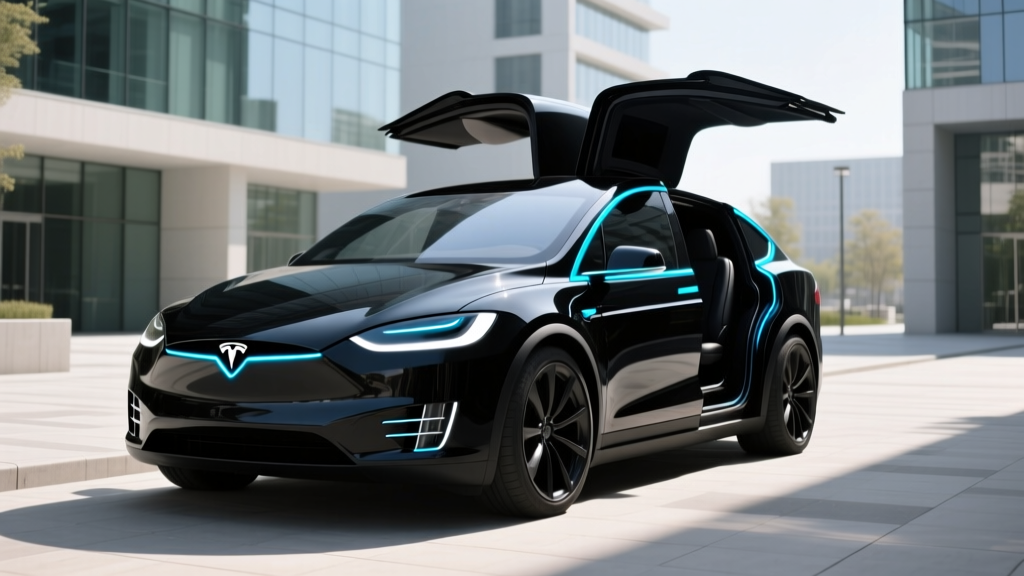
The falcon-wing rear doors are the Model X's signature feature. They open upward with sensors that detect overhead and side obstacles, making third-row access easier in tight parking spaces than conventional doors. They're also slower to open and close than standard doors, and owners in regions with low-clearance garages report occasional sensor frustration.
Standout technology:
- 17-inch center display with gaming-capable hardware (AMD Ryzen-based processor)
- Autopilot standard (adaptive cruise, lane centering); FSD Supervised available as a $8,000 add-on or $99/month subscription
- Over-the-air updates that regularly add features, improve efficiency, and update maps
- Sentry Mode and dashcam recording using the vehicle's exterior cameras
- HEPA air filtration with "Bioweapon Defense Mode" — genuinely effective for allergy sufferers and wildfire smoke regions
Notable drawbacks: No Apple CarPlay or Android Auto (Tesla's proprietary OS only), the yoke steering wheel is standard on Plaid and optional on dual-motor (conventional wheel available), and panel-gap consistency and interior material quality remain behind competitors like the BMW iX and Mercedes EQS SUV at similar or lower prices.
Pros, Cons, and Who Should Buy the Model X
- Class-leading performance (670–1,020 hp)
- Access to Tesla Supercharger network (17,000+ NA stalls)
- Spacious cargo area with frunk; up to 85.1 cu ft
- Best-in-class over-the-air update cadence
- Falcon-wing doors improve third-row access
- Competitive EPA range for a 3-row EV SUV
- Strong safety ratings (NHTSA 5-star)
- Plaid trims exceed $80K MSRP cap — no federal tax credit
- Dated exterior design (unchanged since 2015 refresh)
- No Apple CarPlay / Android Auto
- Yoke steering controversial; conventional wheel availability limited
- Third-row legroom tight for adults (32.7 in)
- Build quality inconsistencies reported by owners
- Insurance premiums 20–40% above segment average
- Choose the Model X if: You need three rows, want supercar acceleration, road-trip frequently (Supercharger network is a major advantage), and value software/tech over traditional luxury finishes.
- Look elsewhere if: Interior material quality is a priority (BMW iX, Mercedes EQS SUV), you want a more modern design (Rivian R1S), you need adult-friendly third-row space regularly, or your budget can't absorb the insurance premium.
- Best use case: Tech-forward families who road-trip 3–6 times per year and want one vehicle for school runs, grocery hauling, and cross-country drives.
Warranty and Ownership Costs
Tesla's warranty coverage is competitive but not class-leading:
- Basic Vehicle Limited Warranty: 4 years / 50,000 miles
- Battery & Drive Unit Warranty: 8 years / 150,000 miles (with minimum 70% capacity retention)
- Roadside Assistance: 4 years / 50,000 miles
The 8-year/150,000-mile battery warranty is a key confidence builder. Tesla's NMC cells have demonstrated strong longevity in fleet data, with most Model X batteries retaining 85–92% capacity at 100,000 miles based on owner-reported data. Out-of-warranty battery replacement currently runs $18,000–$25,000 depending on the pack — rare, but worth budgeting awareness for long-term ownership.
Insurance costs are the hidden expense. The Model X's high repair costs (aluminum body, sensor-dense bumpers, integrated glass roof) push premiums well above comparable ICE SUVs. Expect $250–$450/month depending on your driving record, location, and coverage level. Always get an insurance quote before committing to a purchase.
Frequently Asked Questions
What is the real-world range of the Tesla Model X?
The EPA rates the dual-motor Model X at 335 miles and the Plaid at 326 miles. In real-world highway driving at 70–80 mph, expect 265–290 miles. In cold weather below freezing, range can drop to 220–260 miles. For daily commuting, the EPA figure is largely achievable.
How fast does the Model X charge at home and on the road?
At home on a Level 2 Tesla Wall Connector (11.5 kW / 48A), the Model X adds about 34 miles of range per hour, with a full charge taking roughly 9 hours. On a Tesla Supercharger V3/V4, it peaks at 250 kW and charges from 10–80% in approximately 30 minutes. Charge speed tapers significantly above 80% SoC.
Does the Tesla Model X qualify for the $7,500 federal tax credit?
The base dual-motor Model X (MSRP $79,990) falls under the $80,000 SUV MSRP cap and may qualify for up to $7,500 under IRS §30D — provided the buyer meets income limits ($300K joint / $150K single) and the battery meets current-year critical-mineral and component sourcing thresholds. Model X Plaid trims exceed the $80K MSRP cap and do not qualify for the new-vehicle credit. Always verify on the IRS website and consult a tax professional.
How much horsepower does the Tesla Model X have?
The dual-motor Model X produces 670 horsepower. The tri-motor Model X Plaid produces 1,020 horsepower, making it one of the most powerful production SUVs ever built.
Is the Model X worth buying over competitors like the Rivian R1S or BMW iX?
It depends on priorities. The Model X wins on Supercharger network access, performance (especially Plaid), and software updates. The Rivian R1S offers more modern design, better off-road capability, and a more rugged image. The BMW iX delivers a significantly more luxurious interior and a conventional steering wheel. Test-drive all three before deciding.
What are the biggest drawbacks of owning a Model X?
The most commonly cited issues are: dated exterior styling, no Apple CarPlay/Android Auto, controversial yoke steering, tight third-row legroom for adults, higher-than-average insurance costs, and panel-gap/build-quality inconsistencies. The falcon-wing doors, while distinctive, are slower to operate and can frustrate in low-clearance garages.
What battery chemistry does the Model X use?
The Model X uses NMC (nickel manganese cobalt) lithium-ion chemistry, which offers higher energy density than LFP — important for maximizing range in a heavy SUV. NMC batteries benefit from daily charge limits of 80% for longevity, charging to 100% only when needed for longer trips.