Quick Verdict: The Model X's Weight Works in Your Favor
When evaluating the 2026 Tesla Model X, buyers often overlook a critical spec hiding in the fine print: the Gross Vehicle Weight Rating. The Tesla Model X GVWR 6000 lbs classification is more than a technicality — it directly affects your eligibility for the federal EV tax credit under IRS §30D rules. Because the Model X is classified as a light truck/SUV with a GVWR above 6,000 pounds, it qualifies for a higher MSRP cap under current federal incentive rules, giving it a pricing advantage over sedans that face a stricter $55,000 ceiling.
But tax credit eligibility is only part of the equation. The 2026 Model X remains one of the most capable three-row electric SUVs on the market, offering up to 335 miles of EPA-estimated range, access to the expansive Tesla Supercharger network, and performance figures that embarrass sports cars half its price. Below, we break down every number that matters — from battery chemistry and real-world range to charging curves and total cost of ownership.
Range, Battery, and Efficiency: What the EPA Doesn't Tell You
EPA Estimated Range: 335 miles (Long Range AWD) | 320 miles (Plaid)
Real-World Expectation: Expect 270–295 miles in mixed highway driving at 70–75 mph. In cold weather (below 32°F), plan for a 20–30% reduction — roughly 230–260 miles — due to cabin heating demands and increased battery resistance. City driving with regenerative braking can push closer to the EPA sticker or slightly above.
The 2026 Model X Long Range uses a ~100 kWh battery pack (usable capacity approximately 95 kWh) with NMC (nickel manganese cobalt) chemistry. Tesla does not use LFP (lithium iron phosphate) cells in the Model X — LFP is reserved for the standard-range Model 3 and Model Y due to its lower energy density. NMC offers superior energy density, which is essential for a vehicle this size to achieve 335 miles without excessive pack weight.
Efficiency comes in at 100 MPGe combined (Long Range), which translates to roughly 34 kWh per 100 miles. For a 5,000+ pound three-row SUV, that figure is competitive — the Rivian R1S achieves 97 MPGe combined, while the BMW iX xDrive50 lands at 86 MPGe. The Model X's heat pump, standard across all trims, plays a major role in preserving efficiency during cold months by scavenging waste heat from the powertrain rather than relying solely on resistive cabin heating.
| Spec | Long Range AWD | Plaid |
|---|---|---|
| EPA Range | 335 miles | 320 miles |
| Battery (usable) | ~95 kWh (NMC) | ~95 kWh (NMC) |
| MPGe (combined) | 100 MPGe | 98 MPGe |
| kWh / 100 mi | 34 | 35 |
| 0–60 mph | 3.8 seconds | 2.5 seconds |
| Horsepower | 670 hp | 1,020 hp |
| Drivetrain | Dual-Motor AWD | Tri-Motor AWD |
| Top Speed | 155 mph | 163 mph |
| Towing Capacity | 5,000 lbs | 5,000 lbs |
| GVWR | 6,000+ lbs | 6,000+ lbs |
| Base MSRP | $79,990 | $94,990 |
Charging Speeds: Supercharger Network and Home Setup
Charging remains one of Tesla's strongest advantages, and the Model X is no exception. The 2026 Model X supports a peak DC fast-charge rate of 250 kW on V3 Superchargers. In practice, a 10–80% session takes approximately 30 minutes under optimal conditions — meaning the battery is preconditioned via navigation routing to a Supercharger.
Here's what the charging curve actually looks like in the real world: the Model X sustains its peak ~250 kW rate between roughly 10% and 35% state of charge. From 35–60%, the rate tapers to approximately 150–170 kW. Above 80%, charging slows dramatically to protect battery longevity — expect only 30–50 kW. This is why Tesla (and every EV manufacturer) quotes 10–80% times rather than 0–100%. If you're road-tripping, plan your stops around the 10–80% window for the fastest turnaround.
| Charging Level | Power (kW) | Miles Added per Hour | Notes |
|---|---|---|---|
| Level 1 (120V household) | ~1.4 kW | ~3–4 miles/hr | Emergency/trickle only |
| Level 2 (240V, 48A Wall Connector) | 11.5 kW | ~34 miles/hr | Full charge in ~9 hours |
| Level 2 (240V, 32A mobile connector) | 7.7 kW | ~23 miles/hr | Standard mobile connector |
| DC Fast (V3 Supercharger) | Up to 250 kW | ~200 miles in 15 min | 10–80% in ~30 min |
| DC Fast (CCS adapter, non-Tesla) | Up to 150 kW | ~120 miles in 15 min | Requires CCS adapter |
For home charging, Tesla's Wall Connector at 48 amps (requiring a 60-amp circuit) delivers 11.5 kW — enough to replenish a full day's driving overnight. If your electrical panel supports a 60-amp dedicated circuit, budget $500–$1,500 for professional installation depending on panel proximity and local permitting. Homes with older 100-amp panels may require a $2,000–$4,000 panel upgrade to accommodate a 48-amp EV charger alongside existing loads.
The Model X uses the NACS (North American Charging Standard) connector natively — the same Tesla proprietary plug now being adopted industry-wide. With Tesla opening its Supercharger network to non-Tesla EVs, NACS access is no longer exclusive, but Tesla owners still benefit from the most seamless plug-and-charge experience on the road, with no app fumbling or RFID cards required at Superchargers.
Performance and Drivetrain: Absurd Power, Genuine Utility
The Model X Long Range's dual-motor AWD setup produces 670 horsepower and rockets to 60 mph in 3.8 seconds — quicker than a Porsche Cayenne Turbo GT. The Plaid variant's tri-motor configuration generates a staggering 1,020 horsepower and hits 60 in 2.5 seconds, making it one of the fastest production SUVs ever built.
Beyond straight-line speed, the Model X delivers genuine utility. The 5,000-pound towing capacity is competitive within the electric SUV segment (the Rivian R1S tows 7,700 lbs, but at a higher price point). Tesla's adaptive air suspension provides up to 8.2 inches of ground clearance for rough roads and can lower the vehicle at highway speeds to reduce drag and improve range.
The Model X offers seating for up to seven passengers across three rows. Cargo volume measures 88.1 cubic feet with both rear rows folded, 42.5 cubic feet behind the second row, and 13.2 cubic feet behind the third row. The front trunk (frunk) adds an additional 6.5 cubic feet of secure, weatherproof storage — useful for charging cables or groceries.
Pricing, Tax Credits, and the GVWR 6,000 Lbs Advantage
The Tesla Model X GVWR 6000 lbs classification matters because IRS §30D rules set different MSRP caps for different vehicle classes. SUVs, vans, and pickup trucks with a GVWR above 6,000 pounds face an $80,000 MSRP cap, while sedans are limited to $55,000. The Model X Long Range starts at $79,990 — just under the SUV cap — meaning it can qualify for the full $7,500 federal tax credit if all other requirements are met.
The Plaid trim at $94,990 exceeds the $80,000 cap and does not qualify for the §30D credit.
§30D Federal Tax Credit Requirements (2026):
- MSRP Cap: ≤$80,000 for SUVs/light trucks (GVWR >6,000 lbs) — Model X Long Range qualifies; Plaid does not
- Buyer Income Cap: ≤$300,000 joint filers / ≤$225,000 head of household / ≤$150,000 individual (modified AGI)
- Battery Sourcing: Critical minerals and battery components must meet phased-in domestic/free-trade-agreement sourcing thresholds per IRS guidelines — verify current-year compliance at irs.gov
- Point-of-Sale Transfer: Eligible buyers can transfer the credit to the dealer at purchase, reducing the out-of-pocket price immediately rather than waiting for a tax refund
- VIN Verification: Confirm your specific vehicle's eligibility using the IRS VIN lookup tool before signing
| Trim | Base MSRP | §30D Credit | Effective Price | Eligible? |
|---|---|---|---|---|
| Long Range AWD | $79,990 | Up to $7,500 | ~$72,490 | Yes (if income/sourcing met) |
| Plaid (Tri-Motor) | $94,990 | $0 | $94,990 | No (exceeds $80K MSRP cap) |
Always consult a tax professional before relying on credit eligibility. Battery sourcing requirements have tightened annually since 2023, and specific vehicle eligibility can shift model year to model year. The fueleconomy.gov tax credit lookup is a reliable starting point.
Interior, Technology, and Driver Assistance
The Model X interior centers on a 17-inch center touchscreen with a resolution of 2200x1300 pixels — the sharpest and most responsive display in the segment. Tesla's infotainment system handles navigation, media, climate, and vehicle settings without Apple CarPlay or Android Auto (Tesla does not support either). The trade-off is a tightly integrated experience: navigation routes to Superchargers automatically, preconditioning is seamless, and over-the-air updates continuously add features.
A second 8-inch rear touchscreen allows second-row passengers to control climate, media, and gaming. The Model X also features a 22-speaker, 960-watt audio system, wireless phone charging, and Tesla's signature yoke or round steering wheel options.
On the driver-assistance front, Autopilot comes standard and includes adaptive cruise control, lane-keeping, and automatic emergency braking. Full Self-Driving (Supervised) is available as a $8,000 add-on (or $99/month subscription) and adds features like Navigate on Autopilot (automatic highway interchanges), Auto Lane Change, Autopark, and Summon.
SAE Automation Level: Tesla Autopilot and FSD (Supervised) are Level 2 driver-assistance systems per SAE International. This means the driver must remain fully engaged, hands on or near the wheel, and eyes on the road at all times. These systems are not self-driving. Only Level 4 services like Waymo operate without a human driver, and those are limited to geofenced urban areas.
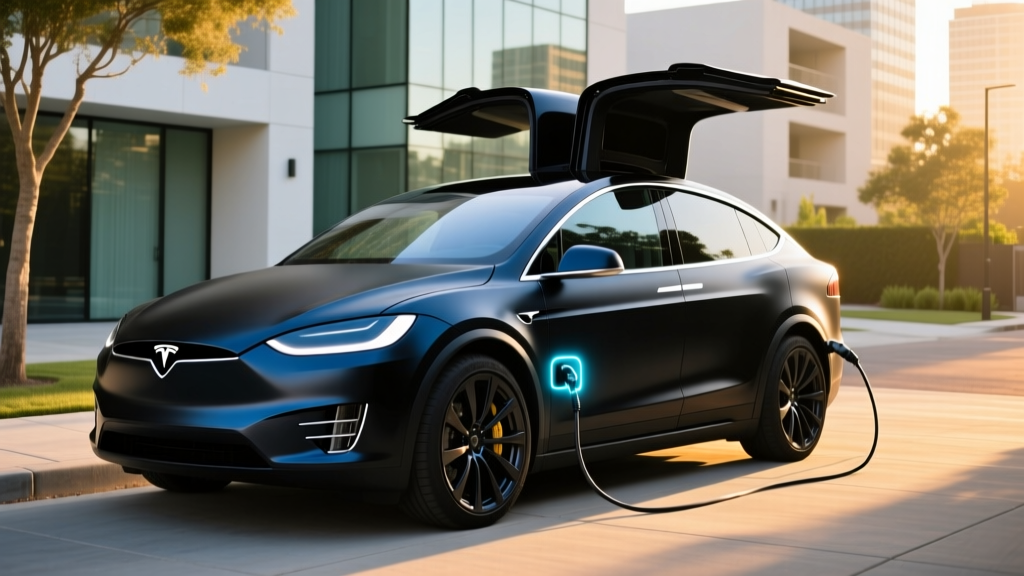
The Model X's most recognizable feature remains its falcon-wing rear doors — double-hinged gullwing doors that open upward, providing dramatic access to the second and third rows. They're practical in tight parking spaces (requiring only ~12 inches of side clearance) but add mechanical complexity. Owners report occasional sensor-related hesitation in opening or closing, particularly in heavy rain or when overhead obstructions are detected.
Warranty, Longevity, and Ownership Costs
Tesla covers the Model X with a 4-year/50,000-mile limited warranty and an 8-year/150,000-mile battery and drive unit warranty. The battery warranty guarantees retention of at least 70% of original capacity over the warranty period. If degradation exceeds 30% within 8 years or 150,000 miles, Tesla will repair or replace the battery pack at no cost.
Real-world degradation data from Tesla's fleet suggests the Model X's NMC pack retains approximately 90% capacity after 100,000 miles, with the degradation curve flattening significantly after the initial 20,000–30,000 miles. Best practices for longevity include keeping daily charge limits at 80–90% and only charging to 100% for long trips.
Insurance costs for the Model X are above average — expect $2,500–$4,000 annually depending on your state, driving record, and coverage level. Tesla offers its own insurance product in many states, which uses real-time driving data (via the Safety Score feature) to set premiums. Safe drivers can see meaningful savings, but high-mileage or aggressive-driving profiles may pay more than traditional carriers.
Maintenance is minimal compared to internal-combustion SUVs. There are no oil changes, spark plugs, or transmission fluid swaps. Expect to budget for cabin air filter replacement (~$100–$150 annually), tire rotation ($50–$100 every 6,000–10,000 miles), brake fluid checks, and wiper fluid. The regenerative braking system significantly extends brake pad life — many owners report 80,000+ miles on original pads.
How It Compares: Model X vs. the Competition
The Model X competes in a growing segment of luxury electric SUVs. Here's how it stacks up against key rivals:
vs. Rivian R1S: The R1S offers superior off-road capability, a 7,700-lb towing capacity, and a more rugged design, but its EPA range tops out at 321 miles and it starts around $79,900. The Model X wins on Supercharger network access and infotainment polish; the R1S wins on adventure utility and interior material quality.
vs. BMW iX xDrive50: The iX starts around $87,000, offers 324 miles of range, and delivers a more traditional luxury interior with superior sound insulation. It lacks the Model X's third row and Supercharger access (though BMW has partnered with Electrify America). Choose the iX if you prioritize ride refinement over raw performance and tech.
vs. Mercedes EQS SUV: The EQS SUV 450+ starts around $105,000, offers 305 miles of range, and provides the most opulent interior in the segment. It's heavier, less efficient, and significantly more expensive than the Model X — a choice driven by luxury prestige over value or performance.
Pros
- Class-leading Supercharger network access (17,000+ V3 stalls in North America)
- Up to 335 miles EPA range — best in the three-row EV SUV segment
- Falcon-wing doors offer genuine third-row access advantages
- Tri-motor Plaid variant delivers hypercar-level acceleration in an SUV
- Continuous OTA updates add features post-purchase
- GVWR >6,000 lbs enables $80K MSRP cap for §30D credit eligibility
Cons
- $79,990 starting price is steep, even with the tax credit
- Plaid trim ($94,990) exceeds MSRP cap — no federal credit
- No Apple CarPlay or Android Auto support
- Falcon-wing doors add mechanical complexity and occasional sensor issues
- Insurance premiums run 30–50% higher than comparable ICE SUVs
- Interior material quality trails BMW iX and Mercedes EQS SUV at this price point
Who Should Buy the 2026 Tesla Model X?
Choose the Model X Long Range if: You need three rows of seating, want maximum range and Supercharger convenience for road trips, and your household income falls within §30D limits to capture the $7,500 credit. It's ideal for families who regularly drive 200+ miles and value the lowest-effort DC charging experience available.
Choose the Model X Plaid if: You want the fastest SUV on the planet and don't need the federal tax credit. The Plaid is a performance statement — buy it for the 2.5-second 0–60 time and tri-motor torque vectoring, not for value.
Look elsewhere if: You need serious off-road capability (Rivian R1S), traditional luxury interior refinement (BMW iX, Mercedes EQS SUV), or a price point below $60,000 (consider the Model Y, Kia EV9, or Hyundai Ioniq 9 instead).
Frequently Asked Questions
What is the real-world range of the Tesla Model X?
The EPA rates the 2026 Model X Long Range at 335 miles. In real-world highway driving at 70–75 mph, expect 270–295 miles. In cold weather below freezing, plan for 230–260 miles due to cabin heating and battery resistance. City driving with regenerative braking can match or slightly exceed the EPA estimate.
How fast does the Model X charge at home and on the road?
On a V3 Supercharger, the Model X peaks at 250 kW and charges from 10–80% in approximately 30 minutes with battery preconditioning. At home on a 48-amp Tesla Wall Connector (240V), it adds about 34 miles of range per hour, fully charging overnight in roughly 9 hours.
Does the Tesla Model X qualify for the $7,500 federal EV tax credit?
The Model X Long Range at $79,990 MSRP qualifies under the §30D SUV MSRP cap of $80,000, provided the buyer meets income limits (≤$300K joint) and the vehicle's battery meets current-year critical mineral and component sourcing requirements. The Plaid trim at $94,990 exceeds the cap and does not qualify. Verify eligibility via the IRS clean vehicle credit page and the VIN lookup tool before purchasing.
Why does the Tesla Model X GVWR 6000 lbs rating matter?
The GVWR above 6,000 pounds classifies the Model X as a light truck/SUV under IRS §30D rules, which applies a higher MSRP cap ($80,000) compared to sedans ($55,000). This classification is what allows the Long Range trim at $79,990 to remain eligible for the federal credit. Sedans priced above $55,000 are ineligible regardless of battery sourcing.
Is the Model X worth buying over the Rivian R1S or BMW iX?
It depends on your priorities. The Model X wins on range (335 mi), Supercharger network access, and tech integration. The Rivian R1S is better for off-road adventures and towing (7,700 lbs). The BMW iX offers a more refined luxury interior and quieter ride. If seamless road-trip charging and maximum range are your top needs, the Model X is the strongest choice in this segment.
How long will the Model X battery last?
Tesla warranties the battery for 8 years or 150,000 miles (whichever comes first) with a minimum 70% capacity retention guarantee. Fleet data suggests NMC packs in the Model X retain approximately 90% capacity at 100,000 miles, with degradation slowing significantly after the first 20,000–30,000 miles. Following best practices (80–90% daily charge limit, avoiding frequent 100% charges) can extend usable battery life well beyond the warranty period.