The Tesla Model X has always been defined by one feature: its rear falcon wing doors. Often missearched as "Tesla wings," these double-hinged, sensor-guided rear doors are the single most polarizing design choice in the EV market. They're also the reason buyers either fall in love with the Model X or walk across the showroom to a Rivian R1S. For 2026, Tesla has refreshed the Model X with updated battery chemistry, faster charging, and revised pricing — but the wings remain. Here's everything you need to know before you buy.
2026 Tesla Model X: Core Specifications at a Glance
| Spec | Long Range AWD | Plaid |
|---|---|---|
| EPA Range | 348 mi | 326 mi |
| Usable Battery | 100 kWh (NMC) | 100 kWh (NMC) |
| Peak DC Fast Charge | 250 kW | 250 kW |
| 10–80% DCFC Time | ~30 min | ~30 min |
| Level 2 Home Charging | 11.5 kW (~34 mi/hr) | 11.5 kW (~34 mi/hr) |
| 0–60 mph | 3.8 sec | 2.5 sec |
| Horsepower | 670 hp | 1,020 hp |
| Drivetrain | Dual-Motor AWD | Tri-Motor AWD |
| MPGe (Combined) | 102 MPGe | 98 MPGe |
| Efficiency | 33 kWh/100 mi | 34 kWh/100 mi |
| Base MSRP | $79,990 | $94,990 |
| Cargo (behind 2nd row) | 37.1 cu ft | 37.1 cu ft |
| Cargo (max, all rows folded) | 83.1 cu ft | 83.1 cu ft |
| Battery Warranty | 8 yr / 150,000 mi | 8 yr / 150,000 mi |
Source: fueleconomy.gov and Tesla's official specifications. Prices exclude destination fee. Specs reflect the 2026 model year as listed.
Range: What the EPA Sticker Doesn't Tell You
EPA Estimate: 348 miles
Real-World Highway (70 mph, mild weather): ~280–310 miles
Real-World Highway (cold, 30°F or below): ~230–260 miles
City / Suburban Mixed Driving: ~310–340 miles
The Model X's 5,000+ lb curb weight and SUV aerodynamics hit efficiency hard at sustained highway speeds. Expect a 15–20% range reduction on road trips compared to the EPA figure, and up to 30% in freezing temperatures due to battery heating demands and cabin climate load. The tri-motor Plaid loses an additional ~22 miles of EPA range due to the extra motor's parasitic drag.
The 100 kWh NMC (nickel manganese cobalt) battery pack remains the sole chemistry option for the Model X. Unlike Tesla's LFP-equipped Model 3 and Model Y RWD variants, NMC offers higher energy density — necessary for a vehicle of this mass — but requires more careful charging habits. Tesla recommends daily charging to 80–90% for NMC packs, reserving 100% for long trips. This means your practical daily range is closer to 280 miles (Long Range) or 260 miles (Plaid), which is still ample for most commutes but worth factoring if you regularly drive 200+ miles without access to charging.
Charging Speed: DC Fast Charging and Home Setup
The 2026 Model X charges at a peak rate of 250 kW on V3 and V4 Tesla Superchargers. In practice, this peak rate holds only between roughly 10–30% state of charge (SoC) before tapering. The charge curve looks roughly like this:
| Charging Method | Power | Miles Added per Hour | Notes |
|---|---|---|---|
| Level 1 (120V outlet) | ~1.4 kW | ~3–4 mi/hr | Emergency/trickle only |
| Level 2 (240V, 48A) | 11.5 kW | ~34 mi/hr | Full charge in ~9.5 hours |
| DC Fast Charge (V3 Supercharger) | Peak 250 kW | ~750 mi/hr (peak) | 10–80% in ~30 min |
| DC Fast Charge (CCS via adapter) | Peak ~150–200 kW | Varies | Depends on station; slower than Supercharger |
Home charging reality: With a Tesla Wall Connector on a 60-amp circuit (48A continuous), you'll add roughly 34 miles of range per hour. An overnight charge from 20% to 80% takes about 6–7 hours — more than sufficient for daily use. Installation costs typically range from $800 to $2,500 depending on your electrical panel capacity and run length. If your home has a 100-amp main panel, expect a potential $1,500–$3,000 panel upgrade to support a dedicated 60-amp EV circuit.
On a road trip, preconditioning is critical. When you navigate to a Supercharger, the Model X automatically warms the battery to optimize charge acceptance. Skip preconditioning (for example, by driving to a third-party CCS station without the car knowing) and your peak charge rate may drop to 50–80 kW until the pack reaches temperature — adding 15–20 minutes to a charging stop.
Performance and Driving Dynamics
The Model X Long Range delivers 670 horsepower from its dual-motor AWD powertrain, hitting 60 mph in 3.8 seconds. That's sports-car acceleration in a three-row SUV weighing over 5,100 pounds. The Plaid's tri-motor setup produces 1,020 hp and a 2.5-second 0–60 time — genuinely absurd performance that no comparable SUV can match, including the BMW iX M60 or Mercedes EQS SUV.
Adaptive air suspension is standard, offering adjustable ride height from 5.5 to 8.1 inches of ground clearance. The system lowers the vehicle at highway speeds for aerodynamic efficiency and raises it for rough roads or snow. Ride quality is firm but compliant — noticeably stiffer than the Rivian R1S but more controlled in corners. Steering is precise if numb, typical of Tesla's electric power steering calibration.
Towing capacity is rated at 5,000 lbs with the optional tow package ($1,200). This covers most small boat trailers and light campers but falls short of the Rivian R1S (7,700 lbs) and even some midsize gas SUVs. If you tow frequently, note that range drops dramatically — expect 40–50% reduction at highway speeds with a loaded trailer.
The Falcon Wing Doors: Novelty or Practical Feature?
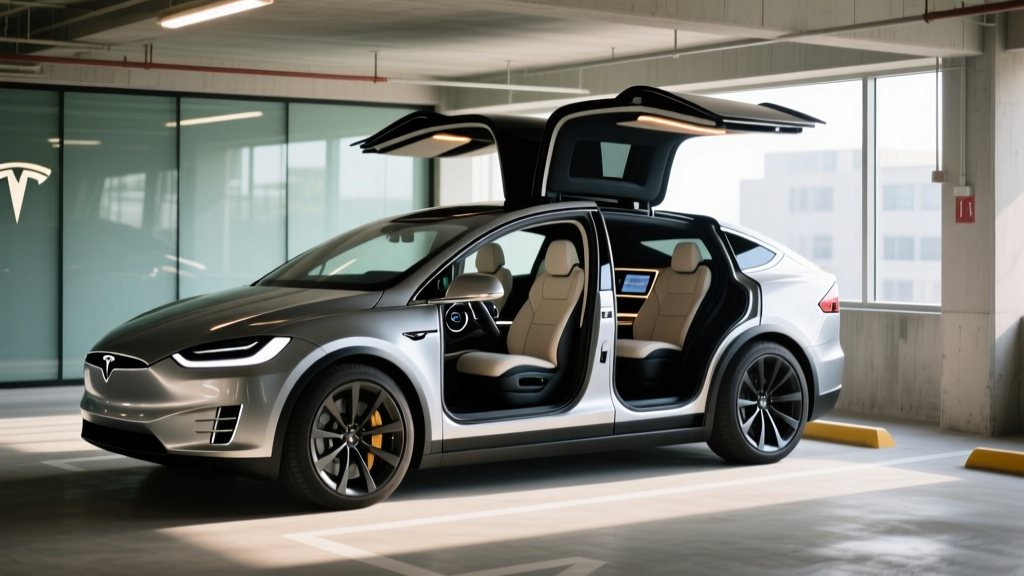
Let's address the search directly: the "Tesla wings" — properly called falcon wing doors — are rear passenger doors that hinge upward from the roof, using a double-hinge design that allows them to articulate in tight spaces. Ultrasonic sensors above each door detect overhead and side obstacles, adjusting the opening arc accordingly.
Where they excel: Loading children into rear-facing car seats is genuinely easier with the open roof access. Standing headroom in the rear doorway makes entering and exiting more natural for adults, and the dramatic opening draws attention everywhere you park.
Where they frustrate: The doors are heavier than conventional doors, and the motorized mechanism adds complexity. Repair costs for a falcon wing door motor or sensor can exceed $2,000 out of warranty. In heavy rain, water pools on the door's inner surface and can drip onto passengers when opening. In tight garages with low ceilings (under 7 feet), the doors may not fully open. And in freezing rain or ice storms, the hinges can freeze shut — a problem conventional doors simply don't have.
Owners remain split. Many consider the wings essential to the Model X identity and wouldn't buy without them. Others tolerate them as the price of admission for Tesla's Supercharger network and software ecosystem. Either way, they remain the Model X's defining differentiator in an increasingly crowded electric SUV market.
Interior, Tech, and Cargo Space
The Model X interior is minimalist in the extreme. A 17-inch center touchscreen (landscape orientation, tilted toward the driver) handles virtually all vehicle controls — there are no physical buttons for climate, audio, or glovebox. A second 8-inch screen for rear passengers controls rear climate and entertainment. The 2026 model year carries over the yoke-style steering wheel as standard, with a conventional round wheel available at no cost (but requiring a special order).
Seating configurations include 5-seat (two rows), 6-seat (with second-row captain's chairs and a center aisle), and 7-seat (bench second row plus a small third row). The 6-seat layout is the most popular and the most practical, offering walk-through access to the third row without folding seats. Third-row space is tight — best suited for children or very short trips. Legroom measures 41.9 inches in the front, 38.4 inches in the second row, and just 32.7 inches in the third row.
Cargo volume behind the second row is 37.1 cubic feet, expanding to 83.1 cubic feet with both rear rows folded. The front trunk (frunk) adds approximately 6.5 cubic feet — enough for a charging cable bag and a soft-sided cooler. Total usable cargo space is competitive with the BMW iX but trails the Rivian R1S and Kia EV9, both of which offer more boxy, utilitarian cargo areas.
On the tech front, the Model X includes Tesla's full infotainment suite: streaming audio (Spotify, Apple Music), Netflix/YouTube/theater mode while parked, a full web browser, and over-the-air (OTA) software updates that add features periodically. The Premium Connectivity package ($9.99/month) is required for satellite maps, live traffic visualization, and streaming media on the go.
Pricing, Trims, and Federal Tax Credit Eligibility
| Trim | Base MSRP | Federal §30D Credit | Effective Price (if eligible) |
|---|---|---|---|
| Long Range AWD | $79,990 | Up to $7,500 | ~$72,490 |
| Plaid | $94,990 | Up to $7,500 | ~$87,490 |
Federal tax credit eligibility (IRS §30D, 2026 rules): The Model X's eligibility for the full $7,500 credit depends on several requirements that change periodically. As of early 2026, the key constraints are:
- MSRP Cap: SUVs must have an MSRP at or below $80,000. The Long Range ($79,990) qualifies; the Plaid ($94,990) does not qualify under current MSRP rules.
- Buyer Income Cap: Adjusted gross income must not exceed $150,000 (single), $225,000 (head of household), or $300,000 (joint).
- Battery Sourcing: A percentage of critical minerals and battery components must be sourced from the U.S. or FTA-partner nations. Tesla's North American battery supply chain has improved sourcing compliance, but the exact credit amount ($3,750 or $7,500) depends on the specific vehicle's battery composition at time of delivery.
- Point-of-Sale Transfer: Eligible buyers can now transfer the credit to the dealer at purchase, reducing the purchase price directly rather than waiting for a tax refund.
The Long Range trim's $79,990 MSRP puts it exactly $10 under the $80,000 SUV cap — a price Tesla has clearly engineered to preserve credit eligibility. However, adding options (paint, wheels, tow package, FSD) pushes the transaction price above $80,000. The MSRP cap applies to the base MSRP, not the as-equipped price, so options do not disqualify you. Always verify current eligibility at IRS.gov before purchasing, as battery sourcing rules tighten annually.
Autopilot, FSD, and Driver Assistance
Tesla Autopilot and Full Self-Driving (Supervised) are Level 2 driver-assistance systems, not self-driving technology. The driver must remain attentive, keep hands on the wheel (or demonstrate engagement via steering torque or camera monitoring), and be prepared to take over at any moment. Only Level 4 systems (e.g., Waymo's driverless robotaxis operating in mapped urban zones) qualify as true self-driving. For a full breakdown, see the NHTSA AV safety page.
Standard Autopilot includes Traffic-Aware Cruise Control and Autosteer (lane-centering on marked highways). The optional Full Self-Driving (Supervised) package — currently $8,000 as a one-time purchase or $99/month — adds Navigate on Autopilot (automatic highway interchanges), Auto Lane Change, Smart Summon (parking lot navigation to the driver), and traffic light/stop sign recognition. FSD's city-street capabilities have expanded significantly through 2025–2026 via neural-net-based end-to-end driving models, but the system still requires active supervision and makes errors in construction zones, unprotected left turns, and complex multi-lane intersections.
Competitor comparison: GM's Super Cruise offers true hands-free driving on 750,000+ miles of mapped highways (with eye monitoring) and is widely regarded as more reliable for hands-off highway cruising. Ford's BlueCruise covers 130,000+ miles of divided highways. Neither system matches Tesla's city-street ambitions, but both offer less stressful highway use without the constant supervision prompts.
Competitive Landscape: Model X vs. the Alternatives
The Model X competes in the premium three-row electric SUV segment against a growing roster of rivals:
| Vehicle | EPA Range | 0–60 | Starting MSRP | Max Cargo |
|---|---|---|---|---|
| Tesla Model X LR | 348 mi | 3.8s | $79,990 | 83.1 cu ft |
| Rivian R1S (Dual-Motor) | 352 mi | 4.5s | $75,900 | 104.7 cu ft |
| BMW iX xDrive50 | 324 mi | 4.4s | $87,250 | 77.9 cu ft |
| Kia EV9 GT-Line AWD | 270 mi | 5.0s | $73,900 | 81.9 cu ft |
| Mercedes EQS 580 SUV | 305 mi | 4.5s | $104,400 | 80.0 cu ft |
The Model X's primary advantages remain its Supercharger network access (now partially shared via NACS adoption by Ford, GM, Rivian, and others — reducing this advantage), its class-leading acceleration, and Tesla's software/OTA ecosystem. The Rivian R1S offers more cargo space, genuine off-road capability, and a lower starting price. The Kia EV9 delivers three-row practicality at a substantially lower cost with a conventional SUV form factor. The BMW iX provides a more luxurious interior but only seats five.
✅ Pros
- Falcon wing doors ease car-seat loading and create dramatic presence
- Class-leading acceleration (Plaid: 2.5s 0–60)
- 348-mile EPA range is competitive in the segment
- Access to Tesla Supercharger network (250 kW peak)
- OTA software updates continuously add features
- 6- and 7-seat configurations available
- Air suspension provides adjustable ride height
❌ Cons
- Falcon wing doors add repair complexity and cost
- Plaid trim ($94,990) exceeds the $80K MSRP cap for federal tax credit
- Third-row legroom (32.7 in) is tight for adults
- No physical buttons — all controls via touchscreen
- Yoke steering wheel is standard (round wheel requires special order)
- Towing capacity (5,000 lbs) trails Rivian R1S by 2,700 lbs
- Interior materials don't match the price vs. BMW iX or Mercedes EQS SUV
- FSD (Supervised) still requires full driver attention
Who Should Buy the 2026 Tesla Model X?
🎯 Choose the Model X If:
- You regularly transport children in car seats and value the overhead access the falcon wing doors provide
- You want three rows plus sports-car acceleration in a single vehicle
- You road-trip frequently and want the fastest, most reliable DC fast-charging network
- You value continuous software improvements and tech-forward features
- Your budget accommodates $80K+ and you qualify for the §30D credit on the Long Range trim
🔀 Look Elsewhere If:
- You need maximum cargo space (Rivian R1S offers 104.7 cu ft vs. 83.1)
- You tow heavy loads (R1S: 7,700 lbs vs. Model X: 5,000 lbs)
- You want a more luxurious interior at this price point (BMW iX, Mercedes EQS SUV)
- You want three rows under $60K (Kia EV9 starts at ~$56K)
- You live in an area with frequent ice storms that could freeze the wing door hinges
Frequently Asked Questions
What is the real-world range of the 2026 Tesla Model X?
The EPA rates the Model X Long Range at 348 miles and the Plaid at 326 miles. In real-world highway driving at 70 mph in mild conditions, expect 280–310 miles. In cold weather (below freezing), range drops to roughly 230–260 miles on the highway. City driving is more efficient and closer to the EPA sticker.
How fast does the Model X charge at home and on the road?
On a Level 2 home charger (11.5 kW / 48A), the Model X gains about 34 miles of range per hour, with a full charge taking roughly 9.5 hours. On a Tesla V3/V4 Supercharger, peak charge rate is 250 kW, and a 10–80% session takes approximately 30 minutes. Charge speed tapers significantly above 80% SoC.
Does the Tesla Model X qualify for the $7,500 federal EV tax credit?
The Long Range AWD (MSRP $79,990) falls under the $80,000 SUV MSRP cap and may qualify for up to $7,500 under IRS §30D, provided the buyer meets income limits ($150K single / $300K joint) and the vehicle's battery meets critical-mineral and component sourcing requirements. The Plaid ($94,990) exceeds the MSRP cap and does not qualify. Always check current rules at IRS.gov.
Are the falcon wing doors reliable long-term?
The doors are covered under Tesla's 4-year/50,000-mile bumper-to-bumper warranty. Out of warranty, individual door motor or sensor repairs typically cost $1,500–$2,500. Some owners report no issues over 100,000+ miles; others have needed hinge or sensor replacements. The complexity is inherently greater than a conventional door, and this should factor into long-term ownership cost expectations.
Is the Model X worth buying over the Rivian R1S?
It depends on priorities. The Model X wins on acceleration, Supercharger access, and tech/software. The R1S wins on cargo space (104.7 vs. 83.1 cu ft), towing (7,700 vs. 5,000 lbs), off-road capability, and interior build quality at a lower starting price ($75,900 vs. $79,990). Test-drive both before deciding.
What is the battery warranty on the Model X?
Tesla covers the Model X battery and drive units for 8 years or 150,000 miles, whichever comes first, with a minimum 70% capacity retention threshold. If the battery degrades below 70% within the warranty period, Tesla will repair or replace it to restore capacity above that threshold. Out-of-warranty battery replacement costs have historically ranged from $15,000 to $22,000, though prices continue to decline.