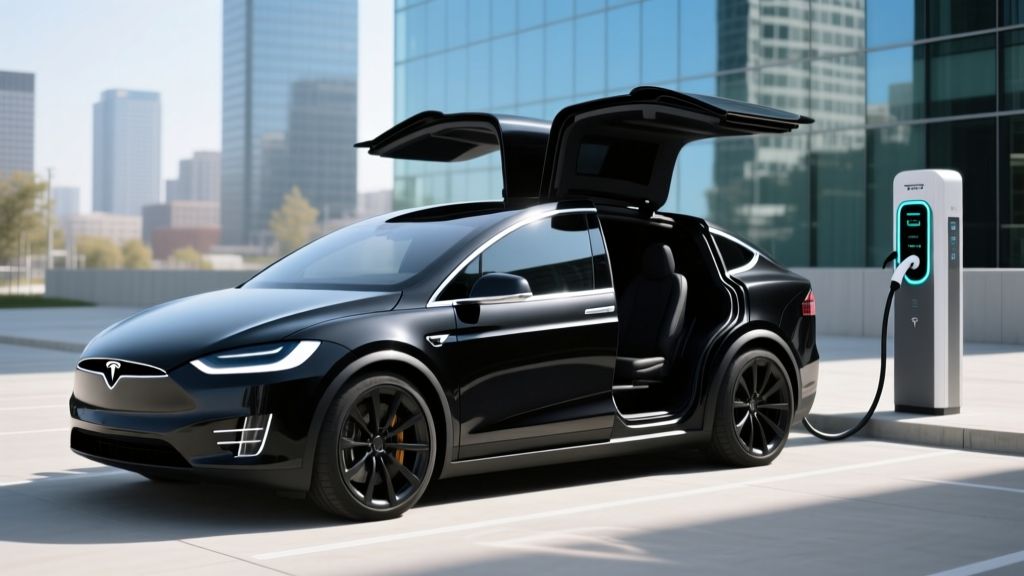
The Tesla Model X has always been the most theatrical SUV in the electric-vehicle market, and the reason is obvious the moment you approach it: the Falcon Wing rear doors. For 2026, Tesla continues to refine this three-row electric SUV with incremental software, efficiency, and interior updates, but the core proposition remains the same — a 5,000-pound family hauler that accelerates like a sports car, charges on the most reliable DC fast-charging network in North America, and opens its rear doors upward like a sci-fi concept car.
But the Falcon Wing doors are more than a party trick. They're also a source of ongoing ownership debate: brilliant for third-row access in tight parking spots, or an over-engineered complexity magnet? This review breaks down every spec that matters — range, charging speed, real-world efficiency, interior space, pricing, and federal tax credit eligibility — so you can decide whether the Model X's signature doors are worth the premium.
2026 Tesla Model X: Key Specifications at a Glance
| Spec | Model X Long Range (Dual Motor) | Model X Plaid (Tri Motor) |
|---|---|---|
| EPA Range | 335 miles | 326 miles |
| Battery Capacity | ~100 kWh usable (NMC) | ~100 kWh usable (NMC) |
| Drivetrain | Dual Motor AWD | Tri Motor AWD |
| Horsepower | 670 hp | 1,020 hp |
| 0-60 mph | 3.8 seconds | 2.5 seconds |
| Top Speed | 155 mph | 163 mph |
| Max DC Fast Charge | 250 kW | 250 kW |
| 10-80% DCFC Time | ~30 minutes | ~30 minutes |
| Level 2 Charge Rate | 11.5 kW (~30 mi/hr) | 11.5 kW (~30 mi/hr) |
| MPGe (Combined) | 102 MPGe | 98 MPGe |
| Efficiency | 33 kWh/100 mi | 34 kWh/100 mi |
| Cargo (Behind 3rd Row) | 15.3 cu ft | 15.3 cu ft |
| Cargo (All Rows Folded) | 88.1 cu ft | 88.1 cu ft |
| Seating | 5, 6, or 7 passengers | 5 or 6 passengers |
| Towing Capacity | 5,000 lbs | 5,000 lbs |
| Base MSRP (2026) | $79,990 | $94,990 |
| Federal Tax Credit (§30D) | Up to $7,500* | Up to $7,500* |
| Battery/Drive Unit Warranty | 8 years / 150,000 miles | 8 years / 150,000 miles |
*Eligibility subject to IRS §30D income, MSRP, and battery-sourcing requirements. See tax credit section below.
Range, Efficiency, and Real-World Expectations
The 2026 Tesla Model X Long Range carries an EPA-estimated 335 miles of range from its approximately 100 kWh usable battery pack. The Plaid variant drops slightly to 326 miles, a consequence of the tri-motor powertrain's higher energy consumption. Both use nickel-manganese-cobalt (NMC) lithium-ion chemistry, which Tesla favors for its higher energy density — necessary in a vehicle this heavy.
EPA Sticker: 335 miles (Long Range) / 326 miles (Plaid)
Highway (70-75 mph, mild weather): Expect 270–300 miles. The Model X's boxy SUV profile and 5,000+ lb curb weight penalize high-speed efficiency more than a sedan like the Model S.
Cold Weather (below 32°F): Plan for 200–240 miles. NMC batteries lose roughly 25–35% range in sustained freezing temps, even with Tesla's heat pump and battery preconditioning.
Best Case (city, 50-65 mph, mild): 320–340 miles is achievable with conservative driving and frequent regen braking.
Efficiency is rated at 33 kWh per 100 miles for the Long Range and 34 kWh/100 mi for the Plaid, per fueleconomy.gov. That's competitive for a three-row electric SUV but noticeably thirstier than the Model S sedan (28 kWh/100 mi) due to the Model X's taller profile, greater weight, and the aerodynamic penalty of those Falcon Wing door seams.
For context, a family road trip from Denver to Moab (~350 miles) will require one DC fast-charge stop in the Long Range model under ideal conditions, but two stops in winter or with a full load of passengers and cargo. The Supercharger network's reliability makes this painless in practice, but it's worth budgeting the time.
Charging Speed: DC Fast Charge and Home Level 2
The 2026 Model X supports up to 250 kW peak DC fast charging on Tesla's V3 and V4 Superchargers. In practice, the charging curve looks like this:
| Charging Method | Power (kW) | Miles Added per Hour | Notes |
|---|---|---|---|
| DC Fast Charge (Supercharger V3/V4) | Peak 250 kW | ~750 mi/hr at peak | 10-80% in ~30 min; tapers sharply above 80% |
| DC Fast Charge (CCS via adapter) | Up to 150-170 kW | ~450-500 mi/hr at peak | Depends on station; CCS adapter included |
| Level 2 Home (Tesla Wall Connector, 48A) | 11.5 kW | ~30 mi/hr | Full charge in ~10 hours; requires 60A circuit |
| Level 2 Home (32A mobile connector) | 7.7 kW | ~20 mi/hr | Requires 40A circuit; slower but common |
| Level 1 (120V standard outlet) | ~1.4 kW | ~3-4 mi/hr | Emergency/trickle only; not viable for daily use |
Charging curve reality: The 250 kW peak rate is only sustained between roughly 10-30% state of charge (SoC). From 30-60%, the rate drops to approximately 170-180 kW. From 60-80%, it tapers further to 100-120 kW. Above 80%, charging slows dramatically to protect the NMC battery — expect 80-100% to take nearly as long as 10-80%. This is standard NMC behavior and not unique to Tesla, but buyers coming from marketing claims of "250 kW charging" should understand that the average rate over a 10-80% session is closer to 140-150 kW.
Battery preconditioning is essential for achieving peak charge rates. Navigate to a Supercharger using the car's built-in navigation, and the Model X will automatically heat the battery to the optimal temperature before you arrive. Without preconditioning — for example, pulling into a non-navigated charger on a cold morning — peak rates may be limited to 100-150 kW until the pack warms up.
For home charging, the Tesla Wall Connector at 48 amps (11.5 kW) adds about 30 miles of range per hour, meaning a depleted pack fully recharges overnight in roughly 10 hours. This requires a dedicated 60-amp circuit installed by a licensed electrician. Budget $500-$1,500 for installation depending on your panel's proximity to the garage and whether a panel upgrade is needed.
Falcon Wing Doors: Engineering, Practicality, and Drawbacks
The Falcon Wing doors are the Model X's defining feature and the primary reason buyers search for "Tesla doors Model X" specifically. Here's what ownership actually looks like:
How they work: The double-hinged gullwing-style doors open upward with a sweeping motion, using ultrasonic sensors on the roof and sides to detect overhead and lateral obstacles. In a tight parking spot, they can open with as little as 12 inches of side clearance — far less than a conventional door needs to swing outward. Tesla claims the sensors adapt the door arc in real time.
Where they excel:
- Third-row access is genuinely excellent. You stand upright and step in, rather than folding forward and climbing over a second-row seat as in most three-row SUVs.
- Loading car seats and buckling children is dramatically easier — you're standing over the seat, not hunched through a door opening.
- Visual drama: they remain the single most attention-grabbing feature in any parking lot, a decade after the Model X launched.
Where they fall short:
- Overhead clearance: garages with low ceilings (under ~7 feet) or covered parking structures can limit the door arc. The sensors prevent a collision, but the door may not open fully.
- Rain and snow: when open, the doors expose the entire rear cabin to the elements from above. Unlike a conventional door that provides a partial roof, the Falcon Wings channel rain inward when open in bad weather.
- Complexity and repair cost: each door contains multiple motors, hinges, and sensors. Out-of-warranty repairs have historically cost $1,500-$3,000 per door, and early Model X vehicles (2016-2019) had well-documented leak and alignment issues. The 2026 generation is far more reliable, but complexity remains higher than a conventional door.
- Cargo on the roof: you cannot use a roof rack or roof box with the Model X, because the Falcon Wing doors need the roof panel clear. This is a meaningful limitation for families who carry skis, kayaks, or cargo boxes.
Performance, Interior, and Technology
The Model X Long Range's dual-motor AWD powertrain delivers 670 horsepower and a 3.8-second 0-60 mph time — numbers that were exotic-car territory a decade ago and still feel startling in a three-row family SUV. The Plaid's tri-motor setup (one front, two rear) pushes output to 1,020 hp and drops the 0-60 to 2.5 seconds, making it one of the quickest production SUVs ever built.
Ride quality has improved significantly over earlier generations. The adaptive air suspension provides a compliant highway ride and can raise the vehicle for light off-road use or steep driveways. Steering is precise but artificially weighted — a Tesla hallmark.
Interior and tech highlights:
- 17-inch center touchscreen with a secondary 8-inch rear-seat display for climate and entertainment controls.
- Yoke steering wheel is standard (a conventional round wheel is available as a no-cost option on 2026 models — strongly recommended for daily driving).
- HEPA air filtration system with "Bioweapon Defense Mode" — genuinely effective for wildfire smoke and urban air quality.
- 22-speaker audio system with immersive sound.
- Glass roof with UV and infrared tinting (no shade — heat rejection is handled by the glass coating).
Driver assistance: The Model X comes standard with Tesla Autopilot (adaptive cruise control and lane-keeping). Full Self-Driving (Supervised) is available as a $8,000 option or $99/month subscription. It's critical to understand that FSD is SAE Level 2 driver assistance — the driver must remain fully engaged, hands on the yoke/wheel, and eyes on the road at all times. It is not autonomous driving. Tesla's naming convention is misleading, and NHTSA continues to scrutinize the branding. For true Level 4 driverless operation, only Waymo's robotaxi service currently qualifies in limited US cities.
Tesla Autopilot and FSD (Supervised) are SAE Level 2 systems. They do NOT make the Model X self-driving. The driver is legally and operationally responsible for all vehicle control. FSD can handle highway interchanges and some city streets, but it can and does make errors — phantom braking, missed stops, and misread construction zones are documented. Never use FSD while fatigued, distracted, or impaired.
Pricing, Trims, and Federal Tax Credit Eligibility
The 2026 Tesla Model X is offered in two trims:
| Trim | Base MSRP | Destination | Typical As-Tested | §30D Credit Potential* |
|---|---|---|---|---|
| Long Range (Dual Motor, 5-seat) | $79,990 | $1,995 | $82,000–$88,000 | Up to $7,500 |
| Plaid (Tri Motor, 5-seat) | $94,990 | $1,995 | $97,000–$105,000 | Up to $7,500 |
Federal Tax Credit (§30D) — Key Rules for 2026:
- MSRP Cap: SUVs/vans must have an MSRP at or below $80,000. The Model X Long Range base MSRP of $79,990 qualifies, but adding options that push the MSRP above $80,000 can disqualify it. The Plaid at $94,990 does NOT qualify under the MSRP cap.
- Buyer Income Limits: Modified adjusted gross income (MAGI) must not exceed $300,000 (married filing jointly), $225,000 (head of household), or $150,000 (single).
- Battery Sourcing: The full $7,500 credit requires meeting both critical-minerals ($3,750) and battery-component ($3,750) sourcing thresholds set by the IRS. Tesla's North American battery supply chain has historically qualified, but check the IRS qualified vehicle list for the specific VIN/configuration before purchasing.
- Point-of-Sale Transfer: The credit can be applied at the time of purchase as a down payment reduction, rather than waiting to claim it on your tax return. This is available through Tesla's checkout process.
- Lease Loophole: If you lease a Model X (including the Plaid), the $7,500 commercial clean vehicle credit (§45W) may pass through as a lease incentive regardless of MSRP or income caps. Tesla and third-party lessors typically reflect this as a reduced lease price.
Always verify current eligibility on irs.gov and consult a tax professional. Rules change, and your individual tax situation determines whether the credit is fully usable.
Model X vs. the Competition: Is It Worth It?
The Model X occupies a unique niche. Its direct competitors in the three-row electric SUV segment include the Rivian R1S, Kia EV9, Hyundai Ioniq 9, and the Mercedes EQB/EQS SUV. Here's how it stacks up on the metrics that matter:
| Vehicle | EPA Range | 0-60 mph | Max DCFC | 3rd-Row Access | Base MSRP | §30D Credit |
|---|---|---|---|---|---|---|
| Tesla Model X LR | 335 mi | 3.8 sec | 250 kW | Falcon Wing (excellent) | $79,990 | Yes* |
| Rivian R1S (Dual Motor) | 330 mi | 4.5 sec | 200 kW | Conventional doors (good) | $75,900 | Yes* |
| Kia EV9 GT-Line AWD | 270 mi | 5.0 sec | 210 kW | Conventional doors (good) | $60,900 | No (Korea-built) |
| Mercedes EQS 580 SUV | 305 mi | 4.4 sec | 200 kW | Conventional doors (tight) | $105,550 | No (over MSRP cap) |
- Falcon Wing doors solve a real access problem for your family (car seats, third-row passengers in tight urban parking).
- Supercharger network access is a priority for road trips — Tesla's network remains the most reliable and widespread DCFC option.
- You want sports-car acceleration in a three-row package and value over-the-air software updates.
- The Long Range trim's sub-$80K MSRP keeps the federal tax credit in play.
- You need a roof rack for cargo (the Falcon Wing roof makes this impossible).
- You want a more conventional, less attention-grabbing SUV (Rivian R1S or Kia EV9).
- Interior material quality and traditional luxury are priorities (Mercedes, BMW iX).
- Budget is a primary concern — the Kia EV9 delivers three-row EV practicality for $20K less.
Warranty, Ownership Costs, and Longevity
Tesla provides a limited vehicle warranty of 4 years / 50,000 miles and a battery and drive unit warranty of 8 years / 150,000 miles (whichever comes first). The battery warranty guarantees that the pack will retain at least 70% of its original capacity over the warranty period. If degradation exceeds 30% within that window, Tesla will repair or replace the battery at no cost.
NMC battery degradation in Tesla vehicles has proven relatively modest in real-world data. Studies by Tesla's own impact reports and independent fleet analyses show average degradation of approximately 10-12% after 150,000 miles. For a 335-mile Model X, that means roughly 295-300 miles of real capacity at 150,000 miles — well within the warranty threshold.
Insurance: The Model X carries higher-than-average insurance premiums due to its repair costs (aluminum body, Falcon Wing door complexity, high-value battery). Expect annual premiums of $2,500-$4,000 depending on your state, driving record, and coverage level. Get a quote before purchasing — it can add $150-$250/month to ownership costs.
Maintenance: EVs eliminate oil changes, spark plugs, and transmission fluid. Expect to budget for tire replacement every 25,000-35,000 miles (the Model X's weight and torque are hard on tires — budget $1,200-$1,800 for a set of four), cabin air filter replacement annually, brake fluid checks every two years, and wiper fluid/blades as needed. Total annual maintenance typically runs $300-$600.
Pros and Cons
- Falcon Wing doors provide unmatched third-row and car-seat access
- 335-mile EPA range is best-in-class for a three-row EV SUV
- 250 kW Supercharger access on the most reliable DCFC network
- Sports-car acceleration (3.8s Long Range, 2.5s Plaid)
- Over-the-air updates continuously add features
- HEPA air filtration is genuinely useful
- 5,000-lb towing capacity
- Strong battery warranty (8yr/150K mi)
- No roof rack or roof box possible
- Falcon Wing doors add complexity, repair cost, and weather exposure
- Plaid trim exceeds the $80K MSRP cap for the federal tax credit
- High insurance premiums ($2,500-$4,000/year)
- Yoke steering is polarizing and impractical for low-speed maneuvers
- Interior material quality lags Mercedes and BMW at this price point
- Highway and cold-weather range loss is significant (~20-35%)
- Service center wait times can be long in some regions
Frequently Asked Questions
What is the real-world range of the 2026 Tesla Model X?
The EPA rates the Model X Long Range at 335 miles and the Plaid at 326 miles. In real-world highway driving at 70-75 mph in mild weather, expect 270-300 miles. In freezing temperatures, plan for 200-240 miles. City driving with regenerative braking can approach or slightly exceed the EPA estimate.
How fast does the Model X charge at home and on the road?
On a Tesla Supercharger (250 kW peak), a 10-80% charge takes approximately 30 minutes, adding roughly 200 miles of range. At home on a Level 2 Tesla Wall Connector (11.5 kW / 48 amps), you'll add about 30 miles per hour, fully recharging in roughly 10 hours. On a standard 120V outlet (Level 1), you'll gain only 3-4 miles per hour — suitable only for emergency trickle charging.
Does the 2026 Model X qualify for the $7,500 federal EV tax credit?
The Long Range trim, with a base MSRP of $79,990, can qualify — but only if your income is within IRS limits ($150K single / $300K joint), the specific vehicle VIN meets battery-sourcing requirements, and options don't push the MSRP above the $80,000 SUV cap. The Plaid trim at $94,990 exceeds the MSRP cap and does not qualify for purchase. Leasing any trim may unlock the credit through the commercial vehicle loophole. Always check the IRS qualified vehicle list before committing.
Are the Falcon Wing doors reliable in 2026?
Tesla has made significant improvements to the Falcon Wing door mechanism since the problematic 2016-2019 models. The current generation is substantially more reliable, with improved seals, sensors, and motor assemblies. That said, they remain more complex than conventional doors, and out-of-warranty repairs are expensive ($1,500-$3,000 per door). If you plan to keep the vehicle past the 4-year/50,000-mile basic warranty, consider an extended service plan.
Can I put a roof rack on the Model X?
No. The Falcon Wing doors require an unobstructed roof panel to open. Tesla does not offer a roof rack or roof box for the Model X, and aftermarket solutions do not exist without interfering with door operation. If you regularly carry roof-mounted cargo (skis, bikes, kayaks), this is a genuine dealbreaker — consider the Rivian R1S or Kia EV9 instead.
Is the Model X worth buying over the Rivian R1S or Kia EV9?
It depends on your priorities. The Model X wins on acceleration, Supercharger network access, and third-row door access. The Rivian R1S offers better off-road capability, a roof rack, and a more adventurous design at a slightly lower price. The Kia EV9 is the budget pick at $60,900, but its shorter range (270 mi AWD) and lack of federal tax credit eligibility (built in Korea) narrow the price gap. For families prioritizing charging infrastructure and performance, the Model X remains compelling. For those prioritizing value, cargo flexibility, or off-road use, the R1S or EV9 may be the smarter buy.
What's the total cost of ownership over 5 years?
For a Model X Long Range at ~$82,000 (after destination), assuming $7,500 in federal tax credits, 15,000 miles/year, $0.14/kWh home electricity, and $3,200/year insurance: expect roughly $3,500 in electricity costs over 5 years (vs. ~$12,000 in gas for a comparable gas SUV at 20 MPG and $3.50/gallon), $16,000 in insurance, $2,000 in maintenance, and $5,000-$7,000 in tire replacements. Depreciation is the largest cost — expect the Model X to retain approximately 45-55% of its value after 5 years, though EV depreciation curves remain volatile. Total 5-year cost of ownership typically lands in the $55,000-$65,000 range after accounting for depreciation, energy, insurance, and maintenance.
Sources: EPA fuel economy data via fueleconomy.gov; Tesla Model X specifications via tesla.com/modelx; IRS §30D qualified vehicle list via irs.gov.