Quick Verdict: The Model X in 2026
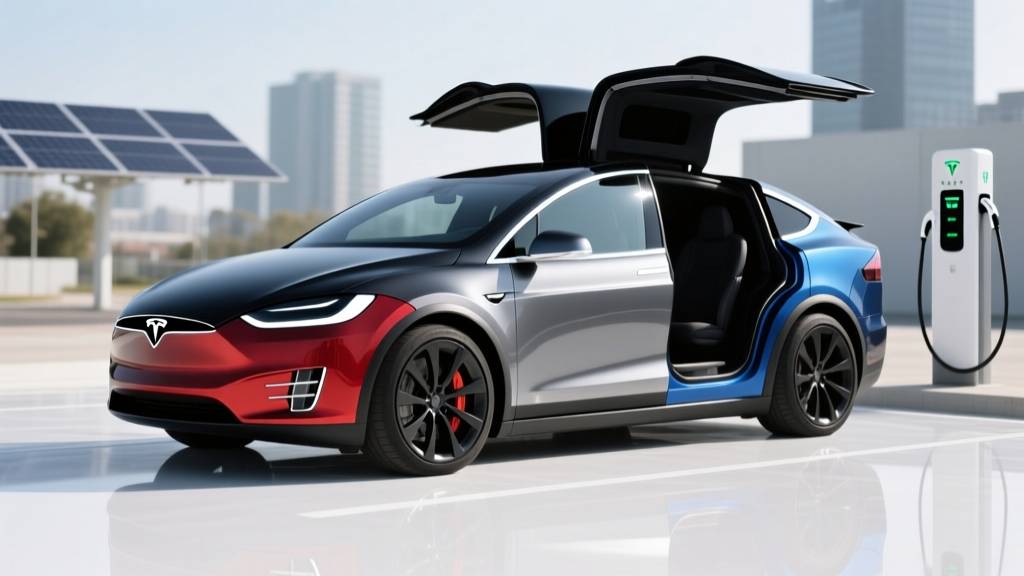
The Tesla Model X remains the only all-electric three-row SUV with falcon-wing rear doors, a 5,000-lb towing capacity, and access to the Supercharger network. For 2026, Tesla continues the dual-motor Long Range and tri-motor Plaid variants with a 100 kWh (usable ~95 kWh) NMC battery pack. The Long Range delivers an EPA-estimated 326–342 miles depending on wheel choice, while the Plaid sacrifices roughly 30 miles for a 2.5-second 0-60 mph sprint that embarrasses most supercars.
If you're researching Tesla Model X colors, you're likely deep in the configurator — and this guide covers every exterior paint option, interior theme, and wheel configuration alongside the hard performance, range, and charging numbers you need before placing an order.
| Spec | Long Range AWD | Plaid (Tri-Motor AWD) |
|---|---|---|
| EPA Range | 326–342 mi | 304–320 mi |
| Battery (usable) | ~95 kWh, NMC | ~95 kWh, NMC |
| Drivetrain | Dual-Motor AWD | Tri-Motor AWD |
| Horsepower | 670 hp | 1,020 hp |
| 0–60 mph | 3.8 sec | 2.5 sec |
| Top Speed | 155 mph | 163 mph |
| Max DC Fast Charge | 250 kW | 250 kW |
| 10–80% DC Time | ~32 min | ~32 min |
| Level 2 (11.5 kW) | ~34 mi/hr | ~34 mi/hr |
| MPGe (combined) | 100 MPGe | 96 MPGe |
| Efficiency | 34 kWh/100 mi | 35 kWh/100 mi |
| Cargo (behind 3rd row) | ~15 cu ft (seats up) | ~15 cu ft (seats up) |
| Cargo (max, all folded) | ~74 cu ft | ~74 cu ft |
| Towing Capacity | 5,000 lbs | 5,000 lbs |
| Battery Warranty | 8 yr / 150,000 mi | 8 yr / 150,000 mi |
| Base MSRP | $77,990 | $92,990 |
Source: Tesla Model X Design Studio, fueleconomy.gov
2026 Tesla Model X Colors: The Complete Paint & Interior Guide
Tesla periodically rotates its paint lineup, and the Model X's large body panels make color choice especially impactful — darker hues absorb more heat (affecting cabin cooling in summer), while lighter colors can better hide swirl marks on such expansive surfaces. Here is the current exterior palette:
Exterior Paint Options
- Pearl White Multi-Coat — Included at no extra cost. A warm, pearlescent white that shows dirt readily but hides minor scratches well. The most popular Model X color by delivery volume.
- Solid Black — $1,500. A deep, non-metallic black that delivers the most dramatic, stealthy look on the Model X's wide stance. Expect more visible swirl marks and higher cabin heat soak in summer.
- Deep Blue Metallic — $1,500. A dark navy with metallic flake that reads as near-black in overcast light and shifts to a rich blue under direct sun. An excellent choice for those wanting understated luxury.
- Ultra Red — $2,500. Tesla's premium multi-coat red, replacing the former Red Multi-Coat. Deep, candy-like depth with excellent color-shift properties. The most expensive standard color option.
- Quicksilver — $2,500. A liquid-metal silver with a warm undertone that highlights the Model X's body lines and falcon-wing creases. Shows fewer water spots than darker colors.
- Midnight Cherry Red — $2,500. A very dark red that can appear nearly black at night but reveals a deep burgundy in sunlight. A sophisticated alternative to Ultra Red.
Interior Themes
- All Black — Standard. Vegan leather (synthetic) in black with black trim. Durable and hides wear.
- Black and White — $1,000. Two-tone with white seats and black dashboard/door panels. Visually striking but the white seat bolsters require more frequent cleaning.
- Cream — $1,000. A warm, light-tan vegan leather. Softer visual tone than the stark black-and-white option.
Wheel Options (Affect Range and Price)
- 20" Cyberstream Wheels — Standard on Long Range. Best range (342 mi EPA).
- 22" Turbine Wheels — $5,500 upgrade. Reduces EPA range to ~326 mi. Sharper handling, firmer ride, more susceptible to pothole damage.
Real-World Range Expectations
EPA Sticker: 326–342 miles (Long Range, depending on wheels)
Real-World Highway (70 mph, 72°F): Expect ~270–295 miles. The Model X's large frontal area and ~5,100-lb curb weight push consumption to roughly 38–40 kWh/100 mi at sustained highway speeds, versus the EPA's blended 34 kWh/100 mi.
Cold Weather (below 32°F): Plan for 220–260 miles. NMC chemistry loses roughly 20–30% range in freezing temperatures due to battery heating demands and increased cabin HVAC load. Preconditioning while plugged in recovers some of this loss.
Towing (loaded trailer): Range drops dramatically to approximately 150–180 miles. The Model X is rated for 5,000 lbs, but towing is best suited for short hauls with planned Supercharger stops.
Charging: DC Fast, Home Level 2, and the Supercharger Advantage
The Model X uses a native NACS (North American Charging Standard) connector — the Tesla plug — which remains the most reliable public charging interface in North America. As of 2026, the Supercharger network exceeds 30,000 stalls in the U.S., and the Model X navigates to chargers automatically via its built-in route planner, preconditioning the battery for optimal charge speed on arrival.
| Charging Level | Power | Speed (Approx.) | Use Case |
|---|---|---|---|
| Level 1 (120V, 12A) | ~1.4 kW | ~4 mi/hr | Emergency/overnight trickle |
| Level 2 (240V, 48A) | 11.5 kW | ~34 mi/hr | Home daily charging (Wall Connector) |
| Level 2 (240V, 32A Mobile) | 7.7 kW | ~23 mi/hr | Portable/rental situations |
| DC Fast (V3 Supercharger) | Peak 250 kW | 10–80% in ~32 min | Road trips |
| DC Fast (V4 Supercharger) | Peak 250 kW* | 10–80% in ~32 min | Newer station locations |
*The Model X architecture is limited to 250 kW peak. V4 stalls can deliver up to 350 kW to compatible vehicles (Cybertruck), but the Model X cannot accept more than 250 kW.
Understanding the Charge Curve
Tesla's 250 kW peak rate applies only between roughly 10–30% State of Charge (SoC). Above 50%, the rate tapers to ~120 kW, and above 80%, it drops further to ~50–70 kW as the battery management system protects cell longevity. This is why the 10–80% metric (~32 minutes) is far more useful than the peak kW number. On a road trip, plan stops around the 15–80% window for the fastest average charge rate — charging from 80% to 100% at a Supercharger can take as long as the 10–80% session itself.
Home Charging Setup
The Tesla Wall Connector ($475) delivers up to 11.5 kW on a 60A circuit (48A continuous). For a typical installation on an existing 200A panel with the breaker box within 20 feet of the garage, expect to pay $500–$1,200 for a licensed electrician to run the circuit, install the connector, and pull permits. If your home has a 100A panel, a service upgrade to 200A can add $1,500–$3,000. A full overnight charge from 10% to 100% on Level 2 takes roughly 8.5 hours — perfectly suited for overnight replenishment.
Performance, Interior, and Standout Technology
The Model X's dual-motor Long Range powertrain produces 670 combined horsepower with instant torque delivery, launching this 5,100-lb SUV to 60 mph in 3.8 seconds. The tri-motor Plaid variant adds a second rear motor for 1,020 hp and a 2.5-second sprint — making it one of the quickest production SUVs ever built. Both variants feature adaptive air suspension with automatic ride-height adjustment, lowering at highway speeds for efficiency and raising for rough roads or loading.
Interior Space and Practicality
- Seating: Available in 5-seat (two rows), 6-seat (captain's chairs in second row with center console), or 7-seat (bench second row + third row) configurations. The 6-seat layout is the most practical for frequent third-row use.
- Front legroom: ~41.2 inches
- Second-row legroom (6-seat): ~38.4 inches
- Third-row legroom: ~32.7 inches (suitable for children or short-trip adults)
- Cargo behind 3rd row: ~15 cu ft
- Cargo behind 2nd row (3rd folded): ~37 cu ft
- Max cargo (all rear seats folded): ~74 cu ft
- Frunk (front trunk): ~6.7 cu ft — useful for charging cables or groceries
Standout Tech Features
- 17" Cinematic Display: Tilting center touchscreen (2200 x 1300 resolution) with Netflix, YouTube, and gaming while parked.
- Rear 8" Touchscreen: Second-row passengers get climate and entertainment controls.
- HEPA Air Filtration: Hospital-grade "Bioweapon Defense Mode" with a massive HEPA filter — genuinely useful for wildfire smoke or urban pollution.
- Autopilot (Standard): SAE Level 2 adaptive cruise + lane centering. Requires continuous driver supervision — this is not self-driving.
- Full Self-Driving (Supervised) — $8,000 option: Adds automatic lane changes, navigation-guided on/off-ramp transitions, traffic light/stop sign recognition, and Autopark. Still SAE Level 2 — the driver must remain fully attentive at all times.
- Falcon Wing Doors: Double-hinged rear doors with ultrasonic obstacle sensors that open upward, providing standing-height access to the second and third rows. Genuinely useful for loading child seats in tight parking spaces, though they operate more slowly than conventional doors and can struggle in low-clearance garages.
Notable Drawbacks
- No Apple CarPlay or Android Auto — Tesla's proprietary infotainment only.
- Falcon wing doors are slower to open/close than conventional doors and add mechanical complexity.
- Build quality, while improved, still shows occasional panel-gap inconsistencies compared to legacy luxury brands.
- The yoke steering wheel (optional) requires an adjustment period and is controversial for low-speed maneuvering.
- Insurance premiums run 15–30% higher than comparable ICE luxury SUVs due to repair costs and aluminum body construction.
Pricing, Tax Credits, and Total Cost of Ownership
The 2026 Model X starts at $77,990 for the Long Range (before destination) and $92,990 for the Plaid. A moderately optioned Long Range with Ultra Red paint, 22" wheels, FSD, and the black-and-white interior lands around $95,000 before incentives.
| Trim | Base MSRP | Typical As-Tested | §30D Credit Eligible? |
|---|---|---|---|
| Long Range AWD | $77,990 | $85,000–$95,000 | Eligible (up to $7,500)* |
| Plaid Tri-Motor AWD | $92,990 | $98,000–$108,000 | Eligible (up to $7,500)* |
Federal Tax Credit Eligibility (§30D) — Key Rules
Both Model X trims fall under the $80,000 SUV MSRP cap for the Long Range base — but options can push the as-tested price above the cap. Under current IRS rules, the MSRP cap applies to the base model + destination charge, not the as-configured price. However, IRS §30D eligibility also depends on:
- Buyer income limits: Modified AGI ≤ $300,000 (joint), $225,000 (head of household), $150,000 (single).
- Battery component sourcing: A percentage of battery components must be manufactured or assembled in North America, and critical minerals must meet sourcing thresholds. Tesla's U.S.-built battery packs generally satisfy these requirements, but rules tighten annually — verify current-year compliance on the IRS website before ordering.
- Point-of-sale transfer: As of 2024+, eligible buyers can transfer the credit to the dealer at purchase, reducing the out-of-pocket price immediately rather than waiting for tax filing.
*Consult a tax professional to confirm your personal eligibility. Incentive rules are subject to legislative change.
5-Year Ownership Cost Snapshot
Compared to a similarly priced BMW X5 xDrive40i (~$70,000), the Model X Long Range offers meaningful running-cost savings:
- Fuel/Energy: At $0.14/kWh (national average home electricity) and 34 kWh/100 mi, the Model X costs ~$4.76 per 100 miles. The X5 at 22 MPG combined and $3.60/gallon costs ~$16.36 per 100 miles. Over 60,000 miles, that's a ~$6,960 savings for the Tesla.
- Maintenance: No oil changes, no transmission fluid, minimal brake wear (regen braking). Expect ~$400–$600/year in cabin air filters, wiper fluid, and tire rotations vs. $1,200–$1,800/year for the BMW.
- Insurance: The Model X typically costs $2,800–$3,800/year to insure (varies by state and driver profile), roughly 15–25% more than the X5.
- Depreciation: Tesla depreciation has moderated with price stabilization, but the Model X still loses roughly 45–55% of value over 5 years — comparable to luxury ICE SUVs.
Who Should Buy the 2026 Tesla Model X?
Choose the Model X if:
- You need three rows and want a pure EV with 300+ miles of range.
- Falcon wing doors genuinely help your use case (child seats, tight urban parking).
- You road-trip frequently and want the most reliable DC fast-charging network.
- You need to tow up to 5,000 lbs (a small boat, utility trailer, or camper).
- You want a 1,020-hp family hauler (Plaid) and can accept the range trade-off.
Look elsewhere if:
- You rarely use a third row — the Model Y or Rivian R1S offers better value.
- You want Apple CarPlay, Android Auto, or traditional dealer service.
- You live in an apartment without home charging access and lack reliable public DC charging nearby.
- You want the quietest, most traditionally luxurious cabin — consider the BMW iX or Mercedes EQS SUV.
Pros and Cons
Pros
- Class-leading EPA range for a three-row electric SUV (326–342 mi)
- Access to Tesla Supercharger network — the most reliable in North America
- Tri-motor Plaid offers supercar-level acceleration in a 7-seat SUV
- HEPA air filtration with Bioweapon Defense Mode
- Falcon wing doors provide standing-height rear access
- Over-the-air updates continuously add features
- 5,000-lb towing capacity
- Frunk adds practical front cargo space
Cons
- Base price near $78K–$93K; options push past $100K
- No Apple CarPlay or Android Auto
- Falcon wing doors are slow and add complexity
- 22" wheels reduce range by ~16 miles and worsen ride quality
- Third row is tight for adults on long trips
- Insurance costs above segment average
- Yoke steering (optional) is polarizing
- Build quality still trails German luxury rivals
Frequently Asked Questions
What is the real-world range of the 2026 Tesla Model X?
The EPA rates the Long Range at 326–342 miles depending on wheel choice. In real-world highway driving at 70 mph in mild weather, expect approximately 270–295 miles. In freezing temperatures, range drops to roughly 220–260 miles due to battery thermal management and cabin heating demands. Towing a loaded trailer cuts range to approximately 150–180 miles.
How fast does the Model X charge at home and on the road?
At home on a Tesla Wall Connector (240V, 48A), the Model X charges at 11.5 kW, adding roughly 34 miles of range per hour — a full overnight session replenishes the battery. On a V3 or V4 Supercharger, it peaks at 250 kW and charges from 10–80% in approximately 32 minutes. Above 80%, the charge rate tapers significantly to protect battery health.
Does the 2026 Tesla Model X qualify for the federal EV tax credit?
Yes, both the Long Range and Plaid variants are eligible for up to $7,500 under IRS §30D, provided the buyer meets income limits (≤$300K joint, $150K single) and the vehicle's battery components satisfy North American sourcing requirements, which tighten annually. The credit can be applied at point of sale. Verify current eligibility on irs.gov before ordering.
Is the Model X worth buying vs. the Rivian R1S or BMW iX?
The Model X wins on range (342 mi vs. R1S's ~321 mi on the Large pack), Supercharger network access, and the falcon-wing door experience. The Rivian R1S (starting ~$75,900) offers more off-road capability, a more conventional door design, and a more truck-like personality. The BMW iX (starting ~$87,000, ~307 mi range) delivers a more traditionally luxurious cabin and dealer service network but lacks a third row and has less DC charging infrastructure access. If three rows and maximum range are priorities, the Model X leads the segment.
Which Tesla Model X color is the most popular?
Pearl White Multi-Coat is historically the most-ordered Model X color, largely because it's the no-cost option. Among paid colors, Deep Blue Metallic and Quicksilver are popular for their ability to highlight the vehicle's body lines. Ultra Red commands the highest resale premium in the used market.
What is the battery warranty on the Model X?
Tesla covers the Model X battery and drive unit for 8 years or 150,000 miles (whichever comes first), with a guaranteed minimum 70% capacity retention over the warranty period. Based on fleet data from Tesla's Impact Reports, Model X batteries typically retain approximately 88–92% capacity at 100,000 miles, with degradation slowing significantly after the initial 20,000-mile break-in period.
Can the Model X use non-Tesla charging networks?
Yes. The Model X uses a native NACS connector, which is the Tesla standard. As of 2026, many non-Tesla networks (Electrify America, EVgo, ChargePoint) have added NACS cables to new and retrofitted stations. The Model X can also use CCS1 chargers with Tesla's official CCS adapter ($250). CHAdeMO charging is not supported without a third-party adapter, and CHAdeMO infrastructure is increasingly rare.
Final Word
The 2026 Tesla Model X occupies a specific niche: a high-performance, long-range electric SUV with genuine three-row practicality and unmatched charging infrastructure access. Its color palette — from the no-cost Pearl White to the premium Ultra Red and Quicksilver — lets buyers personalize a vehicle whose large body panels make paint choice unusually impactful. At $77,990 to $92,990 before incentives, it's a significant investment, but for families who need three rows, tow occasionally, and road-trip regularly, the Model X remains the most capable electric option available. Just budget realistically for insurance, understand the real-world range reduction on highways and in cold weather, and install a Level 2 home charger before delivery day.