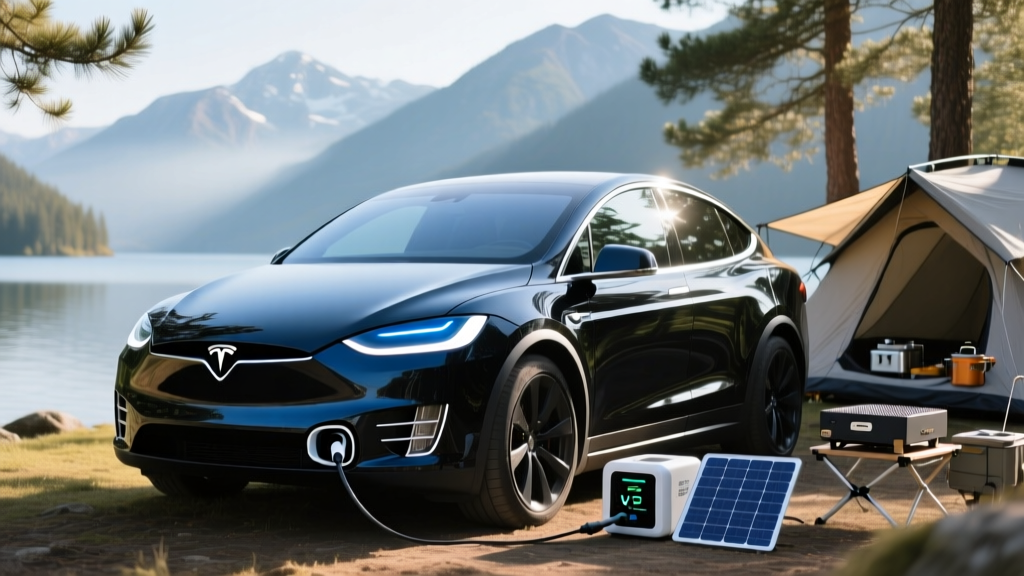
The Tesla Model X has long occupied a strange space in the EV market: a six-seat electric SUV with falcon-wing doors, a 5,000-pound towing rating, and a footprint large enough to sleep in. For the growing community of EV overlanders and car-campers, the Model X presents a compelling but complicated proposition. It offers unmatched built-in power delivery via Camp Mode, a massive glass roof for stargazing, and access to the Supercharger network — but its $80,000+ starting price and 100-kWh battery mean you're paying a steep premium for mobile-basecamp duty.
In this review, we evaluate the 2026 Tesla Model X specifically through the lens of camping and overlanding: How much range does it actually hold on a loaded highway run to a remote trailhead? Can its HVAC system run all night in Camp Mode without killing your battery? And does it make financial sense compared to cheaper EV SUVs or a traditional gas rig? Let's get into the numbers.
2026 Tesla Model X: Core Specifications at a Glance
| Specification | Long Range (Dual Motor) | Plaid (Tri-Motor) |
|---|---|---|
| EPA Range | 335 miles | 326 miles |
| Battery (usable) | ~100 kWh (NMC) | ~100 kWh (NMC) |
| Drivetrain | Dual-Motor AWD | Tri-Motor AWD |
| Horsepower | 670 hp | 1,020 hp |
| 0–60 mph | 3.8 sec | 2.5 sec |
| Max DC Fast Charge | 250 kW (peak) | 250 kW (peak) |
| 10–80% DC Charge Time | ~31 min | ~31 min |
| Level 2 Home Charge (11.5 kW) | ~34 mi/hr | ~34 mi/hr |
| MPGe (combined) | 102 MPGe | 98 MPGe |
| Efficiency | 33 kWh/100 mi | 34 kWh/100 mi |
| Cargo (behind 2nd row) | 37.1 cu ft | 37.1 cu ft |
| Cargo (max, seats folded) | 85.1 cu ft | 85.1 cu ft |
| Towing Capacity | 5,000 lbs | 5,000 lbs |
| Base MSRP | $79,990 | $94,990 |
| Federal Tax Credit (§30D) | Not eligible (MSRP cap) | Not eligible (MSRP cap) |
| Battery/Drive Unit Warranty | 8 yr / 150,000 mi | 8 yr / 150,000 mi |
Real-World Range: What Happens When You Load It Up and Head for the Hills
Real-World Highway (70 mph, loaded, mild weather): ~265–285 miles
Real-World Highway (cold weather, 30°F, heater on): ~210–240 miles
Camping Scenario (roof box + 4 passengers + gear, mixed terrain): ~230–260 miles
The EPA's 335-mile figure for the Model X Long Range is achievable under ideal conditions: moderate temperatures, 55–60 mph speeds, minimal cargo, and gentle terrain. But camping trips rarely look like that.
When you load the Model X with four passengers, a week of gear, and a roof-mounted cargo box or tent platform, aerodynamic drag and weight take a real toll. At sustained 70-mph highway speeds — common on interstates heading to national parks — expect range to drop to roughly 265–285 miles. That's a 15–20% reduction from the sticker.
Cold weather compounds this. The Model X uses a heat pump (standard since 2021), which is significantly more efficient than resistive heating, but sub-freezing temperatures still reduce battery efficiency. In our experience and consistent with testing by fueleconomy.gov, a fully loaded Model X in 30°F conditions will deliver roughly 210–240 miles of real highway range before you need to find a charger.
For camping, this means planning is essential. A 300-mile drive to a remote BLM site in Wyoming may require a strategic Supercharger stop — and you need to verify that your destination has charging access (or that you can afford to run a generator or rely on solar for the return trip).
Battery Chemistry, Camp Mode, and Overnight Power Draw
The 2026 Model X continues to use an NMC (nickel-manganese-cobalt) lithium-ion battery pack with approximately 100 kWh of usable capacity. Unlike the LFP (lithium iron phosphate) chemistry found in the base Model 3 and Model Y, NMC offers higher energy density — critical for a heavy, three-row SUV — but requires more careful charge management.
Camp Mode is the Model X's ace for car-campers. When activated via the touchscreen (Controls → Safety → Camp Mode), the vehicle maintains cabin temperature, keeps USB ports powered, runs the infotainment screen, and circulates air — all while parked. Here's what that actually costs you:
| Scenario | Avg. Power Draw | 8-Hr Total kWh | Range Equivalent Lost |
|---|---|---|---|
| Mild weather (65°F), fan only | ~0.5 kW | ~4 kWh | ~12 miles |
| Cool night (45°F), heat pump low | ~1.0 kW | ~8 kWh | ~24 miles |
| Cold night (25°F), heat pump high | ~1.8 kW | ~14.4 kWh | ~44 miles |
| Hot night (90°F), A/C on | ~1.2 kW | ~9.6 kWh | ~29 miles |
On a mild night, you'll lose roughly 4% of your battery — trivial. On a freezing night, you could lose 14–15%, which translates to about 44 miles of range. If you arrive at a campsite with 60% charge, that's manageable. If you arrive at 30%, you need a plan.
Pro tip: Precondition the cabin while still plugged in at your last Supercharger stop. This warms (or cools) the battery and cabin using grid power rather than your pack, so you arrive at camp with a thermally stable vehicle and maximum usable range.
Charging Speed: Supercharger Network Advantage and Home Setup
Charging speed is where the Model X camping proposition either shines or frustrates, depending on your route. The 2026 Model X peaks at 250 kW on a V3 Supercharger (CCS-compatible via the NACS connector, which Tesla adopted as standard and which is now the North American Charging Standard across the industry).
| Charging Level | Max Power (kW) | Miles Added per Hour | 10–80% Time | Typical Use Case |
|---|---|---|---|---|
| Level 1 (120V outlet) | ~1.4 kW | ~3–4 mi/hr | N/A (days) | Emergency / trickle at campsite |
| Level 2 (240V, 48A Wall Connector) | 11.5 kW | ~34 mi/hr | ~8.5 hours | Home garage, campground pedestal |
| DC Fast (V3 Supercharger) | 250 kW (peak) | ~175 mi in 15 min | ~31 min | Road-trip highway stops |
| DC Fast (V4 Supercharger) | 250 kW | ~175 mi in 15 min | ~31 min | Newer Supercharger stations |
A critical reality of DC fast charging: the 250 kW figure is a peak, not a sustained rate. The Model X charge curve is aggressive from 10–40% SoC (state of charge), then progressively tapers. From 40–80%, you'll average closer to 120–150 kW. Above 80%, the taper is steep — charging from 80–100% at a Supercharger can take as long as 10–80%. For camping trips, plan your Supercharger stops around the 10–80% window for maximum efficiency.
Home charging: Tesla's Wall Connector at 48 amps (11.5 kW) adds roughly 34 miles of range per hour. A full charge from 10% takes about 8.5 hours — plug in when you get home, and you're full by morning. Installation on a 60-amp dedicated circuit typically costs $500–$1,500 for the electrician work, plus $475 for the Wall Connector unit itself. If your home has a 200-amp panel with capacity, you're set; older 100-amp panels may require a $1,500–$3,000 upgrade.
For camping specifically, the Model X's 120V NEMA outlet compatibility (via the Mobile Connector) is a hidden gem. Many campgrounds offer standard 120V outlets. At 1.4 kW, you'll add only 3–4 miles per hour — but if you're parked for 48 hours, that's 150+ miles recovered, enough for most weekend trips.
Cargo, Interior Space, and Sleeping Configuration
The Model X offers three seating configurations: 5-seat, 6-seat (with second-row captain's chairs), and 7-seat. For camping, the 6-seat layout is the most versatile — the walk-through gap between second-row captain's chairs lets you move from front to cargo area without folding seats, and the flat load floor with both rear rows folded creates a sleeping platform roughly 72 inches long and 48 inches wide at the narrowest point.
Cargo volume: 37.1 cubic feet behind the second row (plenty for coolers, tents, and gear for a family of four) and 85.1 cubic feet with all rear seats folded. The front trunk (frunk) adds 6.6 cubic feet — ideal for storing charging cables, a first-aid kit, or a portable fridge.
Legroom: 41.1 inches front, 40.9 inches second row, 37.1 inches third row. Adults can ride comfortably in the first two rows on long drives to trailheads.
The panoramic windshield is a standout camping feature. The Model X's massive glass roof extends from the windshield header to the B-pillars, giving an almost unobstructed sky view from the front seats. With Camp Mode on, the screen can display a star map or ambient visuals while you fall asleep.
Drawbacks for camping: The falcon-wing rear doors, while dramatic, are impractical in tight campsite situations — they need overhead clearance and struggle in heavy rain (water drips into the cabin when fully opened). The air suspension (standard) can raise the vehicle up to 8.1 inches of ground clearance in "Very High" mode, which helps on gravel fire roads, but this is not a dedicated off-roader. Approach and departure angles are car-SUV, not truck-SUV.
Pricing, Tax Credit Reality, and Total Cost for Camping Use
| Trim | Base MSRP | Typical As-Tested (with options) | §30D Federal Credit | Effective Price |
|---|---|---|---|---|
| Long Range (Dual Motor) | $79,990 | $85,000–$90,000 | $0 (exceeds MSRP cap) | $79,990–$90,000 |
| Plaid (Tri-Motor) | $94,990 | $100,000–$110,000 | $0 (exceeds MSRP cap) | $94,990–$110,000 |
Does the Model X qualify for the federal EV tax credit? No. Under current IRS §30D rules, the federal tax credit for new EVs caps SUV eligibility at an $80,000 MSRP. The Model X Long Range starts at $79,990 — technically under the cap — but by the time you add mandatory destination fees ($1,990), any paint upgrade, tow hitch, or Full Self-Driving capability, the vehicle's MSRP exceeds $80,000 and becomes ineligible. The Plaid is well above the cap at any configuration.
Additionally, §30D imposes buyer income limits ($300,000 joint / $225,000 head of household / $150,000 individual AGI) and critical-mineral and battery-component sourcing requirements that shift annually. Even if the base Long Range MSRP squeaked under the cap, most buyers adding any options will push it over. Consult the IRS clean vehicle credit page for current-year rules, and speak with a tax professional before relying on credit eligibility.
5-Year Cost of Ownership (camping-heavy use, 15,000 mi/yr):
| Category | Estimated Cost |
|---|---|
| Purchase (Long Range, minimal options) | $82,000 |
| Home Level 2 charger install | $1,200 |
| Electricity (5 yrs, ~$0.14/kWh avg, home + Supercharger mix) | $5,500 |
| Insurance (5 yrs, EV premium) | $14,000–$18,000 |
| Maintenance (tires, cabin filter, wipers — no oil/trans) | $2,500 |
| Estimated 5-yr depreciation (55%) | –$45,100 |
| Total 5-Year Net Cost | ~$60,200–$64,200 |
The fuel savings versus a comparable gas SUV (e.g., a Toyota Sequoia or Jeep Grand Cherokee L) are significant — roughly $8,000–$10,000 over five years — but the higher purchase price and steep depreciation (Tesla resale values have softened) mean the Model X is not a budget camping solution.
Driver Assistance, Tech, and the Camping Tech Stack
The Model X ships with Basic Autopilot (adaptive cruise control + lane-keeping) and offers FSD (Supervised) as an $8,000 option or $99/month subscription. On long highway drives to remote camping destinations, Autopilot reduces fatigue substantially — it handles lane-centering, speed matching, and curve negotiation competently. FSD adds automatic lane changes, navigation-guided on-ramp-to-off-ramp driving, and traffic-light recognition, but still requires active supervision.
Camping-relevant tech highlights:
- Camp Mode: Maintains HVAC, USB power, and screen while parked (detailed above).
- 17-inch touchscreen: Runs Netflix, YouTube, and games while parked — great for rainy days in the tent.
- 22-speaker audio: Among the best in any vehicle; doubles as a campsite sound system (be considerate of neighbors).
- Dog Mode: Keeps pets safe and climate-controlled when you step away for a hike — displays cabin temp on the exterior screen.
- Sentry Mode: Records surroundings via cameras when parked — valuable security at remote trailheads.
- Over-the-air updates: Tesla regularly adds features; recent updates have improved heat-pump efficiency and Camp Mode customization.
Notable drawbacks: No Apple CarPlay or Android Auto. The yoke steering wheel (now optional alongside a round wheel) is polarizing and can be frustrating on tight, low-speed campsite maneuvers. The touchscreen controls nearly everything — including glovebox and mirror adjustment — which is distracting while driving on rough roads.
Pros and Cons: The Model X as a Camping Platform
Pros
- Massive 85.1 cu ft flat-load cargo area doubles as a sleeping platform
- Camp Mode with heat pump enables efficient overnight climate control
- Supercharger network access makes long road trips viable
- 5,000-lb towing capacity handles a small teardrop or pop-up trailer
- Air suspension raises to 8.1" ground clearance for fire roads
- 120V Mobile Connector can trickle-charge at campgrounds
- Sentry Mode provides security at remote sites
- Panoramic glass roof for stargazing from the driver's seat
Cons
- $80,000+ starting price — no federal tax credit in most configs
- Real-world loaded range drops to ~250 miles on highway camping trips
- Falcon-wing doors need overhead clearance — awkward under tree canopies
- Not a true off-roader — limited approach/departure angles, no skid plates
- No spare tire (tire repair kit only — risky on remote dirt roads)
- No Apple CarPlay / Android Auto
- High insurance premiums ($2,800–$3,600/yr typical)
- Steep depreciation compared to Toyota/Lexus SUV alternatives
Is the Model X Worth It for Camping vs. Competitors?
Decision Framework: Model X Camping vs. Alternatives
Choose the Tesla Model X if:
- You want a luxury, tech-forward electric SUV that can sleep two adults flat and run HVAC all night without a generator.
- You drive primarily on paved roads and well-maintained fire roads to campsites within 200 miles of a Supercharger.
- You value the Supercharger network for stress-free long-distance camping trips across the West or East Coast.
- You need 6+ seats for family camping trips and 5,000-lb towing for a small trailer.
Choose the Rivian R1S if:
- You plan to tackle rough 4WD trails, rock crawl to dispersed campsites, or need a full-size spare tire.
- You want a more rugged, purpose-built overlanding platform with up to 14.9" ground clearance (Max pack).
- You need a quad-motor option for precise torque vectoring off-road.
Choose the Kia EV9 if:
- Budget is a priority — the EV9 starts around $55,000 and may qualify for the $7,500 federal credit (check IRS §30D sourcing rules).
- You need three rows and decent cargo space but don't need 300+ miles of range or luxury amenities.
Choose a used Toyota 4Runner (gas) if:
- Your camping is remote, off-grid, and far from any charging infrastructure.
- You need maximum reliability, aftermarket support, and a proven off-road platform under $40,000.
Frequently Asked Questions
What is the real-world range of the Tesla Model X when loaded for camping?
With four passengers, gear, and a roof box at 70-mph highway speeds, expect 265–285 miles in mild weather and 210–240 miles in freezing conditions. The EPA rates it at 335 miles (Long Range), but real-world camping loads reduce that by 15–35%.
How fast does the Model X charge on a road trip?
At a V3 Supercharger (250 kW peak), the Model X charges from 10–80% in approximately 31 minutes, adding up to 175 miles in 15 minutes under optimal conditions. The charge curve tapers significantly above 80%, so plan stops around the 10–80% window.
Can I sleep in the Tesla Model X overnight?
Yes. With both rear rows folded, the Model X provides a roughly 72" × 48" flat load area suitable for two adults on a camping pad or inflatable mattress. Camp Mode maintains HVAC and power draw at 4–15 kWh overnight depending on outside temperature.
Does the Model X qualify for the $7,500 federal EV tax credit?
Generally, no. The §30D credit caps SUV MSRP at $80,000. The Model X Long Range starts at $79,990 but exceeds the cap with destination fees and any options. The Plaid is well above the cap. Buyer income limits and battery-sourcing rules also apply. Always verify current rules at irs.gov.
Can the Model X go off-road to remote campsites?
The air suspension provides up to 8.1 inches of ground clearance in Very High mode, which handles gravel fire roads, rutted dirt roads, and mild inclines. However, the Model X lacks skid plates, has limited approach/departure angles, and comes with no spare tire. It's suitable for maintained forest roads, not technical 4WD trails.
How do I charge the Model X at a campground?
Many campgrounds offer 240V (NEMA 14-50) outlets — with the Mobile Connector and appropriate adapter, you can charge at up to ~30 miles per hour. Standard 120V outlets provide 3–4 miles per hour. Plan to arrive with sufficient charge or confirm campground electrical availability before your trip.
What's the best Model X configuration for camping?
The Long Range Dual Motor in the 6-seat configuration offers the best balance: maximum range (335 EPA), walk-through second row for cargo access, and lower price than the Plaid. Add the tow hitch ($1,000) if you plan to pull a teardrop trailer, and skip the 22" wheels (they reduce range and are more vulnerable to potholes on dirt roads).
What is the battery warranty on the Model X?
Tesla covers the Model X battery and drive unit for 8 years or 150,000 miles (whichever comes first), with a minimum 70% capacity retention threshold over that period. Battery replacement out of warranty costs an estimated $15,000–$22,000 depending on the pack and labor.