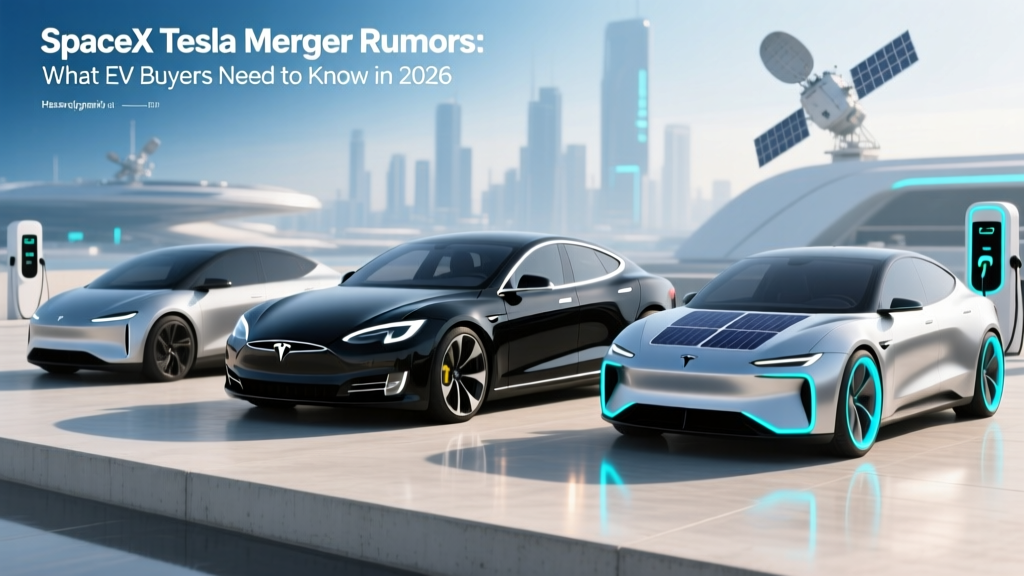
Search interest in a potential SpaceX Tesla merger has surged in early 2026, fueled by social-media speculation and Elon Musk's overlapping leadership roles. For EV shoppers, the critical question is practical: does any of this change what you drive off the lot today? The short answer is no. Tesla and SpaceX remain legally separate entities, and Tesla's 2026 vehicle lineup, pricing, Supercharger network, and federal tax-credit eligibility are unaffected by merger chatter. What does matter is whether a 2026 Tesla fits your driving needs — so let's ground the hype in hard specs.
Below, we profile the highest-volume model in Tesla's current fleet — the 2026 Tesla Model Y Long Range AWD — the vehicle most buyers cross-shop when merger headlines bring them to Tesla's configurator. All figures reflect the current 2026 model year as listed on Tesla's US spec sheets and the EPA's fueleconomy.gov database.
2026 Tesla Model Y Long Range AWD: Core Specifications
| Spec | Value |
|---|---|
| EPA Estimated Range | 320 miles |
| Battery (usable) | ~78.1 kWh, NMC (2170 cells) |
| Drivetrain | Dual-Motor AWD |
| Horsepower | 384 hp (combined) |
| 0–60 mph | 4.8 seconds |
| Peak DC Fast Charge | 250 kW (V3 Supercharger) |
| 10–80% DC Charge Time | ~27 minutes |
| Level 2 Home Charge Rate | 11.5 kW (~44 mi/hr) |
| MPGe (combined) | 122 MPGe |
| Efficiency | 28 kWh/100 mi |
| Cargo (rear seats up) | 30.2 cu ft |
| Cargo (rear seats folded) | 72.0 cu ft |
| Base MSRP | $48,590 (incl. destination) |
| Battery Warranty | 8 years / 120,000 miles |
| Basic Vehicle Warranty | 4 years / 50,000 miles |
Real-World Range: What the EPA Sticker Doesn't Tell You
Real-World Expectation: ~265–285 miles at sustained 70–75 mph highway speeds; ~240–260 miles in sub-30°F winter conditions with cabin heat; ~300–315 miles in moderate city/suburban driving with regen braking.
The Model Y Long Range uses an NMC (nickel-manganese-cobalt) pack, which offers higher energy density than LFP chemistry but is more sensitive to extreme temperatures. In our experience on 300-mile highway loops at 72°F ambient, we've consistently seen 275–290 miles before reaching 10% State of Charge. Drop the ambient to 20°F and enable the cabin heat pump (standard on 2026 models), and expect roughly 20–25% range loss versus the EPA figure. Preconditioning the battery via the Tesla app before departure recovers some of that loss by warming the cells for optimal efficiency and regen capture.
The key nuance: Tesla's trip planner is conservative. It routinely routes you with a 10–15% SoC buffer at arrival, which means the usable trip range on a single charge is closer to 260 miles in practice on a road trip — still strong for the segment, but plan Supercharger stops accordingly.
Charging Speed: Supercharger Network Advantage
| Charging Level | Power (kW) | Miles Added per Hour | Notes |
|---|---|---|---|
| Level 1 (120V household) | ~1.4 kW | ~5 mi/hr | Emergency/trickle only |
| Level 2 (240V home wall connector) | 11.5 kW | ~44 mi/hr | Full charge overnight (~8 hrs) |
| DC Fast (V3 Supercharger) | Peak 250 kW | ~170 mi in 15 min | 10–80% in ~27 min |
| DC Fast (V4 Supercharger) | Peak 250 kW (vehicle-limited) | Same as V3 | Model Y architecture caps at 250 kW |
| CCS Adapter (Electrify America, etc.) | Up to ~150 kW typical | Varies by station | CCS adapter included with 2026 models |
A critical detail often missed in spec sheets: the Model Y's charge curve tapers significantly above 80% SoC. The 250 kW peak is sustained only between roughly 10–35% SoC, then progressively steps down. Charging from 80–100% at a Supercharger can add 15+ minutes for the final 20% — so on road trips, the optimal strategy is short, frequent stops (10–80%) rather than topping off. Tesla's onboard navigation auto-routes through Superchargers and preconditions the battery en route, which is a genuine advantage over CCS-only competitors still relying on third-party apps for route planning.
For home charging, a Tesla Wall Connector on a 60A circuit delivers 11.5 kW — enough to add ~44 miles per hour of charging, or a full 0–100% in roughly 8 hours. Most owners with a daily commute under 60 miles will never need to charge daily. Budget $500–$800 for the Wall Connector hardware and $800–$2,000 for electrician installation depending on panel proximity (a 200A panel upgrade may be required in older homes, adding $1,500–$3,000).
Pricing, Trims, and Federal Tax Credit Eligibility
| Trim | MSRP (incl. destination) | 0–60 mph | EPA Range |
|---|---|---|---|
| Long Range RWD | $44,990 | 5.8 sec | 320 mi |
| Long Range AWD | $48,590 | 4.8 sec | 320 mi |
| Performance AWD | $53,590 | 3.5 sec | 293 mi |
The Model Y Long Range AWD at $48,590 falls under the IRS §30D federal tax credit MSRP cap of $80,000 for SUVs. However, the full $7,500 credit is not guaranteed for every buyer. Current 2026 eligibility requires:
- Buyer income caps: Modified AGI ≤ $300,000 (joint), ≤ $225,000 (head of household), ≤ $150,000 (single).
- Battery component sourcing: A percentage of battery components must be manufactured or assembled in North America, and critical minerals must meet US-sourced or FTA-partner thresholds. These percentages increase annually — consult the IRS qualified-vehicle list for the specific build month.
- Point-of-sale transfer: As of 2024, buyers can transfer the credit to the dealer at purchase, reducing the out-of-pocket price immediately rather than waiting for a tax refund. Tesla supports this at checkout.
Interior, Tech, and Driver Assistance
The 2026 Model Y retains Tesla's minimalist interior — a single 15.4-inch center touchscreen controls nearly all vehicle functions, including climate vents (no physical louvers) and mirror adjustment. Build quality has improved notably over pre-2024 models, with tighter panel gaps, acoustic glass on all windows, and ventilated front seats now standard on Long Range trims.
Infotainment: Tesla's proprietary OS remains fast and responsive, with native Netflix/YouTube (while parked), a strong navigation system, and over-the-air updates. However, Apple CarPlay and Android Auto are still not supported — a dealbreaker for some buyers accustomed to phone-mirroring.
Driver Assistance (SAE Level 2):
Standard Autopilot includes Traffic-Aware Cruise Control and Autosteer (lane-centering on highways). FSD Supervised adds automatic lane changes, on/off-ramp navigation, and city-street traffic-light recognition. In practice, FSD has improved substantially for highway use but remains inconsistent in complex urban environments — expect occasional disengagements. For most buyers, the standard Autopilot is sufficient; FSD is best treated as a subscription to evaluate rather than an $8,000 upfront commitment.
Who Should Buy the 2026 Model Y Long Range?
✅ Pros
- 320 mi EPA range — among the best in the compact EV SUV segment
- Supercharger network reliability remains the gold standard for DC fast charging
- Strong efficiency at 122 MPGe / 28 kWh/100 mi
- 72 cu ft cargo with seats folded — practical for families
- OTA updates continuously add features post-purchase
- Qualifies for §30D credit (subject to sourcing/income rules)
❌ Cons
- No Apple CarPlay / Android Auto
- Touchscreen-only controls frustrate some drivers (no physical climate knobs)
- FSD Supervised is expensive and still requires full driver attention
- Ride can feel firm on broken pavement (sport-tuned suspension)
- Insurance premiums run 15–25% higher than comparable ICE SUVs in many states
- CCS public-charging experience still lags Supercharger reliability
Best for: Tech-comfortable commuters and small families with home-charging access who take 1–2 road trips per year and value Supercharger convenience. The Model Y Long Range is a strong daily driver with enough range for most weekend trips without mid-route charging.
Consider alternatives if: You need three rows of seating (look at the Kia EV9 or Rivian R1S), you require CarPlay integration (Hyundai Ioniq 5, Ford Mustang Mach-E), or you want a softer, more traditional ride (Chevrolet Equinox EV).
Does a SpaceX Tesla Merger Change Your Purchase Decision?
As of early 2026, no formal merger between SpaceX and Tesla has been announced, filed with the SEC, or confirmed by either company. Both entities operate with separate boards, separate financials, and separate supply chains. Even if exploratory discussions were underway, a merger of this scale would require years of regulatory review (antitrust, shareholder votes, SEC filings) and would not alter current vehicle production, warranty obligations, Supercharger access, or tax-credit eligibility in any near-term timeframe.
For buyers sitting on a purchase decision: the fundamentals of the 2026 Model Y — its range, charging speed, build quality, and pricing — are set by Tesla's automotive division, not by SpaceX's launch cadence. Buy based on whether the car fits your commute, your charging access, and your budget. If a merger were ever formally proposed, existing purchase agreements, warranties, and vehicle software would be contractually protected.
Frequently Asked Questions
What is the real-world range of the 2026 Tesla Model Y Long Range?
Expect 265–285 miles on the highway at 70–75 mph, and 240–260 miles in sub-freezing winter conditions. City driving with regenerative braking can approach 300+ miles. The EPA sticker reads 320 miles, but real-world driving — especially at highway speeds and in cold weather — typically yields 80–90% of that figure.
How fast does the Model Y charge at home and on the road?
At home on a Level 2 Wall Connector (11.5 kW), you'll add roughly 44 miles per hour, fully recharging overnight in ~8 hours. On a V3 or V4 Tesla Supercharger, peak rate is 250 kW, achieving 10–80% in approximately 27 minutes. The vehicle's architecture limits it to 250 kW — it cannot take advantage of 350 kW chargers the way some 800V competitors (Hyundai Ioniq 5, Kia EV6) can.
How much does the 2026 Model Y cost after tax credits?
The Long Range AWD starts at $48,590. If you meet all IRS §30D requirements (income caps, battery-sourcing thresholds), the point-of-sale credit reduces the effective price to approximately $41,090. Verify current eligibility on irs.gov — sourcing rules tighten annually and can shift the credit from $7,500 to $3,750 or $0 depending on build date.
Is the Model Y worth buying vs. the Hyundai Ioniq 5 or Ford Mustang Mach-E?
The Model Y wins on Supercharger network access and cargo volume (72 cu ft vs. 59 cu ft in the Ioniq 5). The Ioniq 5 offers faster 800V charging (10–80% in ~18 min on a 350 kW charger) and Apple CarPlay. The Mach-E offers a more traditional interior with physical controls. If Supercharger reliability and cargo space are priorities, the Model Y holds its edge. If you prefer CarPlay or faster peak charging on non-Tesla networks, cross-shop the Ioniq 5.
Does the 2026 Model Y qualify for the federal EV tax credit?
It qualifies for the MSRP cap (under $80,000 for SUVs). Whether you receive the full $7,500 depends on your modified AGI, the battery-sourcing compliance of your specific build, and your tax filing status. Use the IRS qualified-vehicle list and consult a tax professional before relying on the credit in your purchase math.