Quick Verdict: The Model X in 2026
The Tesla Model X remains one of the most capable three-row electric SUVs on the market, blending falcon-wing doors, a 335-mile EPA range, and access to Tesla's Supercharger network. For buyers researching a Tesla Model X body kit—whether for aesthetic upgrades, aerodynamic tweaks, or paint protection—the underlying vehicle must first justify its $79,990 starting price. This review covers the 2026 Model X Long Range and Plaid with exact specs, real-world range data, charging performance, and the aftermarket customization landscape that owners actually navigate.
| Spec | Long Range | Plaid |
|---|---|---|
| EPA Range | 335 mi | 326 mi |
| Battery (usable) | ~95 kWh (NMC) | ~95 kWh (NMC) |
| Drivetrain | Dual-Motor AWD | Tri-Motor AWD |
| Horsepower | 670 hp | 1,020 hp |
| 0–60 mph | 3.8 sec | 2.5 sec |
| Max DC Fast Charge | 250 kW | 250 kW |
| 10–80% DC Time | ~32 min | ~32 min |
| Level 2 Rate | 11.5 kW (~44 mi/hr) | 11.5 kW (~44 mi/hr) |
| MPGe (combined) | 101 MPGe | 98 MPGe |
| Efficiency | 33 kWh/100 mi | 34 kWh/100 mi |
| Cargo (behind 3rd row) | 14.7 cu ft | 14.7 cu ft |
| Cargo (all rows folded) | 77.5 cu ft | 77.5 cu ft |
| Base MSRP | $79,990 | $94,990 |
| Battery Warranty | 8 yr / 150,000 mi | 8 yr / 150,000 mi |
Range & Efficiency: EPA vs. the Real World
The Model X Long Range carries an EPA-estimated 335 miles of range, while the tri-motor Plaid drops slightly to 326 miles due to its higher power draw. Both use Tesla's nickel-manganese-cobalt (NMC) lithium-ion pack with approximately 95 kWh of usable capacity. NMC offers higher energy density than LFP chemistry, which matters in a heavy three-row SUV, but it comes with a recommended 80% daily charge limit to preserve long-term cell health.
In mixed highway driving at 70–75 mph, expect roughly 280–300 miles from the Long Range before needing a charge. In freezing temperatures (below 32°F), range can drop 20–30%, landing closer to 230–260 miles. The Model X's heat pump helps mitigate cabin energy draw in winter, but battery preconditioning is essential for both range preservation and fast-charge speed. City driving with heavy regenerative braking can push range above the EPA figure, sometimes reaching 340–350 miles in stop-and-go traffic.
Efficiency lands at 33 kWh per 100 miles for the Long Range, translating to 101 MPGe combined per fueleconomy.gov. That's competitive with the BMW iX xDrive50 (35 kWh/100 mi) but slightly thirstier than the smaller Tesla Model Y, which benefits from a lighter platform.
Charging: DC Fast, Level 2, and the Supercharger Advantage
Tesla's Supercharger network remains the most reliable public DC fast-charging ecosystem in North America, and the Model X leverages it fully. The 2026 Model X peaks at 250 kW on V3 Superchargers, though it cannot match the 350-kW capability of Hyundai-Kia's E-GMP platform or the Rivian R1S on CCS adapters.
| Charging Level | Power | Speed (mi/hr added) | Notes |
|---|---|---|---|
| Level 1 (120V) | ~1.4 kW | ~3–4 mi/hr | Emergency/trickle only |
| Level 2 (240V, 48A) | 11.5 kW | ~44 mi/hr | Full overnight charge in ~9 hrs |
| DC Fast (V3 Supercharger) | 250 kW peak | ~175 mi in 15 min | 10–80% in ~32 min; tapers above 80% |
| DC Fast (CCS adapter) | Up to 150 kW | Varies by station | Useful on Electrify America, EVgo networks |
The charging curve matters: the Model X sustains peak rates only between roughly 10–40% state of charge, then tapers progressively. A 10–80% session takes approximately 32 minutes at a V3 Supercharger. Above 80%, the rate drops sharply to protect battery longevity—plan to unplug and move on rather than waiting for a full charge on road trips.
At home, a Tesla Wall Connector on a 60-amp circuit delivers 11.5 kW (48 amps), adding about 44 miles of range per hour. Most owners who plug in overnight start each day with a full battery, making public charging relevant only for road trips. Home installation typically costs $800–$2,000 depending on panel proximity and whether a 200-amp service upgrade is needed.
Performance: Dual-Motor vs. Tri-Motor Plaid
The Model X Long Range's dual-motor AWD system produces 670 horsepower and hits 0–60 mph in 3.8 seconds—quick enough to surprise sports cars at stoplights while carrying seven passengers. The Plaid's tri-motor setup pushes 1,020 hp and a 2.5-second 0–60 time, making it one of the fastest production SUVs ever built.
Both trims use adaptive air suspension that adjusts ride height for highway efficiency or rough-road clearance. The Model X can tow up to 5,000 pounds when properly equipped, adequate for a small boat or utility trailer but below the Rivian R1S's 7,700-pound rating.
Regenerative braking is aggressive enough for near one-pedal driving in most conditions, though Tesla removed the user-adjustable regen setting in recent model years. The brake feel is linear, and the blended braking system transitions smoothly from regen to friction brakes.
Interior, Cargo, and Technology
The Model X seats up to seven in a 2-3-2 configuration, or six with optional second-row captain's chairs. Third-row legroom measures 32.7 inches—tight for adults on long trips but workable for children. Second-row legroom is generous at 41.1 inches, and the panoramic windshield creates an airy cabin feel.
Cargo space behind the third row is 14.7 cubic feet, expanding to 77.5 cubic feet with both rear rows folded. The front trunk (frunk) adds another 6.7 cubic feet, useful for charging cables or a small cooler. The falcon-wing rear doors open vertically, providing excellent access to the second and third rows in tight parking spots—though they can be slow to operate and have been a source of reliability complaints in earlier model years.
The 17-inch center touchscreen runs Tesla's latest software, including navigation with real-time Supercharger routing, streaming media, and a built-in trip planner that factors in battery preconditioning. The secondary 8-inch rear touchscreen controls climate and entertainment for back-seat passengers. Wireless phone charging, a 22-speaker audio system, and HEPA air filtration (with Bioweapon Defense Mode) are standard.
Autopilot and FSD (Supervised): The Model X comes with Tesla's basic Autopilot (traffic-aware cruise control and lane centering). Full Self-Driving (Supervised) is available as an $8,000 add-on or $99/month subscription. FSD adds automatic lane changes, traffic light and stop sign recognition, and navigate-on-autopilot for highway interchanges. This is an SAE Level 2 system—the driver must remain fully attentive with hands on the wheel at all times. It is not autonomous driving.
Tesla Model X Body Kit & Aftermarket Options
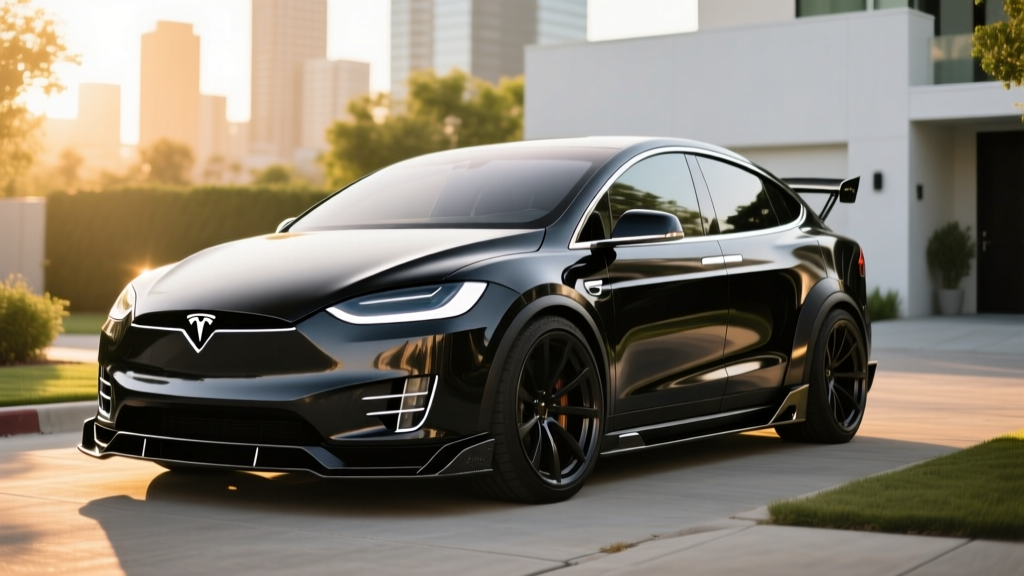
Owners exploring a Tesla Model X body kit typically fall into three categories: aesthetic enhancement, paint and body protection, and aerodynamic optimization. The aftermarket ecosystem for the Model X is smaller than for the Model 3 or Model Y, given its lower production volume, but several options exist.
Carbon Fiber Spoilers and Splitters: Aftermarket front lip spoilers and rear diffuser attachments from companies like EVo Customs and Abstract SA can sharpen the Model X's profile. These bolt-on pieces typically cost $500–$1,500 and may offer marginal aerodynamic gains at highway speeds.
Paint Protection Film (PPF) and Ceramic Coating: The Model X's large, flat hood and falcon-wing door seams are prone to rock chips. Full-body PPF installation runs $5,000–$8,000 at reputable shops and is the most popular "body kit" among new owners who want to preserve factory paint.
Wide-Body Kits: Companies like T Sportline and Novitec offer limited-run wide-body conversions that widen the fenders and accommodate larger wheel setups. These are niche, expensive ($10,000–$25,000+ installed), and may affect warranty coverage if they interfere with suspension or sensor components.
Wheel Upgrades: The factory 20-inch Cyberstream and 22-inch Turbine wheels can be swapped for lighter forged aftermarket options (20–22 inches). Lighter wheels reduce unsprung mass and can improve efficiency by 2–5%, translating to 7–15 additional miles of range. However, larger or heavier wheels reduce range—keep this trade-off in mind.
Important Considerations: Any body modification that alters sensor placement (cameras, ultrasonic sensors) can interfere with Autopilot and FSD functionality. Always verify that aftermarket body kits do not obstruct the eight-camera array or front radar (where equipped). Tesla's warranty does not cover damage caused by third-party modifications, and body shop work on aluminum panels requires specialized equipment.
Pricing, Tax Credits, and Ownership Costs
The 2026 Model X Long Range starts at $79,990 (including destination), while the Plaid begins at $94,990. Adding FSD, premium interior colors, and 22-inch wheels can push a Long Range build past $95,000.
| Trim | Base MSRP | Federal Credit (§30D) | Effective Price |
|---|---|---|---|
| Long Range | $79,990 | Not eligible | $79,990 |
| Plaid | $94,990 | Not eligible | $94,990 |
Tax credit reality: The Model X does not qualify for the $7,500 federal EV tax credit under IRS §30D. The credit applies only to SUVs with an MSRP at or below $80,000, and while the Long Range base price technically meets this cap, the vehicle's battery sourcing and critical mineral requirements may not satisfy current-year rules. Additionally, buyer income caps apply ($300,000 joint / $225,000 individual AGI). Always verify current eligibility on IRS.gov before assuming credit availability.
The Model X also faces higher insurance premiums than average—typically $2,500–$3,500 annually depending on location and driving record, due to its aluminum body repair costs and high performance. Depreciation is steep: expect the Model X to retain roughly 45–50% of its value after three years, based on historical Tesla resale data.
Warranty Coverage
Tesla covers the Model X with a 4-year/50,000-mile basic vehicle warranty and an 8-year/150,000-mile battery and drive unit warranty. The battery warranty guarantees at least 70% capacity retention over that period. If the pack degrades below 70% within the warranty window, Tesla will repair or replace it. Real-world degradation data from Tesla's fleet suggests most Model X packs retain 88–92% capacity after 100,000 miles, with the degradation curve flattening significantly after the initial 20,000–30,000 miles.
Who Should Buy the Model X?
The Model X fits a specific buyer: families who need three rows, want Supercharger access for road trips, and value performance. It's less ideal for buyers who prioritize value (the Rivian R1S and Kia EV9 offer three rows at lower prices), need maximum towing capacity, or want a traditional dealership service experience.
- You need three rows and frequent Supercharger road trips
- You value 250-kW DC fast charging and 335+ mile range
- Falcon-wing doors solve a real parking/access problem for you
- You want tri-motor Plaid performance in a family hauler
- Budget is under $70,000 (consider Kia EV9 or used Model X)
- You need 7,000+ lb towing (Rivian R1S or F-150 Lightning)
- You prefer a dealership service network over Tesla mobile service
- Third-row adult comfort is a priority (BMW iX or Mercedes EQS SUV)
- 335-mile EPA range with 250-kW Supercharger access
- Best-in-class Supercharger network reliability
- Falcon-wing doors improve tight-space access
- Over-the-air updates continuously add features
- Class-leading Plaid acceleration (2.5 sec 0–60)
- No federal tax credit eligibility at current pricing
- Falcon-wing doors have historical reliability issues
- Third row is cramped for adults
- High insurance and depreciation costs
- Aftermarket body kit options are limited and expensive
Frequently Asked Questions
What is the real-world range of the Tesla Model X?
The EPA rates the Long Range at 335 miles and the Plaid at 326 miles. In real-world highway driving at 70–75 mph, expect 280–300 miles. Cold weather (below freezing) can reduce range by 20–30%, dropping to roughly 230–260 miles without preconditioning.
How fast does the Model X charge at home and on the road?
On a Level 2 Tesla Wall Connector (11.5 kW), the Model X adds about 44 miles per hour, fully charging overnight in roughly 9 hours. On a V3 Supercharger, it peaks at 250 kW and charges from 10–80% in approximately 32 minutes, though the rate tapers significantly above 80%.
Does the Tesla Model X qualify for the federal EV tax credit?
As of 2026, the Model X generally does not qualify for the $7,500 §30D federal tax credit. While the Long Range base MSRP of $79,990 meets the SUV price cap, battery critical-mineral and sourcing requirements, plus buyer income limits, affect eligibility. Check current rules at IRS.gov.
Is the Model X worth buying vs. the Rivian R1S or BMW iX?
The Model X wins on Supercharger network access and Plaid performance, but the Rivian R1S offers better off-road capability, 7,700-lb towing, and a lower starting price. The BMW iX provides a more luxurious interior and better third-row comfort, though with less range and no Supercharger access.
Can I install a body kit on the Model X without voiding the warranty?
Bolt-on accessories like spoilers and PPF generally don't affect the warranty. However, any modification that alters suspension geometry, sensor placement, or the high-voltage system can void related warranty coverage. Consult a Tesla service center before major body modifications.
What are the biggest Model X drawbacks?
The falcon-wing doors, while distinctive, have been a source of seal leaks and sensor malfunctions in earlier years. Insurance costs are high, depreciation is steep, and the third row is tight for adults. The Model X also lacks federal tax credit eligibility at its current price point.