The Tesla Model X occupies a rare position in the EV market: a three-row luxury SUV with falcon-wing rear doors, a 348-mile EPA range, and access to the largest fast-charging network in North America. But for buyers researching a purchase, the first question is often logistical — can you actually get one, and how long is the wait? This guide covers current Model X availability by trim, real-world driving range, charging performance, pricing after federal incentives, and whether it still makes sense against newer three-row rivals like the Rivian R1S and Kia EV9.
Current Model X Availability by Trim
As of early 2026, Tesla offers the Model X in two primary configurations: the dual-motor Long Range and the tri-motor Plaid. Both are orderable through Tesla's website with estimated delivery windows that typically range from 2 to 6 weeks for standard configurations, though custom paint, wheel, and interior selections can extend that timeline.
The six-seat interior (second-row captain's chairs) and seven-seat layout are both available on Long Range; the Plaid is offered exclusively in the six-seat configuration. The five-seat layout was discontinued after the 2024 model year.
| Specification | Model X Long Range | Model X Plaid |
|---|---|---|
| Base MSRP | $74,990 | $89,990 |
| Drivetrain | Dual-Motor AWD | Tri-Motor AWD |
| Horsepower | 670 hp | 1,020 hp |
| 0–60 mph | 3.8 seconds | 2.5 seconds |
| EPA Range | 348 miles | 326 miles |
| Battery (usable) | ~100 kWh (NMC) | ~100 kWh (NMC) |
| Efficiency | 100 MPGe (combined) | 98 MPGe (combined) |
| Max DC Fast Charge | 250 kW | 250 kW |
| 10–80% DCFC Time | ~32 minutes | ~32 minutes |
| Level 2 Home Charge | 11.5 kW / ~34 mi/hr | 11.5 kW / ~34 mi/hr |
| Cargo (behind 3rd row) | 37.1 cu ft | 37.1 cu ft |
| Cargo (all rows folded) | 85.1 cu ft | 85.1 cu ft |
| Battery Warranty | 8 yr / 150,000 mi | 8 yr / 150,000 mi |
| Vehicle Warranty | 4 yr / 50,000 mi | 4 yr / 50,000 mi |
Source: Tesla Model X Design Studio and fueleconomy.gov. Prices and specs reflect 2026 model year; verify current figures at time of order.
Real-World Range: What to Expect Beyond the EPA Sticker
Real-World Highway: ~280–300 miles at 70–75 mph
Cold Weather (below 32°F): ~240–270 miles with cabin heat active
The Model X Long Range carries a roughly 100 kWh usable NMC (nickel manganese cobalt) battery pack. Tesla does not publish exact chemistry specs per model year, but teardown data and industry sourcing confirm NMC cells supplied primarily by Panasonic at the Nevada Gigafactory.
EPA range testing uses a blended city/highway cycle with moderate climate-control usage. In practice, highway driving at sustained speeds of 70–75 mph typically yields 280 to 300 miles before the battery reaches 10% State of Charge (SoC). The Model X's large frontal area and heavier curb weight (~5,185 lbs for Long Range) work against it at highway speeds compared to lower-slung sedans.
Cold weather is the bigger variable. NMC chemistry loses efficiency in freezing temperatures, and while the Model X uses a heat pump for cabin and battery thermal management, expect a 20–30% range reduction in sustained sub-freezing conditions. Preconditioning the battery while plugged in — a feature accessible through the Tesla app — can recover some of that loss by warming the pack before departure.
For comparison, the Rivian R1S (Dual-Motor, 149 kWh Max Pack) achieves an EPA 352 miles but weighs significantly more, and the Kia EV9 GT-Line AWD delivers 270 miles EPA with a 100.0 kWh pack at a considerably lower price point.
Charging Speed: DC Fast Charging and Home Setup
The Model X charges via the NACS (North American Charging Standard) connector, native to Tesla's Supercharger network. With adapters, it can also access CCS-equipped public stations, though the vast majority of Model X owners rely primarily on Superchargers and home charging.
| Charging Level | Power / Rate | Miles Added per Hour | Notes |
|---|---|---|---|
| Level 1 (120V) | ~1.4 kW | ~3–4 mi/hr | Emergency/trickle only |
| Level 2 (240V, 48A) | 11.5 kW | ~34 mi/hr | Tesla Wall Connector recommended |
| Level 2 (240V, 32A) | 7.7 kW | ~23 mi/hr | Mobile Connector on 240V outlet |
| DC Fast (Supercharger V3) | Peak 250 kW | ~175 mi in 15 min | 10–80% in ~32 min; tapers above 80% |
| DC Fast (Supercharger V4) | Peak 250 kW* | Similar to V3 | *Model X limited to 250 kW on V4 posts |
Charging curve reality: The Model X peaks at 250 kW only when the battery is preconditioned and at a low SoC (typically 10–20%). Sustained charging averages closer to 150–180 kW across the 10–80% window, which is why the 10–80% time is approximately 32 minutes rather than the ~24 minutes that a sustained 250 kW rate would suggest. Above 80% SoC, the charge rate drops sharply to protect battery longevity — a characteristic of all NMC lithium-ion packs.
For home charging, the Tesla Wall Connector at 48 amps on a 60-amp dedicated circuit delivers the fastest Level 2 speeds the Model X can accept (11.5 kW). A full overnight charge from 20% to 100% takes roughly 7–8 hours, easily covering daily driving needs. Installation typically costs $800–$2,000 depending on panel capacity and wiring distance; a panel upgrade to 200A service may be required in older homes and can add $1,500–$3,500.
Pricing, Tax Credit Eligibility, and Total Cost
The Model X has historically fallen outside the federal IRS §30D tax credit due to its MSRP exceeding the SUV cap of $80,000. Here's how the math works for 2026:
| Trim / Configuration | Base MSRP | Typical As-Tested | §30D Eligible? |
|---|---|---|---|
| Long Range (6-seat) | $74,990 | $79,490–$84,990 | Base only — options push over $80K cap |
| Long Range (7-seat) | $74,990 | $79,490–$84,990 | Base only — options push over $80K cap |
| Plaid (6-seat) | $89,990 | $94,990–$104,990 | No — exceeds $80K SUV cap |
The §30D credit for new clean vehicles provides up to $7,500, but SUVs must have an MSRP at or below $80,000. The Long Range base price of $74,990 technically qualifies, but adding any combination of premium paint ($2,000–$3,000), larger wheels ($1,500–$2,500), Full Self-Driving capability ($8,000), or enhanced Autopilot pushes the vehicle above the cap. Additionally, buyer income limits apply: modified adjusted gross income must not exceed $300,000 (joint filers), $225,000 (head of household), or $150,000 (single). Battery component and critical mineral sourcing requirements also apply.
In practice, most Model X buyers will not qualify for the full federal credit. Some states offer additional rebates — check your state's energy office or the AFDC state incentives database for current programs.
The point-of-sale transfer option (available since January 2024) allows eligible buyers to apply the credit as an immediate price reduction at delivery rather than waiting to claim it on their tax return. However, this still requires meeting all §30D criteria.
Performance, Interior Tech, and Daily Livability
The Model X Long Range's 670 hp and 3.8-second 0–60 time make it one of the quickest three-row SUVs on the market. The Plaid's 1,020 hp and 2.5-second sprint are supercar-tier numbers in a family hauler, though the performance premium costs $15,000 and sacrifices 22 miles of EPA range.
The interior centers on a 17-inch landscape-oriented touchscreen running Tesla's proprietary infotainment OS. Rear passengers get a dedicated 8-inch screen for climate and entertainment controls. The yoke-style steering wheel remains standard, though a conventional round wheel is now available as a no-cost option — a concession to buyer feedback.
Driver assistance: Basic Autopilot (Traffic-Aware Cruise Control and Autosteer) is included. Enhanced Autopilot ($6,000) adds Auto Lane Change, Autopark, and Navigate on Autopilot. Full Self-Driving (Supervised) at $8,000 adds traffic light and stop sign recognition and city street autosteering. All of these are SAE Level 2 systems — the driver must remain fully engaged and supervise at all times. Tesla's FSD is not autonomous driving.
All Tesla driver-assistance features require continuous driver supervision. Hands must remain on the wheel, and eyes must remain on the road. The vehicle does not drive itself.
Cargo and passenger space: Behind the third row, the Model X provides 37.1 cubic feet — competitive with the BMW X7 and Mercedes GLS. Fold both rear rows and cargo volume expands to 85.1 cu ft. The front trunk (frunk) adds additional storage. Third-row legroom is 32.7 inches, adequate for children on longer trips but tight for adults. Second-row captain's chairs in the six-seat layout offer generous space and a center walk-through to the third row.
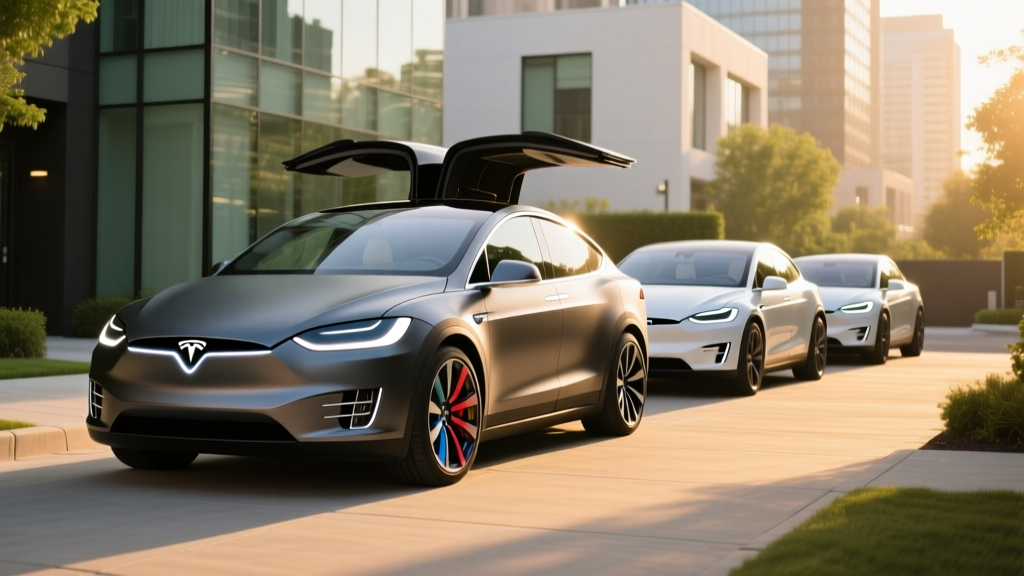
Falcon-wing doors: The signature rear doors open upward and use ultrasonic sensors to detect overhead obstacles. They're practical in tight parking spaces where conventional doors can't fully open, but they add mechanical complexity and have been a source of warranty claims over the years. In freezing rain, the doors can struggle with seal adhesion — a known cold-climate quirk.
Model X vs. Key Three-Row EV Competitors
The three-row electric SUV segment has grown considerably since the Model X launched. Here's how it compares against the most direct rivals:
| Attribute | Tesla Model X LR | Rivian R1S Dual-Motor Max | Kia EV9 GT-Line AWD |
|---|---|---|---|
| Base MSRP | $74,990 | $83,900 | $73,900 |
| EPA Range | 348 mi | 352 mi | 270 mi |
| Max DC Charge | 250 kW | 220 kW | 236 kW |
| 10–80% DCFC | ~32 min | ~36 min | ~24 min |
| Third-Row Legroom | 32.7 in | 30.4 in | 32.0 in |
| Cargo (behind 3rd) | 37.1 cu ft | 20.5 cu ft | 20.2 cu ft |
| Towing Capacity | 5,000 lbs | 7,700 lbs | 5,000 lbs |
| §30D Credit Eligible | Base only (MSRP cap) | Partial (sourcing rules) | Yes (most trims) |
The Model X wins on cargo volume and charging network access. The Rivian R1S leads in towing and off-road capability. The Kia EV9 undercuts all three on price while offering competitive charging speed and solid interior quality, though its shorter range is a trade-off.
Pros, Cons, and Who Should Buy the Model X
- Class-leading 348-mile EPA range for a three-row SUV
- Access to Tesla Supercharger network (17,000+ North American stalls)
- Massive cargo capacity (85.1 cu ft max) and usable frunk
- Strong performance even in base Long Range trim
- Over-the-air updates continuously add features
- Heat pump for efficient cold-weather cabin heating
- Most configurations exceed §30D $80K MSRP cap
- Falcon-wing doors add complexity and cold-weather risk
- Third row tight for adults on long trips
- Interior materials don't match luxury rivals at this price
- High insurance premiums (average $2,800–$3,500/yr nationally)
- 250 kW max DC charge trails some newer 350 kW-capable rivals
Consider alternatives if: You need serious towing capacity (Rivian R1S), want a lower price with the full federal credit (Kia EV9), or prioritize traditional luxury interior finishes (BMW iX, Mercedes EQB/EQS SUV).
Frequently Asked Questions
What is the real-world range of the Tesla Model X?
The EPA rates the Model X Long Range at 348 miles and the Plaid at 326 miles. In real-world highway driving at 70–75 mph, expect 280–300 miles. In freezing temperatures with cabin heat, range drops to approximately 240–270 miles. Preconditioning the battery while plugged in helps mitigate cold-weather losses.
How fast does the Model X charge at home and on the road?
On a Level 2 Tesla Wall Connector (48A/11.5 kW), the Model X adds roughly 34 miles of range per hour, fully charging overnight in 7–8 hours. On a V3 Supercharger, it peaks at 250 kW and charges from 10–80% in approximately 32 minutes, though the actual charging curve tapers significantly above 80% SoC.
Does the Model X qualify for the federal EV tax credit?
The Long Range base model at $74,990 falls under the $80,000 SUV MSRP cap, making it potentially eligible for up to $7,500 under IRS §30D. However, adding options that push the price above $80,000 disqualifies the vehicle. Buyer income caps ($300K joint / $150K single) and battery critical-mineral sourcing rules also apply. The Plaid at $89,990 does not qualify. Always verify current eligibility on irs.gov.
Is the Model X worth buying vs. the Rivian R1S or Kia EV9?
The Model X is the best choice if cargo volume, range, and Supercharger access are your top priorities. The Rivian R1S is superior for towing (7,700 lbs) and off-road use but costs more and has less cargo space. The Kia EV9 is the value pick at under $74K with full tax credit eligibility, though it gives up 78 miles of range compared to the Model X.
What are the biggest drawbacks of owning a Model X?
Insurance costs run higher than average for the segment. The falcon-wing doors, while distinctive, introduce mechanical complexity that can result in higher out-of-warranty repair costs. Interior material quality — particularly the synthetic leather and plastics — does not match the finish of similarly priced German luxury SUVs. The yoke steering wheel remains polarizing, though a round wheel is now available.
How long is the delivery wait for a new Model X?
As of early 2026, Tesla estimates 2–6 weeks for standard Model X Long Range configurations. Custom paint, wheel, and interior options can extend delivery to 6–10 weeks. Plaid availability is similar, though limited production runs can cause periodic delays. Check Tesla's website for real-time estimates in your region.