Quick Verdict: Two Very Different Tesla SUVs
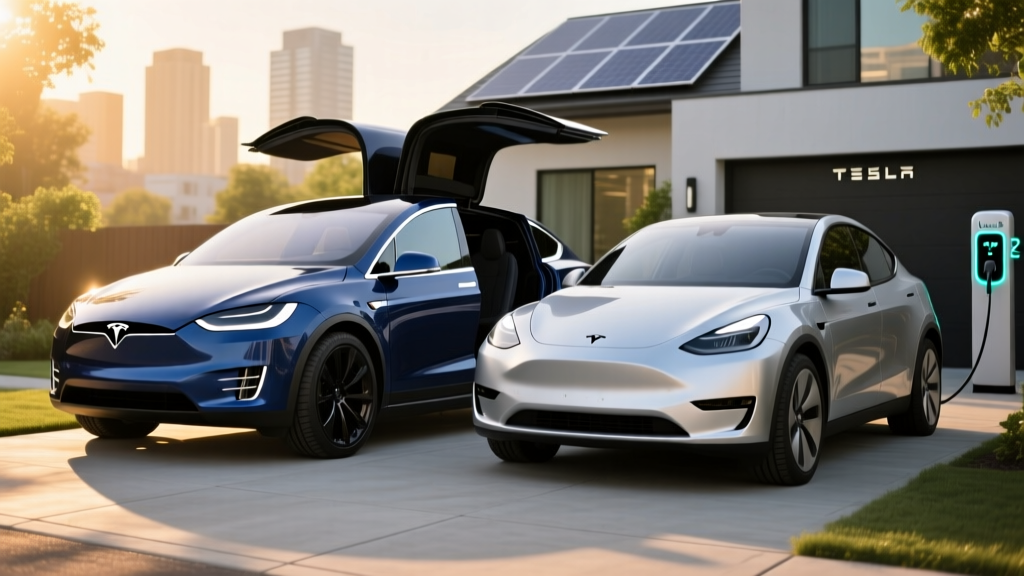
If you're cross-shopping the Tesla Model X and Y, you're really weighing two distinct ownership philosophies. The Model Y is Tesla's volume-selling compact crossover — efficient, affordable, and practical for daily commuting and small families. The Model X is a full-size luxury SUV with falcon-wing rear doors, three-row seating, and performance that embarrasses sports cars, but at roughly double the price.
Both share Tesla's Supercharger network access, over-the-air updates, and the same core software experience. But the gap in battery size, range, charging behavior, and total cost of ownership is substantial. This review breaks down every spec that matters to a real buyer in 2026.
Side-by-Side Spec Table: Model X vs Model Y (2026)
| Specification | 2026 Tesla Model Y Long Range AWD | 2026 Tesla Model X Long Range AWD |
|---|---|---|
| EPA Range | 320 miles | 335 miles |
| Battery Capacity (usable) | ~78 kWh (NMC) | ~95 kWh (NMC) |
| Drivetrain | Dual-Motor AWD | Dual-Motor AWD |
| Horsepower | 384 hp | 670 hp |
| 0–60 mph | 4.8 sec | 3.8 sec |
| Peak DC Fast Charge | 250 kW | 250 kW |
| 10–80% DC Fast Charge | ~27 min | ~30 min |
| Level 2 Charge Rate | 11.5 kW (~44 mi/hr) | 11.5 kW (~34 mi/hr) |
| MPGe (combined) | 122 MPGe | 102 MPGe |
| Efficiency | 28 kWh/100 mi | 33 kWh/100 mi |
| Cargo (behind 2nd row) | 30.2 cu ft | 37.1 cu ft |
| Max Cargo (all seats folded) | 72.1 cu ft | 85.1 cu ft |
| Seating | 5 passengers | 6 or 7 passengers |
| Base MSRP | $48,990 | $79,990 |
| As-Tested (Plaid / top trim) | $65,990 (Performance) | $94,990 (Plaid) |
| Battery Warranty | 8 yr / 120,000 mi | 8 yr / 150,000 mi |
| Basic Vehicle Warranty | 4 yr / 50,000 mi | 4 yr / 50,000 mi |
Source: fueleconomy.gov and Tesla.com specifications, 2026 model year. Figures subject to mid-year updates.
Range and Efficiency: Real-World Expectations
Model Y Long Range AWD: EPA 320 miles. Real-world highway driving at 70–75 mph yields approximately 265–285 miles. In freezing temperatures (below 32°F), expect a 20–30% reduction, dropping effective range to roughly 220–250 miles without preconditioning.
Model X Long Range AWD: EPA 335 miles. The larger, heavier SUV is more sensitive to speed and temperature. Highway real-world range sits around 270–295 miles. Cold-weather range drops to approximately 235–265 miles. The Model X's larger battery provides a bigger absolute buffer, but its aerodynamic drag coefficient (0.24 Cd) and 5,000+ lb curb weight work against it at speed.
Both vehicles use Tesla's heat pump system, which significantly reduces cabin-heating energy draw in winter compared to resistive heaters. Preconditioning the battery while plugged in — a feature both models support via the Tesla app — recovers some of the cold-weather range penalty by warming the pack before departure.
Efficiency favors the Model Y decisively. At 28 kWh/100 mi combined, the Model Y costs roughly $4.20 to travel 100 miles at the national average residential electricity rate of $0.15/kWh. The Model X at 33 kWh/100 mi costs about $4.95 for the same distance. Over 15,000 annual miles, the Model Y saves approximately $110 per year in electricity alone.
Charging Speed: DC Fast Charging and Home Level 2
Both the Model X and Model Y use the NACS (North American Charging Standard) connector natively, meaning direct access to Tesla's Supercharger network — the most reliable DC fast-charging infrastructure in the U.S. as of 2026. Neither vehicle requires an adapter for V3 or V4 Superchargers.
| Charging Level | Model Y Long Range | Model X Long Range |
|---|---|---|
| Level 1 (120V, 12A) | ~1.4 kW / ~5 mi/hr | ~1.4 kW / ~4 mi/hr |
| Level 2 (240V, 48A) | 11.5 kW / ~44 mi/hr | 11.5 kW / ~34 mi/hr |
| DC Fast Charge (peak) | 250 kW | 250 kW |
| DC 10–80% Time | ~27 minutes | ~30 minutes |
| DC 15-min Range Added (peak) | ~162 miles | ~145 miles |
Understanding the charge curve: Both vehicles peak at 250 kW, but that peak is sustained only between roughly 10–30% state of charge (SoC). Above 50%, the charge rate tapers significantly — by 80%, both vehicles are pulling under 60 kW. This is why Tesla (and the industry) quotes 10–80% times rather than 0–100%. Charging from 80–100% can add another 25–35 minutes and is best reserved for destination Level 2 charging.
At home on a Level 2 wall connector (48 amps / 11.5 kW), the Model Y adds roughly 44 miles of range per hour of charging — enough to fully replenish overnight in about 7 hours. The Model X, with its larger 95 kWh battery and lower efficiency, adds only about 34 miles per hour and needs roughly 8.5 hours for a full charge. Most owners charge nightly from partial states, so a full charge cycle is rarely needed.
Home installation note: A 48-amp Level 2 charger requires a dedicated 60-amp circuit. Installation costs range from $500 to $2,500 depending on panel proximity and local permitting. Older homes with 100-amp main panels may require a $1,500–$3,000 panel upgrade. Always consult a licensed electrician for final specifications.
Performance and Driving Dynamics
The Model X Long Range produces 670 horsepower from its dual-motor all-wheel-drive powertrain, launching to 60 mph in 3.8 seconds — remarkable for a 5,185-lb three-row SUV. The Model X Plaid variant (1,020 hp, tri-motor) drops that to 2.5 seconds, though it adds roughly $15,000 to the price.
The Model Y Long Range delivers 384 hp and a 4.8-second 0–60 time, which is brisk for a compact crossover. The Performance trim cuts it to 3.5 seconds with 456 hp. For most buyers, the Long Range variant's acceleration is more than adequate for highway merging and passing.
Both vehicles feature adaptive air suspension on the Model X (standard) and conventional coil springs on the Model Y. The Model X's air suspension provides adjustable ride height — useful for clearing steep driveways or lowering at highway speeds for efficiency. The Model Y's ride quality has improved with the 2025 Juniper refresh, with better damping and reduced cabin noise, but it still trades some comfort for sportiness.
Driver assistance: Both models come with Tesla's Basic Autopilot (lane centering, adaptive cruise control). Full Self-Driving (Supervised) is an optional $8,000 add-on or $99/month subscription.
SAE Automation Level: Level 2. Tesla Autopilot and FSD (Supervised) are Level 2 driver-assistance systems. The driver must remain attentive, keep hands available, and be prepared to take over at any moment. These systems are not self-driving. Only Level 4 services like Waymo operate without a human driver — and only in geofenced areas.
Interior, Cargo, and Technology
Model Y: The cabin is minimalist — a single 15.4-inch touchscreen controls nearly every function. The Juniper redesign (introduced 2025) added ambient lighting, ventilated front seats, a rear-seat touchscreen, and improved sound insulation. Cargo space is 30.2 cu ft behind the second row and 72.1 cu ft with seats folded. A small front trunk (frunk) adds 4.1 cu ft for charging cables or a laptop bag. Legroom is generous for a compact SUV: 41.8 inches front, 37.4 inches rear.
Model X: The Model X offers a 17-inch center touchscreen tilted toward the driver, plus a second-row 8-inch display for rear passengers. Seating configurations include 5-, 6-, and 7-passenger layouts. The signature falcon-wing rear doors open vertically, making child-seat installation and third-row access easier in tight parking spaces — though they can be slow to operate and have historically been a reliability concern. Cargo volume is 37.1 cu ft behind the second row and 85.1 cu ft maximum. The frunk is larger at 6.6 cu ft.
Infotainment and connectivity: Both vehicles run Tesla's proprietary software with built-in navigation, streaming (Netflix, YouTube, Spotify while parked), Sentry Mode dashcam recording, and over-the-air updates that regularly add features. Neither supports Apple CarPlay or Android Auto — a deliberate Tesla choice that frustrates some buyers. Phone-as-key via Bluetooth is standard, and both vehicles support Tesla's mobile app for remote preconditioning, charging monitoring, and location tracking.
Pricing, Trims, and Federal Tax Credit Eligibility
| Trim | Base MSRP | Est. Federal Credit (§30D) | Effective Price |
|---|---|---|---|
| Model Y Long Range AWD | $48,990 | Up to $7,500* | ~$41,490* |
| Model Y Performance AWD | $52,490 | Up to $7,500* | ~$44,990* |
| Model X Long Range AWD | $79,990 | Up to $7,500* | ~$72,490* |
| Model X Plaid (tri-motor) | $94,990 | Up to $7,500* | ~$87,490* |
*Critical tax credit caveats: The federal §30D EV tax credit is subject to multiple eligibility requirements that change frequently. As of 2026, per IRS guidelines:
- MSRP Cap: SUVs, vans, and pickup trucks must have an MSRP at or below $80,000. The Model Y (all trims) qualifies. The Model X Long Range ($79,990) qualifies. The Model X Plaid ($94,990) exceeds the cap and is ineligible.
- Buyer Income Limits: Modified adjusted gross income must not exceed $300,000 (joint filers), $225,000 (head of household), or $150,000 (single filers).
- Battery Component & Critical Mineral Sourcing: The credit is split into two halves ($3,750 each) based on battery component manufacturing and critical mineral sourcing requirements. Vehicles that meet only one set of requirements receive a partial $3,750 credit. Tesla's U.S.-built battery packs have generally met full requirements, but sourcing rules tighten annually — verify current-year eligibility at fueleconomy.gov before purchasing.
- Point-of-Sale Transfer: As of 2024, buyers can transfer the credit to the dealer at the point of sale, reducing the purchase price directly rather than waiting for a tax refund. This effectively functions as an instant discount.
Tax credit rules are subject to change. Consult a tax professional and verify eligibility at the time of purchase. State incentives (e.g., California's CVRP, Colorado's tax credit) may provide additional savings but vary by jurisdiction.
Pros and Cons: Model X vs Model Y
Model Y — Pros
- Best-in-class efficiency (122 MPGe combined)
- Sub-$50K price before tax credits
- Strong Supercharger network access (NACS native)
- Excellent cargo space for its footprint (72.1 cu ft max)
- Low operating costs (~$0.042/mile electricity)
- Juniper refresh improved ride and cabin quietness
Model X — Pros
- Three-row seating (6 or 7 passengers)
- Supercar-level acceleration (3.8 sec 0–60, 2.5 sec Plaid)
- Falcon-wing doors aid child-seat and third-row access
- Air suspension standard — adjustable ride height
- Maximum cargo volume (85.1 cu ft) exceeds most luxury SUVs
- Longer battery warranty (8 yr / 150,000 mi)
Model Y — Cons
- No third-row option
- Coil-spring ride can be firm on rough pavement
- No Apple CarPlay or Android Auto
- High insurance premiums relative to MSRP
- Build quality inconsistencies still reported
Model X — Cons
- Plaid trim exceeds $80K MSRP cap — no federal credit
- Falcon-wing doors historically unreliable; slow to open
- High purchase price ($80K+ before options)
- Lower efficiency (102 MPGe) increases per-mile cost
- Large footprint challenging in tight urban garages
- Insurance among the highest of any EV
Who Should Buy Which Tesla SUV?
Choose the Model Y if: You're a commuter or small family (1–2 children) prioritizing efficiency, affordability, and daily practicality. The Model Y is the best-selling EV in the U.S. for good reason — it covers 90% of use cases at a price that leaves room in the budget for a home Level 2 charger installation. It's also the clear pick if you want to maximize federal tax credit savings.
Choose the Model X if: You need three-row seating for larger families, regularly tow (up to 5,000 lbs), or want a luxury-performance SUV that doubles as a status symbol. The Model X makes sense for road-trippers who value the larger battery's absolute range buffer and air suspension comfort. Budget accordingly — total cost of ownership is significantly higher.
Competitor Comparison: How Do They Stack Up?
Model Y competitors: The Hyundai Ioniq 5 (310 mi range, ~$45K) offers 800V ultra-fast charging and a more conventional interior. The Ford Mustang Mach-E (320 mi extended range, ~$43K) provides a sportier driving feel. The Kia EV6 (310 mi, ~$44K) matches Ioniq 5's charging hardware. However, none match the Model Y's combination of Supercharger access, efficiency, and OTA software updates.
Model X competitors: The BMW iX xDrive50 (~320 mi, ~$87K) offers a more traditional luxury interior and superior build quality. The Rivian R1S (352 mi max, ~$80K) provides genuine off-road capability and a more adventure-oriented design. The Mercedes EQS SUV (~305 mi, ~$105K) is more opulent but less efficient. The Model X's acceleration and Supercharger integration remain advantages, but competitors have closed the gap on interior refinement.
Ownership Costs and Long-Term Value
Over five years and 75,000 miles, the Model Y Long Range costs approximately $52,000 to own (including depreciation, electricity, insurance, maintenance, and tax credit), according to industry estimates. The Model X Long Range runs closer to $85,000 over the same period. The gap is driven primarily by higher purchase price, insurance premiums (averaging $2,800–$3,500/year for the Model X vs. $1,800–$2,400/year for the Model Y), and lower efficiency.
Battery longevity: Both vehicles use NMC (nickel manganese cobalt) lithium-ion battery packs. Tesla's battery management system is among the industry's best, and real-world degradation data from high-mileage owners shows approximately 8–12% capacity loss over 100,000 miles. The Model X's battery warranty covers 8 years or 150,000 miles (whichever comes first) with a minimum 70% capacity retention threshold. The Model Y's warranty covers 8 years or 120,000 miles at the same 70% threshold. Battery replacement outside warranty, if ever needed, is estimated at $12,000–$18,000 for the Model Y and $15,000–$22,000 for the Model X, based on current service pricing.
Maintenance: EVs eliminate oil changes, spark plugs, and transmission fluid. Both models require cabin air filter replacement (~$150–$250 every 2–3 years), tire rotation, and brake fluid checks. Regenerative braking significantly extends brake pad life — many Tesla owners report original brake pads lasting 80,000+ miles. The single biggest maintenance expense is tire replacement, which typically runs $800–$1,500 for a set of four every 25,000–40,000 miles due to the instant torque wearing tires faster than ICE vehicles.
Frequently Asked Questions
What is the real-world range of the Tesla Model Y and Model X?
The Model Y Long Range AWD delivers an EPA-estimated 320 miles, but expect 265–285 miles in real-world highway driving and 220–250 miles in freezing temperatures. The Model X Long Range AWD is rated at 335 miles EPA, with real-world highway range around 270–295 miles and cold-weather range of approximately 235–265 miles. Preconditioning while plugged in helps recover cold-weather losses.
How fast do the Model X and Model Y charge?
Both vehicles peak at 250 kW on DC fast chargers (Tesla Superchargers). A 10–80% charge takes approximately 27 minutes for the Model Y and 30 minutes for the Model X. At home on a Level 2 charger (11.5 kW / 48 amps), the Model Y adds about 44 miles per hour and the Model X adds about 34 miles per hour. Full overnight charges take 7–8.5 hours respectively.
Does the Tesla Model X qualify for the $7,500 federal EV tax credit?
The Model X Long Range ($79,990 MSRP) qualifies for the full §30D credit, assuming the buyer meets income limits and the battery meets sourcing requirements. The Model X Plaid ($94,990 MSRP) exceeds the $80,000 SUV MSRP cap and is ineligible. The Model Y (all trims under $53K) qualifies across the board. Always verify current eligibility at irs.gov and consult a tax professional.
Is the Tesla Model Y worth buying over competitors?
The Model Y remains the default recommendation for most EV buyers due to its unmatched combination of range, efficiency, Supercharger network access, and software ecosystem. Competitors like the Hyundai Ioniq 5 offer faster DC charging speeds and more conventional interiors, but Tesla's integrated charging infrastructure and OTA updates give it a practical edge for road-trippers and tech-forward buyers.
What are the biggest drawbacks of the Model X?
The Model X's primary drawbacks are its high purchase price, the Plaid trim's tax-credit ineligibility, historically questionable falcon-wing door reliability, lower efficiency compared to the Model Y, and some of the highest insurance premiums in the EV market. It excels as a three-row luxury performance SUV, but the total cost of ownership is steep.
Can I tow with the Model Y or Model X?
The Model Y has a maximum towing capacity of 3,500 lbs when equipped with the optional tow hitch. The Model X can tow up to 5,000 lbs. Towing significantly reduces range — expect a 30–50% reduction depending on trailer weight, speed, and terrain. Neither vehicle is ideal for heavy towing, but both handle light utility trailers and small boat trailers competently.