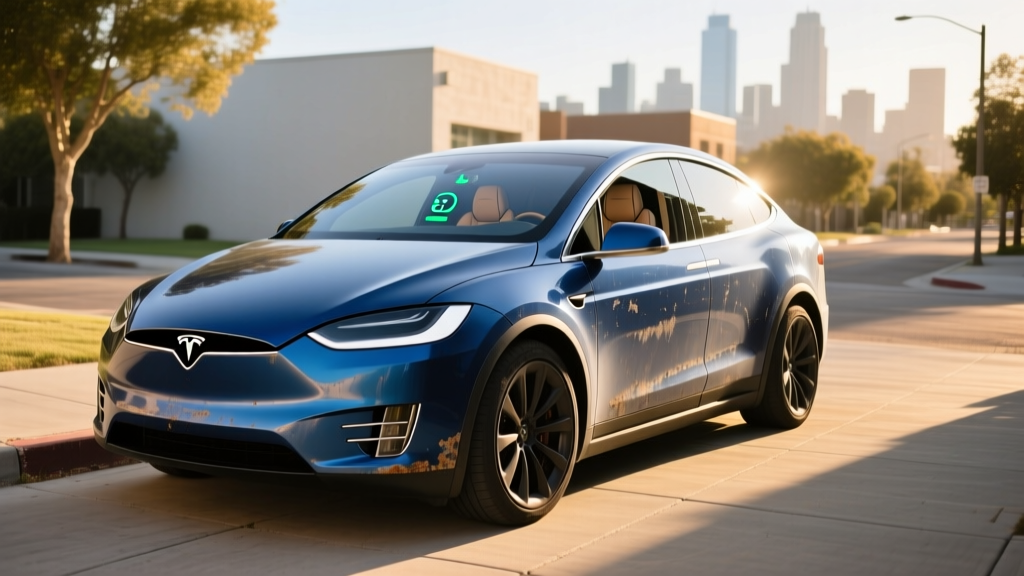
The Tesla Model X 90D occupies a specific niche in the used electric-vehicle market: a three-row luxury SUV with falcon-wing doors, standard all-wheel drive, and a 90 kWh battery pack that Tesla built between 2015 and 2017. If you are shopping for one in 2026, you are almost certainly looking at the pre-owned market — Tesla discontinued the 90D variant years ago in favor of Long Range and Plaid trims. But discontinued does not mean irrelevant. With used examples frequently listing between $22,000 and $38,000 depending on mileage and battery health, the Model X 90D can be a compelling family hauler if you understand exactly what you are buying.
This review breaks down the real-world range you can expect from an aging 90 kWh pack, the charging speeds that still hold up on road trips, the tax-credit path available through the used-EV provision, and the ownership costs that catch first-time Tesla buyers off guard. Let's get into the numbers.
Range, Efficiency, and the Real-World Reality of a 90 kWh Pack
The EPA rated the 2016–2017 Model X 90D at 257 miles of combined range when new. That figure was always on the conservative side for a vehicle of this size, but it also assumed a brand-new battery at full health. In 2026, every surviving 90D has between 60,000 and 150,000+ miles on the odometer, and the NMC (nickel-manganese-cobalt) battery chemistry in these packs has aged accordingly.
Real-World Expectation (2026 Used, ~85% SoH): 200–220 miles combined
Highway at 75 mph: ~180–200 miles (aerodynamic drag penalizes the Model X's 2.46 Cd less than boxier SUVs, but 5,000+ lbs still costs you)
Cold Weather (below 32°F): ~155–175 miles — NMC chemistry loses 20–30% range in freezing temps without preconditioning
City / Moderate Climate: 210–230 miles — regenerative braking recovers energy in stop-and-go driving
Efficiency lands around 89 MPGe combined (EPA) or roughly 38 kWh per 100 miles. That is not class-leading — the newer Model X Long Range achieves closer to 102 MPGe thanks in part to the heat pump Tesla added for the 2021 refresh. The 90D relies on resistive cabin heating, which is a significant range drain in winter. If you live in the northern US, budget for a noticeable range hit from November through March.
Battery Chemistry, Degradation, and State of Health
The Model X 90D uses a 90 kWh NMC lithium-ion battery (approximately 83.5 kWh usable, with the rest reserved as a top-and-bottom buffer to protect longevity). NMC chemistry offers higher energy density than the LFP (lithium iron phosphate) packs Tesla uses in current base Model 3 and Model Y vehicles, but it degrades faster under two conditions: sustained high state-of-charge storage and repeated DC fast charging to 100%.
Based on aggregated owner data and third-party battery health reports, here is what degradation looks like for the 90 kWh pack:
| Milestone | Typical Capacity Retention | Estimated Range at Retention |
|---|---|---|
| New (0 mi) | 100% | 257 mi |
| 50,000 mi | ~92–95% | 235–245 mi |
| 100,000 mi | ~85–90% | 218–231 mi |
| 150,000 mi | ~80–85% | 205–218 mi |
| 200,000 mi | ~75–82% | 192–210 mi |
The critical number: Tesla's battery warranty covers 8 years or 150,000 miles (whichever comes first) with a minimum 70% capacity retention threshold. For a 2016 Model X 90D, the 8-year warranty expired in 2024. A 2017 model's warranty lapses in 2025. This means that as a 2026 buyer, you are purchasing the battery as-is unless you negotiate an extended warranty through Tesla or a third party. Always request a battery health report (accessible through the car's service menu or a Tesla Service Center diagnostic) before committing.
Charging Speeds: Supercharger Compatibility and Home Setup
The Model X 90D supports DC fast charging via Tesla's proprietary connector (now officially designated NACS — North American Charging Standard). Here are the numbers that matter for trip planning and daily use:
| Charging Level | Max Rate | Practical Speed | Notes |
|---|---|---|---|
| Level 1 (120V household) | ~1.4 kW | ~3–4 mi/hr | Emergency/trickle only; adds ~40 mi overnight |
| Level 2 (240V home, 48A) | ~11.5 kW | ~30–34 mi/hr | Full charge in ~8 hours; ideal daily solution |
| Level 2 (240V home, 32A) | ~7.7 kW | ~20–23 mi/hr | Common with mobile connector + NEMA 14-50 |
| DC Fast (V2 Supercharger) | Peak ~120 kW | 10–80% in ~40 min | Charge curve tapers hard above 60% SoC |
| DC Fast (V3 Supercharger) | Capped ~120 kW | 10–80% in ~40 min | 90D cannot accept V3's 250 kW peak — older pack architecture limits throughput |
The key takeaway for road-trip planning: the 90D's charge curve is not flat. It pulls close to peak rate (100–120 kW) between roughly 10% and 50% state of charge, then tapers to 60–70 kW through 80%, and drops further above that. Plan your Supercharger stops around the 20–80% window for the fastest experience. Charging from 80–100% at a Supercharger adds 25+ minutes for only ~40 miles of range — not worth the time on a road trip.
For home charging, the 90D's onboard charger supports up to 48 amps (11.5 kW) on a hardwired Level 2 circuit. Most owners install a Tesla Wall Connector on a 60-amp breaker. Expect installation costs between $800 and $2,500 depending on whether your electrical panel needs an upgrade to support a dedicated 60A circuit. Always get a quote from a licensed electrician before purchasing equipment.
Performance, Drivetrain, and What Dual-Motor AWD Delivers
The "D" in 90D stands for dual-motor — one AC induction motor on each axle, providing full-time all-wheel drive. This is not a performance-oriented variant (that would be the P90D with Ludicrous mode), but the 90D is far from slow:
- 0–60 mph: 4.8 seconds (Tesla estimate)
- Horsepower: ~417 hp combined (259 hp front motor + 259 hp rear motor, system-limited)
- Torque: ~487 lb-ft combined
- Drivetrain: Dual-motor AWD, single-speed reduction gear
- Curb weight: ~5,271 lbs
- Towing capacity: 5,000 lbs (with tow package)
That 4.8-second 0–60 time puts the 90D ahead of most gas-powered three-row SUVs from the same era, and the instant electric torque makes highway merging effortless. The adaptive air suspension (standard on all Model X variants) adjusts ride height automatically — it lowers at speed for aerodynamics and raises for clearance on rough roads or snow. However, air suspension repairs on high-mileage examples are a known cost point: budget $1,500–$3,000 per corner if struts fail outside warranty.
Interior Space, Cargo, and Family Practicality
The Model X 90D was offered in five-seat, six-seat (with second-row captain's chairs), and seven-seat configurations. Cargo volume depends heavily on seating layout:
| Configuration | Behind 3rd Row | Behind 2nd Row | Max (Seats Folded) |
|---|---|---|---|
| 5-seat | N/A | ~58.1 cu ft | ~83.1 cu ft (with front folded) |
| 6-seat | ~12.8 cu ft | ~44.2 cu ft | ~76.5 cu ft |
| 7-seat | ~12.8 cu ft | ~44.2 cu ft | ~76.5 cu ft |
The front trunk (frunk) adds approximately 6.6 cu ft of sealed storage — useful for charging cables or a small cooler. Second-row legroom measures about 38.4 inches, and third-row legroom is 32.7 inches — adequate for children on longer trips but tight for adults beyond 30-minute rides.
The falcon-wing rear doors are the Model X's signature feature. They open vertically with articulating hinges, making car-seat installation and third-row access easier in tight parking spaces than conventional doors. They also draw attention everywhere. The trade-off: they are mechanically complex, and repair costs for hinge motors, sensors, or seal replacements are significant. Verify smooth, rattle-free operation during a test drive.
Pricing, Tax Credit Eligibility, and Total Cost of Ownership
Since the Model X 90D is only available on the used market in 2026, the relevant tax credit is the §25E Previously Owned Clean Vehicle Credit, not the new-vehicle §30D credit. Here is how the economics break down:
| Factor | Amount / Detail |
|---|---|
| Used Market Price Range (2026) | $22,000–$38,000 depending on mileage, condition, battery SoH |
| §25E Used EV Tax Credit | Up to $4,000 (30% of sale price, capped at $4,000) |
| Vehicle Price Cap (§25E) | Sale price must be $25,000 or less to qualify |
| Buyer Income Cap (§25E) | $75,000 single / $112,500 HOH / $150,000 MFJ (modified AGI) |
| Dealer Requirement | Must purchase from a licensed dealer (private-party sales do not qualify) |
| Effective Price After Credit (qualifying example) | $25,000 sale → $21,000 net after $4,000 credit |
Critical caveat: The §25E credit has a strict $25,000 sale price cap. Many Model X 90D examples list above this threshold. If you find a dealer willing to sell at or below $25,000 — more likely on higher-mileage examples (100,000+ miles) or those with cosmetic issues — and your income falls within the caps, the $4,000 credit is available as a point-of-sale reduction or a tax-time claim. Verify current-year rules at IRS.gov's used vehicle credit page before relying on eligibility, as legislation can modify these thresholds.
For total cost of ownership, plan for these ongoing expenses beyond the purchase price:
- Insurance: $2,400–$4,000/year depending on state, driving record, and coverage level (Model X insurance is above average due to repair costs)
- Electricity (home charging): ~$0.13/kWh national average × 38 kWh/100mi = ~$0.049/mile, or about $590/year for 12,000 miles
- Maintenance: No oil changes or spark plugs, but budget $800–$1,500/year for tires (the Model X is heavy and eats tires), cabin air filters, brake fluid checks, and wiper fluid
- Potential repairs: Air suspension, falcon-wing door mechanisms, MCU (media control unit) upgrades, and drive unit replacements are the common big-ticket items on 90D models past 80,000 miles
Tech, Driver Assistance, and Notable Drawbacks
The 2016–2017 Model X 90D originally shipped with a 17-inch touchscreen running Tesla's proprietary infotainment OS, Autopilot basic functionality (adaptive cruise control + lane-keeping), and over-the-air software updates. Several tech notes for 2026 buyers:
- MCU1 vs MCU2: Early 90D models shipped with MCU1 (NVIDIA Tegra 3), which is noticeably sluggish by modern standards and no longer receives full software feature updates. Tesla offered an MCU2 upgrade (Intel Atom) for ~$2,000 that brings faster performance, updated maps, and better media support. Confirm whether the vehicle you are evaluating has had this upgrade.
- Autopilot: Basic Autopilot (Traffic-Aware Cruise Control + Autosteer) is a SAE Level 2 driver-assistance system — you must keep your hands on the wheel and eyes on the road. Full Self-Driving (FSD) capability was an expensive add-on; most used 90D examples do not have it, and those that do carry FSD as a non-transferable license in many cases.
- No heat pump: The 90D uses resistive electric heating for the cabin, which draws significantly more energy than the heat pump Tesla introduced in later models. This directly impacts winter range.
- Build quality: Early Model X production is known for panel-gap inconsistencies, interior rattles, and water ingress around the falcon-wing doors. Inspect carefully or hire a pre-purchase inspector familiar with Teslas.
- Spacious three-row SUV with usable frunk and flexible seating
- Standard dual-motor AWD with confident traction in rain and snow
- Access to Tesla Supercharger network (20,000+ stations in North America)
- Air suspension adjusts ride height for clearance or efficiency
- Strong 0–60 performance (4.8s) for a 5,200+ lb family vehicle
- 5,000-lb towing capacity with tow package
- Over-the-air updates still add incremental improvements
- Battery warranty has expired on all 90D examples — out-of-pocket replacement risk ($14,000–$20,000)
- Real-world range of ~200 mi falls short for long road trips without planning
- DC fast charging capped at ~120 kW — slower than modern EVs at V3/V4 Superchargers
- Falcon-wing doors are expensive to repair and prone to sensor issues
- No heat pump — significant winter range loss in cold climates
- MCU1 infotainment is outdated unless upgraded to MCU2
- Insurance premiums above segment average
Who Should Buy the Model X 90D in 2026?
- You need three rows and AWD for under $30,000 and can accept a ~200-mile real-world range
- You have reliable home Level 2 charging and your daily commute is under 80 miles round-trip
- You value Supercharger network access for occasional road trips
- You can budget $2,000–$5,000 for potential repairs in the first year (suspension, doors, MCU)
- You find an example with documented battery health above 85% SoH
- You regularly drive more than 200 miles in a day and cannot stop to charge
- You live in a very cold climate and need maximum winter range (consider a newer EV with a heat pump)
- You want a warranty-backed battery — the 90D's coverage has expired
- You prioritize low insurance costs or minimal repair risk
Frequently Asked Questions
What is the real-world range of a used Tesla Model X 90D?
Expect 200–220 miles combined with a battery at roughly 85% state of health. Highway driving at 75 mph drops that to 180–200 miles, and cold weather (below freezing) can push it down to 155–175 miles. Always verify the specific vehicle's battery health before purchase.
How fast does the Model X 90D charge at home and on the road?
At home on a 48-amp Level 2 charger, the 90D adds about 30–34 miles of range per hour, fully recharging overnight in roughly 8 hours. On a DC fast charger (V2 or V3 Supercharger), it peaks at approximately 120 kW, achieving a 10–80% charge in about 40 minutes. The 90D cannot take advantage of V3 Supercharger peak speeds (250 kW) due to its older battery architecture.
Does the Tesla Model X 90D qualify for any federal tax credit?
Not the new-vehicle §30D credit — the 90D is only available used. However, it may qualify for the §25E Previously Owned Clean Vehicle Credit, which offers up to $4,000 (30% of the sale price). To qualify, the sale price must be $25,000 or less, you must buy from a licensed dealer, and your modified adjusted gross income must fall below $75,000 (single), $112,500 (head of household), or $150,000 (married filing jointly). Check current rules at IRS.gov.
How much does a battery replacement cost if the 90D pack fails?
Out-of-warranty battery replacements for the 90 kWh pack typically range from $14,000 to $20,000 including labor at a Tesla Service Center. Third-party EV repair shops may offer refurbished packs for $10,000–$14,000. This is the single biggest financial risk of buying any used Model X outside of warranty.
Is the Model X 90D worth buying vs. competitors like the Jaguar I-PACE or Audi e-tron?
It depends on priorities. The 90D offers more interior space (three rows vs. two in the I-PACE), Supercharger access, and a larger usable battery than the original e-tron (which EPA-rated at 204 miles). However, the I-PACE and e-tron have more conventional doors (no falcon-wing repair risk), better interior materials, and in some cases remaining CPO warranties. If three-row seating and Supercharger infrastructure matter most, the 90D wins. If build quality and warranty peace of mind are higher priorities, explore certified pre-owned alternatives.
Can the Model X 90D tow, and how does towing affect range?
Yes — with the factory tow package, the 90D is rated for 5,000 lbs. Towing at or near maximum capacity typically cuts range by 40–50%, so plan for roughly 100–120 miles between charges when pulling a loaded trailer. Precondition the battery before Supercharger stops to maintain charge speed.
The Tesla Model X 90D is not the most efficient or worry-free EV you can buy in 2026. But for a buyer who needs three rows, AWD, and Supercharger access on a sub-$30,000 budget — and who approaches the purchase with eyes open about battery health and repair costs — it remains one of the most capable used electric SUVs on the market. Get a pre-purchase inspection, verify battery SoH, and run the numbers on your specific commute before signing.