Quick Verdict: A Used EV Bargain With Falcon-Wing Quirks
The Tesla Model X 75D was produced from roughly 2017 through 2019, and by 2026 it has become one of the most accessible entry points into the used luxury electric SUV market. With a 75 kWh (usable) NMC battery pack, dual-motor all-wheel drive, and seating for up to seven, the 75D offers practical family hauling at a fraction of its original $80,000+ MSRP. But as a used EV purchase, the 75D demands careful scrutiny: battery degradation, outdated charging hardware, and the realities of a 237-mile EPA range mean this isn't a plug-and-play upgrade for every buyer.
If you're cross-shopping used electric SUVs — perhaps a Model X 75D versus a used Audi e-tron or Jaguar I-PACE — this profile gives you the exact numbers and ownership context you need to decide.
Tesla Model X 75D Specifications at a Glance
| Specification | Value |
|---|---|
| Battery Capacity (Usable) | ~75 kWh (NMC chemistry) |
| EPA Estimated Range | 237 miles |
| Drivetrain | Dual-Motor AWD |
| Horsepower | ~328 hp (combined) |
| 0-60 mph | 5.2 seconds |
| Top Speed | 130 mph |
| MPGe (Combined) | 93 MPGe |
| Efficiency | 36 kWh/100 mi |
| Max DC Fast Charge Rate | ~120 kW (peak) |
| 10-80% DC Fast Charge | ~40-45 minutes |
| Level 2 Home Charging | 11.5 kW (48A) / ~29 mi/hr |
| Cargo Volume (behind 2nd row) | 26.6 cu ft |
| Cargo Volume (max, seats folded) | 70.9 cu ft |
| Seating Capacity | 5, 6, or 7 passengers |
| Battery Warranty (original) | 8 years / 150,000 miles |
| Original Base MSRP (2018) | ~$79,500 (before incentives) |
| Typical Used Price (2026) | $28,000 – $38,000 |
Real-World Range: What 237 EPA Miles Actually Means
EPA Sticker: 237 miles (combined cycle)
Real-World Highway (70-75 mph, moderate temps): ~190-210 miles
Real-World Cold Weather (below 32°F, highway): ~150-175 miles
City / Commuter Driving (regen-heavy): ~220-240 miles
The EPA's 237-mile figure for the Model X 75D was respectable when it launched, but in 2026 it trails newer electric SUVs significantly. More importantly, real-world highway driving at sustained speeds typically yields 190 to 210 miles before you're hunting for a charger. The Model X's large frontal area and heavy curb weight (~5,070 lbs) work against efficiency at highway velocities.
Cold weather is the bigger concern. The 75D predates Tesla's heat-pump architecture (introduced with the Model Y and later refreshed Model S/X), relying instead on resistive cabin heating. In sub-freezing temperatures, expect a 25-35% range reduction. A 237-mile rated battery delivering 160 miles on a cold January highway run is a real scenario, not a worst-case exaggeration.
For context on how this compares to current EPA ratings across the EV market, fueleconomy.gov provides side-by-side efficiency data for the Model X across model years.
Degradation factor: Because the 75D is now 6-9 years old, battery degradation is a real variable. Most 75D packs show 8-15% capacity loss depending on charging habits and climate. A 75D with 12% degradation effectively has ~66 kWh of usable capacity, reducing real-world range proportionally. Always request a State of Health (SoH) reading or use Tesla's in-car range display at 100% charge to estimate remaining capacity before purchasing.
Charging Speeds: The 75D's Biggest 2026 Limitation
| Charging Level | Power / Rate | Miles Added per Hour | Notes |
|---|---|---|---|
| Level 1 (120V household) | ~1.4 kW | ~3-4 mi/hr | Emergency / trickle only |
| Level 2 (240V, 48A) | 11.5 kW | ~29 mi/hr | Full charge in ~7-8 hours |
| DC Fast Charge (Tesla Supercharger V2) | ~120 kW peak | Up to ~250 mi/hr (peak) | 10-80% in ~40-45 min |
| DC Fast Charge (Supercharger V3/V4) | ~120 kW (vehicle-limited) | Same as V2 for this vehicle | V3/V4 stalls won't deliver 250 kW to a 75D |
The Model X 75D uses Tesla's proprietary connector (now being phased in favor of NACS standardization, though the physical connector is identical — NACS is the Tesla connector). The 75D's onboard charge architecture tops out around 120 kW on DC fast charging. Plugging into a 250 kW V3 Supercharger won't damage anything, but the vehicle will only accept its maximum rate.
The charge curve matters here. The 75D sustains roughly 90-120 kW between 10% and 50% State of Charge, then tapers progressively. From 50% to 80%, you're looking at 60-80 kW, and above 80% the rate drops sharply to protect the NMC cells. A realistic 10-80% session takes 40 to 45 minutes at a V2 or V3 Supercharger.
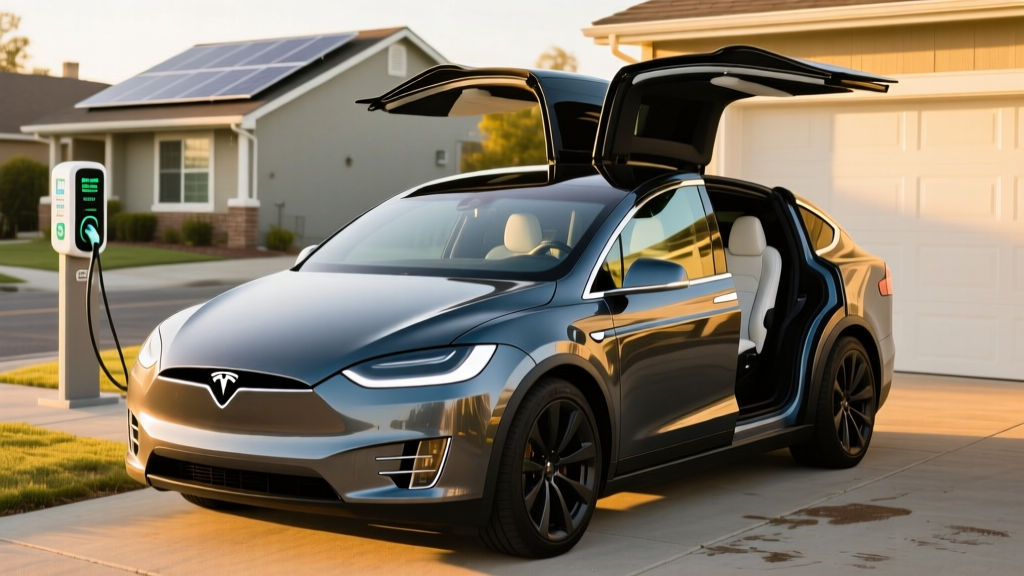
For home charging, the 75D's 11.5 kW onboard charger is excellent — a Wall Connector on a 60-amp circuit delivers roughly 29 miles of range per hour, meaning a depleted battery fully replenishes overnight in about 7-8 hours. This is one area where the 75D still holds up well against newer EVs.
CCS adapter note: Tesla's CCS adapter allows the 75D to access non-Tesla DC fast-charging networks (Electrify America, EVgo, etc.) at reduced speeds, typically 50-80 kW due to adapter protocol limitations. Plan road trips around Superchargers when possible for optimal charge speed.
Performance and Driving Dynamics
The dual-motor AWD powertrain in the 75D produces approximately 328 combined horsepower, launching this 5,070-pound SUV to 60 mph in 5.2 seconds. That's brisk by any measure, though it feels less urgent than the 3.2-second P100D variant or the current Model X Plaid's sub-2.5-second sprint.
What the 75D sacrifices in straight-line drama, it makes up in daily usability. The regenerative braking system is strong enough for genuine one-pedal driving in most conditions, reducing brake wear significantly. The air suspension provides adjustable ride height — useful for scraping over snow drifts or lowering for highway efficiency — and the adaptive dampers keep the heavy chassis surprisingly composed through corners.
Steering feel remains a Tesla hallmark: precise, quick-ratio, but somewhat numb at the limit. The 75D rides on 20-inch wheels as standard (22-inch optional), and the larger wheels noticeably degrade ride quality on rough pavement. If you're buying used, prioritize a 20-inch-equipped example for better comfort and cheaper tire replacements.
Interior, Cargo, and Technology
The pre-refresh Model X interior (2017-2019 era) divides opinion. The minimalist dashboard centers on a 17-inch portrait touchscreen that controls virtually every vehicle function. Build quality on these early Model X vehicles is inconsistent — panel gaps, rattling trim, and early-production seal issues are well-documented. Tesla improved assembly quality progressively, so a 2019 model year 75D is generally better built than a 2017.
Seating configurations:
- 5-seat: Standard second-row bench, maximum cargo flexibility
- 6-seat: Individual second-row captain's chairs with center pass-through
- 7-seat: Adds a small third row — usable for children only, with just 26.6 cu ft of cargo behind the second row
Cargo volume reaches 70.9 cu ft with both rear rows folded — competitive with midsize luxury SUVs. The front trunk (frunk) adds roughly 5.3 cu ft of sealed storage, useful for charging cables or groceries.
Notable tech features:
- Autopilot basic functionality (Traffic-Aware Cruise Control, Autosteer) — SAE Level 2, requires active driver supervision
- Enhanced Autopilot / Full Self-Driving Capability (optional, $3,000-$8,000 when purchased) — still Level 2, not autonomous
- Over-the-air software updates (the 75D continues to receive Tesla OTA updates in 2026, though some newer features are hardware-limited by the older MCU1 or MCU2 infotainment computer)
- Falcon Wing rear doors — dramatic but mechanically complex; inspect seal condition and hinge operation carefully on any used example
- HEPA air filtration with "Bioweapon Defense Mode" — genuinely effective cabin air quality system
Autopilot / FSD Reminder: The Model X 75D's Autopilot and optional FSD Capability are SAE Level 2 driver-assistance systems. They do not make the vehicle self-driving. You must keep your hands on the wheel and eyes on the road at all times. Tesla's marketing terminology has historically caused confusion, but the legal and safety reality is unambiguous: the driver is responsible.
Used Pricing, Tax Credits, and Ownership Costs
| Cost Factor | Amount |
|---|---|
| Original MSRP (2018 75D) | ~$79,500 |
| Typical Used Price (2026, 60k-90k miles) | $28,000 – $38,000 |
| Federal Used EV Tax Credit (§25E) | Up to $4,000 (30% of sale price, max $4,000) |
| Price After Potential Credit | $24,000 – $34,000 |
| Average Annual Insurance | $2,400 – $3,200 |
| Estimated Annual Electricity (12,000 mi) | $520 – $700 (at $0.14/kWh avg) |
The Model X 75D does not qualify for the new-vehicle §30D federal tax credit (up to $7,500), because it is no longer manufactured. However, it can qualify for the §25E Used Clean Vehicle Credit, which provides up to $4,000 (30% of the sale price, capped at $4,000) for eligible used EV purchases from a licensed dealer.
§25E Used EV Credit eligibility requirements (2026):
- Vehicle must be at least 2 model years old (the 75D qualifies)
- Sale price must be $25,000 or less for the full $4,000 credit; partial credit applies up to higher prices
- Buyer adjusted gross income limits: $75,000 (single), $112,500 (head of household), $150,000 (joint filers)
- Must purchase from a licensed dealer (private-party sales do not qualify)
- Credit is non-refundable but can be transferred to the dealer as a point-of-sale reduction
- Vehicle must not have been previously transferred to a qualifying buyer after August 16, 2022 (check vehicle history)
For the latest IRS rules on the used clean vehicle credit, consult the IRS §25E page directly, as income thresholds and sourcing rules are subject to legislative change.
Insurance reality: Model X insurance premiums remain elevated relative to conventional SUVs due to expensive aluminum body panels, specialized repair requirements, and Tesla's direct-repair network limitations. Budget $200-$270/month depending on your driving record and state.
Pros and Cons of the Used Model X 75D
Pros
- Supercharger network access (Tesla's most reliable fast-charging ecosystem)
- Genuine 7-seat capability in an electric SUV (rare in the used market)
- Strong Level 2 home charging (11.5 kW / 29 mi/hr)
- Continued OTA software update support from Tesla
- Falcon Wing doors provide wide rear-seat access in tight parking spaces
- HEPA cabin filtration is class-leading
- Dual-motor AWD with strong traction in snow and rain
Cons
- DC fast charging limited to ~120 kW (slow vs. modern 250-350 kW EVs)
- Real-world highway range of ~190-210 miles requires frequent stops on road trips
- No heat pump — cold-weather range loss is severe (25-35%)
- Falcon Wing doors are mechanically complex; expensive to repair out of warranty
- Pre-refresh interior quality is inconsistent; MCU1 infotainment is dated
- Battery degradation (8-15%) reduces already modest range on used examples
- Insurance costs remain high for the segment
Model X 75D vs. Key Used Competitors
If you're shopping a used electric SUV in the $28,000-$40,000 range, the 75D competes with several alternatives:
- Used Jaguar I-PACE (2019-2021): 90 kWh battery, EPA 234 miles, better interior quality, but no Supercharger access and less cargo space. CCS charging peaks at 100 kW. More engaging to drive.
- Used Audi e-tron (2019-2021): 95 kWh battery (84 kWh usable), EPA 204 miles, superior build quality and ride comfort, but heavier and less range. CCS charging peaks at 150 kW. Better highway cruiser.
- Used Tesla Model Y Long Range (2020-2021): 75 kWh battery, EPA 326 miles, heat pump, 250 kW DC charging. Less cargo and no third row, but dramatically more efficient and faster-charging. The pragmatic choice for most buyers.
The 75D wins if you specifically need 7-seat capacity and Supercharger access on a budget. For everyone else, a used Model Y Long Range is the more efficient, faster-charging, and lower-depreciation choice.
Frequently Asked Questions
What is the real-world range of the Tesla Model X 75D?
The EPA rates the 75D at 237 miles combined. In real-world highway driving at 70-75 mph, expect 190-210 miles. In cold weather (below freezing), that drops to 150-175 miles due to the resistive heating system and battery thermal losses. City driving with heavy regenerative braking can approach or slightly exceed the EPA figure.
How fast does the Model X 75D charge?
On DC fast charging (Tesla Supercharger), the 75D peaks at approximately 120 kW, with a 10-80% session taking 40-45 minutes. On Level 2 home charging at 11.5 kW (48 amps), you gain about 29 miles of range per hour, fully charging from empty in 7-8 hours. Level 1 (120V) adds just 3-4 miles per hour and is only suitable for emergency trickle charging.
Does the used Model X 75D qualify for any federal tax credit?
It does not qualify for the §30D new-vehicle credit (up to $7,500), since it is no longer in production. However, it may qualify for the §25E Used Clean Vehicle Credit (up to $4,000) if purchased from a licensed dealer, the sale price is within limits, and the buyer's income falls under IRS thresholds ($75K single / $150K joint). Check the IRS §25E guidelines for current eligibility rules.
Is the Model X 75D worth buying in 2026 vs. competitors?
It's worth buying if you need 7-seat electric SUV capability on a sub-$35,000 budget and value Supercharger network access. For 5-seat buyers who prioritize range, charging speed, and lower operating costs, a used Model Y Long Range or a used Hyundai Ioniq 5 offers substantially more real-world range and faster DC charging. The 75D is a niche pick, not a default recommendation.
What's the biggest risk of buying a used Model X 75D?
Three risks dominate: (1) Battery degradation reducing already modest range — always verify State of Health before purchase. (2) Falcon Wing door mechanism failures, which can cost $2,000-$4,000+ per door to repair out of warranty. (3) The original battery/powertrain warranty (8 years / 150,000 miles) is expiring or has expired on most 75D examples, meaning a battery replacement — estimated at $12,000-$18,000 — would be an out-of-pocket expense. Factor these risks into your purchase budget.
What battery chemistry does the Model X 75D use?
The 75D uses Nickel-Manganese-Cobalt (NMC) lithium-ion cells supplied primarily by Panasonic. NMC offers higher energy density than LFP (lithium iron phosphate) but is more susceptible to degradation from frequent 100% charging and high-temperature exposure. Tesla recommends daily charging to 80-90% for NMC packs, reserving 100% charges for trips — a practice that meaningfully extends long-term battery health.
Who Should Buy the Model X 75D?
The used Tesla Model X 75D is best suited for a specific buyer profile: a family needing three-row electric seating on a moderate budget, with reliable home charging access, and a willingness to accept 190-mile real-world range as adequate for daily life and manageable (if inconvenient) on road trips.
If your commute is under 80 miles round-trip, you charge at home nightly, and you take road trips fewer than four times a year, the 75D's limitations are livable. The Supercharger network makes long-distance travel possible, even if 40-minute charge stops every 180 miles test your patience versus a newer EV with 300+ miles of range and 250 kW charging.
If you need a daily driver with minimal range compromise, faster charging, or modern interior quality, look at a used Model Y Long Range, a certified pre-owned Hyundai Ioniq 5, or a used Kia EV6 instead. The 75D is a compelling used bargain — but only for buyers who understand exactly what they're getting.