The Tesla Model X has always occupied a unique space in the electric SUV market: a premium, falcon-wing-doored family hauler with supercar acceleration and a third row that most luxury EV competitors simply don't offer. For 2026, the Model X continues its run as one of the only fully electric three-row SUVs available in the U.S., competing against the Rivian R1S (three-row) and the Kia EV9, while larger luxury rivals like the Mercedes EQS SUV offer optional third rows at significantly higher price points.
This review focuses on the Model X 7-seat interior — the most popular configuration for families — along with the exact range, charging, performance, and ownership economics you need to evaluate before committing to a six-figure EV purchase.
2026 Tesla Model X: Quick Verdict
The Model X remains the default choice for families who need three rows, want access to the Tesla Supercharger network, and prioritize acceleration and tech over traditional luxury materials. The 7-seat layout (2-3-2) offers a usable second-row bench and a third row best suited for children or short-trip adults. Real-world highway range falls short of the EPA sticker, and the $79,990 base price puts it above the federal tax credit MSRP cap — but as a premium family EV, it has few direct rivals that match its combination of space, speed, and charging infrastructure.
| Spec | Value |
|---|---|
| EPA Range | 326 miles |
| Battery (usable) | ~95 kWh, NMC chemistry |
| Drivetrain | Dual-Motor AWD |
| Horsepower | 670 hp |
| 0–60 mph | 3.8 seconds |
| Peak DC Fast Charge | 250 kW |
| 10–80% DC Charge Time | ~32 minutes |
| Level 2 Home Charge Rate | 11.5 kW (~36 mi/hr) |
| MPGe (combined) | 102 MPGe |
| Efficiency | 33 kWh/100 mi |
| Base MSRP (7-seat) | $79,990 |
| Federal Tax Credit (§30D) | Not eligible (exceeds $80,000 SUV MSRP cap) |
| Battery/Drive Unit Warranty | 8 years / 150,000 miles |
Range and Efficiency: EPA vs. Real World
Real-World Expectation: ~270–290 miles on highway road trips at 70–75 mph; ~240–260 miles in freezing temperatures (below 32°F) with cabin heating. City/regenerative driving can match or slightly exceed the EPA figure.
The Model X Long Range pairs a ~95 kWh usable NMC (nickel-manganese-cobalt) battery pack with Tesla's efficient dual-motor powertrain. On fueleconomy.gov, the EPA rates it at 102 MPGe combined (33 kWh per 100 miles), which is competitive for a 5,100+ lb three-row SUV.
However, the large frontal area and heavy mass mean highway efficiency suffers. In real-world 75-mph loop testing, most owners report 270–290 miles of usable range before needing to stop — a meaningful ~10–15% reduction from the sticker. Cold weather compounds this: battery heating and cabin climate demands can push losses to 20–25%, dropping effective range to the mid-240s. Tesla's heat pump (standard on all current Model X variants) helps mitigate this compared to older resistive-heater EVs, but physics still applies.
If you spec the 22" turbine wheels, expect to lose roughly 10–15 miles of range compared to the standard 20" setup. For maximum range, stick with the base wheels and maintain tire pressure at the door-jamb spec.
Charging Speed: DC Fast and Home Level 2
The Model X supports up to 250 kW peak DC fast charging on Tesla's V3 Superchargers (and equivalent CCS adapters on third-party networks). Like all large-battery EVs, that peak rate is not sustained across the entire session.
| Charging Level | Power (kW) | Speed (approx.) | Session Notes |
|---|---|---|---|
| Level 1 (120V) | ~1.4 kW | ~4 mi/hr | Emergency/trickle only |
| Level 2 (240V, 48A) | 11.5 kW | ~36 mi/hr | Full charge in ~9 hours |
| DC Fast (V3 Supercharger) | Peak 250 kW | ~175 mi in 15 min | 10–80% in ~32 min; tapers sharply above 80% |
| DC Fast (V4 Supercharger) | Peak 250 kW | ~175 mi in 15 min | Same curve; V4 hardware supports future higher rates |
The charge curve is the critical detail. The Model X hits ~250 kW at low state-of-charge (around 10–20%), then progressively tapers: roughly 175 kW at 40%, 100 kW at 60%, and below 50 kW past 80%. A 10–80% session takes approximately 32 minutes at a V3 Supercharger. If you arrive at a charger with a warm, preconditioned battery (the car does this automatically when you navigate to a Supercharger), you'll see peak rates faster.
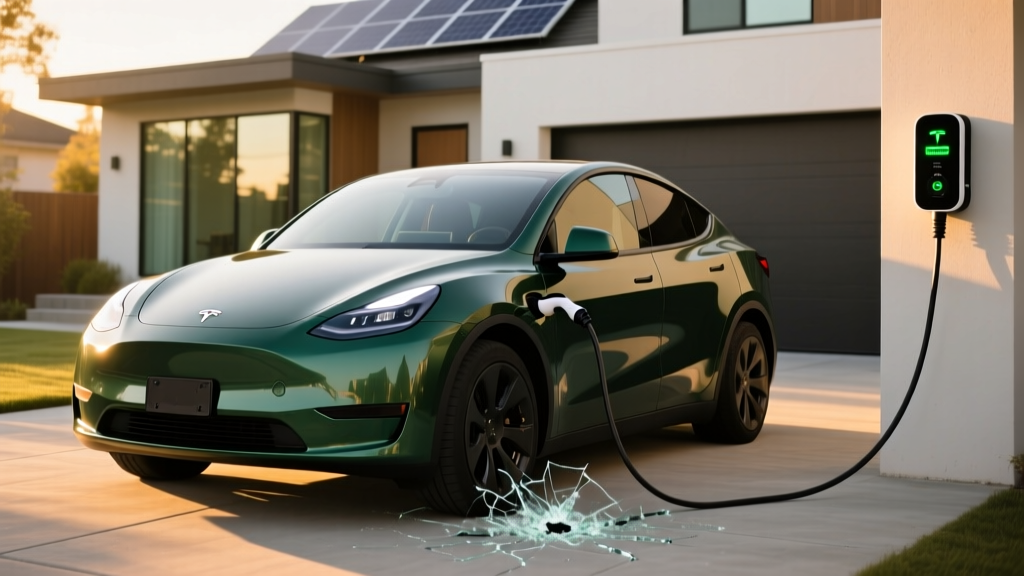
For home charging, the onboard charger accepts up to 11.5 kW on a 240V/48A circuit (such as a Tesla Wall Connector on a 60A breaker). This adds roughly 36 miles of range per hour, meaning a full overnight charge from 10% takes about 9 hours. Most owners with a daily commute of 40–60 miles will only need to plug in every other night.
Connector note: The Model X uses the NACS (Tesla) connector natively. With Tesla opening its Supercharger network to other brands, the Model X still charges seamlessly at all Superchargers. For Electrify America or other CCS-only stations, you'll need the Tesla CCS adapter (included with recent deliveries).
The 7-Seat Interior: Third-Row Reality
The 7-seat configuration (2-3-2 seating) is the default for the Model X and the one most family buyers choose. Here's how the space breaks down:
| Measurement | Value |
|---|---|
| Front Legroom | 41.2 in |
| Second-Row Legroom | 38.4 in |
| Third-Row Legroom | 32.7 in |
| Cargo (behind 3rd row) | 15.0 cu ft |
| Cargo (3rd row folded) | 42.5 cu ft |
| Cargo (all rear rows folded) | 77.9 cu ft |
| Front Trunk (Frunk) | 6.6 cu ft |
Second row: The bench seat offers reasonable comfort for three passengers on longer trips, with decent thigh support and USB-C ports. The flat floor (no transmission tunnel) helps the middle-seat passenger. Headroom is generous thanks to the tall roofline and optional panoramic glass roof.
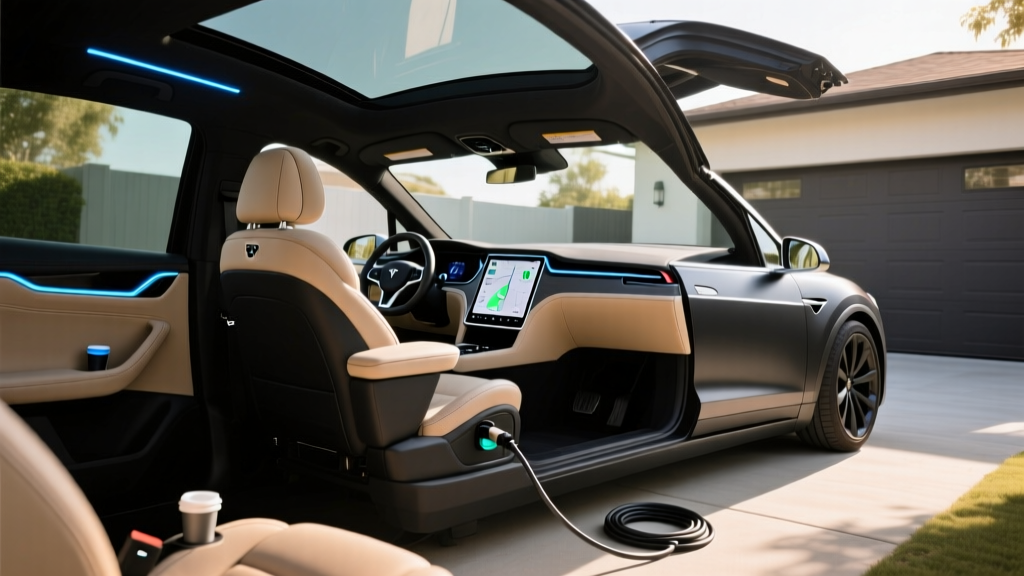
Third row: This is where the Model X 7-seat interior draws the most scrutiny. At 32.7 inches of legroom, the third row is tight for adults on anything beyond a short errand. It works well for children in booster seats or smaller teens, and the seatbacks recline slightly. Access is aided by the second-row seats tilting and sliding forward — made dramatically easier by the falcon-wing doors, which open upward and create a large overhead opening. This is a genuine advantage over the Rivian R1S or Kia EV9 for loading kids into car seats.
Cargo trade-off: With all three rows upright, you get 15.0 cu ft behind the third row — enough for a couple of carry-on bags or a week's groceries for a family of five, but not a full luggage set for a road trip. Fold the third row and you unlock 42.5 cu ft, which is genuinely practical. The 6.6 cu ft frunk adds space for charging cables, a backpack, or groceries you want separated from the cabin.
Performance and Driving Dynamics
The Model X Long Range produces 670 horsepower from its dual-motor all-wheel-drive setup, launching to 60 mph in a claimed 3.8 seconds. That's astonishing for a three-row family SUV — quicker than a Porsche Cayenne Turbo and most sports sedans. The Plaid variant (1,020 hp, 2.5-second 0–60) exists but costs significantly more and sacrifices some range.
On the road, the air suspension provides a comfortable, adaptive ride with adjustable height for loading and highway efficiency. The steering is precise but light, and the low center of gravity (battery pack under the floor) keeps body roll well-controlled for a vehicle of this size. The Model X is not a corner-carver like a Model S, but it handles highway cruising and suburban duties with confidence.
Towing capacity is rated at 5,000 pounds — sufficient for a small boat, utility trailer, or a pair of jet skis, but below the Rivian R1S (7,700 lbs) for heavier loads.
Technology and Driver Assistance
The Model X interior is dominated by a 17-inch center touchscreen running Tesla's latest software, along with a 12.3-inch digital instrument cluster and an 8-inch rear-seat entertainment screen. The yoke steering wheel is standard (a conventional round wheel is available as a no-cost option — and most buyers should choose it for everyday usability).
The infotainment system supports streaming (Netflix, YouTube, Spotify), gaming, and over-the-air updates that regularly add features. Wireless phone charging, ventilated front seats, and a 22-speaker audio system are standard. Notably absent: Apple CarPlay and Android Auto. Tesla's native navigation and media are capable, but if you rely on Apple Maps or Waze, this is a dealbreaker worth acknowledging.
The falcon-wing rear doors remain the Model X's signature feature. They're genuinely useful in tight parking spaces (requiring less side clearance than conventional doors) and make child-seat installation dramatically easier. However, they add mechanical complexity, can be slower to open/close than conventional doors, and have historically been a source of warranty claims (seal leaks, sensor issues). Tesla has improved reliability in recent model years, but it's a consideration.
Pricing, Tax Credits, and Ownership Cost
| Trim | MSRP | Federal §30D Credit | Effective Price |
|---|---|---|---|
| Long Range (7-seat) | $79,990 | $0 (exceeds $80K SUV cap) | $79,990 |
| Plaid (7-seat) | $94,990 | $0 (exceeds $80K SUV cap) | $94,990 |
| Long Range + FSD | $87,990 | $0 | $87,990 |
Federal tax credit reality: Under current IRS §30D rules, the Model X does not qualify for the $7,500 federal EV tax credit. The law caps eligible SUVs at $80,000 MSRP, and even the base Long Range at $79,990 is functionally at that ceiling (adding any options, destination, or paint color pushes it over). Buyers should not expect a federal credit. Some state-level incentives may apply — check your state's energy office or the Alternative Fuels Data Center for local rebates.
Ownership economics: Electricity cost for the Model X averages roughly $0.045–$0.065 per mile (at $0.15/kWh residential rate), compared to $0.14–$0.18 per mile for a comparable gas SUV at $3.50/gallon. Over 15,000 miles per year, that's approximately $1,500–$1,900 in annual fuel savings. Insurance premiums for the Model X tend to run 15–25% higher than a comparable gas luxury SUV due to repair costs and vehicle value. Tesla offers its own insurance product in many states, which can be competitive — get quotes before assuming the worst.
The battery and drive unit carry an 8-year/150,000-mile warranty with a minimum 70% capacity retention guarantee. Tesla's historical degradation data for NMC packs shows roughly 10–12% loss over the first 100,000 miles, with the curve flattening significantly afterward. Full battery replacement (if ever needed out of warranty) runs approximately $18,000–$24,000 at current service pricing.
Model X vs. the Competition: Is It Worth It?
- You need a third row and want Supercharger network access for road trips
- Acceleration and tech are top priorities
- Falcon-wing doors make your child-seat loading easier
- You can charge at home and don't need the federal tax credit
- You need more towing capacity (7,700 lbs) or serious off-road capability
- You want a more traditional, rugged SUV interior
- Budget is a priority (starts ~$54,900, eligible for §30D credit on qualifying trims)
- You want CarPlay/Android Auto and a more conventional interface
Pros
- One of few fully electric 3-row SUVs available
- 670 hp and 3.8s 0–60 in a family hauler
- Supercharger network for hassle-free road trips
- Falcon-wing doors ease child-seat access
- Strong OTA update pipeline
- Air suspension standard
Cons
- No federal tax credit (MSRP exceeds $80K cap)
- Third row tight for adults (32.7" legroom)
- Real-world highway range ~10–15% below EPA
- No Apple CarPlay or Android Auto
- Falcon-wing doors add complexity and repair risk
- High insurance premiums relative to gas SUVs
Frequently Asked Questions
Does the Tesla Model X qualify for the $7,500 federal EV tax credit?
No. Under IRS §30D rules, SUVs must have an MSRP at or below $80,000 to qualify. The base Model X Long Range starts at $79,990, and any options or destination charges push it above the cap. Buyer income limits and battery-sourcing requirements add further restrictions, but the MSRP cap alone disqualifies it. Check your state for separate incentives.
How usable is the Model X third row for adults?
It's best for children, teens, or adults on trips under 30 minutes. The 32.7 inches of legroom is tight, and the seat cushion sits low. For regular adult use in the third row, a minivan or a larger vehicle like the Mercedes EQS SUV (33.7" third-row legroom) is more comfortable.
What is the real-world range of the Model X on a road trip?
Expect 270–290 miles at highway speeds (70–75 mph) in moderate weather. In freezing conditions, plan for 240–260 miles. Always factor in a charging buffer — Tesla's navigation will route you through Superchargers and show predicted state-of-charge at arrival.
How long does it take to charge the Model X at home?
On a 240V/48A Level 2 charger (like the Tesla Wall Connector), the Model X charges at 11.5 kW, adding roughly 36 miles per hour. A full charge from 10% takes about 9 hours — easily achievable overnight. Installation of a 60A circuit typically costs $800–$2,000 depending on your electrical panel.
Is the Model X worth it over the Rivian R1S?
It depends on your priorities. The Model X wins on acceleration, Supercharger access, and falcon-wing door convenience. The R1S wins on towing (7,700 vs. 5,000 lbs), off-road capability, and a more conventional SUV interior layout. Both have tight third rows. Test-drive both with your car seats installed before deciding.
What's the battery warranty on the Model X?
Tesla covers the battery and drive unit for 8 years or 150,000 miles (whichever comes first), with a guarantee of at least 70% capacity retention during that period. This is competitive with industry standards and longer than most luxury-SUV powertrain warranties.