The Tesla Model X has long occupied a unique niche: a premium electric SUV with falcon-wing rear doors, a three-row cabin, and performance that embarrasses sports cars at stoplights. For 2025–2026, the Tesla Model X 7-passenger configuration remains one of very few battery-electric vehicles offering genuine three-row seating with usable cargo space behind the third row — making it a default shortlist pick for large families ready to ditch the minivan.
But at a starting price hovering near $80,000, buyers need more than novelty. They need real-world range data, honest charging speeds, and a clear picture of whether the federal EV tax credit actually applies. This review covers the Model X Long Range and Plaid trims with exact numbers, owner-relevant trade-offs, and a direct look at how it stacks up against the Rivian R1S, Kia EV9, and Mercedes EQS SUV.
Tesla Model X 7-Passenger Specs at a Glance
| Spec | Long Range AWD | Plaid AWD |
|---|---|---|
| EPA Range | 335 miles | 326 miles |
| Battery (usable) | ~95 kWh (NMC) | ~95 kWh (NMC) |
| Drivetrain | Dual-Motor AWD | Tri-Motor AWD |
| Horsepower | 670 hp | 1,020 hp |
| 0–60 mph | 3.8 sec | 2.5 sec |
| Max DC Fast Charge | 250 kW | 250 kW |
| 10–80% DC Time | ~32 min | ~32 min |
| Level 2 Rate (48A) | ~11.5 kW / 35 mi/hr | ~11.5 kW / 35 mi/hr |
| MPGe (combined) | 102 MPGe | 98 MPGe |
| Efficiency | 33 kWh/100 mi | 34 kWh/100 mi |
| Towing Capacity | 5,000 lbs | 5,000 lbs |
| Base MSRP (7-seat) | $79,990 | $94,990 |
| Battery Warranty | 8 yr / 150,000 mi | 8 yr / 150,000 mi |
Sources: EPA fueleconomy.gov, Tesla Model X specs.
Real-World Range: What the EPA Sticker Doesn't Tell You
EPA sticker: 335 miles (Long Range) / 326 miles (Plaid)
Real-world highway (70 mph, 72°F): ~275–295 miles
Cold weather (30°F, mixed driving): ~230–260 miles
Full load, 7 passengers + cargo, highway: ~260–280 miles
The Model X uses a nickel-manganese-cobalt (NMC) battery pack with approximately 95 kWh of usable capacity. Tesla's thermal management system — which includes a heat pump standard on all trims — is among the best in the industry for cold-weather efficiency, but physics still applies. Expect a 15–25% range reduction in freezing temperatures, less if you precondition the cabin while plugged in.
At sustained highway speeds above 75 mph, aerodynamic drag takes a significant toll on this tall, wide SUV. The Model X's 0.24 Cd drag coefficient is impressive for its class, but the frontal area is large. On a 300-mile road trip with a full family and roof cargo box, plan charging stops around the 240-mile mark to maintain a safety buffer.
For daily commuting and city driving where regenerative braking recovers energy, hitting or even slightly exceeding the EPA estimate is achievable. The Model X rewards drivers who use the "Hold" regen mode for maximum one-pedal efficiency.
Charging Speed: DC Fast Charge and Home Level 2
Tesla's Supercharger network remains the gold standard for reliability and ease of use, and the Model X peaks at 250 kW on V3 Superchargers. Here's what that translates to in practice:
| Charging Level | Power | Speed (approx.) | Use Case |
|---|---|---|---|
| Level 1 (120V) | ~1.4 kW | ~5 mi/hr | Emergency / trickle |
| Level 2 (240V, 48A) | 11.5 kW | ~35 mi/hr | Home overnight charging |
| DC Fast (V3 Supercharger) | Peak 250 kW | ~175 mi in 15 min | Road trips |
| DC Fast (CCS adapter) | Up to ~150 kW | Varies by station | Non-Tesla networks |
Charging curve reality: The 250 kW peak only sustains between roughly 10–30% state of charge. Above 50%, the rate tapers significantly, and above 80%, charging slows dramatically to protect battery health. A 10–80% session takes approximately 32 minutes at a V3 Supercharger. Plan to charge to 80% and go — sitting at the charger to fill from 80–100% can add another 30+ minutes for just ~65 miles of range.
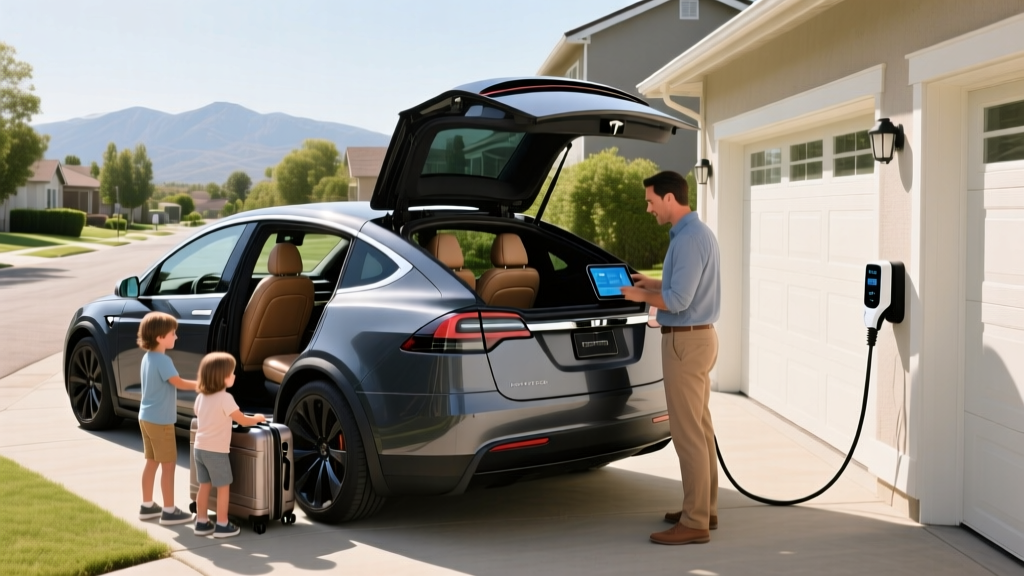
For home charging, a Tesla Wall Connector on a 60-amp circuit delivers 48 amps (11.5 kW), replenishing about 35 miles of range per hour. An overnight session of 8 hours adds roughly 280 miles — more than enough for most daily needs. If your home has a 200-amp electrical panel, installation typically runs $500–$1,500; older homes may require a panel upgrade ($1,500–$3,000+). Always consult a licensed electrician for final specs.
The Model X uses the NACS (North American Charging Standard) connector natively. A CCS adapter is available from Tesla for use on Electrify America and other non-Tesla DC networks, though speeds may be limited to 150 kW depending on the adapter version.
Interior, Cargo, and 7-Passenger Practicality
The 7-passenger layout uses a 2-3-2 seating configuration: two captain's chairs in the second row and a two-seat bench in the third row. This is where the Model X distinguishes itself from most electric SUVs, which max out at five passengers.
Cargo volume (behind third row): approximately 13.4 cu ft — enough for a few grocery bags or two carry-on suitcases. Fold the third row and you get roughly 37.6 cu ft. Fold both rear rows for a maximum of about 70.2 cu ft, plus the front trunk (frunk) adds another 6.7 cu ft.
Legroom: Front row offers 41.1 inches, second row provides 39.4 inches, and the third row delivers 33.8 inches. That third row is best suited for children or shorter adults on trips under an hour. For full-size adults in all three rows, the Rivian R1S offers slightly more third-row headroom, but the Model X's falcon-wing doors make third-row access genuinely easier than conventional SUVs — the large upward-opening doors and low step-in height mean kids can climb in without ducking and contorting.
The 17-inch center touchscreen handles nearly all vehicle controls, including a yoke-style or round steering wheel option (round is now standard again). Rear passengers get their own 8-inch touchscreen for climate and entertainment. Build quality on the 2025–2026 Model X has improved noticeably over earlier production years, with tighter panel gaps and upgraded materials, though some owners still note minor wind noise at highway speeds around the falcon-wing door seals.
Performance and Driving Dynamics
Even in its base Long Range trim, the Model X delivers 670 horsepower and a 3.8-second 0–60 mph time — figures that would have defined a supercar a decade ago. The dual-motor all-wheel-drive system provides confident traction in rain and light snow, and the adaptive air suspension adjusts ride height automatically for efficiency at speed or ground clearance on rough roads.
The Plaid trim's tri-motor setup (one front, two rear) produces 1,020 hp and a 2.5-second 0–60 time. It's absurdly quick for a 5,185-pound SUV, but the $15,000 premium is hard to justify for family duty. The Long Range is the smarter buy unless you regularly attend drag races.
Ride quality is generally composed, though the large 22-inch turbine wheels (optional) transmit more road imperfections than the standard 20-inch set. The air suspension's "High" setting adds roughly 1.5 inches of clearance for speed bumps and driveways. Steering is precise but light — this is a cruiser, not a corner carver, despite the horsepower.
Pricing, Trims, and Federal Tax Credit Eligibility
| Trim | Base MSRP | Est. As-Tested (w/ common options) | §30D Federal Credit |
|---|---|---|---|
| Long Range AWD | $79,990 | $85,000–$92,000 | See eligibility below |
| Plaid AWD | $94,990 | $100,000–$112,000 | Not eligible (MSRP cap) |
Federal tax credit (§30D) critical details: The Model X Plaid's MSRP exceeds the $80,000 SUV cap set by the Inflation Reduction Act, making it ineligible for the federal credit regardless of buyer income. The Long Range trim falls just under the cap at $79,990, but eligibility depends on several factors that change frequently:
- Buyer income caps: Modified AGI must not exceed $300,000 (joint), $225,000 (head of household), or $150,000 (single).
- MSRP cap: SUVs must have an MSRP at or below $80,000. Adding options that push the Long Range above $80,000 may disqualify it.
- Battery sourcing requirements: Critical minerals and battery components must meet escalating domestic-content thresholds. Tesla's battery supply chain has been shifting, and eligibility can change month to month.
- Point-of-sale transfer: As of 2024, the credit can be transferred to the dealer at purchase, reducing the upfront price rather than waiting for a tax refund. This is available through IRS-registered dealers.
Always verify current eligibility on the IRS clean vehicle credit page before purchasing. State incentives (California, Colorado, and others) may provide additional savings — check your state's energy office for details.
Autopilot, FSD, and Smart Driving Features
Tesla Autopilot and Full Self-Driving (Supervised) are driver-assistance systems, not autonomous driving. The driver must remain attentive, keep hands available, and be prepared to take over at any moment. These are not Level 4 self-driving systems like Waymo.
The Model X comes standard with Basic Autopilot, which includes Traffic-Aware Cruise Control and Autosteer (lane-centering) on divided highways. The optional Enhanced Autopilot ($6,000) adds Navigate on Autopilot (automatic highway interchanges), Auto Lane Change, Autopark, and Summon.
Full Self-Driving (Supervised) costs $8,000 as a one-time purchase or $99/month. It extends Autosteer to city streets, recognizes traffic lights and stop signs, and handles more complex intersections. In practice, FSD (Supervised) handles the majority of driving scenarios competently, but it still requires active supervision. Disengagements occur at construction zones, complex unprotected left turns, and in heavy rain. Expect to intervene 1–5 times per 30-minute drive in mixed conditions.
Standard safety features include automatic emergency braking, blind-spot monitoring, lane departure warning, and 360-degree cameras. The Model X earned a 5-star overall rating from NHTSA.
Model X vs. the Competition: Rivian R1S, Kia EV9, Mercedes EQS SUV
The 7-passenger electric SUV market has grown, and the Model X faces legitimate alternatives:
| Vehicle | EPA Range | Base MSRP | Max DC Charge | 3rd-Row Usability |
|---|---|---|---|---|
| Tesla Model X LR | 335 mi | $79,990 | 250 kW | Good (kids/short trips) |
| Rivian R1S Dual-Motor | 352 mi | $75,900 | 220 kW | Good (slightly more headroom) |
| Kia EV9 GT-Line AWD | 270 mi | $63,900 | 210 kW | Fair (tighter third row) |
| Mercedes EQS 580 SUV | 305 mi | $105,550 | 200 kW | Optional 3rd row (very tight) |
Choose the Tesla Model X if: You want the most proven Supercharger network access, the fastest DC charging in the segment, falcon-wing door convenience for child-seat loading, and the longest real-world range among 7-seat EVs.
Choose the Rivian R1S if: You prioritize off-road capability, want a more traditional SUV design, value the slightly lower starting price, and prefer a more adventure-oriented community and brand.
Choose the Kia EV9 if: Budget is a primary concern, you want an 800V architecture for competitive charging speeds, and your third-row needs are occasional rather than daily.
Who the Tesla Model X 7-Passenger Is For
This SUV is best suited for families of 5–7 who need regular third-row use, have access to home Level 2 charging, and take road trips where the Supercharger network provides a meaningful advantage. The Model X also makes sense for buyers who tow occasionally (5,000-lb capacity covers most small boat and utility trailers) and who value over-the-air updates that continue adding features years after purchase.
It's less ideal for buyers on a strict budget (the Kia EV9 saves $15,000–$20,000), for those who need adult-sized third-row seating on long trips, or for apartment dwellers without reliable charging access. The falcon-wing doors, while convenient, can be problematic in tight parking garages with low ceilings — they require approximately 12 inches of lateral clearance and significant overhead space to open fully.
- Class-leading 335-mi EPA range
- 250 kW DC fast charging, proven Supercharger network
- Falcon-wing doors ease child-seat loading
- 670 hp standard; absurd performance even in base trim
- Heat pump standard for cold-weather efficiency
- Over-the-air updates keep the vehicle current
- Starting price near $80K; tax credit eligibility uncertain
- Third row fits children, not full-size adults comfortably
- Falcon-wing doors can struggle in low-clearance garages
- FSD (Supervised) still requires active driver attention
- Cargo space behind 3rd row is modest (13.4 cu ft)
- No CCS port natively — adapter required for non-Tesla chargers
Frequently Asked Questions
What is the real-world range of the Tesla Model X 7-passenger?
The EPA rates the Long Range at 335 miles and the Plaid at 326 miles. In real-world highway driving at 70 mph, expect roughly 275–295 miles. In cold weather (below freezing), that drops to approximately 230–260 miles. Preconditioning while plugged in mitigates some cold-weather loss.
How fast does the Model X charge at home and on the road?
On a V3 Supercharger, the Model X peaks at 250 kW and charges from 10–80% in about 32 minutes. At home on a 48-amp Level 2 Wall Connector, it adds roughly 35 miles of range per hour (11.5 kW), fully replenishing the battery overnight.
Does the Tesla Model X qualify for the $7,500 federal EV tax credit?
The Long Range trim at $79,990 MSRP falls under the $80,000 SUV cap, but eligibility depends on buyer income limits, battery-sourcing requirements, and whether added options push the price above the cap. The Plaid trim exceeds the MSRP cap and does not qualify. Always check current eligibility at IRS.gov before purchasing.
Is the Model X worth buying over the Rivian R1S or Kia EV9?
If Supercharger network access, the longest range in the segment, and falcon-wing door convenience matter to you, the Model X holds an edge. The Rivian R1S offers more rugged capability and a slightly lower price. The Kia EV9 is the budget pick but sacrifices ~65 miles of range. Your decision likely hinges on budget, charging access, and third-row frequency.
How long will the Model X battery last?
Tesla warranties the battery for 8 years or 150,000 miles, whichever comes first, with a minimum 70% capacity retention guarantee. Based on fleet data from earlier Model S/X vehicles, NMC packs typically retain 85–90% capacity at 100,000 miles when charged primarily to 80–90% daily. Battery replacement, if needed out of warranty, costs approximately $15,000–$20,000 including labor.
Can the Model X tow, and how does towing affect range?
The Model X is rated to tow 5,000 lbs. Towing a 3,500-lb trailer at highway speeds typically reduces range by 40–50%, bringing real-world towing range to approximately 150–180 miles. Tesla's built-in trailer mode adjusts stability control and regen behavior when a trailer is connected.