Does Tesla Record Accidents? The Short Answer
Yes — Tesla vehicles continuously capture and store data that can document a crash, but the way that footage and telemetry is recorded, saved, and accessed depends on which system you're looking at. Three distinct layers of data capture exist in every modern Tesla:
- Dashcam — four-camera video recording (front, rear, left repeater, right repeater) that saves clips manually or automatically around detected incidents.
- Sentry Mode — a parked-surveillance system that triggers recording when threats or impacts are detected near the vehicle.
Event Data Recorder (EDR) — the "black box" that logs vehicle telemetry (speed, brake application, steering angle, seatbelt status, airbag deployment) in the seconds before, during, and after a collision.
If you're asking "does Tesla record accidents" because you want video evidence after a crash, the Dashcam system is your primary tool — but it requires proper USB setup and is not enabled by default out of the box. If you're asking from a safety or legal-evidence standpoint, the EDR captures hard vehicle data that can be subpoenaed and extracted by investigators or Tesla directly.
How Tesla's Dashcam Records Accidents
Tesla's built-in Dashcam uses the same cameras that power Autopilot and FSD (Supervised) to record video while driving. Here's how it works in practice:
Recording Behavior
- The system continuously buffers the most recent 10 minutes of driving footage across four cameras.
- Footage is not permanently saved unless: (a) you tap the dashcam icon on the touchscreen to manually save, or (b) the car detects an incident — airbag deployment, sudden deceleration above a threshold, or an automatic emergency braking (AEB) event — and auto-saves the clip.
- Saved clips are written to a USB drive (or glovebox SSD in 2024+ models) in a folder structure organized by date and event type.
What Gets Captured in a Crash
When the vehicle detects a collision event, the Dashcam auto-saves a clip covering approximately one minute before and several seconds after the trigger. This includes footage from all four cameras, giving you front-impact, rear-impact, and side-context video.
However, there are limitations worth understanding:
- No audio recording — Tesla dashcam captures video only, not cabin audio.
- Night quality varies — the front camera performs adequately in low light, but side repeater cameras can struggle with headlight glare and darkness.
- Overwrite risk — if the USB drive fills up and is not configured to overwrite oldest files, new clips may fail to save.
Sentry Mode: Recording When You're Not in the Car
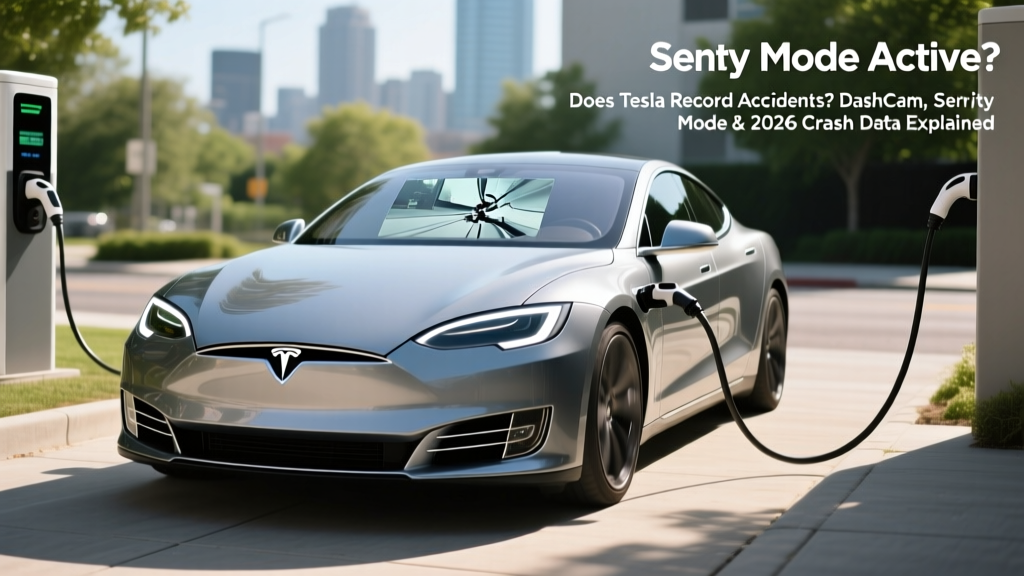
Sentry Mode activates when the vehicle is parked and locked, using the external cameras to monitor the surroundings. It operates in three escalating stages:
- Standby — cameras are watching but not recording.
- Aware — a nearby motion trigger causes the system to start recording and display a warning on the touchscreen that recording is active.
- Alarm — a break-in attempt, impact, or glass-break event triggers full alarm, saves the video clip, and sends a push notification to your phone.
For parking-lot hit-and-runs, Sentry Mode is the feature most likely to capture the at-fault driver. It logs a timestamped video clip of the event and flags it in the Dashcam viewer under "Sentry Events."
The Event Data Recorder (EDR): Tesla's Black Box
Every Tesla sold in the United States includes an Event Data Recorder, the same type of device mandated in all passenger vehicles since 2014 under NHTSA regulations. The EDR captures a snapshot of vehicle telemetry in the moments surrounding a crash, including:
- Vehicle speed (pre-impact, at impact)
- Accelerator and brake pedal position
- Steering input angle
- Seatbelt engagement status for each occupied seat
- Airbag deployment timing and force
- Stability control and ABS activation
- Whether Autopilot/FSD was engaged at the time of impact
This data is stored in non-volatile memory and survives most collision forces. It can be extracted by:
- Tesla directly — remotely via cellular connection (with owner consent or legal process) or physically at a service center.
- NHTSA or law enforcement — with proper legal authority.
- Third-party accident reconstructionists — using specialized OBD-II or direct EDR download tools.
In multiple high-profile crash investigations and wrongful-death lawsuits, Tesla EDR data has been central evidence. Unlike dashcam footage, EDR data cannot be tampered with or deleted by the vehicle owner.
Tesla Model 3 (2026): Full EV Review
Beyond accident recording, here's how the current-generation Tesla Model 3 (Highland refresh, carried into 2026) stacks up as a daily-driver EV.
| Spec | RWD (Standard Range) | Long Range AWD | Performance |
|---|---|---|---|
| EPA Range | 272 mi | 341 mi | 315 mi |
| Battery (usable) | ~57.5 kWh, LFP | ~75 kWh, NMC | ~75 kWh, NMC |
| Drivetrain | Rear-Wheel Drive | Dual Motor AWD | Dual Motor AWD |
| Horsepower | 271 hp | 346 hp | 510 hp |
| 0–60 mph | 5.8 sec | 4.2 sec | 2.9 sec |
| Max DC Fast Charge | 170 kW | 250 kW | 250 kW |
| 10–80% DC Time | ~25 min | ~25 min | ~25 min |
| Level 2 Home Charging | 11.5 kW / ~44 mi/hr | 11.5 kW / ~44 mi/hr | 11.5 kW / ~44 mi/hr |
| MPGe (combined) | 132 MPGe | 117 MPGe | 113 MPGe |
| Efficiency | 25 kWh/100 mi | 28 kWh/100 mi | 29 kWh/100 mi |
| Cargo Volume | 23 cu ft (rear trunk + frunk combined) | ||
| Rear Legroom | 35.3 in | ||
| Base MSRP | $38,990 | $44,990 | $52,990 |
| Battery Warranty | 8 yr / 100,000 mi | 8 yr / 120,000 mi | |
Source: fueleconomy.gov, Tesla.com. Verify current pricing at time of purchase.
Charging Speed: Home and DC Fast Charging
The Model 3's charging capabilities remain competitive in 2026, though newer rivals like the Hyundai Ioniq 6 (with its 800V architecture) outpace it on DC fast charging.
DC Fast Charging
On a Tesla Supercharger V3 (250 kW) or equivalent CCS/NACS station, the Long Range and Performance models peak at 250 kW. However, peak rate is sustained only briefly — typically between 10–30% SoC. The charging curve tapers significantly above 60%, and the 60–80% portion can take nearly as long as the 10–60% portion. Expect a realistic 10–80% session of about 25 minutes under ideal conditions (warm battery, preconditioned via navigation to a Supercharger).
The RWD model, with its LFP battery, peaks at a lower 170 kW and takes roughly the same 10–80% time due to its smaller battery capacity.
Home Level 2 Charging
Using a Tesla Wall Connector on a 60-amp circuit (48 amps continuous), the onboard charger accepts up to 11.5 kW, adding approximately 44 miles of range per hour. An overnight charge from 20% to 80% takes roughly 5–6 hours — more than adequate for daily use. On a standard 240V/40A dryer-style circuit, expect ~33 mi/hr.
Pricing, Trims & Federal Tax Credit Eligibility
The 2026 Model 3 lineup starts at $38,990 for the RWD and climbs to $52,990 for the Performance. Here's how the federal tax credit landscape applies:
| Trim | MSRP | §30D Credit Potential | Effective Price |
|---|---|---|---|
| RWD (Standard Range) | $38,990 | Up to $7,500* | ~$31,490 |
| Long Range AWD | $44,990 | Up to $7,500* | ~$37,490 |
| Performance | $52,990 | Up to $7,500* | ~$45,490 |
- Income cap: AGI ≤ $150,000 (single) / $300,000 (married filing jointly)
- MSRP cap: Sedan ≤ $55,000 (all Model 3 trims qualify)
- Battery sourcing: Critical minerals and battery components must meet escalating domestic-content thresholds — verify current-year compliance on Tesla's website or fueleconomy.gov
- Point-of-sale transfer: You can transfer the credit to the dealer at purchase for an immediate price reduction, or claim it on your tax return
Driver Assistance: Autopilot and FSD (Supervised)
The Model 3 comes standard with Basic Autopilot (lane centering, traffic-aware cruise control). The optional FSD (Supervised) package ($8,000 one-time or $99/month as of early 2026) adds automatic lane changes, traffic-light and stop-sign recognition, and assisted navigation on city streets. In crash scenarios, Autopilot engagement status is logged in the EDR — a fact that has been pivotal in NHTSA investigations into Tesla crashes.
Pros and Cons
✅ Pros
- Class-leading efficiency (25 kWh/100 mi on RWD)
- Supercharger network access — the most reliable DC fast-charging ecosystem in North America
- Four-camera dashcam system built in (no aftermarket hardware needed)
- Over-the-air updates continuously improve features
- Strong resale value relative to most EVs
- LFP battery on RWD supports daily 100% charging without degradation concerns
❌ Cons
- No traditional instrument cluster — all info on center screen requires glancing right
- Rear legroom (35.3 in) is tighter than Hyundai Ioniq 6 or BMW i4
- Turn-signal stalks removed in Highland refresh — steering-wheel buttons take adjustment
- FSD (Supervised) is expensive and still requires full driver attention
- Ride quality on 19" wheels can be firm on rough pavement
- Insurance premiums tend to run 15–25% higher than comparable non-Tesla sedans
Who the Model 3 Suits Best
Best for: Tech-forward commuters who want a premium EV sedan with access to the best fast-charging network, built-in dashcam/Sentry recording for peace of mind, and industry-leading efficiency that keeps charging costs low.
Consider alternatives if: You regularly carry rear-seat adults (the Ioniq 6 offers more legroom), you need a hatchback or wagon for cargo flexibility (look at the Model Y or Ioniq 5), or you prefer physical controls and a traditional instrument cluster (BMW i4 or Hyundai Ioniq 6).
Frequently Asked Questions
Does Tesla automatically save dashcam footage when an accident occurs?
Yes, but only if Dashcam is properly configured. You must have a USB drive (or SSD) inserted and formatted for Dashcam use, and the feature must be set to "Auto" or "On" in the safety settings. When the car detects a collision event — airbag deployment, AEB activation, or sudden high-G deceleration — it automatically saves the preceding minute of four-camera footage. If Dashcam is not set up, no video is recorded.
Can Tesla remotely access my crash data?
Tesla can receive a crash-notification data packet via the vehicle's cellular connection when a severe impact is detected. This includes basic telemetry (impact force, airbag deployment, approximate location) but not full EDR data or dashcam video. Full EDR extraction requires physical access to the vehicle or a formal legal request. Tesla states it will not share detailed data without owner consent or a valid court order.
Does Sentry Mode record hit-and-run damage in a parking lot?
Yes, if Sentry Mode was active at the time. When an impact is detected, Sentry Mode saves a clip from the moments before and after the event, tags it as a "Sentry Event," and sends a notification to your phone. The video quality is generally sufficient to capture license plates at close range in daylight, though nighttime clarity depends on ambient lighting.
Is the Tesla Model 3 eligible for the $7,500 federal EV tax credit in 2026?
All three Model 3 trims fall under the $55,000 sedan MSRP cap. However, eligibility depends on your income (AGI limits apply), and the vehicle's battery must meet the current-year critical-mineral and component-sourcing thresholds under §30D. These thresholds escalate annually. Verify the specific build's eligibility on fueleconomy.gov or with your tax advisor before purchase.
How does Tesla's dashcam compare to an aftermarket dashcam?
Tesla's built-in system offers four-camera coverage with zero extra hardware, which is a significant advantage. However, aftermarket dashcams (e.g., BlackVue, Garmin) often provide higher resolution, GPS overlays, G-sensor sensitivity adjustment, and cabin audio recording — none of which Tesla's system offers. Many Tesla owners run both for redundancy.
What is the real-world highway range of the Model 3 Long Range?
EPA-rated at 341 miles, the Long Range AWD typically delivers 280–310 miles in real-world highway driving at 70–75 mph in moderate temperatures. In winter conditions (below 32°F), expect 240–280 miles depending on cabin heat usage and whether you precondition the battery. These figures make it one of the most efficient long-range sedans in its class.