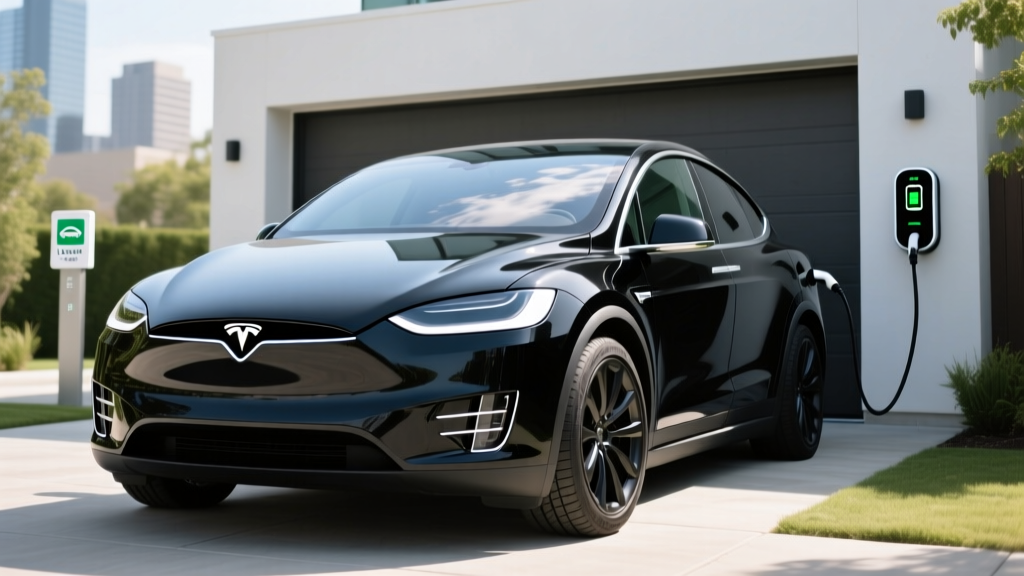
The 2024 Tesla Model X occupies a strange space in the EV market: a six- or seven-seat luxury SUV with supercar acceleration, falcon-wing rear doors, and access to the most reliable DC fast-charging network in North America. It's also one of the oldest nameplates in Tesla's lineup, riding on an architecture that debuted in 2015 and received its last major interior refresh for the 2021 model year. If you're shopping this SUV in 2026 as a certified pre-owned or remaining-new-inventory vehicle, the question isn't whether it's impressive on paper — it is — but whether its real-world trade-offs make sense for your family.
This review breaks down the 2024 Model X with the numbers that matter: EPA range versus what you'll actually see on the highway in January, peak versus sustained charging speeds, the exact cost after federal incentives, and how it stacks up against the Rivian R1S, BMW iX, and Mercedes EQS SUV.
2024 Tesla Model X Quick Spec Sheet
| Specification | Long Range (Dual Motor) | Plaid (Tri-Motor) |
|---|---|---|
| EPA Range | 335 miles | 326 miles |
| Battery (usable) | ~100 kWh, NMC | ~100 kWh, NMC |
| Drivetrain | Dual Motor AWD | Tri-Motor AWD |
| Horsepower | 670 hp | 1,020 hp |
| 0-60 mph | 3.8 seconds | 2.5 seconds |
| Top Speed | 155 mph | 163 mph |
| Peak DC Fast Charge | 250 kW | 250 kW |
| 10-80% DC Time | ~30 minutes | ~30 minutes |
| Level 2 Home Charge | 11.5 kW (~34 mi/hr) | 11.5 kW (~34 mi/hr) |
| MPGe (combined) | 102 MPGe | 98 MPGe |
| Energy Consumption | 33 kWh/100 mi | 34 kWh/100 mi |
| Seating | 5, 6, or 7 passengers | 5, 6, or 7 passengers |
| Cargo (behind 3rd row) | 15.3 cu ft | 15.3 cu ft |
| Cargo (max, seats folded) | 88.1 cu ft | 88.1 cu ft |
| Towing Capacity | 5,000 lbs | 5,000 lbs |
| Base MSRP (2024) | $77,990 | $92,990 |
| Battery Warranty | 8 yr / 150,000 mi | 8 yr / 150,000 mi |
| Basic Warranty | 4 yr / 50,000 mi | 4 yr / 50,000 mi |
Sources: EPA fueleconomy.gov, Tesla Model X Design Studio
Range and Efficiency: EPA Sticker vs. Reality
Real-World Expectation: Plan for roughly 270–300 miles on mixed highway driving at 70-80 mph. In cold weather (below 32°F), expect a 15–30% reduction depending on cabin heating demand and whether you precondition the battery. Summer highway cruising with mild HVAC can approach the EPA number, but sustained 80+ mph speeds will drop range to around 250–270 miles.
The Model X Long Range's 335-mile EPA figure remains competitive among three-row electric SUVs, though it falls short of what the smaller, lighter Tesla Model Y Long Range achieves (310 miles from a smaller battery, but in a lighter, more aerodynamic package). The Model X's tall, wide stance and falcon-wing door seams create more aerodynamic drag than a crossover, and at highway speeds, drag is the dominant efficiency factor.
Per the EPA, the Long Range model consumes 33 kWh per 100 miles — translating to 102 MPGe combined. That's respectable for a 5,185-pound vehicle, but it means you'll draw roughly 33 kWh from the grid for every 100 miles driven, which at a national average residential rate of $0.17/kWh works out to about $5.61 per 100 miles at home. On DC fast charging at $0.35–$0.48/kWh (common on Electrify America and EVgo networks), the same 100 miles costs $11.55–$15.84. For context, a Toyota Highlander Hybrid at 35 MPG and $3.50/gallon fuel runs about $10.00 per 100 miles.
The heat pump Tesla introduced with the 2021 refresh does meaningful work in moderate cold (30–45°F), reducing the HVAC energy penalty compared to resistive heaters. Below 20°F, however, the heat pump's efficiency drops and range loss becomes more pronounced. Preconditioning the battery while plugged in — a feature accessible through the Tesla app — mitigates some cold-weather loss and is essential for maximizing DC fast-charge speeds in winter.
Charging Speeds: Supercharger Network Advantage
The 2024 Model X uses the NACS (North American Charging Standard) connector natively — meaning it plugs directly into Tesla Superchargers without an adapter. This remains the single biggest practical advantage Tesla owners have over competitors relying on CCS1 networks, where charger uptime and payment reliability remain inconsistent in many regions.
| Charging Level | Power | Speed / Notes |
|---|---|---|
| Level 1 (120V household) | ~1.4 kW | ~4 miles per hour — overnight trickle only |
| Level 2 (240V, 48A Wall Connector) | 11.5 kW | ~34 miles per hour — full charge in ~9.5 hours |
| Level 2 (public, 40A) | 9.6 kW | ~28 miles per hour |
| DC Fast (Tesla Supercharger V3) | Up to 250 kW peak | 10-80% in ~30 minutes; ~175 miles in 15 min |
| DC Fast (CCS station w/ adapter) | Up to 250 kW peak | Requires Tesla CCS adapter ($175); speed depends on station |
A critical nuance that spec sheets obscure: the Model X does not sustain its 250 kW peak for long. The charge curve tapers significantly above 50% state of charge (SoC), and by 80%, you're pulling closer to 50–70 kW. The 10-80% time of roughly 30 minutes is realistic when you arrive at the charger with a warm, preconditioned battery (navigation to a Supercharger triggers automatic preconditioning). Arrive cold, and that 10-80% session can stretch to 45 minutes or more.
For home charging, Tesla's Wall Connector at 48 amps on a 60A circuit is the gold standard. Most Model X owners report that plugging in each evening and charging to 80-90% (the daily recommended limit for NMC chemistry) replenishes a day's driving in 2–3 hours. Expect a Level 2 installation to cost $800–$2,000 total (equipment + electrician + permit), assuming your electrical panel has capacity. A 200A panel upgrade adds $1,500–$3,000 if needed.
Performance: Supercar in a Minivan Body
The Model X Long Range hits 0-60 mph in 3.8 seconds with 670 horsepower from its dual-motor all-wheel-drive setup. That's quicker than a Porsche Cayenne S and roughly matches a BMW X5 M Competition. For a 5,185-pound three-row SUV, the acceleration is startling — and it never feels like it's trying too hard, thanks to the instant torque delivery inherent to electric motors.
The Plaid trim adds a third rear motor for 1,020 hp and a 2.5-second 0-60 time. This is legitimately hypercar territory in a vehicle with cupholders and a third row. The Plaid also features torque vectoring across the rear axle and a carbon-sleeved rotor design that sustains high-speed pulls without overheating. In practice, very few owners will ever use this capability, but it exists and it works.
Ride quality on the adaptive air suspension is a mixed story. The 2021 refresh improved damping significantly over earlier Model X generations, and highway cruising is comfortable and quiet. However, the 22-inch wheel option (standard on Plaid) transmits more road imperfections than you'd expect at this price point. The 20-inch wheels on the Long Range are the better choice for daily comfort. The air suspension also enables adjustable ride height — useful for steep driveways, speed bumps, and the 5,000-pound towing capacity.
Interior, Tech, and the Falcon-Wing Question
The Model X interior is dominated by a 17-inch landscape-oriented touchscreen running Tesla's proprietary infotainment system. It handles navigation, media, climate, vehicle settings, and even gaming (a Steam-compatible processor was added in the 2022 refresh). The system is fast and visually clean, but it forces nearly all controls through the screen — including the glovebox release, mirror adjustments, and windshield wiper settings. There are no physical buttons for climate or volume beyond the steering wheel scroll wheels and a single hazard-light button.
The 2024 Model X offers three seating configurations: five-seat (two rows), six-seat (captain's chairs in the second row with a center aisle to the third), and seven-seat (bench second row). The six-seat layout is the most practical for families who need third-row access, as the center aisle lets kids climb through without folding the second row. Third-row legroom is 32.7 inches — tight for adults on long trips but fine for children. Cargo behind the third row is 15.3 cu ft, expanding to 88.1 cu ft with both rear rows folded.
The falcon-wing rear doors are the Model X's most polarizing feature. They open upward with a double-hinge design that allows them to swing up in tight parking spaces (Tesla says they need only 11 inches of side clearance). In practice, they make loading car seats and accessing the third row dramatically easier than conventional doors — you stand up fully while loading. The trade-offs: they're slower to open and close than sliding minivan doors, they can be noisy in wind, and repair costs if a hinge motor fails are significant. They also cannot accommodate a roof rack, which limits cargo options for outdoor enthusiasts.
Autopilot, FSD, and Driver Assistance
The driver must remain fully engaged, with hands on the wheel and eyes on the road, at all times. Autopilot and FSD (Supervised) are not self-driving systems. Tesla's Full Self-Driving (Supervised) name is a marketing term — the system does not meet SAE Level 3 or Level 4 criteria.
Every 2024 Model X comes with Tesla's basic Autopilot, which includes Traffic-Aware Cruise Control and Autosteer (lane-centering on divided highways). The optional FSD (Supervised) package — priced at $8,000 as a one-time purchase or $99/month in 2024 — adds automatic lane changes, Navigate on Autopilot (on-ramp to off-ramp highway driving), traffic light and stop sign recognition, and Autopark.
In our experience, FSD (Supervised) performs well on well-marked highways with moderate traffic. It struggles with construction zones, faded lane markings, unprotected left turns in complex intersections, and aggressive urban traffic. Driver monitoring is enforced through a cabin camera that tracks eye direction, and the system will issue warnings and eventually disengage if you look away too long. The NHTSA has opened multiple investigations into Tesla's Autopilot/FSD systems related to crashes with stationary emergency vehicles; buyers should treat this as an assist feature, not a replacement for attention.
Compared to GM's Super Cruise (hands-free on pre-mapped highways) or Ford's BlueCruise (hands-free on approved divided highways), Tesla's approach offers broader geographic coverage but requires more active supervision. Super Cruise and BlueCruise use infrared driver-monitoring cameras and are limited to mapped roads, but they allow true hands-off driving within their operational design domains.
Pricing, Trims, and Federal Tax Credit Eligibility
| Trim | Base MSRP (2024) | Federal Credit (§30D) | Effective Price |
|---|---|---|---|
| Long Range | $77,990 | $0 — exceeds MSRP cap | $77,990 |
| Plaid | $92,990 | $0 — exceeds MSRP cap | $92,990 |
Common options that affect pricing: Ultra Red or Quicksilver paint adds $2,500; 22-inch Turbine wheels add $4,500; the six-seat interior adds $6,500; and FSD (Supervised) adds $8,000. A realistically equipped Long Range with metallic paint, six seats, and no FSD lands around $86,990 — well above the credit threshold.
For buyers who can access a home Level 2 charger and drive under 40 miles daily, some states offer their own rebates or HOV lane access regardless of federal credit eligibility. Check your state's energy office for local incentives, as these vary significantly by jurisdiction.
Competitor Comparison: Model X vs. the Field
| Feature | 2024 Tesla Model X LR | 2024 Rivian R1S Dual | 2024 BMW iX xDrive50 | 2024 Mercedes EQS 450+ SUV |
|---|---|---|---|---|
| EPA Range | 335 mi | 352 mi (Max Pack) | 324 mi | 305 mi |
| 0-60 mph | 3.8 sec | 4.5 sec | 4.4 sec | 6.5 sec |
| Peak DC Charge | 250 kW | 220 kW | 200 kW | 200 kW |
| Seating | 5/6/7 | 7 | 5 | 5/7 |
| Cargo (max) | 88.1 cu ft | 104.7 cu ft | 77.9 cu ft | 80.0 cu ft |
| Towing | 5,000 lbs | 7,700 lbs | 3,500 lbs | 3,500 lbs |
| Base MSRP | $77,990 | $74,900 | $87,100 | $104,400 |
| Federal Credit | Conditional | Yes (most configs) | No (MSRP cap) | No (MSRP cap) |
| Charging Network | Tesla Supercharger | CCS + NACS adapter | CCS + EA partnership | CCS + EA partnership |
Choose the Rivian R1S if: You need serious off-road capability, 7,700-lb towing, a more traditional SUV interior with physical controls, or a configuration that qualifies for the $7,500 federal credit.
Choose the BMW iX if: You prioritize interior build quality and refinement, want a quieter cabin, prefer a five-seat luxury crossover, and don't need a third row.
Choose the Mercedes EQS SUV if: Budget is flexible, you want the most luxurious ride quality in the segment, and third-row space is occasional-use only.
Pros, Cons, and Who Should Buy
- 335-mile EPA range is among the best in three-row EVs
- Tesla Supercharger network remains the most reliable DC fast-charging system in North America
- Falcon-wing doors make car-seat and third-row access uniquely easy
- Supercar-level acceleration (3.8s 0-60 Long Range, 2.5s Plaid)
- Over-the-air updates continue to add features years after purchase
- 5,000-lb towing capacity with integrated trailer brake controller option
- 8-year/150,000-mile battery and drive unit warranty
- Largely ineligible for $7,500 federal tax credit due to MSRP cap when optioned
- Touchscreen-only controls require menu diving for basic adjustments
- Falcon-wing doors are slow, can leak, and prevent roof rack use
- Interior materials and build quality don't match BMW/Mercedes at this price
- Third-row space is tight for adults (32.7" legroom)
- FSD (Supervised) requires constant driver attention despite the name
- Platform dates to 2015; next-generation replacement is overdue
- Insurance costs are above segment average due to repair complexity
Who the 2024 Model X suits best: Families who want a fast, long-range electric SUV with three rows, rely on frequent road trips where Supercharger access matters, and can charge at home. It's ideal for tech-forward buyers who prioritize performance and charging infrastructure over traditional luxury craftsmanship. If you need to tow more than 5,000 pounds, go off-road, or want the federal tax credit with a fully loaded build, the Rivian R1S is the stronger choice.
Frequently Asked Questions
What is the real-world range of the 2024 Tesla Model X?
The EPA rates the Long Range at 335 miles and the Plaid at 326 miles. In real-world mixed highway driving at 70-80 mph, expect 270-300 miles. In cold weather below freezing, plan for 230-270 miles depending on HVAC use and whether you precondition the battery. The heat pump helps in moderate cold but can't eliminate the physics of lithium-ion chemistry in low temperatures.
How fast does the Model X charge at home and on the road?
At home on a Level 2 Tesla Wall Connector (11.5 kW / 48A), the Model X adds roughly 34 miles of range per hour — a full overnight session replenishes a depleted battery in about 9.5 hours. On a V3 Supercharger (250 kW peak), a 10-80% session takes approximately 30 minutes with a preconditioned battery, adding about 175 miles in 15 minutes. Charging above 80% slows dramatically to protect battery health.
Does the 2024 Tesla Model X qualify for the $7,500 federal EV tax credit?
It depends on your exact configuration. The Long Range base MSRP of $77,990 sits under the $80,000 SUV cap, so a base Long Range with no options can qualify — provided you meet the income caps ($150,000 single / $300,000 joint) and the vehicle meets that year's critical-mineral and battery-component sourcing thresholds. However, adding nearly any option (premium paint, larger wheels, six-seat layout, FSD) pushes the MSRP above $80,000, disqualifying the vehicle. The Plaid at $92,990 never qualifies. Check IRS.gov and consult a tax professional before relying on the credit.
Is the Model X worth buying over the Rivian R1S or BMW iX?
It depends on your priorities. The Model X wins on Supercharger access, acceleration, and tech-forward features. The Rivian R1S wins on off-road capability, towing (7,700 lbs vs. 5,000 lbs), interior versatility, and tax credit eligibility. The BMW iX wins on interior quality, cabin quietness, and ride refinement — but only seats five. If Supercharger reliability is your top concern for road trips, the Model X has no equal. If you need a more practical, rugged family hauler, test-drive the R1S.
What's the biggest drawback of the Model X in 2026?
The platform's age. The Model X architecture debuted in 2015, and while the 2021 interior refresh and powertrain updates kept it competitive, newer rivals like the Rivian R1S and upcoming electric SUVs from legacy automakers offer fresher designs, better interior materials, and more modern structural engineering. The falcon-wing doors, while practical for loading, remain a maintenance risk as the vehicle ages. Buyers shopping in 2026 should weigh whether Tesla's software and charging advantages outweigh the platform's maturity.
How long will the Model X battery last?
Tesla warranties the battery and drive unit for 8 years or 150,000 miles, whichever comes first, with a minimum 70% capacity retention guarantee. Tesla's own fleet data (published in impact reports) suggests average degradation of approximately 12-15% after 200,000 miles for NMC packs. With proper care — avoiding frequent 100% charges, limiting DC fast charging to road trips, and keeping the vehicle plugged in at moderate SoC in extreme temperatures — the pack should outlast 200,000 miles with usable capacity. A full battery replacement, if needed out of warranty, currently ranges from $15,000 to $22,000 depending on the service center and pack availability.