Quick Verdict: The Electric S-Class That Redefined Luxury EV Efficiency
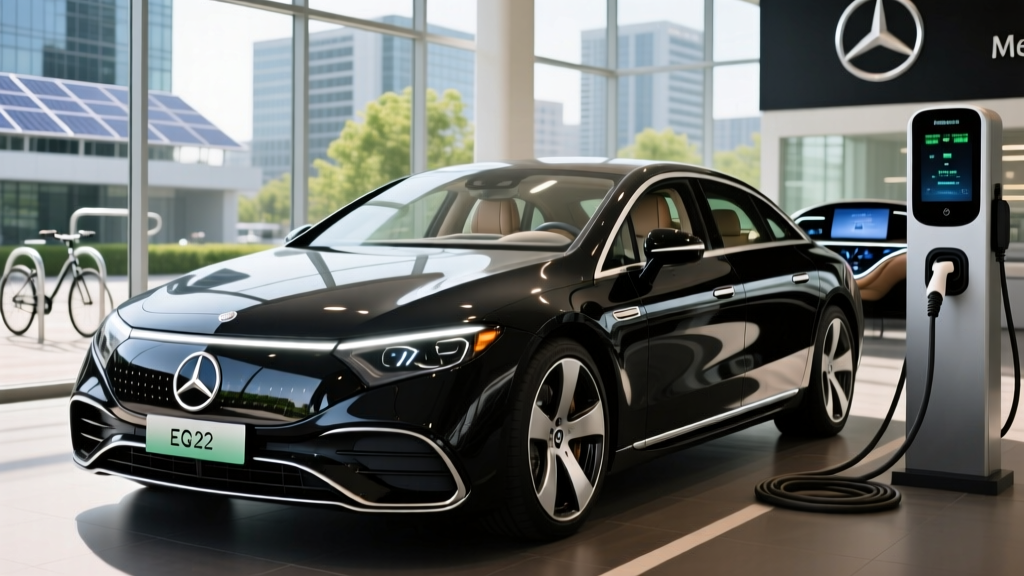
The 2022 Mercedes-Benz EQS-Class arrived as the brand's flagship electric sedan, and it remains one of the most range-efficient luxury EVs ever built. With an EPA-estimated 350 miles on the EQS 450+ and a drag coefficient of just 0.20 — the lowest of any production car at launch — the EQS proved that a full-size luxury sedan could rival smaller EVs on efficiency. Now available on the used market, the 2022 model year represents a compelling entry point for buyers seeking S-Class refinement with battery-electric powertrain economics.
But the EQS isn't without compromises. Its swooping roofline cuts into rear headroom, the MBUX Hyperscreen demands a learning curve, and federal tax credit eligibility for the original buyer was limited by MSRP caps. Here's the complete data-driven breakdown.
| Spec | EQS 450+ | EQS 580 4MATIC |
|---|---|---|
| EPA Range | 350 miles | 340 miles |
| Battery (usable) | 107.8 kWh (NMC) | 107.8 kWh (NMC) |
| Drivetrain | RWD (single motor) | AWD (dual motor) |
| Horsepower | 329 hp | 516 hp |
| Torque | 406 lb-ft | 631 lb-ft |
| 0–60 mph | 5.5 sec | 4.1 sec |
| Max DC Fast Charge | 200 kW | 200 kW |
| 10–80% DC Time | ~31 min | ~31 min |
| Level 2 Rate | 9.6 kW (~31 mi/hr) | 9.6 kW (~31 mi/hr) |
| MPGe (combined) | 97 MPGe | 94 MPGe |
| kWh/100 mi | 34 kWh | 36 kWh |
| Base MSRP (2022) | $102,310 | $125,900 |
| Battery Warranty | 10 yr / 155,000 mi | 10 yr / 155,000 mi |
Range and Efficiency: EPA vs. Real-World Driving
Real-World Expectation: ~290–320 miles on highway road trips at 70–75 mph; ~250–280 miles in freezing temperatures with cabin heat; up to 340+ miles in mild-weather city driving with regenerative braking engaged.
The EQS 450+ earned its 350-mile EPA rating through a combination of the 107.8 kWh usable battery pack and that record-breaking 0.20 Cd aerodynamic profile. According to fueleconomy.gov, the 450+ achieves 97 MPGe combined, translating to roughly 34 kWh per 100 miles — remarkably efficient for a 5,600-pound sedan.
In real-world highway testing by multiple outlets, the EQS 450+ typically delivers between 290 and 320 miles before requiring a charge at sustained 70–75 mph speeds. Cold weather (below 32°F) introduces a 15–25% range reduction common to NMC lithium-ion packs, dropping effective range to roughly 250–280 miles. The EQS includes a heat pump as standard equipment, which mitigates some of this loss by scavenging waste heat from the drivetrain rather than relying solely on resistive cabin heating.
For city-heavy commutes, the story flips: regenerative braking recaptures energy during stop-and-go driving, and several owners report exceeding the EPA sticker in mild conditions. The EQS offers three regen levels selectable via steering-wheel paddles, plus an adaptive "D Auto" mode that uses radar and navigation data to modulate regen dynamically — coasting when the road ahead is clear, braking when it detects a slower vehicle or upcoming intersection.
Charging Speed: DC Fast Charging and Home Level 2
| Charging Level | Power / Voltage | Speed (miles added per hour) | Notes |
|---|---|---|---|
| Level 1 (120V) | ~1.4 kW | ~4–5 mi/hr | Emergency/trickle only; 70+ hours for full charge |
| Level 2 (240V, 40A) | 9.6 kW | ~31 mi/hr | Full charge in ~11.25 hours; standard home setup |
| DC Fast Charge | 200 kW peak (CCS) | ~180–200 mi in 15 min | 10–80% in ~31 min; tapers significantly above 80% |
The 2022 EQS uses a CCS1 connector for DC fast charging and accepts up to 200 kW at compatible stations. On a 350 kW Electrify America or similar charger, the EQS ramps quickly to its 200 kW peak and sustains strong charging speeds through roughly 50–60% state of charge before tapering. The 10–80% charge takes approximately 31 minutes under ideal thermal conditions.
Charging curve reality check: That 200 kW figure is a peak, not an average. The actual average rate from 10–80% hovers closer to 150–165 kW. Above 80%, charging slows dramatically to protect the NMC cells — expect 80–100% to take an additional 30–40 minutes. For road trips, the optimal strategy is charging to 80% and moving on, which is where the EQS's long range becomes a genuine advantage: 80% of 350 miles still gives you 280 miles of driving.
At home, the onboard charger accepts up to 9.6 kW on a Level 2 (240V/40A) circuit, adding roughly 31 miles of range per hour. A full charge from near-empty takes about 11 hours, making overnight replenishment straightforward. Mercedes offers an optional 22 kW AC onboard charger in some markets, but the US-spec 2022 EQS is limited to 9.6 kW AC.
Preconditioning is critical for fast-charging performance. The EQS's navigation system will automatically begin warming the battery when you route to a DC fast charger, bringing cells to optimal temperature for maximum charge acceptance. Without preconditioning — particularly in cold weather — your first several minutes at the charger will operate well below the 200 kW peak.
Performance and Driving Dynamics
The EQS 450+ delivers its 329 horsepower and 406 lb-ft of torque through a single rear-mounted motor. The 0–60 mph sprint takes 5.5 seconds — quick for a 5,600-pound luxury sedan, though hardly sports-sedan territory. The EQS 580 4MATIC, with dual motors producing a combined 516 hp and 631 lb-ft, cuts that to 4.1 seconds and adds the all-weather confidence of AWD.
Where the EQS truly excels is ride quality. Standard AIRMATIC air suspension with adaptive damping delivers a magic-carpet feel over imperfect surfaces, and the optional rear-axle steering (up to 10 degrees) shrinks the car's effective turning circle to that of a compact hatchback — just 35.4 feet. This is a car engineered for wafting, not carving, and the steering weight reflects that priority.
Drive modes include Eco, Comfort, Sport, and Individual. Sport mode sharpens throttle response and firms the dampers but doesn't fundamentally alter the EQS's grand-touring character. The brake pedal feel, a common EV pain point due to the blending of regenerative and friction braking, is among the better implementations in the luxury segment — progressive and predictable once you learn the paddle-selectable regen system.
Interior, Cargo, and Technology
Passenger Space
Front-seat passengers enjoy 41.7 inches of legroom and 40.4 inches of headroom. Rear accommodations offer 41.9 inches of legroom — genuinely limousine-like — but the sloping roofline limits rear headroom to 38.0 inches, which may cause taller passengers to notice the headliner. The center rear position is best suited for shorter trips due to the floor tunnel hump (housing wiring and structural components, not a driveshaft).
Cargo Volume
The EQS provides 22.0 cubic feet of trunk space via a traditional sedan lid rather than a liftback or hatch. That's competitive with the BMW 7 Series and S-Class, but less versatile than the Tesla Model S's hatchback design (26.3 cu ft). There is no front trunk (frunk) — the space under the hood houses power electronics and the HVAC system. A 60/40 split-folding rear seat expands cargo capacity for longer items.
MBUX Hyperscreen and Infotainment
The optional MBUX Hyperscreen spans 56 inches across the entire dashboard, integrating a 12.3-inch instrument cluster, a 17.7-inch central OLED touchscreen, and a 12.3-inch passenger display behind a single curved glass panel. It's visually stunning but introduces a learning curve: menu structures are deep, and the touch-capacitive controls on the steering wheel require deliberate presses to avoid accidental inputs.
Standard technology includes wireless Apple CarPlay and Android Auto, a fingerprint reader for driver-profile authentication, an augmented-reality head-up display, and Mercedes' "Hey Mercedes" natural-language voice assistant, which handles everything from navigation to climate control with impressive accuracy.
Driver Assistance (SAE Level 2)
The EQS comes equipped with Mercedes' latest Driver Assistance Package, including:
- Active Distance Assist DISTRONIC: Adaptive cruise with stop-and-go
- Active Steering Assist: Lane-centering on highways
- Active Lane Change Assist: Semi-automated lane changes when turn signal is engaged
- Active Emergency Stop Assist: Safely stops the vehicle if the driver becomes unresponsive
Despite its sophistication, the EQS driver-assist system requires continuous driver supervision. Your hands must remain on the steering wheel, and your eyes must remain on the road. This is not autonomous driving. Mercedes' actual Level 3 system (DRIVE PILOT) was approved in Germany for limited conditions but was not available on the US-spec 2022 EQS.
Pricing, Trims, and Federal Tax Credit Eligibility
| Trim | Base MSRP (2022) | Typical As-Tested Price | §30D Federal Credit (New) |
|---|---|---|---|
| EQS 450+ Sedan | $102,310 | $110,000–$120,000 | Not eligible (MSRP cap: $55,000 for sedans) |
| EQS 580 4MATIC Sedan | $125,900 | $135,000–$145,000 | Not eligible (MSRP cap: $55,000 for sedans) |
| EQS 580 SUV (2023+) | $104,400 | $112,000+ | Not eligible (MSRP cap: $80,000 for SUVs) |
Under the IRS §30D Clean Vehicle Credit rules, new passenger sedans must have an MSRP at or below $55,000 to qualify for the up-to-$7,500 federal tax credit. The 2022 EQS-Class sedan, starting above $102,000, far exceeds this cap and does not qualify. Additionally, buyer income limits ($150,000 single / $300,000 joint AGI) and battery critical-mineral sourcing requirements further restrict eligibility even for lower-priced EVs.
For used-EV buyers in 2026, the §25E Used Clean Vehicle Credit offers up to $4,000 (or 30% of the sale price, whichever is lower) on qualifying pre-owned EVs purchased from a dealer. The used-EV credit has its own requirements: the vehicle must be at least two model years old, the sale price must not exceed $25,000, and buyer income caps apply ($75,000 single / $150,000 joint). Given that 2022 EQS models trade well above $25,000 on the used market — typically $55,000–$75,000 depending on mileage and condition — they will generally not meet the used-credit price cap either. Always consult IRS.gov or a tax professional to confirm your specific eligibility.
Ownership Costs and Warranty Coverage
Mercedes backs the 2022 EQS with a competitive warranty package:
- New Vehicle Limited Warranty: 4 years / 50,000 miles
- High-Voltage Battery Warranty: 10 years / 155,000 miles (guarantees minimum 70% capacity retention)
- Powertrain Warranty: 4 years / 50,000 miles (electric motors, power electronics)
- Corrosion Perforation: 4 years / 50,000 miles
The 10-year/155,000-mile battery warranty exceeds the federal minimum (8 years / 100,000 miles) and provides meaningful long-term confidence. Mercedes guarantees the pack will retain at least 70% of its original capacity during the warranty period — meaning your 350-mile range should not fall below roughly 245 miles within that window.
On the cost side, electricity for the EQS averages roughly $0.045–$0.055 per mile when charging at home at the national average of $0.16/kWh (using the 450+'s 34 kWh/100 mi consumption). Public DC fast charging at $0.35–$0.50/kWh raises that to $0.12–$0.17 per mile. For comparison, a similarly sized gas-powered S-Class achieving 24 MPG combined at $3.50/gallon costs about $0.146 per mile — meaning home-charged EQS ownership delivers fuel savings of roughly 60–70%.
Insurance premiums for the EQS tend to run 15–25% higher than the gas S-Class due to repair costs, battery replacement expense, and the vehicle's high value. Expect annual premiums in the $3,500–$5,000 range depending on your profile and location.
Pros, Cons, and Who Should Buy the EQS
✓ Pros
- Class-leading 350-mile EPA range (450+)
- Ultra-quiet cabin with exceptional ride isolation
- Record-low 0.20 Cd drag coefficient boosts highway efficiency
- Generous rear-seat legroom (41.9 in)
- 10-year/155,000-mile battery warranty
- Standard heat pump minimizes cold-weather range loss
- Rear-axle steering for remarkable low-speed maneuverability
- 200 kW DC fast charging with battery preconditioning
✗ Cons
- No federal tax credit eligibility (new or used price caps)
- MBUX Hyperscreen learning curve; touch controls can be finicky
- Sedan trunk (22 cu ft) less versatile than a hatchback
- No front trunk (frunk)
- Rear headroom limited by roofline slope
- High insurance premiums
- Heavy at 5,600+ lbs — tire wear is a long-term cost
- CCS-only in 2022 (NACS adapter may be needed for Tesla Superchargers)
Who the 2022 EQS Suits Best
Ideal buyer: A luxury-sedan loyalist transitioning from an S-Class or BMW 7 Series who prioritizes ride comfort, cabin isolation, and real-world range over sporty dynamics. The EQS excels as an executive commuter and long-distance cruiser. Its 350-mile range means most owners will charge exclusively at home and only use DC fast charging on road trips exceeding 300 miles.
Less ideal for: Buyers who need hatchback cargo versatility, those on a tighter budget (the used market still commands $55K+), or anyone expecting sports-sedan engagement. Families with tall teenagers may find the rear headroom limiting on longer trips.
Competitive Comparison: EQS vs. Rivals
| Attribute | Mercedes EQS 450+ | Tesla Model S LR | BMW i7 xDrive60 |
|---|---|---|---|
| EPA Range | 350 mi | 405 mi | 318 mi |
| Battery (usable) | 107.8 kWh NMC | ~95 kWh | 101.7 kWh NMC |
| 0–60 mph | 5.5 sec | 3.1 sec | 4.5 sec |
| DC Fast Charge | 200 kW (CCS) | 250 kW (NACS) | 195 kW (CCS) |
| Cargo Space | 22.0 cu ft | 26.3 cu ft (hatch) | 17.7 cu ft |
| Base MSRP (2022) | $102,310 | $94,990 | $119,300 |
| Battery Warranty | 10 yr / 155K mi | 8 yr / 150K mi | 8 yr / 100K mi |
The Tesla Model S Long Range wins on range (405 mi), acceleration (3.1 sec), and Supercharger network access, but its interior quality and ride refinement fall short of the Mercedes. The BMW i7, launched for 2023, offers comparable luxury but less range and a higher starting price. The EQS occupies a unique middle ground: S-Class-caliber comfort with genuinely competitive efficiency.
Frequently Asked Questions
What is the real-world range of the 2022 Mercedes-Benz EQS 450+?
Expect 290–320 miles on highway road trips at 70–75 mph and up to 340+ miles in mild-weather city driving. In freezing temperatures, plan for 250–280 miles. The EPA sticker of 350 miles is achievable in optimal conditions but represents a best-case scenario rather than a daily average.
How fast does the 2022 EQS charge at home and on the road?
On a Level 2 home charger (240V/40A), the EQS charges at 9.6 kW, adding about 31 miles per hour — a full charge takes roughly 11 hours. On a DC fast charger, it peaks at 200 kW and charges from 10–80% in approximately 31 minutes. Above 80%, charging slows significantly to protect battery health.
Does the 2022 EQS qualify for the federal EV tax credit?
No. The §30D new-vehicle credit caps sedan MSRP at $55,000, and the EQS starts above $102,000. The §25E used-vehicle credit caps the sale price at $25,000, which used EQS models exceed. Always verify current rules at IRS.gov.
Is the 2022 EQS worth buying used vs. the Tesla Model S or BMW i7?
If you value S-Class ride quality, cabin silence, and long-range efficiency over outright acceleration, the EQS is the strongest choice. The Model S wins on performance and Supercharger access; the i7 offers similar luxury but less range and a higher price. On the used market, the EQS 450+ often represents the best value per mile of range in the luxury EV sedan segment.
What battery chemistry does the EQS use, and how long will it last?
The 2022 EQS uses NMC (nickel-manganese-cobalt) lithium-ion cells. Mercedes warranties the 107.8 kWh pack for 10 years / 155,000 miles with a 70% capacity-retention guarantee. Real-world data from early high-mileage examples suggests annual degradation of roughly 1.5–2.5% under normal use, consistent with NMC chemistry best practices (avoiding frequent 100% charges and DC fast charging in extreme heat).
Can the 2022 EQS use Tesla Superchargers?
The 2022 EQS was built with a CCS1 port. As Mercedes-Benz has been transitioning to NACS for newer models, 2022 EQS owners may need a CCS-to-NACS adapter to access Tesla Superchargers that have opened to non-Tesla vehicles. Confirm adapter compatibility with Mercedes before purchasing a third-party adapter, as not all adapters support the EQS's communication protocols.