Quick Verdict: A Used Luxury EV SUV With Few Direct Rivals
If you're shopping the premium three-row electric SUV market and keep circling back to the Tesla Model X 2022, you're not alone. The 2022 model year represents Tesla's post-refresh "Plaid" architecture — meaning you get the updated interior, the yoke-or-wheel option, the 250 kW Supercharger compatibility, and up to 348 miles of EPA range in Long Wheelbase (Long Range) trim. In 2026, these vehicles are landing on the used market at meaningful discounts, making them arguably the most compelling way to access Tesla's flagship SUV without the six-figure new-car price tag.
But the Model X isn't without compromises. Falcon-wing doors can be slow and finicky, panel gaps still vary by unit, and the 2022 model year predates the NACS port standardization that newer Teslas enjoy (though it still charges on the Supercharger network natively). Here's everything you need to know before you buy.
Range, Battery, and Real-World Efficiency
The 2022 Model X came in two primary trims: Long Range (dual-motor AWD) and Plaid (tri-motor AWD). Both use a ~100 kWh usable battery pack with NMC (nickel-manganese-cobalt) chemistry — Tesla reserves LFP for its lower-cost, RWD Model 3/Y vehicles.
| Trim | EPA Range | Battery (usable) | Chemistry | MPGe (combined) | kWh/100 mi |
|---|---|---|---|---|---|
| Long Range (AWD) | 348 mi | ~100 kWh | NMC | 102 MPGe | 33 |
| Plaid (AWD) | 333 mi | ~100 kWh | NMC | 98 MPGe | 34 |
Efficiency is competitive for a 5,185-pound SUV. The heat pump (standard on the 2022 refresh) helps preserve range in cold conditions compared to older resistive-heating EVs. According to fueleconomy.gov, the Long Range achieves 102 MPGe combined, which translates to roughly 33 kWh per 100 miles — a figure that holds up well against the Rivian R1S and BMW iX.
Charging Speed: DC Fast, Level 2, and the Supercharger Advantage
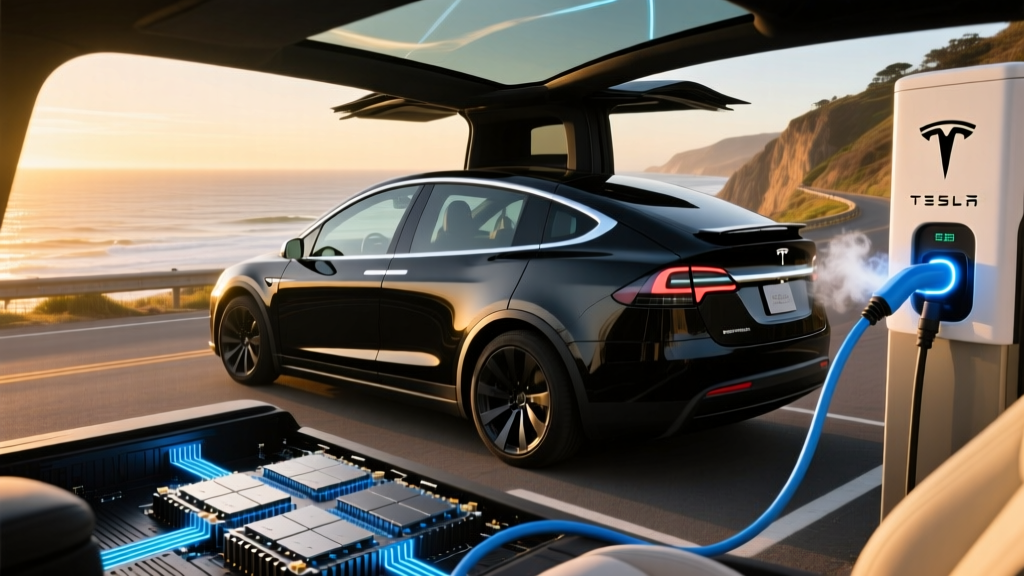
The 2022 Model X supports up to 250 kW peak DC fast charging on Tesla's V3 Superchargers. That's the same peak rate as the Model 3/Y and significantly faster than the older 150 kW V2 stations.
| Charging Level | Power / Rate | Speed | Notes |
|---|---|---|---|
| Level 1 (120V household) | ~1.4 kW | ~3–4 mi/hr | Emergency/trickle only |
| Level 2 (240V home, 48A) | 11.5 kW | ~30–34 mi/hr | Full charge in ~10 hours |
| DC Fast (V3 Supercharger) | 250 kW peak | 10–80% in ~30 min | Tapers above 60% SoC |
| DC Fast (CCS adapter, 3rd party) | Up to 150 kW typical | 10–80% in ~40 min | Requires Tesla CCS adapter |
Charging curve reality: The 250 kW peak is only sustained briefly at low state of charge (roughly 10–30% SoC). By 50% SoC, expect the rate to taper to ~150 kW, and above 80% it drops sharply to protect the NMC cells. A 10–80% session takes approximately 30 minutes at a V3 Supercharger — competitive, though not class-leading versus Hyundai/Kia's 800V architecture (which does 10–80% in ~18 minutes). For a 100 kWh pack, though, the sustained throughput is impressive.
Home charging: The onboard charger supports up to 11.5 kW (48 amps) on a Level 2 circuit. You'll need a 60-amp dedicated circuit (NEMA 14-60 or hardwired Wall Connector). A full overnight charge from 10% to 100% takes roughly 10 hours. Tesla's Wall Connector ($475) is the cleanest solution, but any J1772-compatible Level 2 station works with the included adapter.
Connector note: The 2022 Model X uses Tesla's proprietary connector (which became the NACS standard). It charges natively on all Superchargers. For Electrify America, EVgo, or other CCS networks, you'll need Tesla's CCS adapter (sold separately, ~$250) — unlike 2025+ models, it was not included standard.
Performance: Long Range vs. Plaid
The performance gap between the two 2022 trims is enormous.
| Spec | Long Range (Dual-Motor AWD) | Plaid (Tri-Motor AWD) |
|---|---|---|
| Horsepower | 670 hp | 1,020 hp |
| 0–60 mph | 3.8 seconds | 2.5 seconds |
| Top Speed | 155 mph | 163 mph |
| Drivetrain | Dual-motor AWD | Tri-motor AWD (torque vectoring) |
| Towing Capacity | 5,000 lbs | 5,000 lbs |
The Long Range's 3.8-second 0–60 is already supercar territory from a decade ago. The Plaid's 2.5 seconds is, frankly, absurd for a 5,200-pound family SUV — it will out-accelerate a Porsche 911 Turbo S off the line. Both trims feature adaptive air suspension, which adjusts ride height for efficiency, ground clearance, and loading.
Interior, Cargo, and Technology
The 2022 refresh brought a significantly updated interior over the pre-2021 Model X. Key changes include a 17-inch landscape-oriented center touchscreen, a rear-seat entertainment display, ventilated front seats, and a redesigned center console.
Seating configurations: The Model X offers 5-seat, 6-seat (with second-row captain's chairs), and 7-seat layouts. The 6-seat config is the most popular for family buyers — it provides walk-through access to the third row and more comfortable second-row seating.
| Dimension | Measurement |
|---|---|
| Cargo (behind 3rd row) | ~15 cu ft (est., varies by config) |
| Cargo (3rd row folded) | ~40 cu ft |
| Cargo (all rows folded) | ~88 cu ft (max, 5-seat config) |
| Front legroom | 41.2 in |
| 2nd-row legroom | 38.4 in |
| 3rd-row legroom | 32.7 in (tight for adults) |
| Frunk (front trunk) | ~6.6 cu ft |
Standout tech:
- Autopilot (standard) — adaptive cruise, lane-keeping, auto lane change. This is SAE Level 2 driver assistance; you must keep hands on the wheel and eyes on the road.
- Full Self-Driving (Supervised) — optional ($15,000 at time of purchase, or $12,000 on the used market in some cases). Adds traffic light/stop sign recognition, autosteer on city streets, and Smart Summon. Still Level 2 — not autonomous.
- Falcon-wing rear doors — ultrasonic-sensor-equipped gullwing doors that articulate to open in tight spaces. Unique but slower than conventional doors and prone to sensor errors in rain/snow.
- HEPA air filtration with "Bioweapon Defense Mode" — genuinely best-in-class cabin air quality.
- 17-inch touchscreen + rear display — runs navigation, media, games, and vehicle controls. No Apple CarPlay or Android Auto.
Notable drawbacks:
- No Apple CarPlay/Android Auto — Tesla's ecosystem is closed.
- Falcon-wing doors add complexity and repair cost; sensors can malfunction.
- Panel gap inconsistency is still a known issue on 2022 units — inspect carefully.
- Third row is best for children only; adults will find it cramped on longer trips.
- Yoke steering (if equipped) has a steep learning curve and is controversial for daily driving.
Pricing, Trims, and 2026 Tax Credit Eligibility
When new, the 2022 Model X Long Range started at $120,990 MSRP (including destination), and the Plaid at $138,990. Options like FSD, 22-inch wheels, and premium interior colors pushed well-equipped units past $150,000.
| Trim | Base MSRP (2022) | Typical Used Price (2026 est.) |
|---|---|---|
| Long Range | $120,990 | $65,000–$80,000 |
| Plaid | $138,990 | $75,000–$95,000 |
Warranty and Battery Longevity
Tesla's warranty coverage for the 2022 Model X:
- Basic Vehicle Limited Warranty: 4 years / 50,000 miles
- Battery & Drive Unit Warranty: 8 years / 150,000 miles (whichever comes first), with a minimum 70% capacity retention threshold
The 150,000-mile battery warranty is generous and reflects Tesla's confidence in its NMC pack management. Real-world data from Tesla's impact reports and owner communities suggest ~10–12% degradation at 100,000 miles for NMC packs — meaning most 2022 units with moderate mileage should still be well above the 70% warranty floor. If you're buying used, request the battery State of Health (SoH) reading from Tesla's service menu or a third-party diagnostic.
For context, a full battery replacement on the Model X costs approximately $15,000–$20,000 out of warranty — a figure worth considering if you're evaluating a high-mileage example.
Pros and Cons
Pros
- Class-leading range (348 mi EPA, Long Range)
- Supercharger network access (17,000+ US stations)
- Blistering acceleration in both trims
- Spacious cabin with frunk + rear cargo
- Over-the-air updates keep software current
- HEPA air filtration is genuinely excellent
- Strong towing capacity (5,000 lbs)
Cons
- No Apple CarPlay / Android Auto
- Falcon-wing doors add complexity and potential repair cost
- Panel gap inconsistency on many 2022 units
- Third row cramped for adults
- No federal tax credit available (new or used) at typical prices
- Insurance costs are above segment average
- Yoke steering divisive; service center wait times can be long
Who Should Buy the 2022 Model X?
Choose the 2022 Model X if:
- You need a three-row electric SUV with 300+ miles of real-world range and access to the Supercharger network for road trips.
- You value performance (3.8s or 2.5s 0–60) in a family vehicle.
- You want Tesla's software ecosystem, OTA updates, and Autopilot/FSD integration.
- You can charge at home (Level 2) and don't rely solely on public charging.
Look elsewhere if:
- You need a genuinely usable adult-sized third row (consider the Rivian R1S or Kia EV9).
- You want Apple CarPlay or a more traditional dealership service experience.
- Tax credit eligibility is a deal-breaker in your purchase decision.
- You want the latest 800V charging architecture (Hyundai/Kia/Porsche charge faster).
Competitor Comparison
| Spec | Tesla Model X LR | Rivian R1S (Dual) | BMW iX xDrive50 |
|---|---|---|---|
| EPA Range | 348 mi | 316 mi | 324 mi |
| Battery | ~100 kWh NMC | ~128 kWh (Large Pack) | ~105 kWh NMC |
| 0–60 mph | 3.8s | ~4.5s | 4.4s |
| DC Fast Charge (peak) | 250 kW | 220 kW | 200 kW |
| 3rd Row | Tight | Tight | None (2-row only) |
| Towing | 5,000 lbs | 7,700 lbs | 3,500 lbs |
| Charging Network | Supercharger (native) | NACS adapter / CCS | CCS (EA, etc.) |
| Est. Used Price (2026) | $65K–$80K | $55K–$70K | $50K–$65K |
The Model X wins on range and Supercharger access. The Rivian R1S wins on towing and off-road capability. The BMW iX wins on interior luxury and build quality. Your choice depends on which of those three priorities dominates your use case.
Frequently Asked Questions
What is the real-world range of the 2022 Tesla Model X?
The EPA rates the Long Range at 348 miles and the Plaid at 333 miles. In real-world highway driving at 70–75 mph, expect 280–310 miles (Long Range) and 260–290 miles (Plaid). Cold weather (below freezing) can reduce range by 15–25%, so winter highway trips may yield 240–260 miles. City driving with regenerative braking often matches or slightly exceeds the EPA figure.
How fast does the 2022 Model X charge?
On a Tesla V3 Supercharger, it peaks at 250 kW and charges from 10–80% in approximately 30 minutes. The charging curve tapers significantly above 60% SoC to protect the NMC battery. At home on a Level 2 (240V, 48A) charger, it adds roughly 30–34 miles of range per hour, with a full charge taking about 10 hours.
Does the 2022 Model X qualify for a federal tax credit in 2026?
Effectively, no. The new-vehicle §30D credit ($7,500) had an $80,000 MSRP cap for SUVs — the Model X exceeded this. The used-vehicle §25E credit (up to $4,000) requires a sale price of $25,000 or less, which no 2022 Model X will meet on the current used market. Always verify with a tax professional and IRS.gov §25E guidelines.
Is the 2022 Model X worth buying vs. the Rivian R1S or BMW iX?
It depends on your priorities. The Model X leads in EPA range (348 mi), Supercharger network access, and raw acceleration. The Rivian R1S is better for towing (7,700 lbs vs. 5,000), off-road use, and has a more conventional service model. The BMW iX offers a quieter, more luxurious interior and better build quality but lacks a third row. For road-trip-heavy families who value charging convenience, the Model X remains hard to beat.
How long will the 2022 Model X battery last?
Tesla warranties the battery for 8 years / 150,000 miles with a 70% capacity retention floor. Real-world data suggests NMC packs lose roughly 10–12% capacity over 100,000 miles under normal use. With proper care (avoiding frequent 100% charges, using daily charge limits of 80–90%), most 2022 Model X batteries should provide reliable service well beyond the warranty period.
Is Autopilot or FSD on the 2022 Model X self-driving?
No. Both Autopilot and Full Self-Driving (Supervised) are SAE Level 2 driver-assistance systems. You must remain fully engaged — hands on the wheel, eyes on the road — at all times. The vehicle can steer, accelerate, and brake in many scenarios, but it cannot handle all driving situations and is not autonomous. Only Level 4 services like Waymo operate without a driver.