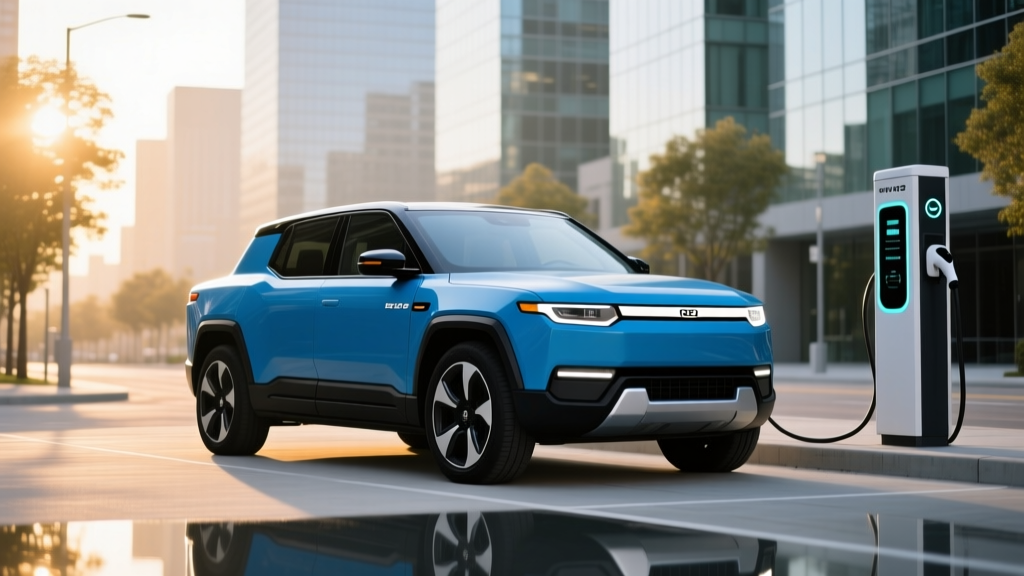
The Rivian R2 is no longer a distant concept — it is actively rolling off the Normal, Illinois assembly line in 2026, and thousands of reservation holders are finally converting their deposits into firm orders. If you are considering joining the Rivian R2 waitlist today, the critical questions have shifted from "Will it get built?" to "How long until I get mine?" and "Does the math actually work against a Tesla Model Y or Hyundai Ioniq 5?"
This profile breaks down every confirmed spec Rivian has published for the 2026 R2 launch window, reconciles EPA range estimates with real-world expectations, maps out the charging architecture, and runs the tax-credit gauntlet so you know exactly what you are signing up for before you put down a refundable deposit.
What the Rivian R2 Waitlist Actually Looks Like in 2026
Rivian began R2 production in the first half of 2026 using a newly retooled line at its Normal plant, ahead of the previously announced Georgia facility. Reservations opened in early 2024 with a $1,000 refundable deposit, and by mid-2025 the company disclosed that the waitlist had surpassed 68,000 names. As of early 2026, Rivian is working through that backlog in waves, prioritizing the Launch Edition and higher-trim dual-motor configurations before opening the base single-motor RWD variant later in the model year.
If you place a deposit today, expect a delivery window in late 2026 or early 2027 depending on trim selection and your geographic region. Rivian has been more disciplined about wave-based scheduling than its R1T/R1S ramp-up, but supply-chain variability — particularly around the new 4680-format cylindrical cells — means firm delivery dates are not assigned until approximately 8–10 weeks before your build slot.
The dual-motor AWD R2 carries an EPA-estimated 330 miles of range on the standard battery pack. In real-world highway driving at 70–75 mph, expect approximately 270–290 miles. In sub-freezing winter conditions (20–30°F), plan for a 20–30% reduction, landing around 230–265 miles depending on cabin heat usage and whether you precondition the battery. The upcoming single-motor RWD variant is targeted for 340+ miles EPA, but that trim is not yet in production.
Complete Rivian R2 Specs: Range, Battery, and Efficiency
Rivian has been transparent about the R2's core architecture. The standard pack uses an NMC (nickel manganese cobalt) chemistry in a structural 4680-format cylindrical cell layout, with approximately 85 kWh of usable capacity. Rivian has not released a gross capacity figure, but the usable number is what determines your drivable range and charging behavior.
An LFP (lithium iron phosphate) variant has been hinted at for a future standard-range or fleet-oriented trim, which would trade energy density for cycle life and the ability to charge to 100% daily without degradation concerns. As of 2026, all R2 reservations are being fulfilled with the NMC pack.
| Specification | Value |
|---|---|
| EPA Estimated Range | 330 miles |
| Battery Usable Capacity | ~85 kWh (NMC, 4680 cells) |
| Efficiency | ~26 kWh/100 mi (~129 MPGe combined) |
| Drivetrain | Dual-motor AWD |
| Horsepower | ~450 hp (est., dual-motor) |
| 0–60 mph | ~4.5 seconds (est.) |
| Max DC Fast Charge Rate | ~200 kW peak |
| 10–80% DC Fast Charge | ~28 minutes |
| Level 2 Home Charging | 11.5 kW (~37 mi/hr) |
| Cargo Volume (rear seats up) | ~34 cu ft |
| Cargo Volume (rear seats folded) | ~68 cu ft |
| Front Trunk (Frunk) | ~11 cu ft |
| Rear Legroom | ~38 inches |
| Towing Capacity | ~3,300 lbs (est.) |
| Battery/Powertrain Warranty | 8 years / 100,000 miles |
| Bumper-to-Bumper Warranty | 5 years / 60,000 miles |
Note: Rivian has published the 330-mile EPA target and 85 kWh usable figure. Horsepower, 0–60, and cargo dimensions are based on Rivian's pre-production disclosures and may shift slightly for final EPA certification. Check fueleconomy.gov for the finalized sticker once the vehicle ships to customers.
Charging Speed and Infrastructure: What R2 Owners Need to Know
The R2 is equipped with a NACS (North American Charging Standard) port natively, meaning it plugs directly into Tesla Superchargers without an adapter — a significant advantage over CCS-equipped competitors that still rely on dongles. Rivian owners gained access to the Supercharger network starting in 2024 via adapter for R1 vehicles, but the R2 is the first Rivian designed from the ground up with NACS.
On a DC fast charger, the R2 peaks at approximately 200 kW, though like all EVs, it does not sustain that rate for the entire session. The charge curve is aggressive from 10–50% SoC, tapering meaningfully above 80%. A 10–80% session takes roughly 28 minutes at a capable 250+ kW station. On Electrify America or EVgo stalls limited to 150 kW, expect 10–80% to stretch to 35–40 minutes.
At home on a Level 2 wall connector at 11.5 kW (48-amp circuit, requiring a 60-amp breaker), the R2 adds approximately 37 miles of range per hour, meaning a full 10–100% charge takes about 8.5 hours — easily achievable overnight. Level 1 trickle charging on a standard 120V outlet adds roughly 3–4 miles per hour, useful for topping off but not practical as a primary strategy.
| Charging Level | Power (kW) | Miles Added per Hour | 10–80% Time |
|---|---|---|---|
| Level 1 (120V household) | ~1.4 kW | ~3–4 mi/hr | N/A (days) |
| Level 2 (240V, 48A home) | 11.5 kW | ~37 mi/hr | ~7.5 hours |
| DC Fast (150 kW station) | ~150 kW sustained avg | ~400+ mi/hr (peak) | ~35–40 min |
| DC Fast (250+ kW station) | ~200 kW peak | ~550+ mi/hr (peak) | ~28 min |
Pricing, Trims, and Federal Tax Credit Eligibility
The R2's pricing strategy is central to Rivian's volume ambitions. The announced MSRP structure positions it squarely against the Tesla Model Y, Hyundai Ioniq 5, and upcoming Chevrolet Equinox EV trims.
| Trim / Config | Base MSRP | Est. After §30D Credit | Notes |
|---|---|---|---|
| Standard AWD (Dual-Motor) | $52,900 | $45,400* | Launch wave, currently building |
| Premium AWD | $57,500 | $50,000* | Added luxury/tech package |
| Base RWD (Single-Motor) | $45,000 | $37,500* | Late 2026 / early 2027 availability |
*The $7,500 federal EV tax credit under IRS §30D is not guaranteed for every buyer or every vehicle. Eligibility depends on multiple factors that change annually:
- MSRP Cap: SUVs must have an MSRP at or below $80,000. All announced R2 trims clear this threshold.
- Buyer Income Cap: Adjusted gross income must not exceed $150,000 (single), $225,000 (head of household), or $300,000 (joint). Verify against your tax return.
- Battery Sourcing: A percentage of critical minerals and battery components must be sourced from the U.S. or free-trade-agreement countries. Rivian has not publicly confirmed full §30D compliance for every R2 battery batch — verify at the point of sale or on irs.gov.
- Point-of-Sale Transfer: As of 2024, you can transfer the credit to the dealer at purchase, reducing your out-of-pocket cost immediately rather than waiting for a tax refund. Rivian's direct-to-consumer model supports this.
Always consult a tax professional before relying on the credit. The sourcing rules in particular have disqualified several EVs mid-year, and Rivian's supply chain is still maturing.
Performance, Tech, and Daily Livability
The dual-motor AWD R2 produces an estimated 450 horsepower and should reach 60 mph in approximately 4.5 seconds. That puts it in the same performance bracket as a Model Y Long Range but below the Performance variant. Rivian's torque vectoring and quad-motor heritage (from the R1T/R1S) suggest the R2 will punch above its spec sheet on loose surfaces, though we have not yet independently verified production-vehicle handling.
Inside, the R2 runs Rivian's latest infotainment stack on a 15.6-inch center display with a fully digital instrument cluster. Key technology features include:
- Driver+ (Level 2 ADAS): Rivian's proprietary driver-assistance suite offering adaptive cruise, lane-centering, and highway assist. This is SAE Level 2 — you must keep your hands on or near the wheel and remain attentive at all times. It is not autonomous driving.
- Over-the-Air Updates: Full-vehicle OTA capability covering powertrain calibration, infotainment, ADAS tuning, and feature unlocks.
- Adventure Network Integration: Built-in trail mapping, camping waypoints, and range-aware routing optimized for outdoor use cases.
- Vehicle-to-Load (V2L): The R2 supports powering external devices (camping gear, power tools, tailgate setups) from the traction battery, though exact outlet wattage has not been finalized.
- Gear Tunnel Option: A transverse pass-through storage compartment behind the rear seats, echoing the R1T's signature feature in a smaller footprint.
Cargo space is competitive for the compact electric SUV segment. With rear seats upright, expect roughly 34 cubic feet behind the second row — enough for a weekend camping trip for two or a Costco run for a family of four. Fold the 60/40 split rear bench and capacity expands to approximately 68 cubic feet. The 11-cubic-foot frunk adds secure, weatherproof storage for charging cables or a small cooler.
Rear legroom at approximately 38 inches is adequate for adults on shorter trips but tighter than a Hyundai Ioniq 5's generous 39.4 inches. Taller passengers (6'2"+) will notice the sloping roofline cutting into headroom in the outboard rear seats.
Rivian R2 vs. Key Competitors: Is It Worth the Wait?
The R2 does not exist in a vacuum. Here is how it stacks up against the three vehicles most R2 reservation holders cross-shop, based on current 2026 data:
| Attribute | Rivian R2 AWD | Tesla Model Y LR | Hyundai Ioniq 5 LR AWD | Chevy Equinox EV 3RS |
|---|---|---|---|---|
| EPA Range | 330 mi | 320 mi | 290 mi | 319 mi |
| Battery (usable) | ~85 kWh | ~75 kWh | 77.4 kWh | ~85 kWh |
| DC Fast Charge (peak) | ~200 kW | 250 kW | 240 kW | ~190 kW |
| 10–80% Time | ~28 min | ~22 min | ~18 min | ~32 min |
| Base MSRP (AWD) | $52,900 | $48,990 | $50,250 | $44,900 (FWD) |
| NACS Native | Yes | Yes | No (adapter req.) | No (adapter req.) |
| Cargo (seats up) | ~34 cu ft | 30 cu ft | 27 cu ft | 26 cu ft |
| Towing | ~3,300 lbs | 3,500 lbs | 2,300 lbs | 1,500 lbs |
- You prioritize cargo versatility, frunk storage, and adventure-oriented features (gear tunnel, V2L, trail mapping)
- You want native NACS/Supercharger access without carrying an adapter
- You value Rivian's brand ethos and are willing to wait 6–12 months for delivery
- Towing capacity above 3,000 lbs matters for a small trailer or boat
- You need a vehicle now — the Model Y and Ioniq 5 have immediate or near-immediate inventory
- Fastest possible DC charging is your top priority (Ioniq 5's 18-minute 10–80% is class-leading)
- Price sensitivity is paramount and the Equinox EV's lower MSRP fits your budget
The Biggest Pros and Cons of the R2
- 330-mile EPA range is competitive and practical for road trips
- Native NACS port — seamless Supercharger access
- Strong cargo versatility with frunk + gear tunnel option
- Rivian's proven ADAS and OTA update track record from R1 fleet
- V2L capability for camping and outdoor use
- Refundable $1,000 deposit — low-risk reservation
- Waitlist delivery may stretch into 2027 for later reservations
- ~200 kW peak DC charge rate trails Ioniq 5 and Model Y
- Rear headroom compromised by sloping roofline for tall passengers
- Rivian's service center network is still expanding — coverage gaps in rural areas
- Tax-credit battery-sourcing compliance not yet fully confirmed for all build waves
- No third-row option (unlike the larger R1S)
Who the Rivian R2 Suits Best
The R2 is engineered for a specific buyer profile: outdoor-oriented households who need a practical daily driver that can also handle weekend camping trips, light towing, and dirt-road excursions without switching vehicles. If you currently own a Subaru Outback, Toyota RAV4 Adventure, or Ford Bronco Sport and are ready to go electric, the R2 is arguably the most spiritually aligned replacement in the 2026 EV market.
It also works well as a two-car household's primary EV when paired with a second vehicle for heavy towing or long solo commutes. The 330-mile range and Supercharger access make it viable as a sole vehicle for most families, provided your longest regular drive is under 250 miles one-way (allowing a comfortable buffer in winter).
It is not the right choice if you need immediate delivery, require third-row seating, or prioritize absolute fastest-charging performance over adventure utility.
Frequently Asked Questions
What is the real-world range of the Rivian R2?
The EPA estimates 330 miles for the dual-motor AWD variant. In real-world highway driving at 70–75 mph, expect 270–290 miles. In cold weather (below 32°F), plan for 230–265 miles depending on how aggressively you use cabin heat and whether you precondition the battery before driving.
How fast does the R2 charge at home and on the road?
On a home Level 2 charger at 11.5 kW, the R2 adds about 37 miles per hour — a full overnight charge takes roughly 8.5 hours. On a 250+ kW DC fast charger, 10–80% takes approximately 28 minutes. On a 150 kW station, that stretches to 35–40 minutes due to the charge-curve taper.
How much does the R2 cost after the federal tax credit?
The dual-motor AWD starts at $52,900 MSRP. If you qualify for the full $7,500 §30D credit (subject to income, MSRP, and battery-sourcing rules), the effective price drops to approximately $45,400. The future single-motor RWD at $45,000 could land near $37,500 after credit. Always verify eligibility on irs.gov or with a tax professional.
Does the Rivian R2 qualify for the $7,500 federal EV tax credit?
It is expected to, but eligibility is not automatic. The R2's MSRP clears the $80,000 SUV cap. Your personal income must fall below IRS thresholds ($150K single / $300K joint). The battery-sourcing requirement is the wildcard — Rivian has been working to secure compliant supply chains, but you should confirm at the time of order whether your specific build batch qualifies. The credit can be transferred at point of sale.
Is the Rivian R2 worth waiting for vs. buying a Model Y or Ioniq 5 now?
If you value adventure utility (frunk, gear tunnel, V2L, trail mapping), native Supercharger access, and are comfortable waiting 6–12 months, the R2 offers a differentiated ownership experience. If you need a car immediately or prioritize the fastest DC charging speeds, the Ioniq 5 (18-min 10–80%) or Model Y (immediate inventory, 250 kW peak) may be more pragmatic.
What is Rivian's battery warranty on the R2?
Rivian provides an 8-year / 100,000-mile battery and powertrain warranty, consistent with federal minimum requirements and matching most competitors. The bumper-to-bumper coverage is 5 years / 60,000 miles. Rivian has not published a specific capacity-retention threshold (e.g., 70% SoH) for the R2 yet — check your purchase agreement for exact terms.
Can I cancel my R2 reservation and get my deposit back?
Yes. Rivian's $1,000 reservation deposit is fully refundable. You can cancel at any time through your Rivian account before converting to a firm order. This makes joining the waitlist a low-risk way to hold your place while you evaluate the competitive landscape.
Sources: Rivian official specifications (rivian.com), U.S. Department of Energy fueleconomy.gov, IRS §30D Clean Vehicle Credit guidance (irs.gov). All specs reflect the latest available data as of early 2026 and are subject to final EPA certification and production adjustments.