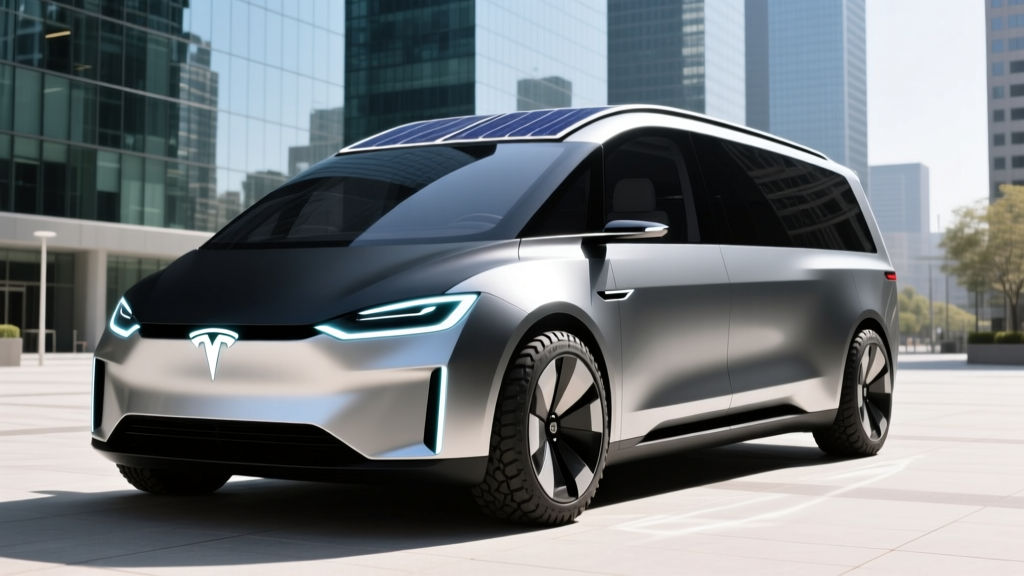
Tesla has teased a passenger van concept—internally referred to as the "Robovan" and widely searched as the Tesla Model Van—since at least 2020. As of early 2026, the vehicle remains an announced concept with no official specifications, pricing, or on-sale date published by Tesla. This profile compiles every confirmed statement, credible projection based on Tesla's current platform architecture, and honest assessment of what buyers can reasonably expect if and when this vehicle reaches production.
If you're searching for a Tesla people-mover or fleet shuttle today, this article will clarify whether waiting makes sense or whether current market alternatives better serve your needs right now.
What Is the Tesla Model Van (Robovan)?
The Tesla Robovan was first mentioned during Tesla's 2020 Battery Day event, where Elon Musk outlined a future vehicle lineup that would include a van capable of carrying up to 20 passengers. Musk described it as a high-volume, potentially autonomous-capable people-mover designed for both personal and fleet use.
Since then, the concept has surfaced sporadically in Tesla earnings calls and public appearances. In 2024, Tesla designer Franz von Holzhausen confirmed that the Robovan design had been explored but noted it was not yet in active production development. As of Q1 2026, Tesla's publicly listed vehicle lineup includes the Model S, Model 3, Model X, Model Y, Cybertruck, and the next-generation Roadster—no van.
The "Tesla Model Van" search term has gained traction among buyers looking for:
- A Tesla-branded passenger van for large families (7-8+ seats)
- A fleet shuttle or ride-hailing vehicle with autonomous capability
- A camper-conversion platform with Tesla's Supercharger network access
- A commercial cargo van competitor to the Ford E-Transit or Mercedes eSprinter
None of these use cases can currently be fulfilled by a Tesla product.
Projected Specifications: What We Can Estimate
While Tesla has not released official specs, we can build reasonable projections based on the company's current battery architecture, motor configurations, and the physics of a large van platform. The table below represents estimated figures—treat them as informed projections, not confirmed data.
| Attribute | Estimated / Projected | Basis for Estimate |
|---|---|---|
| EPA Range | 250–320 miles (projected) | Based on 100–120 kWh pack, van aerodynamics |
| Battery Capacity | ~100–120 kWh usable (estimated) | Sized for heavy vehicle; similar to Cybertruck |
| Battery Chemistry | Likely NMC (high energy density needed) | LFP too heavy for large-van range targets |
| Drivetrain | Dual-motor AWD (likely) | Heavy vehicle needs traction + power |
| 0–60 mph | 5.5–7.0 seconds (estimated) | Heavy curb weight limits acceleration |
| Peak DC Fast Charge | ~250–350 kW (projected) | 800V architecture possible; Cybertruck peaks at 350 kW |
| 10–80% DC Charge Time | ~25–35 minutes (estimated) | Large pack + taper above 80% SoC |
| Level 2 Home Charging | 11.5 kW (~30–35 mi/hr) | Tesla Wall Connector standard |
| Seating Capacity | 7–20 passengers (config-dependent) | Musk's 2020 Battery Day statement |
| Cargo Volume | Unknown (no body style confirmed) | — |
| Base MSRP | $70,000–$100,000+ (estimated) | Large pack + platform cost; fleet pricing possible |
| Battery Warranty | 8 yr / 150,000 mi (projected) | Consistent with Tesla's current heavy-vehicle coverage |
Real-World Range: What to Expect From a Large EV Van
Real-World Highway Expectation: ~200–260 miles at 70 mph
Cold-Weather Expectation (20°F): ~160–220 miles (30–40% reduction from EPA)
Even if Tesla achieves a 300+ mile EPA rating, real-world range in a large van will face significant physics challenges:
- Aerodynamic drag: A tall, boxy van has a drag coefficient (Cd) likely between 0.30–0.38, compared to the Model S at 0.208. Highway efficiency drops sharply with poor aero.
- Curb weight: A passenger van with a 100+ kWh battery could weigh 6,000–7,500 lbs, demanding more energy per mile than any current Tesla passenger car.
- Cold-weather loss: LFP and NMC batteries alike lose 25–40% of range in sustained sub-freezing temperatures. A heat pump (standard on current Teslas) mitigates cabin heating draw but cannot fully offset battery chemistry losses.
- Charging-curve taper: A 100+ kWh pack charging at 250–350 kW peak will sustain that rate only up to roughly 50–60% SoC. Expect the 60–80% portion to add 8–12 minutes. The published 10–80% time accounts for this taper, but real-world charging sessions often extend further if the pack isn't preconditioned.
For comparison, the Ford E-Transit (a cargo van with a 68 kWh usable battery) achieves an EPA-estimated 126 miles of range. A Tesla van with roughly double the battery capacity could plausibly reach 250+ miles—but only if Tesla engineers manage the weight and aero trade-offs effectively.
Charging Speed: DC Fast and Home Level 2 Projections
Charging speed is often the deciding factor for commercial and fleet van buyers who need minimal downtime. Here's what a Tesla Model Van would likely deliver based on current Tesla charging architecture:
| Charging Level | Power (kW) | Miles Added per Hour | Notes |
|---|---|---|---|
| Level 1 (120V household) | ~1.4 kW | ~3–4 mi/hr | Impractical for daily use on a large pack |
| Level 2 (240V, Tesla Wall Connector) | 11.5 kW | ~30–35 mi/hr | Full charge in ~9–11 hours overnight |
| DC Fast Charge (Supercharger V3/V4) | 250–350 kW peak | ~500–700 mi/hr (peak) | Sustained only to ~50–60% SoC; tapers above |
Key distinction: kW (kilowatts) measures charging power—the rate at which energy flows into the battery. kWh (kilowatt-hours) measures battery capacity—the total energy stored. A 350 kW peak charge rate doesn't mean you're getting 350 kWh in an hour; the rate tapers as the battery fills, especially above 80% State of Charge (SoC). This is why 10–80% charge times are the industry standard metric.
If Tesla equips the Robovan with an 800V architecture (as used in the Cybertruck), peak charge rates could reach 350 kW at V4 Superchargers. However, a ~110 kWh pack at 350 kW peak would still require roughly 25–35 minutes for a 10–80% session due to the taper curve. Fleet operators should plan for 30–40 minute charging stops, not the 15-minute sessions possible with smaller packs.
Home charging on a standard 48-amp Level 2 circuit (Tesla Wall Connector) would fully replenish a ~110 kWh pack in approximately 9–11 hours. Fleet depots would need to install multiple high-power Level 2 or DC fast chargers to keep a van fleet operational.
Pricing, Tax Credits, and the §30D Problem
Pricing for the Tesla Model Van is entirely speculative. Based on Tesla's current pricing structure and the cost of a large battery pack, here's a reasonable projection:
| Trim / Config | Estimated MSRP | §30D Credit Eligibility |
|---|---|---|
| Base (RWD, 7-seat) | ~$70,000–$80,000 | Possible if under $80K MSRP cap |
| Long Range (AWD, 7-seat) | ~$85,000–$95,000 | Likely exceeds MSRP cap for vans |
| Fleet / 15-20 seat | ~$95,000–$120,000+ | Exceeds MSRP cap; commercial credit (§45W) may apply |
Federal Tax Credit Eligibility (IRS §30D)
The IRS §30D Clean Vehicle Credit provides up to $7,500 for qualifying new EVs, but eligibility depends on several factors that create real obstacles for a Tesla van:
- MSRP Cap: Vans, SUVs, and pickup trucks must have an MSRP at or below $80,000. Sedans are capped at $55,000. If Tesla prices any Model Van trim above $80,000, it loses the credit entirely.
- Buyer Income Limits: Modified adjusted gross income (MAGI) must not exceed $150,000 (single), $225,000 (head of household), or $300,000 (joint). These are hard caps.
- Battery Sourcing: The vehicle must meet critical-mineral and battery-component sourcing requirements that tighten annually. By 2026, a significant percentage of battery minerals must be sourced from the US or free-trade-agreement countries, and components cannot come from a "foreign entity of concern." Tesla's supply chain has adapted for current models, but a new platform introduces uncertainty.
- Point-of-Sale Transfer: As of 2024, buyers can transfer the credit to the dealer at purchase, reducing the upfront price rather than waiting for a tax refund. This applies if the vehicle qualifies.
Bottom line: A base Model Van might qualify if Tesla prices it at or below $80,000 and meets sourcing requirements. Higher trims almost certainly will not. Fleet buyers should investigate the separate §45W Commercial Clean Vehicle Credit, which has different rules for business-owned vehicles. Consult a tax professional before relying on credit projections.
Driver Assistance and Autonomous Capability
Tesla's Robovan concept has often been discussed in the context of autonomous fleet operations. Musk has suggested the vehicle could eventually operate as a driverless shuttle. However, Tesla's current Full Self-Driving (Supervised) software remains a Level 2 system despite its name. The National Highway Traffic Safety Administration (NHTSA) has investigated multiple Tesla Autopilot and FSD incidents, and the system requires active driver monitoring.
If a production Model Van launches with Tesla's current hardware suite (HW4 cameras and neural-network processing), it would offer:
- Adaptive cruise control with stop-and-go
- Lane centering and automatic lane changes (with confirmation or in supervised mode)
- Traffic-light and stop-sign recognition
- Park assist and summon features
Any claim of "autonomous" or "self-driving" capability for a consumer Tesla van should be treated skeptically until NHTSA certifies a Level 4 or Level 5 system for the vehicle—a milestone Tesla has not yet achieved for any production model.
Who Should Wait — and Who Should Look Elsewhere
The Tesla Model Van concept targets several distinct buyer profiles. Here's an honest assessment of whether waiting makes sense for each:
✓ Wait If You…
- Need a 10+ seat Tesla specifically and have no timeline pressure
- Run a fleet operation and can wait 2–4+ years for potential autonomous features
- Want Supercharger network access for a large passenger van
- Are speculating on Tesla's robotaxi/fleet business model
✗ Look Elsewhere If You…
- Need a van now for family, business, or fleet use
- Require confirmed specs and pricing for budgeting
- Want a vehicle with established safety ratings (NHTSA/IIHS)
- Need to confirm federal tax credit eligibility before purchasing
Available Alternatives Today
If you need an electrified van in 2026, these options are actually on sale:
- Ford E-Transit (cargo): EPA-estimated 126 miles range, 68 kWh battery, starts ~$47,000. Proven fleet platform with DC fast charging to 115 kW.
- Mercedes-Benz eSprinter: EPA-estimated ~200 miles range (with 113 kWh pack), starts ~$72,000. Available in cargo and passenger configurations.
- Rivian EDV (Amazon delivery van): Not available to consumers, but demonstrates that a modern EV van platform is viable.
- Chrysler Pacifica Hybrid (PHEV): For families needing 7 seats with some electric capability, this plug-in hybrid offers 32 miles of electric-only range and 30 MPG combined thereafter. Available now, starts ~$51,000.
Biggest Pros and Cons (Projected)
Potential Pros
- Supercharger network access (17,000+ stalls in North America)
- Tesla's OTA software updates and feature improvements over time
- Potential for best-in-class efficiency vs. legacy EV vans
- Integrated Tesla ecosystem (Powerwall, solar, fleet management)
- Strong resale value history for Tesla products
Known Concerns
- Not available — no confirmed production timeline
- No official specs, pricing, or safety data
- Large battery = high cost; likely exceeds §30D MSRP cap on most trims
- Tesla's track record with new-vehicle production delays (Roadster, Cybertruck)
- Insurance costs for Tesla vehicles are historically above segment average
- Service center capacity for a large new vehicle line is unproven
Frequently Asked Questions
What is the real-world range of the Tesla Model Van?
Tesla has not published an EPA range estimate because the vehicle does not yet exist in production form. Based on projected battery capacity (~100–120 kWh) and the aerodynamic and weight penalties of a van body, a real-world highway range of 200–260 miles is a reasonable estimate. Cold-weather driving could reduce this to 160–220 miles. These are projections, not guarantees.
How fast does the Tesla Model Van charge?
No official charging specs exist. Projected DC fast charging at 250–350 kW peak (depending on architecture) could deliver a 10–80% charge in approximately 25–35 minutes. Home Level 2 charging at 11.5 kW would add roughly 30–35 miles of range per hour, requiring 9–11 hours for a full charge. Actual speeds depend on battery preconditioning, ambient temperature, and charger availability.
How much does the Tesla Model Van cost after tax credits?
There is no confirmed price. Estimated base pricing of $70,000–$80,000 could potentially qualify for the $7,500 federal §30D credit if the MSRP stays at or below the $80,000 van cap and the buyer meets income requirements. That would bring a base model to roughly $62,500–$72,500. Higher trims likely exceed the MSRP cap and would not qualify. These are estimates for a vehicle that is not yet on sale.
Is the Tesla Model Van worth buying vs. competitors?
There is nothing to buy yet. If Tesla eventually produces a van with 250+ miles of range, Supercharger access, and competitive pricing, it could be compelling for fleet operators and large families. Today, buyers who need an electric van should evaluate the Ford E-Transit, Mercedes eSprinter, or (for passenger needs) the Chrysler Pacifica Hybrid. Waiting for an unconfirmed Tesla product carries significant timeline risk.
Does the Tesla Model Van qualify for the federal EV tax credit?
Cannot be determined. The vehicle is not in production and has no official MSRP. If a base trim is priced at or below $80,000 and meets 2026 battery-sourcing requirements under IRS §30D rules, it could qualify. Buyers must also meet income caps ($150K single / $300K joint). Consult a tax professional before making any purchase decision based on projected credit eligibility.
When will the Tesla Model Van be available?
Tesla has not announced a production timeline for the Robovan / Model Van. Elon Musk mentioned the concept in 2020, and Tesla designers have confirmed exploratory work, but the vehicle is not in Tesla's publicly stated near-term production roadmap. Given Tesla's history of multi-year delays on announced products (Roadster 2.0 was announced in 2017 and remains unreleased as of 2026), a realistic production window—if it happens at all—is likely 2028 or later.
Can I reserve a Tesla Model Van today?
No. Tesla is not accepting reservations for any van or Robovan product. Any website or third party claiming to take reservations for a Tesla Model Van is not affiliated with Tesla and should be treated with extreme caution.
Sources: Tesla official site, IRS §30D Clean Vehicle Credit, fueleconomy.gov. All projected specifications are estimates based on publicly available information about Tesla's current platforms and are not confirmed by Tesla. This article will be updated if and when Tesla releases official Robovan specifications.