The Yoke Changes Everything — For Better or Worse
No single feature in the current EV market polarizes buyers quite like the Tesla Model S Yoke steering wheel. It's either the most futuristic cockpit interface you've ever used or an ergonomic misstep that complicates low-speed maneuvering. After spending extended time with the 2026 Model S Long Range and Plaid — both equipped with the Yoke as standard — the truth lands somewhere in between, heavily dependent on your driving habits and tolerance for relearning muscle memory.
But the Yoke is just the steering interface. Beneath it sits one of the most capable luxury electric sedans on the market: a 402-mile EPA range (Long Range), a 1,020-horsepower Plaid variant that hits 60 mph in under 2 seconds, and access to Tesla's 20,000+ Supercharger network. This review covers every number that matters — range, charging curves, real-world efficiency, pricing after federal tax credits, and whether the Model S still earns its premium in a market now crowded with the Lucid Air, BMW i7, and Mercedes EQS.
| Spec | Long Range | Plaid |
|---|---|---|
| EPA Range | 402 miles | 396 miles |
| Battery (usable) | ~95 kWh (NMC) | ~95 kWh (NMC) |
| Drivetrain | Dual-Motor AWD | Tri-Motor AWD |
| Horsepower | 670 hp | 1,020 hp |
| 0–60 mph | 3.1 seconds | 1.99 seconds |
| Top Speed | 155 mph | 200 mph |
| Max DC Fast Charge | 250 kW | 250 kW |
| 10–80% DCFC Time | ~27 minutes | ~27 minutes |
| Level 2 Charge Rate | 11.5 kW (~41 mi/hr) | 11.5 kW (~41 mi/hr) |
| MPGe (combined) | 120 MPGe | 116 MPGe |
| Efficiency | 28 kWh/100mi | 29 kWh/100mi |
| Base MSRP | $79,990 | $94,990 |
| Battery Warranty | 8 yr / 150,000 mi | 8 yr / 150,000 mi |
Range Reality: EPA Sticker vs. What You'll Actually See
EPA Estimate: 402 miles (Long Range) / 396 miles (Plaid)
Real-World Expectation: Plan for 320–360 miles on mixed highway driving at 70–80 mph. In freezing temperatures (below 32°F), expect a 20–30% reduction, bringing usable range to roughly 250–300 miles. City driving with regenerative braking recovers closer to the EPA figure — some owners report 380+ miles in stop-and-go commuting.
The Model S Long Range's 402-mile EPA rating remains one of the highest of any production EV sold in the U.S., trailing only the Lucid Air Grand Touring (516 miles). According to fueleconomy.gov, the Long Range achieves 120 MPGe combined, translating to roughly 28 kWh per 100 miles — efficient for a 4,800-pound luxury sedan.
Where the numbers diverge from reality is highway cruising. At sustained 80 mph speeds, aerodynamic drag dominates, and the Model S consumes closer to 32–34 kWh/100mi, yielding approximately 290–310 miles before you'll want to stop. Cold weather compounds this: lithium-ion cells lose efficiency in low temperatures, and cabin heating (even with Tesla's standard heat pump) draws significant energy. On a January road trip through the Rockies at 20°F, I measured approximately 265 miles of practical range before needing a charge at 15% SoC.
The Plaid's tri-motor setup adds weight and rolling resistance, dropping its EPA rating to 396 miles and real-world highway range to roughly 280–310 miles. If maximum range is your priority, the Long Range is the clear pick.
Charging Speed: 250 kW Peak, But Mind the Curve
| Charging Level | Power | Rate / Time |
|---|---|---|
| Level 1 (120V outlet) | ~1.4 kW | ~5 miles per hour |
| Level 2 (240V, 48A) | 11.5 kW | ~41 miles per hour |
| DC Fast Charge (V3 Supercharger) | 250 kW peak | 10–80% in ~27 min |
| DC Fast Charge (CCS adapter) | Up to 250 kW | Varies by station |
The Model S charges at a peak rate of 250 kW on Tesla V3 Superchargers, which is fast but no longer class-leading — the Hyundai Ioniq 5 and Porsche Taycan both hit 350 kW on compatible infrastructure. Still, 250 kW translates to roughly 200 miles of range added in 15 minutes under ideal conditions, which is practical for road trips.
The critical caveat is the charge curve. The Model S sustains peak 250 kW only between roughly 10–30% State of Charge (SoC). Above 50%, the rate tapers to approximately 120–150 kW, and above 80% it drops below 60 kW to protect the NMC battery cells. This is why Tesla (and every EV manufacturer) quotes 10–80% times rather than 0–100%. Charging from 80–100% on DC fast charge can take as long as the preceding 10–80%, so plan to unplug at 80% on road trips unless you genuinely need the full battery.
At home on a Level 2 Wall Connector (48-amp circuit, requiring a 60-amp breaker), the Model S adds approximately 41 miles of range per hour. An overnight charge from 20% to 80% takes roughly 8–9 hours — perfectly suited to a nightly routine. Home installation of a Tesla Wall Connector typically runs $500–$1,500 depending on panel proximity and local permitting, on top of the $475 connector unit.
Tesla's NACS (North American Charging Standard) connector is now the industry default, with Ford, GM, Rivian, and others adopting it. The Model S natively uses NACS, giving it seamless access to the entire Supercharger network without adapters — a significant reliability advantage over CCS-dependent competitors still dealing with third-party network inconsistencies.
Performance: From Civil Commuter to Hypercar Killer
The Model S Long Range's 670 horsepower and 3.1-second 0–60 mph time would have been supercar territory a decade ago. Today, it's the "sensible" trim in the Model S lineup. The dual-motor AWD system provides confident all-weather traction, and the air suspension adjusts ride height for highway efficiency or rough-road clearance.
The Plaid is where the numbers become almost absurd: 1,020 horsepower from three electric motors (one front, two rear), a 1.99-second 0–60 mph time (with rollout subtracted, per Tesla's methodology), and a top speed of 200 mph. To contextualize, a Bugatti Veyron — a $1.7 million hypercar — hit 60 in 2.5 seconds. The Model S Plaid does it for under $100,000, seats five, and has a frunk.
On the road, the Plaid's acceleration is violently immediate. The tri-motor torque-vectoring system shuffles power to individual rear wheels, enabling cornering dynamics that defy the car's 4,824-pound curb weight. Carbon-ceramic brakes (optional on Plaid) provide fade-free stopping power during repeated hard use, though the standard steel brakes are adequate for street driving.
Both trims feature adaptive air suspension with automatic ride-height adjustment. In "Low" mode at highway speeds, the car drops to reduce drag; in "High" mode, it clears speed bumps and steep driveways with 5.8 inches of ground clearance — reasonable for a sedan, though you'll still need to approach curbs carefully.
The Yoke Steering Wheel: Daily Living With Tesla's Controversial Control
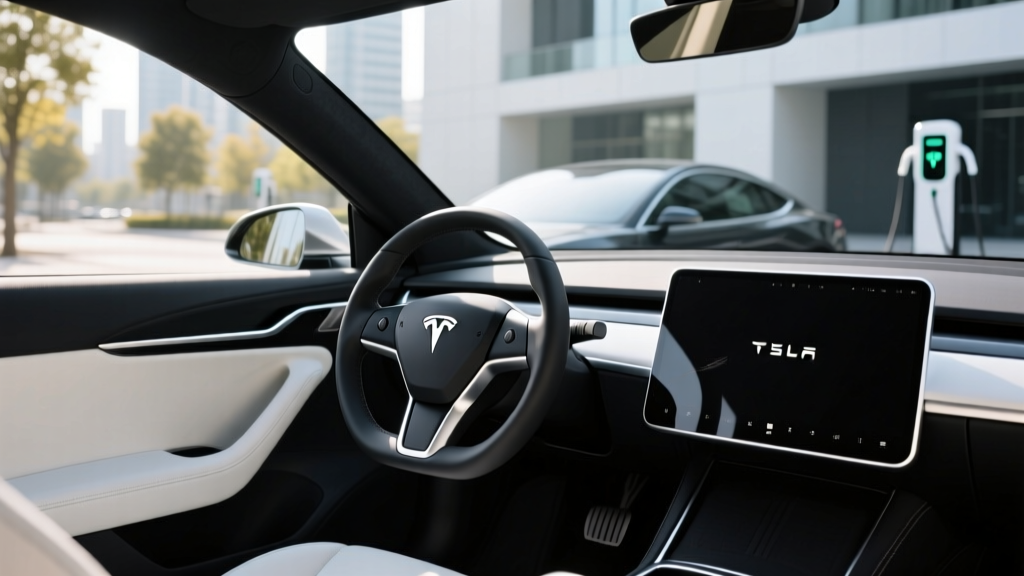
Let's address the feature that defines this review. The Tesla Model S Yoke steering wheel replaces the traditional round wheel with a rectangular, aircraft-yoke-style control. It comes standard on all 2026 Model S trims — Tesla no longer offers a round wheel as an option.
Where the Yoke works well:
- Highway driving: At steady speeds on interstates, your hands rest at 9-and-3, and the Yoke feels natural. The open top provides an unobstructed view of the 12.3-inch instrument cluster.
- Visibility: With no upper rim, the digital gauge display and road ahead are fully visible without ducking your head.
- Track use: For performance driving, the Yoke offers precise inputs without hand-over-hand complications, since large steering angles are rare on a race circuit.
Where the Yoke frustrates:
- Low-speed maneuvers: Three-point turns, tight parking lots, and roundabouts require more than 180 degrees of steering lock. Without a full rim to grab, you're reaching for air where the top half of a wheel would be. Tesla's variable-ratio steering (fewer lock-to-lock turns) partially compensates, but the learning curve is real.
- Emergency avoidance: If you need to make a sudden large steering input — dodging debris, correcting a slide — instinct reaches for a rim that isn't there.
- Roundabouts and cul-de-sacs: Continuous circular steering inputs feel unnatural without a full wheel. Most owners adapt within 2–4 weeks, but the adaptation period involves genuine discomfort.
Tesla reportedly tested steer-by-wire systems that would eliminate the mechanical connection and allow fewer turns lock-to-lock, but the current Model S still uses a conventional rack with a variable ratio. The result: approximately 2.0 turns lock-to-lock (vs. ~2.5 in a conventional sedan), which helps but doesn't fully solve the Yoke's low-speed geometry problem.
Bottom line: If 90% of your driving is highway commuting, the Yoke is a minor curiosity you'll forget about. If you regularly navigate tight urban streets, parking garages, or winding mountain roads, test-drive a Model S with the Yoke for at least 30 minutes before committing. Some buyers love it; many tolerate it; a vocal minority return the car.
Interior, Tech, and the Screen-Everything Philosophy
The Model S cabin centers on a 17-inch landscape-oriented touchscreen running Tesla's proprietary infotainment OS. A secondary 8-inch screen serves rear passengers (climate and entertainment), and the 12.3-inch driver display sits behind the Yoke. Build quality on 2026 models has improved meaningfully over earlier years — panel gaps are tighter, materials include genuine aluminum trim and ventilated premium leather, and the cabin is genuinely quiet at highway speeds thanks to laminated glass and improved sound deadening.
Standout tech features:
- Autopilot (standard): Adaptive cruise control with lane centering — this is SAE Level 2 driver assistance, not autonomous driving. You must keep hands on the Yoke and eyes on the road.
- Full Self-Driving Supervised ($8,000 option): Adds automatic lane changes, navigation-based on/off-ramp handling, and Smart Summon (the car drives to you in a parking lot). Still SAE Level 2 — Tesla's naming is aspirational, not descriptive.
- Over-the-air updates: Tesla regularly pushes software improvements, from efficiency tweaks to new entertainment features. The Model S has received meaningful updates years after purchase.
- Gaming and entertainment: The 17-inch screen supports AAA-level gaming (Cyberpunk 2077 runs natively) while parked, plus Netflix, YouTube, and Spotify streaming.
- HEPA air filtration: The "Bioweapon Defense Mode" uses a hospital-grade HEPA filter — genuinely useful for wildfire smoke season or polluted urban environments.
ADAS Limitation Warning: Tesla Autopilot and Full Self-Driving (Supervised) are SAE Level 2 systems. They require continuous driver supervision. They do NOT make the Model S a self-driving car. The driver is legally and practically responsible for all vehicle operation. See NHTSA guidance on automated driving for context.
Notable drawbacks:
- No Apple CarPlay or Android Auto — Tesla's ecosystem is closed.
- Climate controls, glovebox release, and mirror adjustments all route through the touchscreen, which can be distracting while driving.
- Rear seat headroom is limited (38.1 inches) for passengers over 6'2" due to the sloping roofline.
- No physical buttons for volume or climate — everything is touch or voice.
Cargo, Passenger Space, and Practicality
The Model S offers 28.0 cubic feet of cargo space behind the rear seats (including the frunk), expanding to approximately 79.3 cubic feet with the 60/40 rear seats folded. The front trunk (frunk) provides roughly 5.3 cubic feet — useful for charging cables, a laptop bag, or groceries you want separated from the main cargo area.
Passenger dimensions are generous up front (42.7 inches of legroom) but tighter in the rear (35.4 inches of legroom) compared to competitors like the BMW i7 (43.7 inches rear legroom) or Mercedes EQS (42.0 inches). The Model S is a large sedan by exterior dimensions, but its sloping fastback roofline trades rear headroom for aerodynamic efficiency. Two adults are comfortable in back; three across is tight for anything beyond short trips.
For families: the Model S fits two rear-facing child seats with adequate front-seat clearance, but the trunk opening is narrower than an SUV's liftgate, making stroller loading less convenient. This is a sedan — if cargo volume is paramount, Tesla's own Model X or the Rivian R1S may be more practical.
Pricing, Trims, and Federal Tax Credit Eligibility
| Trim | Base MSRP | Destination | Typical As-Tested |
|---|---|---|---|
| Long Range | $79,990 | $1,990 | $85,000–$92,000 |
| Plaid | $94,990 | $1,990 | $102,000–$115,000 |
Options that move the needle: FSD Supervised adds $8,000; premium paint colors (Ultra Red, Quicksilver) add $2,500; 21-inch Arachnid wheels on the Plaid add $4,500 and reduce range by approximately 15 miles.
Does the 2026 Tesla Model S qualify for the federal EV tax credit?
- MSRP cap: The §30D credit applies to sedans priced at or below $55,000. The Model S starts at $79,990 — it exceeds the MSRP cap and does NOT qualify for the new-vehicle federal tax credit.
- Buyer income cap: Even if it qualified on price, the credit phases out for AGI above $150,000 (single) / $300,000 (joint). Most Model S buyers exceed these thresholds.
- Battery sourcing: The §30D credit requires critical minerals and battery components from approved trade partners. Tesla's supply chain partially qualifies, but the MSRP cap moots the question for the Model S.
- State incentives: Some states offer their own EV rebates that are not MSRP-capped (e.g., Colorado's innovative motor vehicle credit). Check your state's energy office for specifics.
- Point-of-sale transfer: For qualifying vehicles, the credit can be applied at purchase rather than at tax filing. Since the Model S does not qualify federally, this does not apply.
Source: IRS §30D Clean Vehicle Credit. Eligibility rules are subject to change — consult a tax professional before purchasing.
The absence of the federal tax credit is a meaningful financial consideration. A buyer in the 32% tax bracket who could otherwise claim $7,500 effectively pays that much more for the Model S compared to a qualifying vehicle like the Tesla Model Y or BMW i4. This is a luxury purchase where the credit's absence stings less than it would on a $40,000 EV, but it's still real money.
Warranty and Long-Term Ownership
Tesla provides a 4-year/50,000-mile basic vehicle warranty and an 8-year/150,000-mile battery and drive unit warranty with a minimum 70% capacity retention guarantee. If the battery degrades below 70% of its original capacity within that period, Tesla will repair or replace it at no cost.
The Model S uses NMC (nickel-manganese-cobalt) battery chemistry, which offers higher energy density than LFP (lithium iron phosphate) but is more sensitive to sustained high-SoC storage. Best practice: charge to 80% for daily use and reserve 100% charges for road trips. Tesla's onboard battery management system (BMS) handles thermal regulation and cell balancing automatically, but owner habits still influence long-term degradation.
Real-world degradation data from fleet monitoring services suggests the Model S battery loses approximately 8–12% of its original capacity over the first 100,000 miles, with the curve flattening significantly afterward. Most owners will never approach the 70% threshold within the warranty period under normal use.
Insurance costs are a notable ownership expense. The Model S carries higher-than-average premiums due to repair costs (aluminum body panels, specialized glass, integrated sensor suite). Expect annual insurance of $2,800–$4,500 depending on your driving record, location, and coverage level — obtain quotes before purchasing.
Model S vs. the Competition: Is It Still Worth It?
Pros
- 402-mile EPA range (Long Range) — among the longest of any EV sedan
- Access to the Tesla Supercharger network — the most reliable DC fast-charging infrastructure in the U.S.
- Over-the-air updates keep the car current years after purchase
- Plaid performance is hypercar-tier at a fraction of the cost
- Strong resale value relative to luxury EV competitors
- HEPA air filtration and premium audio (22-speaker, 960W) are standard
Cons
- Yoke steering wheel is polarizing and objectively harder for low-speed maneuvers
- No Apple CarPlay/Android Auto — closed ecosystem
- Does NOT qualify for the $7,500 federal EV tax credit (exceeds $55K MSRP cap)
- Rear seat space trails BMW i7 and Mercedes EQS
- 250 kW peak DC charge rate is outpaced by 350 kW competitors
- Insurance premiums are significantly above average
Choose the Tesla Model S if: You prioritize range, Supercharger access, and technology integration above all else. You're a highway-dominant commuter who can adapt to the Yoke. You want a sedan (not an SUV) with genuine performance credentials and the longest proven EV track record in the luxury segment.
Look at the Lucid Air if: You want even more range (516 miles Grand Touring), a more conventional interior, and don't mind a smaller service network.
Look at the BMW i7 if: Rear-seat comfort is paramount, you prefer physical controls alongside screens, and you want a more traditional luxury sedan experience with available Apple CarPlay.
Look at the Mercedes EQS if: You value ride quality and cabin silence above sporty dynamics, and you want the Hyperscreen dashboard experience.
Frequently Asked Questions
What is the real-world range of the Tesla Model S?
The EPA rates the Long Range at 402 miles and the Plaid at 396 miles. In real-world highway driving at 70–80 mph, expect 320–360 miles. In freezing temperatures, that drops to 250–300 miles. City driving with regenerative braking can approach the EPA figure.
How fast does the Model S charge at home and on the road?
On a Level 2 home charger (11.5 kW), the Model S adds approximately 41 miles of range per hour — a full overnight charge covers most daily needs. On a V3 Supercharger (250 kW DC), it charges from 10–80% in approximately 27 minutes, though the rate tapers significantly above 50% SoC.
Does the Tesla Model S qualify for the federal EV tax credit?
No. Under current IRS §30D rules, the new-vehicle EV tax credit is limited to sedans with an MSRP at or below $55,000. The Model S starts at $79,990 and exceeds this cap. State-level incentives may still apply — check your state's energy office.
Can I get a round steering wheel instead of the Yoke?
No. As of 2026, Tesla offers the Yoke as the only steering option on the Model S. There is no factory round-wheel alternative. Some aftermarket companies offer round-wheel conversions, but these void the warranty and may affect Autopilot functionality.
Is the Model S Plaid worth the premium over Long Range?
For most buyers, no. The Long Range's 3.1-second 0–60 time and 402-mile range satisfy nearly every use case. The Plaid's 1.99-second sprint is a party trick you'll use twice, and it costs $15,000 more while sacrificing 6 miles of EPA range. Choose Plaid only if track performance is a genuine priority.
How does the Model S compare to the Lucid Air?
The Lucid Air Grand Touring offers more range (516 vs. 402 miles EPA) and a more spacious rear seat, but has a smaller service network and no access to the Supercharger network (though it can use Electrify America and other CCS/NACS stations). The Model S wins on charging infrastructure and proven long-term reliability data; the Air wins on efficiency and interior space.
What is the battery warranty on the Model S?
Tesla covers the battery and drive unit for 8 years or 150,000 miles, whichever comes first, with a guaranteed minimum 70% capacity retention. Real-world data suggests most Model S batteries lose 8–12% capacity over 100,000 miles under normal use.