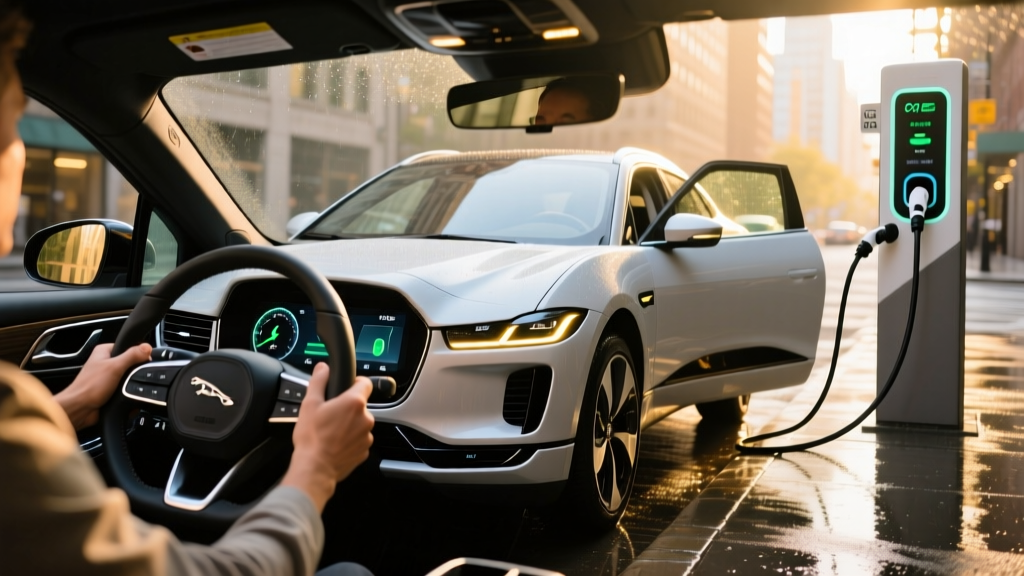
Quick Answer: Is the Jaguar I-PACE EV Worth Buying?
The Jaguar I-PACE EV is a luxury electric SUV that delivers sharp handling, a premium cabin, and an EPA-estimated 246 miles of range from its 90 kWh battery pack. Starting around $73,100 in its most recent model year, it costs roughly $15,000–$20,000 less than a Tesla Model X or BMW iX while offering comparable performance (0–60 mph in 4.5 seconds, 394 hp). However, its DC fast-charging speed peaks at just 105 kW — meaning a 10–80% charge takes about 45 minutes, significantly slower than rivals like the Hyundai Ioniq 5 or BMW iX. The I-PACE is best suited for buyers who prioritize driving dynamics and design over cutting-edge charging tech, and who have reliable home Level 2 charging access.
Jaguar I-PACE EV: Core Specs at a Glance
| Spec | Value |
|---|---|
| EPA Range | 246 miles |
| Battery Capacity | 90 kWh usable (NMC chemistry) |
| Powertrain | Dual-motor AWD, 394 hp, 512 lb-ft torque |
| 0–60 mph | 4.5 seconds |
| DC Fast Charge (Peak) | 105 kW (CCS1 connector) |
| 10–80% DC Charge Time | ~45 minutes |
| Level 2 Charge Rate | 7.4 kW (onboard charger) — ~37 hours for full charge; ~11.5 hours 10–80% |
| Efficiency | 76 MPGe combined (44 kWh/100mi) |
| Cargo Volume | 25.3 cu ft (rear seats up) / 51.0 cu ft (folded) |
| Base MSRP (final model year) | ~$73,100 (including destination) |
| Battery/Powertrain Warranty | 8 years / 100,000 miles |
Real-World Range Reality: The EPA rates the I-PACE at 246 miles. In mixed highway driving at 70 mph in moderate temperatures, expect roughly 210–225 miles. In cold weather (below 30°F), range can drop to 170–190 miles due to battery resistance and cabin heating demands. The I-PACE lacks a heat pump, which means resistive heating draws directly from the traction battery in winter — a notable efficiency penalty compared to heat-pump-equipped rivals like the BMW iX or Tesla Model Y.
How Does the I-PACE Compare to Gas and Hybrid Luxury SUVs?
The I-PACE competes with midsize luxury SUVs like the Porsche Cayenne, BMW X5, and Mercedes-Benz GLE. Here's how the numbers stack up against a gasoline rival and a plug-in hybrid alternative:
| Metric | Jaguar I-PACE (BEV) | BMW X5 xDrive40i (Gas) | BMW X5 xDrive50e (PHEV) |
|---|---|---|---|
| Powertrain | Dual-motor AWD | Turbo I-6 AWD | Turbo I-6 + electric motor |
| Horsepower | 394 hp | 335 hp | 483 hp |
| 0–60 mph | 4.5 sec | 5.2 sec | 4.6 sec |
| EPA Range / MPG | 246 mi / 76 MPGe | 22 MPG combined | ~38 mi electric + 22 MPG gas |
| Starting MSRP | ~$73,100 | ~$66,600 | ~$74,500 |
| Annual Fuel/Energy Cost* | ~$750 | ~$2,700 | ~$1,600 |
| Maintenance (5-yr est.) | ~$1,200 | ~$4,500 | ~$3,800 |
*Based on 15,000 miles/year, $0.14/kWh home electricity, $3.60/gallon premium gas. Source: fueleconomy.gov
The I-PACE's energy cost advantage is substantial. Charging at home at the national average of $0.14/kWh, a full 90 kWh charge costs about $12.60 — delivering 246 miles for roughly $0.05/mile. The gas-powered X5, by contrast, costs about $0.18/mile in fuel alone. Over five years and 75,000 miles, that's a fuel savings of approximately $9,750 with the I-PACE.
However, the X5 xDrive50e PHEV offers a compelling middle ground: 38 miles of electric-only range covers most daily commutes, while the gas engine eliminates range anxiety on road trips. If you lack home charging or regularly drive 300+ miles between stops, the PHEV is a more pragmatic choice.
Total Cost of Ownership: 5-Year Breakdown
| Cost Category | Jaguar I-PACE | BMW X5 xDrive40i (Gas) |
|---|---|---|
| Purchase Price (MSRP) | $73,100 | $66,600 |
| Federal Tax Credit (§30D) | $0 (does not qualify — see below) | $0 |
| Estimated Depreciation (5 yr) | -$36,500 (50%) | -$29,900 (45%) |
| Fuel / Electricity (5 yr) | $3,750 | $13,500 |
| Maintenance (5 yr) | $1,200 | $4,500 |
| Insurance (5 yr avg) | $12,500 | $9,800 |
| Home Charger Install | $1,200–$2,500 | $0 |
| Estimated 5-Year Total Cost | ~$57,650 | ~$64,500 |
The I-PACE comes out ahead on five-year total cost primarily due to fuel and maintenance savings, despite a steeper depreciation curve. EV depreciation has historically been harsher than gas vehicles — luxury EVs in particular lose value quickly as newer models with faster charging and longer range enter the market. If you plan to keep the car beyond five years, the operating-cost advantage widens further.
Federal Tax Credit: Does the I-PACE Qualify?
Under current IRS §30D rules, the Jaguar I-PACE does not qualify for the federal clean vehicle credit of up to $7,500. The credit requires final assembly in North America, and the I-PACE is manufactured in Graz, Austria. Additionally, the battery sourcing and critical-mineral requirements further disqualify most imported EVs.
§30D Credit Requirements (2026):
- ✅ MSRP under $80,000 for SUVs (I-PACE qualifies on price)
- ✅ Buyer income under $300,000 MFJ / $150,000 single (buyer-dependent)
- ❌ Final assembly in North America (I-PACE fails — built in Austria)
- ❌ Battery component and critical-mineral sourcing thresholds (I-PACE fails)
If the federal credit is a deciding factor, consider the Tesla Model Y, Ford Mustang Mach-E (certain trims), or VW ID.4, which have qualified for partial or full credits depending on model year and battery sourcing. Always verify current eligibility on the IRS Clean Vehicle Credit page before purchasing.
Charging: The I-PACE's Biggest Limitation
The I-PACE uses a CCS1 connector for DC fast charging and a J1772 inlet for Level 2 AC charging. Its 105 kW peak DC charge rate was competitive at its 2019 launch but has been thoroughly eclipsed by the 2026 landscape:
| Charging Level | Power | Connector | Time / Rate |
|---|---|---|---|
| Level 1 (120V outlet) | ~1.4 kW | J1772 | ~3–4 miles per hour |
| Level 2 (240V home) | 7.4 kW | J1772 | ~23 miles per hour; 10–80% in ~11.5 hours |
| DC Fast Charge | 105 kW peak | CCS1 | 10–80% in ~45 minutes |
For context, the Hyundai Ioniq 5 peaks at 240 kW (10–80% in ~18 minutes) and the BMW iX at 150 kW (~31 minutes). On a road trip with two DC fast-charge stops, the I-PACE adds roughly 40–50 extra minutes of charging time compared to an 800V-architecture rival.
Charging curve reality: The I-PACE sustains near-peak power from roughly 10% to 50% SoC, then tapers progressively. From 80% to 100%, charging slows dramatically — adding the final 20% can take nearly as long as the first 70%. For battery longevity and trip efficiency, plan DC stops around the 10–80% window.
Home charging is essential. The I-PACE's 7.4 kW onboard charger means an overnight session on a Level 2 home charger (e.g., ChargePoint Home Flex or Tesla Wall Connector with J1772 adapter) replenishes roughly 170–190 miles in 8 hours — sufficient for nearly all daily driving. Without home charging, relying solely on public 105 kW DC stations becomes a time-consuming routine that erodes the ownership experience.
Common Misconceptions About the I-PACE
| Myth | Fact |
|---|---|
| "The I-PACE gets the full $7,500 tax credit." | It does not qualify — it's built in Austria and fails §30D assembly and sourcing rules. |
| "246 miles of range is enough for any road trip." | At highway speeds in cold weather, real range drops to ~170–190 miles. Plan charging stops every 150–170 miles in winter. |
| "It charges as fast as other modern EVs." | At 105 kW peak, it's roughly half the speed of 800V-platform EVs like the Ioniq 5 or Porsche Taycan. |
| "EVs cost more to insure." | Often true. The I-PACE's insurance averages ~$2,500/year vs ~$1,960/year for a gas X5, due to higher repair costs and parts pricing. |
| "The battery will need replacing soon." | Jaguar warranties the battery for 8 years/100,000 miles against dropping below 70% capacity. NMC batteries in liquid-cooled packs typically retain 85–90% capacity at 100,000 miles based on industry degradation data. |
Who Should Buy the Jaguar I-PACE — and Who Shouldn't?
Choose the Jaguar I-PACE if:
- You want a luxury EV with genuinely engaging driving dynamics — its torque-vectoring AWD and low center of gravity make it one of the best-handling electric SUVs.
- You have reliable Level 2 home charging and a daily commute under 150 miles round-trip.
- You value distinctive design and a quiet, well-trimmed cabin over having the latest infotainment or fastest charging.
- You plan to own the vehicle 5+ years and absorb higher depreciation in exchange for lower running costs.
Look elsewhere if:
- You take frequent road trips of 300+ miles — the 105 kW charge rate and 246-mile range make long-distance travel noticeably slower than in a BMW iX (150 kW, 324-mile range) or Tesla Model Y (250 kW, 330-mile range).
- You live in a cold climate without a garage — the lack of a heat pump means significant winter range loss.
- The federal tax credit is essential to your budget — the I-PACE doesn't qualify.
- You want the latest ADAS tech — the I-PACE's driver-assistance features (adaptive cruise, lane-keeping) are competent but a generation behind Ford BlueCruise or GM Super Cruise in hands-free capability. Note: these are all SAE Level 2 systems requiring active driver supervision.
Frequently Asked Questions
What is the real-world range of the Jaguar I-PACE?
The EPA rates it at 246 miles. In real-world mixed driving at moderate temperatures, expect 210–225 miles. In winter highway conditions (below 30°F), plan for 170–190 miles. The absence of a heat pump makes the I-PACE less efficient in cold weather than competitors that use one.
How much does it cost to charge the I-PACE at home?
A full charge from empty to 100% using 90 kWh at the national average of $0.14/kWh costs approximately $12.60. For a typical 10–80% daily charge (~63 kWh), the cost is about $8.80. This translates to roughly $0.05 per mile — about one-quarter the per-mile cost of premium gasoline in a comparable luxury SUV.
Does the Jaguar I-PACE support NACS (Tesla Supercharger)?
No. The I-PACE uses the CCS1 standard. Jaguar has not announced a NACS retrofit adapter for existing I-PACE vehicles. As of 2026, Tesla Supercharger access for non-Tesla CCS vehicles has expanded via Magic Dock at select stations, but coverage is limited compared to the full Supercharger network. Plan road trips around Electrify America, EVgo, and other CCS-compatible networks.
What does I-PACE maintenance look like compared to a gas SUV?
Routine maintenance is minimal: cabin air filter replacement (~$80–$120 every 2 years), brake fluid flush (~$150 every 3 years), tire rotation, and windshield washer fluid. There are no oil changes, spark plugs, transmission fluid, or exhaust system repairs. Regenerative braking significantly extends brake pad life — many EV owners report original pads lasting 80,000+ miles. Total 5-year maintenance runs approximately $1,200 vs $4,500 for a gas-powered BMW X5.
Is the Jaguar I-PACE still in production?
Jaguar discontinued the I-PACE as part of its brand relaunch strategy, with the final model year being 2024 in the US market. Remaining new inventory may be available at dealers, and the used market offers I-PACE models from 2019–2024. If buying used, verify battery State of Health (SoH) via a pre-purchase diagnostic and confirm remaining warranty coverage. Used EVs priced under $25,000 may qualify for the used clean vehicle credit of up to $4,000 (30% of sale price), subject to income limits and dealer reporting requirements.
How does the I-PACE battery hold up over time?
The I-PACE uses a 90 kWh NMC (nickel-manganese-cobalt) lithium-ion pack with active liquid thermal management. Industry data from similar NMC packs suggests 85–92% capacity retention at 100,000 miles under normal use. Jaguar's warranty guarantees the battery will not fall below 70% of original capacity within 8 years or 100,000 miles. To maximize longevity, avoid routinely charging to 100% or draining below 10% — keeping daily SoC between 20–80% reduces cell stress.