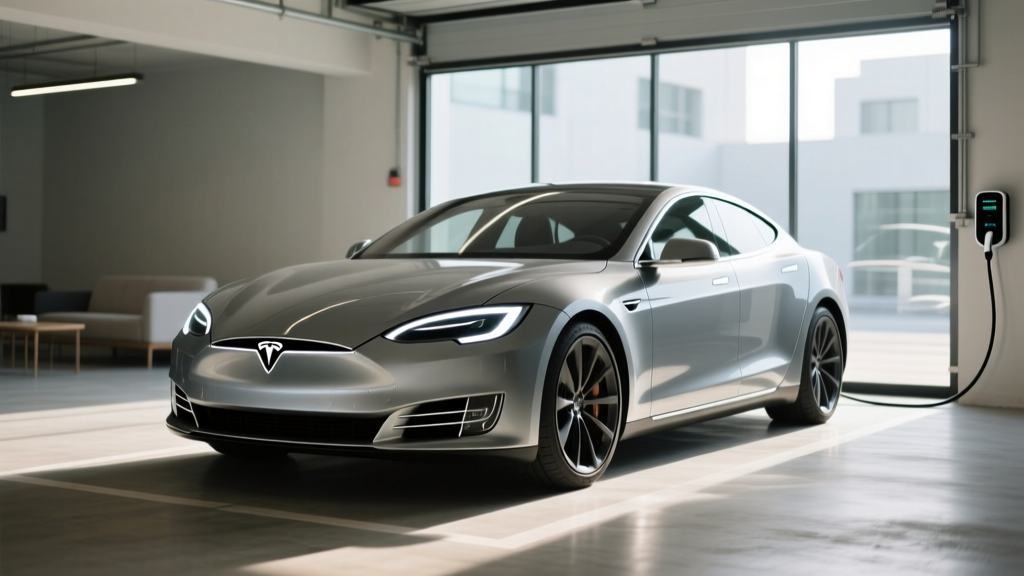
The Tesla Model S has been the benchmark luxury electric sedan for over a decade, but as battery packs have grown and chassis materials have evolved, buyers are asking a surprisingly practical question: how much does a Tesla S weigh? The answer matters for more than curiosity — curb weight affects tire wear, braking distances, efficiency, and even your garage floor load. Below, we put the 2026 Model S on the scales and pair that number with every spec an EV buyer actually needs: EPA range, charging curves, real-world efficiency, and federal tax-credit eligibility under current IRS §30D rules.
2026 Tesla Model S Curb Weight: The Numbers
For the 2026 model year, the Tesla Model S Long Range carries an EPA-reported curb weight of approximately 4,561 lbs (2,069 kg). The performance-oriented Model S Plaid tips the scales slightly heavier at roughly 4,766 lbs (2,162 kg), owing to its tri-motor powertrain and additional cooling hardware.
To put that in perspective, the Model S is heavier than a midsize gasoline sedan like the Toyota Camry (~3,300 lbs) but lighter than full-size body-on-frame SUVs. The mass comes primarily from the 100 kWh-class battery pack, which alone accounts for roughly 1,200 lbs of the total. Tesla's use of an aluminum-intensive unibody and cast rear underbody helps offset the pack weight compared to steel-construction rivals.
| Spec | Model S Long Range | Model S Plaid |
|---|---|---|
| Curb Weight | 4,561 lbs | 4,766 lbs |
| Gross Vehicle Weight Rating (GVWR) | 5,093 lbs | 5,160 lbs |
| Weight Distribution (F/R) | 49% / 51% | 48% / 52% |
| Length | 196.0 in | 196.0 in |
| Wheelbase | 116.5 in | 116.5 in |
| Ground Clearance | 5.5 in (adjustable) | 5.5 in (adjustable) |
Battery, Chemistry, and Energy Capacity
Both the Long Range and Plaid variants use a 100 kWh (usable ~95 kWh) NMC (nickel-manganese-cobalt) lithium-ion battery pack. Tesla does not offer an LFP (lithium iron phosphate) pack in the Model S — LFP is reserved for the standard-range Model 3 and Model Y, where its lower energy density is less of a packaging penalty.
NMC chemistry gives the Model S its high energy density, enabling 400+ miles of range in a sedan footprint. The trade-off is that NMC cells are more sensitive to prolonged high-state-of-charge storage; Tesla recommends daily charging to 80% and saving 100% for road trips. The pack uses a structural-battery-adjacent design with 4680-format cells in a rigid carrier that contributes to chassis stiffness, partially explaining the car's favorable weight distribution.
EPA Range vs. Real-World Range
EPA Range (Plaid): 396 miles
Real-World Expectation: In mixed driving at 65-75 mph, expect 330–360 miles from the Long Range and 310–340 miles from the Plaid. In sustained cold weather (below 32°F / 0°C), range can drop to 260–290 miles due to cabin heating demands and reduced battery efficiency, even with the standard heat pump.
Tesla's efficiency remains class-leading. The Long Range achieves 120 MPGe combined (28 kWh/100 mi) per fueleconomy.gov, while the Pladi returns 116 MPGe combined (29 kWh/100 mi). Highway driving at 80 mph pushes consumption closer to 32–34 kWh/100 mi, which is where the real-world range gap widens versus the EPA sticker.
Charging Speed: DC Fast, Level 2, and Level 1
The Model S uses Tesla's proprietary NACS connector natively and can access the full Supercharger network, now also open to CCS-equipped EVs via adapter. Peak DC fast-charge rate is 250 kW on V3 Superchargers.
| Charging Level | Power / Voltage | Speed (Miles Added) | Typical Use |
|---|---|---|---|
| DC Fast (V3 Supercharger) | Peak 250 kW | ~200 mi in 15 min (10–80% in ~25 min) | Road trips |
| DC Fast (V4 Supercharger) | Peak 250–350 kW* | Up to ~230 mi in 15 min | Newer stations |
| Level 2 (Wall Connector) | 11.5 kW / 48A | ~41 mi/hr | Home overnight |
| Level 2 (Public J1772 w/ adapter) | Up to 19.2 kW | ~52 mi/hr (if supported) | Destination charging |
| Level 1 (120V household) | ~1.4 kW | ~3–4 mi/hr | Emergency top-off |
*V4 Supercharger cabinets are rated to 350 kW, but the Model S onboard architecture currently caps draw near 250 kW. Preconditioning the battery via onboard navigation routing to a Supercharger is essential for achieving peak charge rates — arriving cold can cut speeds by 40% or more.
The charge curve is the detail most spec sheets hide: the Model S sustains ~200–250 kW up to roughly 40% state of charge, then tapers progressively. Charging from 80–100% can take as long as the 10–80% portion. For daily driving, programming a charge limit to 80% preserves battery health and avoids the slow taper entirely.
Performance: 0–60, Horsepower, and Drivetrain
The Long Range uses a dual-motor all-wheel-drive layout producing 670 horsepower and achieves a blistering 0–60 mph in 3.1 seconds. The Plaid adds a third rear motor for a tri-motor AWD configuration generating 1,020 horsepower and a supercar-rivaling 0–60 mph in 1.99 seconds (with rollout subtracted, per Tesla's testing methodology).
Despite weighing over 4,500 lbs, the Model S exploits electric torque delivery — instant, no turbo lag, no transmission shifts — to out-accelerate combustion cars costing three times as much. The adaptive air suspension and torque-vectoring rear motors keep the mass well-controlled through corners, though this is a grand-touring sedan, not a track car. Repeated hard launches on the Plaid will trigger thermal management interventions.
Pricing, Trims, and Federal Tax Credit Eligibility
| Trim | Base MSRP | Est. As-Tested* | §30D Federal Credit |
|---|---|---|---|
| Long Range | $79,990 | $85,000–$92,000 | Not eligible (MSRP cap exceeded) |
| Plaid | $94,990 | $100,000–$115,000 | Not eligible (MSRP cap exceeded) |
*As-tested prices include common options such as FSD (Supervised) at $8,000, premium paint ($2,000–$2,500), and 21" wheels ($4,500). Destination fee included in MSRP.
Under current IRS §30D rules, the federal clean-vehicle credit is capped at $55,000 MSRP for sedans. Since every Model S trim starts well above that threshold, the Model S does not qualify for the up-to-$7,500 federal tax credit. Buyers should also be aware of income caps ($300,000 MFJ / $150,000 single) and battery critical-mineral sourcing requirements that apply to eligible vehicles. Consult a tax professional for your specific situation.
Some states offer their own EV incentives that have no MSRP cap — check your state energy office or DMV for local programs.
Cargo, Passenger Space, and Interior
The Model S offers 28.0 cu ft of rear cargo space behind the second row, expandable to ~64 cu ft with the 60/40 split seats folded. The front trunk (frunk) adds another 3.1 cu ft — enough for a charging cable kit and a soft bag.
Passenger room is generous for a low-slung sedan: 42.7 inches of front legroom and 35.4 inches of rear legroom. The flat floor (no transmission tunnel) makes the middle rear seat usable for short trips. Headroom can be tight for taller passengers (over 6'2") due to the sloping roofline, especially in the rear outboard seats.
The interior centers on a 17-inch center touchscreen (landscape orientation) with a secondary 12.3-inch driver display and an available 8-inch rear passenger screen. The yoke steering wheel remains standard, with a round wheel available as a no-cost option. Build quality has improved significantly post-2021 refresh, with tighter panel gaps and higher-grade materials, though some competitors (Lucid Air, Mercedes EQS) still edge ahead on perceived luxury.
Driver Assistance and Standout Tech
Standard Autopilot includes adaptive cruise control, lane-centering, and automatic emergency braking. The optional Full Self-Driving (Supervised) package ($8,000) adds city-street navigation, traffic-light recognition, and automatic lane changes, but requires constant driver supervision. Tesla's camera-only "Tesla Vision" approach means no LiDAR or radar redundancy — a philosophical choice that has drawn scrutiny from NHTSA in various investigations.
Other standout tech includes over-the-air software updates that meaningfully add features (not just bug fixes), a 22-speaker audio system with active noise cancellation, and gaming capability on the center screen (up to 10 teraflops of GPU compute). The Model S also supports Sentry Mode, Dog Mode, and camping mode with climate control running off the main battery.
Warranty Coverage
Tesla provides the following warranty structure for the 2026 Model S:
- Basic Vehicle Limited Warranty: 4 years / 50,000 miles
- Battery & Drive Unit Warranty: 8 years / 150,000 miles (Long Range & Plaid), with a minimum 70% capacity retention threshold over the warranty period
- Restraint System: 5 years / 60,000 miles
- Corrosion Perforation: 12 years, unlimited miles
The 150,000-mile battery warranty is competitive within the luxury EV segment. Out-of-warranty battery replacement for the Model S currently ranges from $12,000 to $20,000 depending on pack configuration, though real-world data from high-mileage Teslas suggests most NMC packs retain 85–90% capacity at 100,000 miles under normal charging habits.
Pros and Cons
- 402-mile EPA range (Long Range) — among the highest of any EV sold in the U.S.
- Sub-2-second 0–60 (Plaid) with usable daily comfort
- Access to the Tesla Supercharger network — still the most reliable DC fast-charging infrastructure
- Continuous OTA updates add real functionality
- Class-leading efficiency (120 MPGe combined)
- Strong resale value relative to luxury EV peers
- No federal tax credit — MSRP far exceeds the §30D sedan cap
- Yoke steering is polarizing and not ideal for low-speed maneuvering
- Interior luxury falls short of Lucid Air and Mercedes EQS at this price point
- DC fast-charge peak (250 kW) trails rivals like the Lucid Air (300+ kW) and Porsche Taycan (320 kW on 800V)
- Rear headroom limited for tall passengers
- No Apple CarPlay or Android Auto — Tesla's proprietary interface only
Who Should Buy the 2026 Tesla Model S?
Choose the Model S Plaid if: Supercar acceleration is a priority, you want a daily-drivable four-door that embarrasses Porsches at stoplights, and budget is flexible.
Look elsewhere if: You need the $7,500 federal tax credit (consider the Model 3 Long Range, which qualifies), you prioritize traditional luxury materials (Lucid Air, BMW i5), or you need three rows of seating (Model X, Rivian R1S).
Frequently Asked Questions
How much does a Tesla S weigh compared to the Model 3?
The Model S Long Range weighs approximately 4,561 lbs, while the Model 3 Long Range weighs about 4,034 lbs — a difference of roughly 527 lbs. The extra mass in the S comes from its larger battery pack, aluminum-intensive body, and additional luxury features.
Does the Tesla Model S qualify for any tax credits in 2026?
The Model S does not qualify for the federal §30D clean-vehicle credit because its MSRP exceeds the $55,000 sedan cap. Some state-level incentives (such as those in California, Colorado, and Massachusetts) may still apply, and used Model S vehicles priced under $25,000 may qualify for the up-to-$4,000 used-EV credit if buyer income limits are met.
What is the real-world highway range of the Model S?
At sustained highway speeds of 70–75 mph, expect approximately 330–350 miles from the Long Range on a full charge. In cold weather (below freezing), that number can fall to 260–290 miles. The heat pump helps, but cabin heating and reduced battery efficiency in cold temps remain the biggest range killers.
How long does it take to charge a Model S at home?
Using a Tesla Wall Connector at 11.5 kW (48 amps on a 60-amp circuit), a full 0–100% charge takes approximately 9–10 hours. Most owners charge from 20% to 80% overnight, which takes about 5 hours — more than enough for daily use.
Is the Model S worth buying over the Lucid Air?
The Model S wins on Supercharger access, software ecosystem, and proven long-term reliability data. The Lucid Air (starting ~$69,900, EPA range up to 516 mi) offers superior interior luxury, more rear-seat space, and faster 800V DC charging. If range and luxury are paramount and you can charge at home, the Air is a strong alternative. If road-trip charging infrastructure matters most, the Model S remains the safer bet.
Does the Model S weight affect tire wear?
Yes. At over 4,500 lbs with instant electric torque, the Model S wears through tires faster than a comparable gas sedan. Expect 20,000–30,000 miles from a set of OEM tires under normal driving. Tesla recommends Michelin Pilot Sport EV or P Zero Elect tires, which carry a weight-and-torque-optimized compound but cost $300–$450 per corner.